


Hiring in 2026 is not just harder, it is more complex than ever.
Recruiters are dealing with shrinking talent pools, rising application volumes, disconnected tools, and the rapid rise of AI.
Everything is moving faster. But hiring does not feel easier.
On paper, recruiting looks more efficient. In reality, most teams are overwhelmed. They are reviewing more candidates than ever, switching between tools to complete simple workflows, and trying to keep up with AI without fully understanding it.
More work. Less clarity. More pressure.
The result is a hiring process that feels heavier, slower, and harder to control, even with more technology in place.
In this blog, I talked about the 9 most pressing talent acquisition challenges in 2026 and how to solve them with practical, actionable strategies.
9 Most common talent acquisition challenges of 2026
1. Application overload crisis
No matter how niche your job requirement is, nowadays recruiters are always overwhelmed with thousands of applications.
51% of employers globally have reported an increase in job applications, mainly driven by one-click apply features and AI-assisted tools.
As a result, recruiters are spending more time reviewing candidate profiles. It is reported that 22% of recruiters are spending three to five hours each day on screening alone.
A large portion of these applications is either unqualified or loosely aligned, which makes the screening process more exhausting for them.
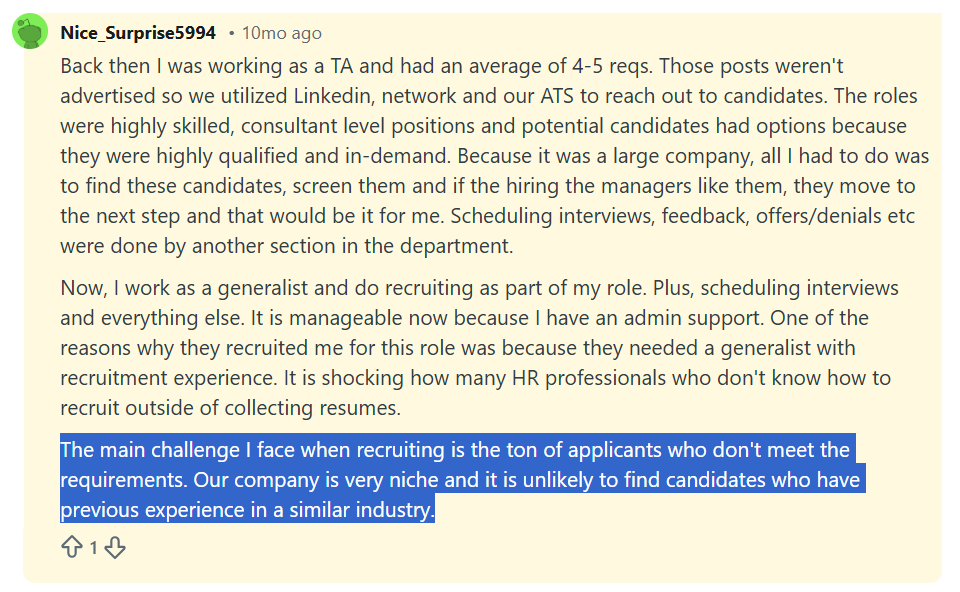
There are three solutions to deal with this problem:
- Redesign your job application to analyze better: Add three to five knockout questions, a role-specific short assignment, or asynchronous video introductions for deep assessment.
- Add AI screening to your toolkit for speed screening: Use AI screening that scores and ranks applications based on your customized criteria in seconds. It provides top applications in a matter of seconds.
- Use niche communities and job boards for top-tier candidates: Apart from popular platforms like Indeed or LinkedIn, post on industry-specific Slack channels or communities to attract a smaller pool of top candidates.
2. Tech stack fragmentation (“Franken-stack” problem)
Many recruiting teams today operate with seven to ten unrelated tools that barely speak to each other. The result is operational chaos.
Recruiters are constantly jumping between tools just to complete a single workflow, leading to heavy context switching and lost productivity. Instead of focusing on hiring, they spend time managing tools.
Here’s a recruiter’s take on the challenges of a decentralized recruiting tech stack:
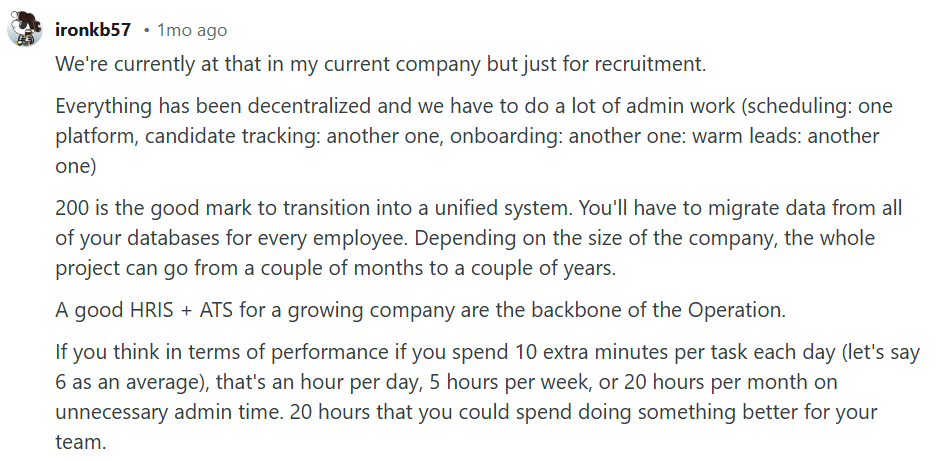
This not only slows down decision-making but also leads to inconsistent candidate experiences.
Here are some warning signs you have a RecTech ‘Frankenstack’:
- You have more than 5 different tools and vendors.
- Your tools are not integrated with each other
- Heavy spending on integrations and customizations
- Lack of visibility into total tech stack costs
- Overdependence on manual processes
To overcome this, teams must consolidate their stack where possible or invest in strong integrations that create a single source of truth.
TA leaders should:
- Start by auditing your current recruiting tech stack and removing duplicate or unused tools to immediately reduce clutter and unnecessary costs.
- Bring your remaining tools into one unified platform (ATS platform) where possible, as it removes the need to constantly switch and manage integrations.
- Automate the entire hiring workflow from start to finish to reduce manual effort and save time.
- Make sure all your candidate data lives in one place to give you full context for better decisions.
- Choose tools that can scale over time to prevent your stack from becoming messy again.
With the right hiring tech stack, DeepScribe was able to reduce hiring costs by 30% by automating screening, scheduling, candidate communication, interview notes, and reporting.
Read the full DeepScribe case study to see how they reduced hiring costs.
3. AI complexity
While AI is often positioned as a solution in recruiting, it also introduces a new layer of complexity that many teams underestimate.
One major concern is bias. AI models learn from historical data, and if that data reflects past hiring biases, the system can unintentionally reinforce them.
Bias & compliance concerns are the primary reasons for slowing AI adoption. According to Kula’s 2025 State of Recruiting Report, 55% of recruiters say AI-generated results aren’t accurate enough, and 56% worry about losing
To manage bias, make sure:
- Your ATS tool conducts bias audits monthly independently with a third party tool.
- Evaluate AI vendors and make sure your systems are compliant with GDPR, the EU AI Act, or local hiring regulations
- Document your compliance processes
Another important method to manage bias is to maintain human oversight for the final hiring decision.
When too much of the hiring process is automated screening, outreach, or even interviews, it leads to missed nuances that AI cannot fully capture. Adding human involvement helps with candidate experience and also removes any kind of bias or incompetence that AI may have committed.
Another major challenge to AI adoption is inadequate team training. Many recruiters are expected to use AI tools without fully understanding how they work or how to use them effectively in their workflows.
To address this, companies need to invest in structured training and onboarding. This includes hands-on sessions, clear playbooks for using AI in hiring, and ongoing upskilling.
When teams are well-trained, they can use AI more confidently.
4. Candidate fraud/AI misuse
A fast-emerging challenge in 2025–2026 is the rise of candidate fraud driven by AI tools. What was once limited to minor resume exaggeration has now evolved into more sophisticated forms of deception.
And apparently, it is only going to get worse. 1 in 4 job applicants could be fake by 2028.
Some of the key red flags to spot fake applicants are:
- Resumes that feel unrealistically perfect, with no trade-offs, failures, or depth
- GitHub profiles with high activity but low originality, such as copy-pasted code, no evolution, or lack of real opinions
- Projects that look functional but are generic or tutorial-driven, showing little real-world judgment
- Candidates who struggle to explain their own work or basic concepts, despite senior-level claims
- AI-assisted answering during interviews, noticeable through sudden changes in response or typing patterns
- Mismatch between candidate identity and profile, such as appearing different from resume or portfolio details
- Portfolios filled with AI-generated or surface-level work, lacking genuine understanding
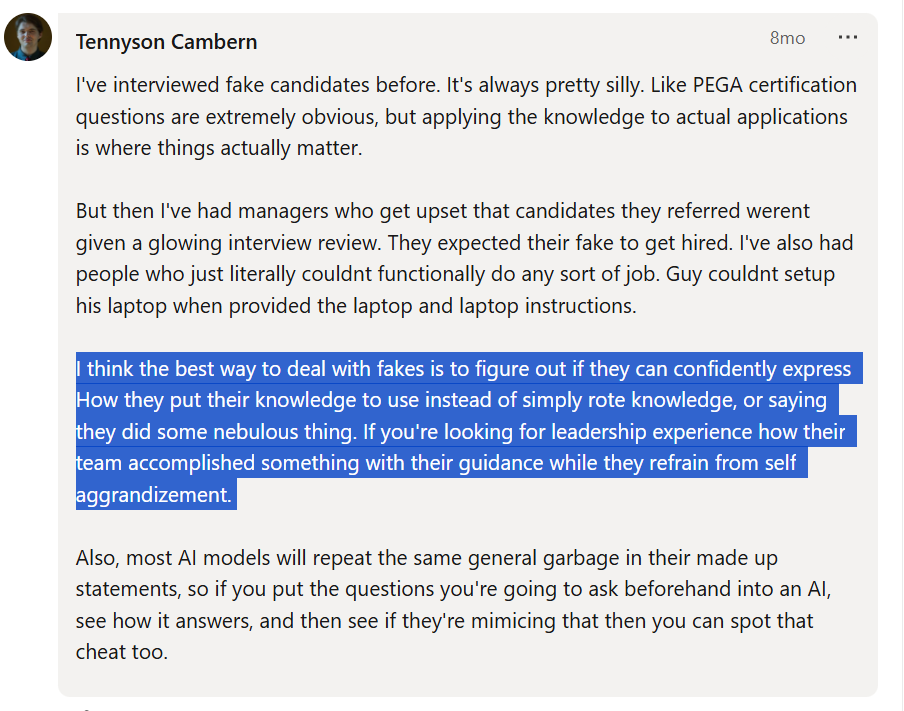
Here’s what recruiters can actively do to overcome candidate fraud and AI misuse, beyond spotting red flags:
- Verify early in the funnel: Ask for a short, unedited video explaining a real project or decision to filter out fake candidates upfront
- Go beyond the resume: Pick random points from the resume and ask candidates to explain them in detail to test actual experience
- Use real-world, messy assessments: Give ambiguous problems that require thinking and clarification, not just straightforward answers
- Add identity verification steps: Use live video checks, cross-verify profiles, and validate references before investing too much time
- Track inconsistencies across rounds: Compare answers, behavior, and interview summaries to spot mismatches or scripted responses
- Use AI to detect AI misuse: Use tools like code similarity checks, typing pattern analysis, and copy-paste detection
5. Remote hiring complexity
Hybrid and remote work are further complicating hiring strategies. 41% of recruiters report that location-based complexities are making it harder to attract and retain talent.
One of the biggest issues with remote hiring is time zone misalignment. Coordinating interviews across regions slows down scheduling and often leads to delays in decision-making.
There’s also a growing reliance on asynchronous communication, which creates gaps in the evaluation and feedback loops. Such a process establishes a disrupted candidate experience.
Differences in local regulations, compensation expectations, and cultural nuances also add another layer of complexity.
Together, these challenges make remote hiring less seamless than it appears.
To overcome this, TA leaders must
- Use smart scheduling for interviews to avoid conflicts and speed up coordination across time zones.
- Standardize interviews with predefined stages and evaluation criteria, improving fairness and ensuring every candidate goes through a consistent process.
- Automate candidate communication to share timelines, next steps, and status updates for hiring process transparency.
6. Skills Shortage and Competition for Top Talent
The global talent shortage has undergone more than a two-fold jump since 2014. For recruiters, this extends time-to-hire and forces them to settle with sub-par candidates for the role.
Every top company today is doing its best to secure the best talent for its organization. The competition is cutthroat
To solve this problem:
- Expand your reach by posting across multiple job boards and channels to attract a wider pool of candidates.
- Maintain consistent and proactive communication throughout the hiring process to keep candidates engaged.
- Regularly benchmark competitor offerings to stay competitive in terms of compensation and benefits.
- Focus on building strong employer branding. Showcase what makes your company an excellent workplace. Talk about training opportunities. Post pictures of happy employees at work and showcase employee testimonials.
7. Candidate Experience, Ghosting, and Offer Shopping
Candidates often judge a company based on how smooth, transparent, and respectful the hiring process feels.
When the experience falls short, it not only damages the employer brand but also leads to candidate ghosting and offer shopping, where top candidates disengage or choose competing offers.
An unsatisfactory candidate experience also shows your employer brand in an unfavorable light on public review platforms such as Glassdoor, Indeed, or LinkedIn.
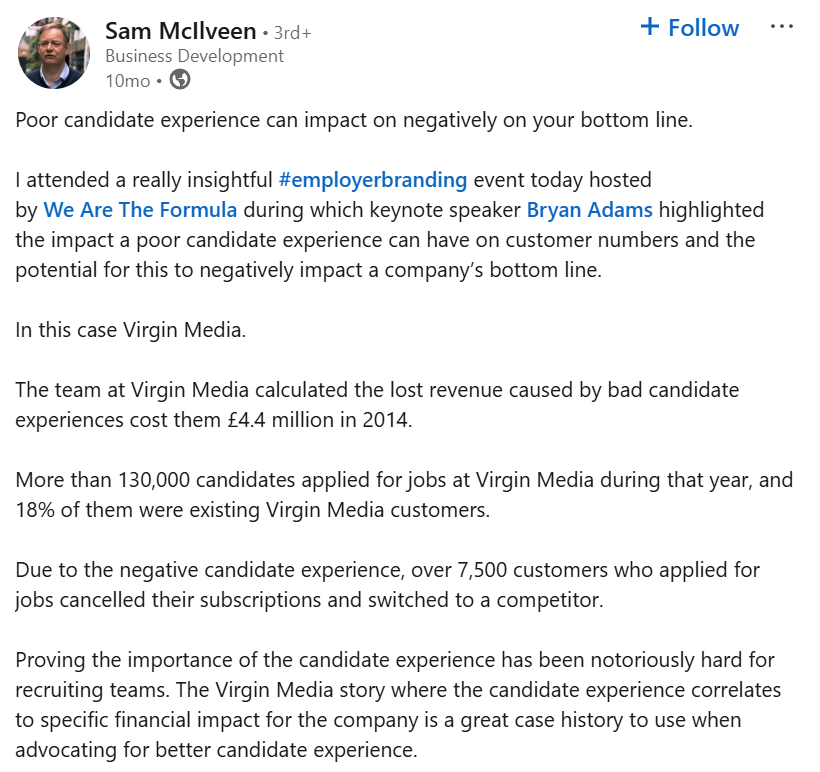
And negative candidate experiences have real consequences. The Virgin Media case highlights this well.
To overcome this talent acquisition challenge:
- Create a simple, mobile-friendly application process to reduce friction from the start
- Offer flexibility in interview formats and scheduling to improve candidate convenience
- Communicate clearly at every stage, including timelines, next steps, and expectations
- Showcase team culture by introducing candidates to hiring managers or team members early
- Offer competitive compensation, flexibility, and clear role expectations to reduce drop-offs
8. Recruiter Bias and Diversity Challenges
Bias in hiring remains one of the biggest barriers to building strong and diverse teams.
Bias doesn’t just appear in final decisions, it seeps in at multiple stages of the hiring process, often unconsciously:
- Job descriptions- Biased or gendered language limits who applies
- Resume screening- Names, colleges, or locations trigger unconscious preferences
- Sourcing channels- Over-reliance on referrals creates homogenous pipelines
- Shortlisting- Preference for “familiar” profiles over qualified ones
- Interviews- Unstructured conversations allow personal bias to influence decisions
- Feedback- Vague feedback like “not a culture fit” hides subjective judgments
- Offers- Bias can affect compensation offers or the final selection between similar candidates.
This not only impacts hiring quality but can also harm the employer's brand and expose companies to legal risks.
At the same time, achieving diversity and inclusion remains a challenge.
Reports show that achieving gender equitability in their company is one of the top priorities for 71% of TA professionals. However, the disparity between the number of male and female applicants is significant.
Solution:
- Design clear DE&I policies in your talent acquisition strategy.
- Build diverse interview panels to reduce bias in decision-making
- Use structured and standardized evaluation criteria to ensure fair and consistent candidate assessment
- Use gender-neutral terms in your job boards and include people from different genders, backgrounds, and races in your recruiting panel.
- Use AI screening for consistency, but regularly audit it to ensure it’s not reinforcing bias (as we already talked about).
- Track diversity metrics to continuously improve hiring outcomes
9. Recruiter workload increasing while teams shrink
Another growing challenge in 2026 is the imbalance between shrinking recruiting teams and increasing hiring expectations. Many companies are reducing HR and TA headcount while still expecting equal or higher hiring output.
Teams are shrinking, but hiring volumes and candidate inflow are higher than ever, creating significant operational overhead. This forces recruiters to spend more time managing hiring processes and less time on high-impact work such as evaluating candidates and advising stakeholders.
But there is another reality to this challenge, that most hiring challenges are easily misdiagnosed as capacity issues.
Here is how to scale hiring without burdening recruiters:
- Reframe hiring as an operating mode, make it more data-driven and automated.
- Build your talent pipeline to move from episodic hiring to continuous hiring.
- Shift metrics from activity (from number of calls or emails) to outcomes (time to fill, etc.).
- Make your hiring more predictable by using historical hiring data and defining what “successful hire” means for each role
- Add AI to your toolkit for speed, and train your recruiters to use it effectively.
Further read: How to Scale Hiring in 2026 Without Scaling Recruiting Headcount
Automate, simplify, and solve talent acquisition challenges with the right ATS
These challenges may initially seem like a lot to deal with. But with focused effort and strategies, you can overcome them and optimize your inbound and outbound recruiting process.
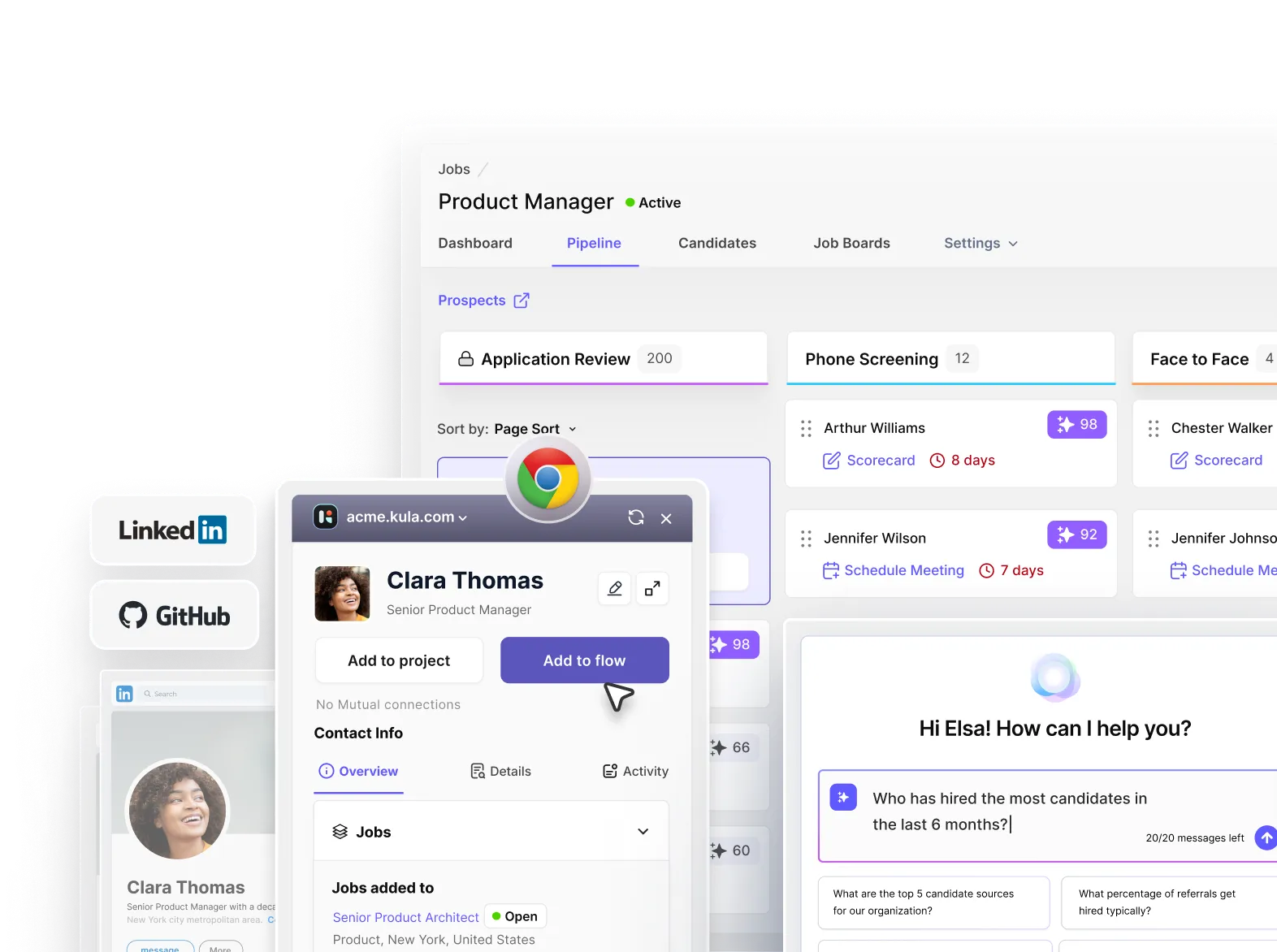
However, to apply these strategies, your ATS needs to be reliable, and that’s what we offer with Kula’s recruitment workflow automation.
So, sign up for a free trial and take your employer brand to the next level with data-driven, bias-free, and seamless recruitment operations.