


2025 was anything but steady for recruiters.
The year began with cautious optimism after a tough 2024, only to slow down mid-year as economic and political uncertainty crept in.
By Q3 and Q4, momentum returned, with many agencies closing the year profitably. Still, hiring never fully returned to pre-boom highs.
Across this uneven cycle, one thing became clear: recruiters weren’t just reacting to market swings—they were rethinking how hiring actually worked.
From DEI and AI to candidate experience, employer branding, and data-led decisions, 2025 forced teams to move past surface-level practices and focus on what truly held up under pressure.
This year-in-review breaks down the biggest lessons recruiters learned while navigating 2025’s hiring rollercoaster, and what those shifts mean heading into 2026.
How 2025 Changed the Way Recruiting Actually Works
1. DEI in 2025: From Performative Promises to Practical Reality
In 2025, DEI moved out of the spotlight and into scrutiny. Economic pressure, political backlash, and tighter regulation forced organizations to decide whether inclusion was truly embedded or merely aspirational.
For recruiters, this shift meant that DEI had transitioned from being a brand narrative to a data-driven strategy focused on understanding the law and adapting to political challenges to make inclusion a genuine aspect of important decisions.
This year, we have seen companies like Microsoft removing diversity metrics from their employee assessments and have also stopped publishing their annual DEI report.
Google also softened its DEI language across key AI and ethics teams, and Meta rolled back several DEI commitments and rebranded its internal approach.
When you dig deep into these changes, you understand the reason is more strategic than dramatic. Frank Shaw, Microsoft's Chief Communications Officer, speaks about this decision:
“The company was moving "to formats that are more dynamic and accessible – stories, videos, and insights that show inclusion in action" rather than producing a traditional comprehensive document.”
Before 2025, DEI metrics were increasingly considered performative, which started changing in 2025. Microsoft appears to be responding to this fatigue by removing DEI from formal scoring
The company now wants to avoid being judged purely on year-over-year demographic deltas. Leadership now expects inclusion to be a cultural expectation, not a graded deliverable.
Quinetta Roberson, one of the world’s foremost thought leaders on DEI, when talking about the future of DEI, says:
“In 2026, organizations will move beyond traditional diversity, equity, and inclusion (DEI) frameworks. The emphasis will shift from demographic metrics and program implementation and/or utilization to assessing access and decision quality, including who gets heard, who gets sponsored, and who receives stretch assignments that accelerate advancement.”
In short, 2025 revealed a simple truth: DEI didn’t disappear; it exposed which organizations had truly built it into the way they hire and lead.
Recommended read: Strategies to bring diversity and inclusion in your recruiting efforts
2. AI in recruiting: From experimentation to everyday recruiting infrastructure
2025 marked a clear shift in mindset: recruiters stopped asking whether AI belonged in hiring and started focusing on where it created the most leverage. In short, AI was widely adopted by 37% of organizations for recruiting, up from 27% a year ago.
Events like RecFest 2025 reinforced this shared reality across the industry. Many TA leaders shared their thoughts on how AI wasn’t replacing recruiters but instead taking over the busywork that had slowed them down for years.
Carrie Corbin, co-founder of a recruitment marketing and advertising agency, suggested that recruiters shouldn’t fear AI and should actively experiment with it.
Tara Turks emphasized using AI to give time back to hiring managers so they can focus on their core responsibilities, rather than using AI to reduce their recruiter headcount.
Unlike earlier years, AI screening was no longer viewed as a black box. Recruiters increasingly rely on AI to handle time-consuming tasks such as resume screening, candidate ranking, interview note-taking, and data analysis.
While concerns around bias remained, 2025 saw an increased focus on audits. Jeffrey Pole, Co-founder & CEO @Warden AI, shared a shocking insight on AI fairness/bias to human bias comparison. He says, “ AI actually does better than humans on this topic.”
In a nutshell, 2025 was understanding AI more deeply and using it intentionally in recruiting. AI in recruiting was incorporated into the entire hiring funnel, from outreach, application scoring, to interview assessments.
3. Candidate Experience in 2025: Fast by Default, Human by Choice
In 2025, candidate experience stopped being a “soft” metric. It became something candidates actively judged, talked about, and remembered.
Long silences and ghosting after interviews were still common, and they did real damage. Nearly 58% of job seekers rejected a job offer due to poor candidate experience.
People also actively shared these experiences openly in group chats and on review sites, damaging employer branding.
Another growing frustration of many applicants was being auto-rejected by companies' AI tool even though they met all the requirements. In many cases, this came down to inefficient or shallow application scoring that lacked proper context.
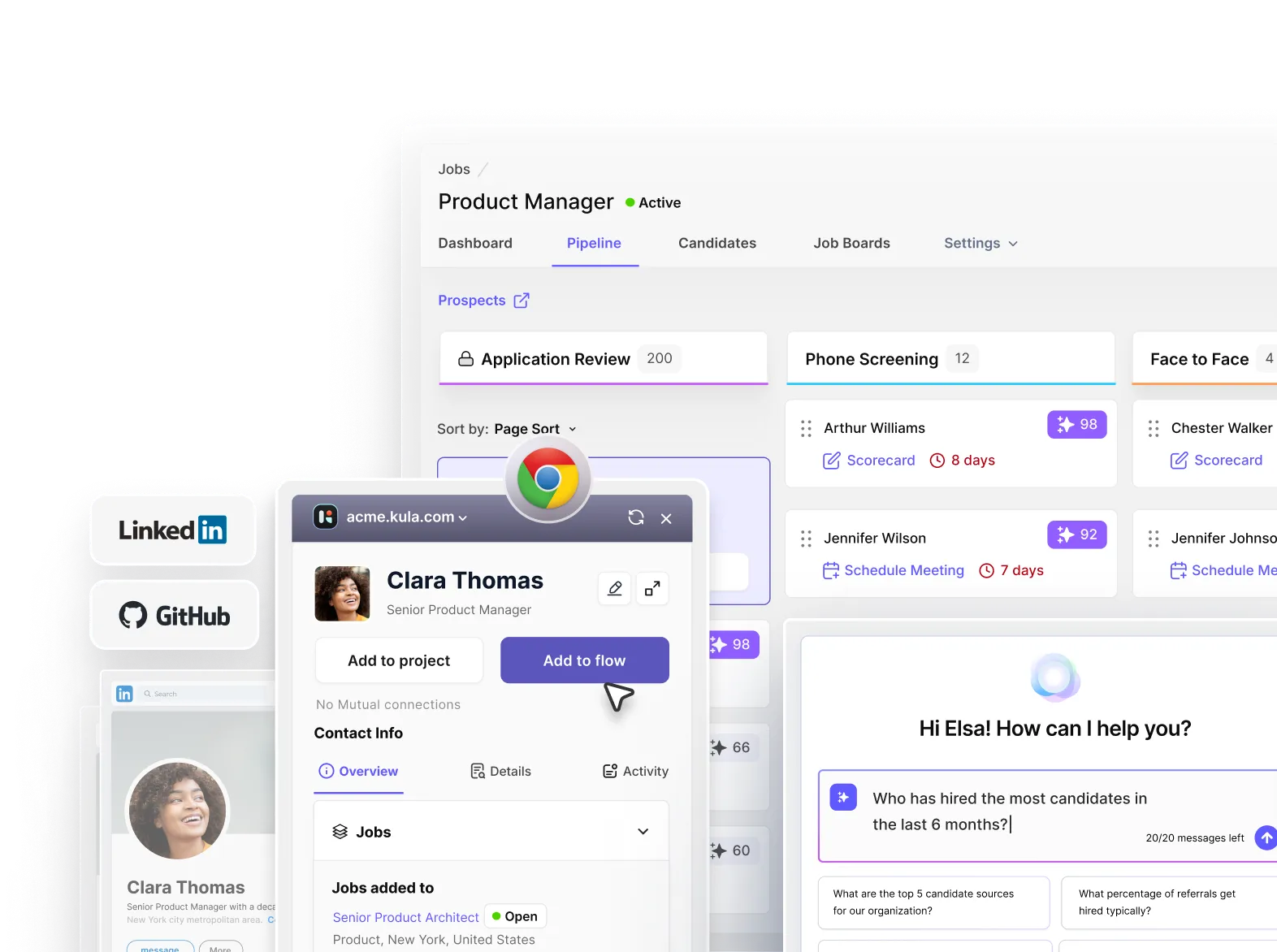
To address these gaps, Kula upgraded its AI scoring and made it more advanced.
Advanced AI Scoring is an AI-driven evaluation system that analyzes resumes and applications against an Ideal Candidate Profile (ICP), using contextual understanding and customizable attributes to rank candidates accurately.
Candidate experience is not limited to basic employer branding. Candidates expect quick response, clarity, and basic respect.
Companies that got this right didn’t just fill roles faster. They built trust that lasted beyond the hiring process.
Recommended read:
The ROI of Candidate Experience: How It Impacts Hiring Success
CHRO’s 2025 Guide for an Outstanding Candidate Experience
The 2025 Candidate Journey Roadmap for Hiring Success
4. Employer Branding in 2025: Trust over polish
In 2025, employer branding became less about how a company presented itself and more about how it felt to go through its hiring process. They looked at reviews, talked to peers, scanned LinkedIn comments, and noticed patterns.
The companies that did well didn’t try to polish their image. Instead, they listened. They paid attention to feedback from candidates, new hires, and leavers, fixed what was breaking trust, and then showed that progress honestly.
Another quiet shift was discoverability. Candidates increasingly found employer brands through search and AI tools, not just careers pages. Clear answers about pay ranges, growth paths, and work models mattered more than perfectly written brand statements.
The lesson from 2025 was simple: employer branding wasn’t about saying the right things. It was about aligning what candidates heard, read, and experienced.
Here’s how hiring teams can stay competitive with employer branding in 2026:
- Candidates want real stories, not polished campaigns
- Well-being isn’t a perk anymore, it’s expected
- Look back at what actually worked in 2025
- Build employer branding around real employee experiences
- Make your content easy to find on search and AI tools
Recommended read: How to build a data-driven employer branding strategy
5. Data-driven recruiting: From gut feel to measurable impact
In 2025, recruiting became far more data-led out of necessity, not trend-chasing. With talent shortages, tighter budgets, and higher candidate expectations, teams could no longer afford intuition-only hiring. Decisions had to be backed by evidence.
AI and analytics moved into the core of hiring workflows. Automation took over resume screening, interview scheduling, and early assessments. This freed recruiters to focus on more important tasks.
Skills-based hiring also accelerated sharply. Companies relied less on degrees and job titles and more on real performance data from assessments, challenges, and simulations. This expanded talent pools and improved the quality of hire.
The most effective recruiting teams weren’t the most automated; they were the most intentional. They used data to make smarter decisions and fairer evaluations.

The biggest challenge was balancing speed with trust. Recruiters were under pressure to move faster using AI and automation, while candidates and hiring managers still expected clarity, fairness, and human judgment. Teams that did well didn’t rush decisions—they fixed broken processes so speed came from better systems, not shortcuts.
Recruiters were no longer just filling roles; they were expected to guide decisions. Hiring managers increasingly relied on recruiters for market insights, data-backed recommendations, and realistic hiring timelines. Recruiters who could explain why roles were stalling, where pipelines were weak, and what needed to change gained more trust and influence.
Recruiters should move away from generic employer branding, blind trust in AI outputs, and gut-feel decisions that can’t be explained. 2025 showed that credibility comes from being clear, consistent, and evidence-driven. Tools help, but decisions still need human oversight and accountability.