




AI is still treated as an add-on tool instead of the foundation of how recruiting work gets done. Teams automate tasks, but decision-making, prioritization, and accountability remain largely unchanged.
By 2026, this approach won’t scale.
Recruiting leaders will be expected to hire with speed and predictability, maintain quality under volume, and explain hiring outcomes with data, not anecdotes.
Doing that requires a deliberate AI recruiting strategy, often built in collaboration with a trusted AI development company, that embeds AI into the recruiting operating model while keeping humans in control of judgment-heavy decisions.
This blog cuts through the hype to explain what a future-ready AI recruiting strategy actually involves, how mature teams approach AI adoption, and how to design recruiting systems that scale without losing quality or the human touch.
How AI maturity determines hiring quality
In simple terms, AI maturity describes how much your recruiting system can support hiring decisions when things get busy, without relying on people to work harder.
Low maturity means hiring only works when recruiters compensate with effort. High maturity means hiring holds up because the system does more of the work.
This matters because in 2026, pressure is constant. High volume, tight timelines, and harder roles are the norm, not exceptions.
Here’s how an AI maturity model can help scale your recruiting strategy:
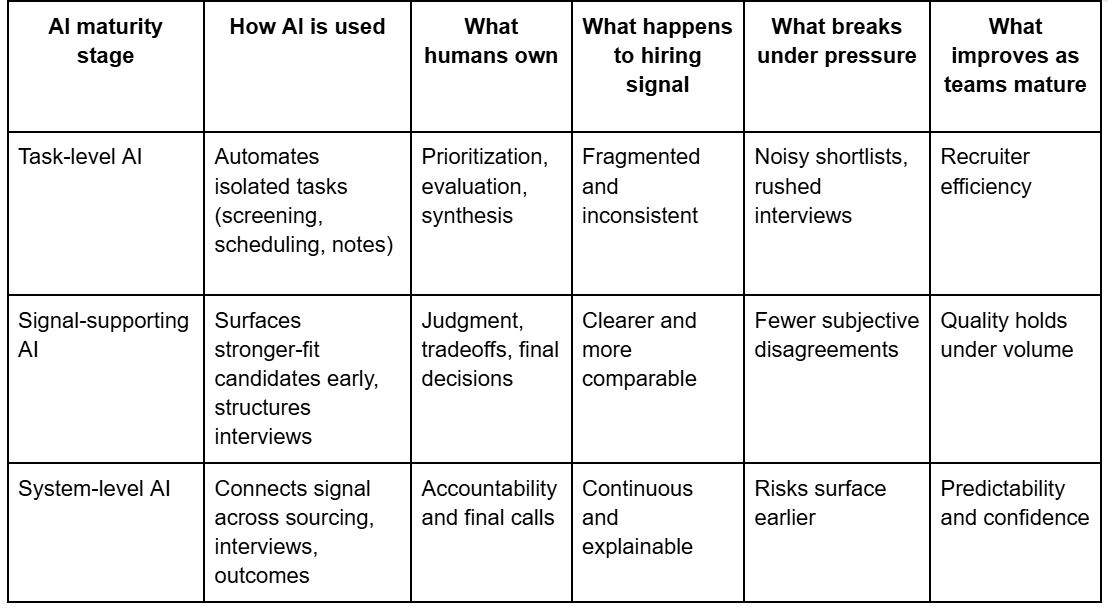
At lower levels of AI maturity, AI mainly saves time. It helps recruiters move faster by automating tasks like screening, scheduling, or note-taking. But when hiring volume increases, recruiters still have to manually handle the hardest parts of the process:
- Deciding which candidates to prioritize
- Evaluating interview feedback
- Synthesizing inputs across interviews and stakeholders
As pressure builds, this approach breaks down. Candidate shortlisting becomes noisier, interview quality varies, and decisions increasingly rely on gut feel rather than consistent signal.
As teams move up the maturity curve, AI starts supporting decisions before they’re made. Instead of just speeding up tasks, AI helps improve the quality of inputs that feed hiring decisions:
- Stronger-fit candidates surface earlier
- Interviews are structured and easier to compare
- Feedback is captured consistently instead of reconstructed later
As a result, hiring quality doesn’t get sacrificed even when volume increases.
At the highest level of maturity, AI becomes part of the recruiting infrastructure rather than a layer on top of it. Signal flows across sourcing, interviews, and outcomes instead of living in silos. Leaders gain visibility while hiring is still in progress, which allows them to:
- Spot quality risks earlier
- Course-correct before roles stall or mis-hires happen
- Explain hiring decisions with clarity, not hindsight
Humans still make the final call at every stage. What changes is the quality of information they’re working with.
Instead of relying on partial context and intuition, they’re deciding with clearer signal and fewer blind spots.
This is why AI maturity is not about tools. It’s about design. Every team is implicitly deciding:
- Where AI should reduce noise
- Where humans should apply judgment
- How decisions are made when pressure increases
Hung Lee also points out in LinkedIn’s Talent Report; the single most important thing talent leaders need to do is AI self-enable. Without understanding how AI shapes prioritization, signal, and decision-making, teams automate tasks while the most critical decisions remain fragile.
Designing your 2026 AI recruiting strategy
Here’s how to design a 2026 AI recruiting strategy in practice, starting with what to automate and where AI should support human decisions.
1. Principle: Automate low-value tasks, augment high-value decisions
AI should handle repetitive, operational work that slows recruiters down but doesn’t require human judgment. Tasks like resume screening, interview scheduling, and outreach sequences are ideal candidates for automation.
They are necessary, time-consuming, and highly standardizable. Human involvement should stay focused where it matters most:
- Interviews
- Assessing cultural and role fit
- Making final hiring decisions
This balance is critical. When recruiters spend most of their time coordinating calendars, filtering resumes, or managing follow-ups, decision quality suffers. When that work is automated, recruiters can focus on evaluating candidates properly and partnering with hiring managers.
And there’s clear evidence this works.
In 2025, organizations using AI-powered recruiting tools reported around 31% faster hiring cycles and up to a 50% improvement in quality of hire, largely because recruiters were no longer forced to trade speed for thoughtful evaluation.
The goal isn’t to remove humans from hiring. It’s to use AI to protect their time and judgment.
2. Top-of-funnel: Attract and prioritize right candidates
By 2026, most recruiting teams won’t struggle to source candidates. They’ll struggle to prioritize the right candidates early enough.
Candidates enter the funnel through many channels at once: inbound applications, job boards, outbound sourcing, referrals, and past pipelines. When volume is low, recruiters can review profiles carefully. But when volume increases, that approach stops working.
Under pressure, recruiters end up reviewing candidates in the order they applied, relying on obvious keywords, or skimming profiles until time runs out.
To address this issue, candidates coming from different channels should be evaluated together, not in separate queues. When these profiles sit in different systems or workflows, they’re delayed or overlooked for reasons unrelated to fit.
With AI-supported sourcing, you can bring candidates from all channels into a single evaluation layer. This ensures prioritization happens across the full pool, rather than channel by channel.
The second improvement is ordering.
This is where AI scoring becomes essential. Not as a rigid filter, but as a way to establish a clear starting point when recruiter time is limited.
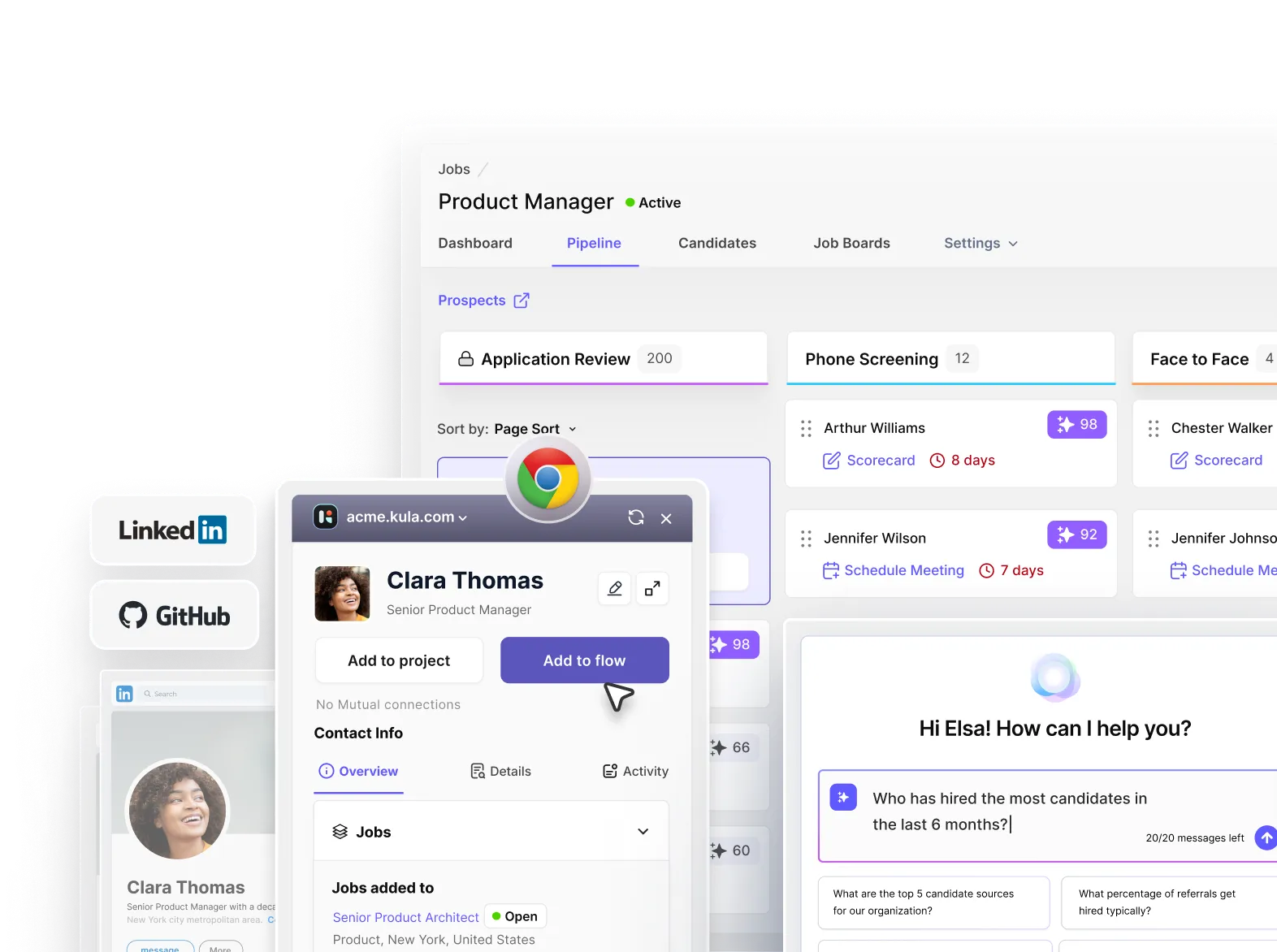
Some platforms use AI Scoring to rank candidates based on role-specific criteria such as skills, experience, and background, and clearly show why each candidate appears where they do.
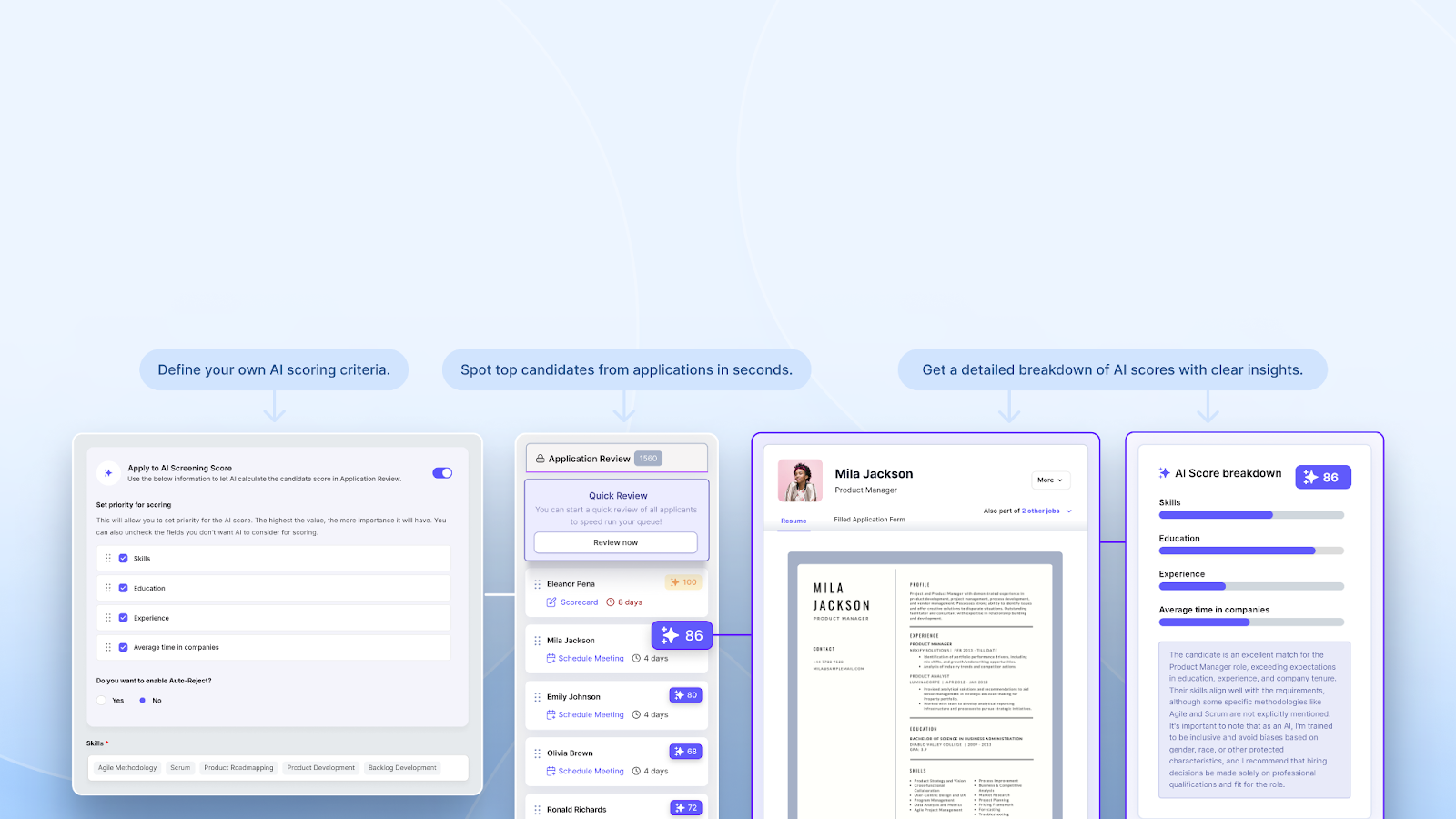
Recruiters still remain in control of decisions, but they no longer have to rely on timing, guesswork, or manual skimming to decide who to review first.
The impact is straightforward:
- Stronger candidates are identified and engaged earlier
- Recruiters spend less time filtering out obvious mismatches
- High-quality profiles are less likely to be lost during volume spikes
Prioritization also directly affects candidate experience. When attention is misallocated, strong candidates wait longer for responses, receive generic communication, or disengage before meaningful interaction happens.
AI-powered candidate experiences help reduce this friction. Dynamic job pages and personalized messaging allow teams to deliver relevant information faster and more consistently, even at scale. The result is a process that feels intentional instead of transactional.
A strong top-of-funnel AI recruiting strategy does three things well:
- Evaluates candidates from all channels together
- Prioritizes candidates based on fit, not timing
- Prevents strong profiles from being buried in volume
When this stage is designed properly, the rest of the hiring process becomes easier to manage. When it isn’t, no amount of optimization later in the funnel can fully correct the damage.
3. Mid-funnel: Streamline coordination and interview workflows
Scheduling interviews still requires manual effort in many teams. Recruiters match availability, send reminders, manage reschedules, and follow up when interviewers don’t respond.
AI-driven interview scheduling removes this overhead. Availability matching, calendar updates, reminders, and reschedules run automatically, which keeps candidates moving and prevents interviews from becoming a bottleneck. Recruiters get time back to focus on evaluating candidates instead of managing logistics.
But, coordination is only half the issue. The bigger breakdown happens in how interview feedback is captured and used.
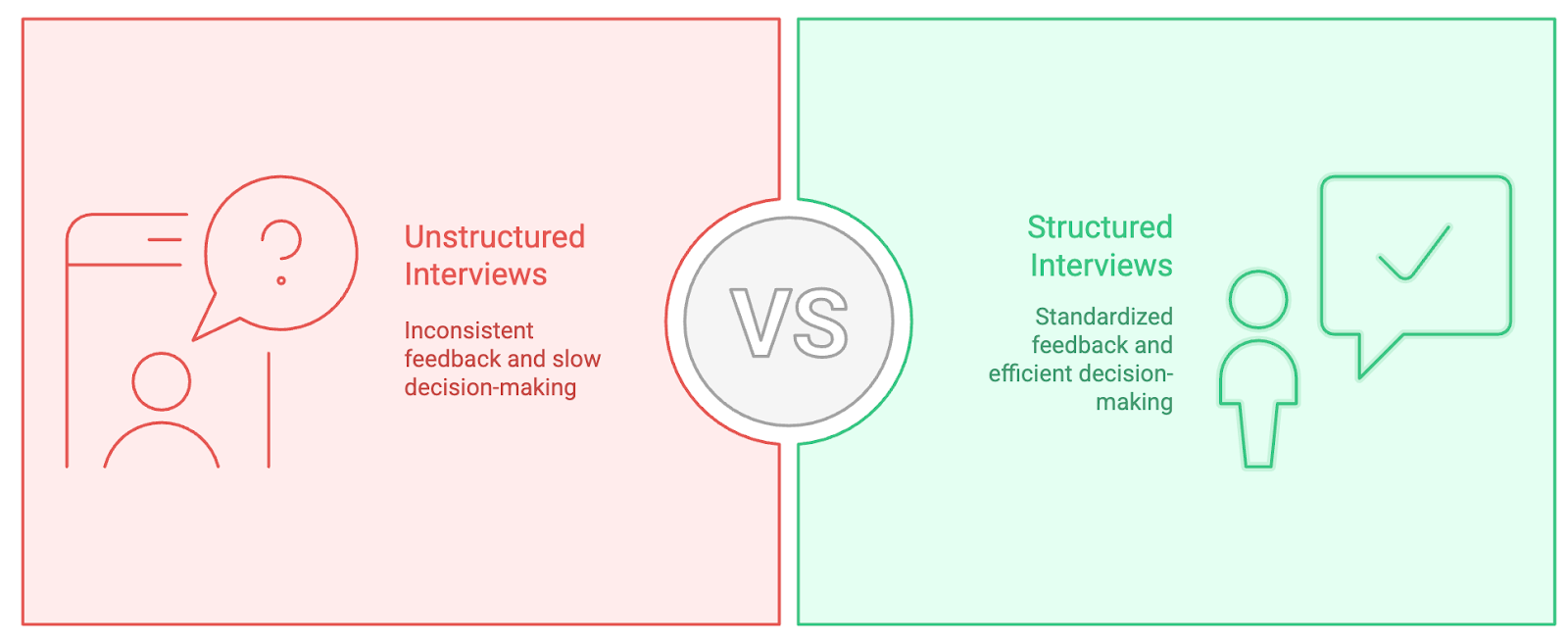
When interviews aren’t structured:
- Feedback becomes hard to compare.
- Interviewers focus on different criteria, ask different questions, and submit notes in different formats.
- Decision making slows down because candidates are not evaluated on the same basis.
Using standardized questions and clear scoring criteria fixes that. Candidates are assessed on the same dimensions, feedback becomes comparable across interviewers, and interview data becomes usable later in the funnel instead of subjective.
Many hiring teams still rely on memory during debriefs. Important details get lost, bias increases, and decisions turn into opinion-driven discussions.
AI-generated interview summaries remove this risk.
Interviews are captured in full, key moments are recorded automatically, and feedback is available immediately after the interview. Interviewers stay focused on the conversation, and recruiters don’t have to chase notes or clarify context later.
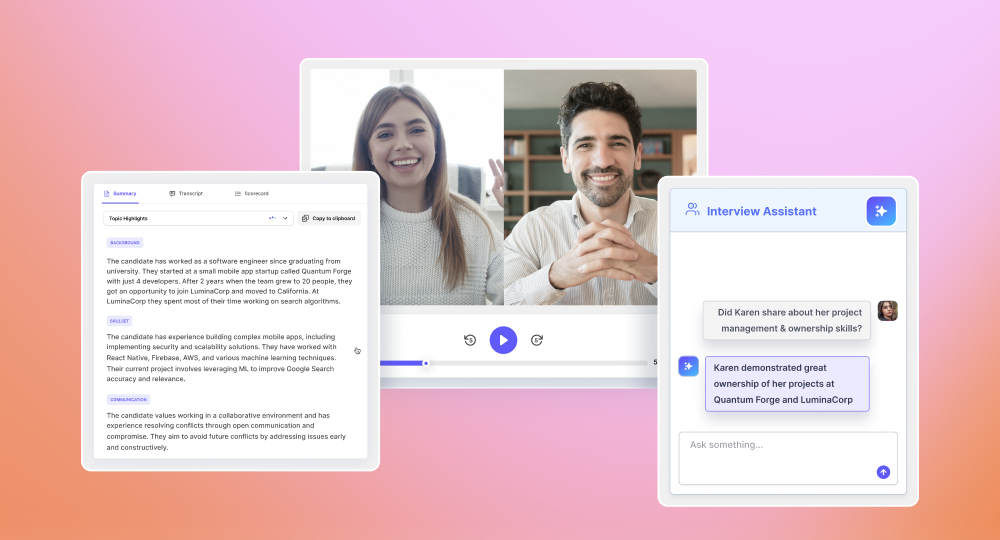
Some modern ATS platforms include an AI Notetaker that fits directly into this workflow by generating structured summaries and storing transcripts alongside candidate profiles. Every interviewer works from the same source of truth, which speeds up debriefs and reduces rework.
4. Bottom-funnel: Data-driven decisions and predictable hiring outcomes
Most teams still make final decisions based on scattered inputs: interview feedback in different formats, metrics pulled from multiple tools, and retrospective reports that explain what happened too late to fix it. This is where predictability breaks.
AI-powered dashboards and analytics give teams a real-time view of what’s actually happening in the funnel, instead of relying on lagging reports. Recruiters and leaders can track:
- Time-to-fill and time-to-offer
- Pipeline health across roles and teams
- Source effectiveness beyond raw applicant volume
- Candidate quality trends over time
This visibility matters because it shifts hiring conversations from “what happened” to “what’s about to break.”
The second step is comparison.
AI makes it easier to benchmark current performance against a pre-AI baseline. Teams can look at how key recruiting metrics behaved before automation and intelligence were introduced, and compare them to current performance.
This helps answer questions that recruiting leaders are increasingly expected to explain clearly:
- Has time-to-shortlist improved since screening and prioritization were automated?
- Are interview-to-offer ratios more consistent now that interviews are structured?
- Has cost-per-hire changed as manual effort decreased?
- Is quality-of-hire improving, or just hiring speed?
When these metrics live in one system and update continuously, recruiters don’t need to assemble reports manually or rely on quarterly reviews. With built-in reporting features available in an AI-native ATS, recruiters don't even have to waste time on creating these reports.
Get pre-built, customizable reports for your most important metrics, or get instant insights for tough questions through conversational AI .
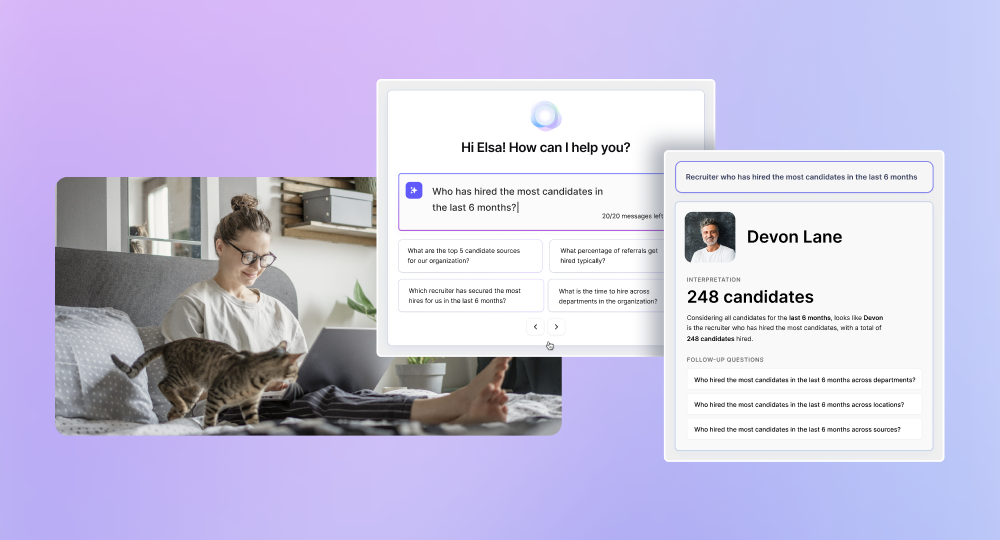
That’s what a strong bottom-funnel AI strategy delivers: fewer surprises, clearer decisions, and hiring outcomes teams can actually plan around.
Common mistakes to avoid for an AI recruiting strategy
1. Treating AI scoring or matching as a final decision-maker: When teams blindly trust scores without review, they risk reinforcing bias baked into historical data or overlooking candidates who don’t match conventional profiles but could perform well. AI should narrow focus and improve consistency. Humans should still validate, question, and decide.
2. Trying to automate everything before the basics are ready: Many teams rush into recruiting automation without fixing foundational issues like unclear role requirements, inconsistent interviews, or messy data. In these cases, AI doesn’t fix the process, it only accelerates its flaws. The most effective teams automate in layers, starting with repetitive coordination work and only adding intelligence once inputs are stable and structured.
3. Optimizing for efficiency while ignoring candidate experience: Over-automation often shows up as generic outreach, silent rejections, or unclear next steps. Candidates may expect AI in the process, but they still value transparency, responsiveness, and moments of human interaction.
4. Not establishing a baseline or tracking the right metrics: Without a baseline, it’s impossible to prove improvement or diagnose new issues. Metrics like time-to-shortlist, interview-to-offer ratio, cost-per-hire, and quality-of-hire over time are what show whether AI is improving outcomes or just changing where effort happens.
5. Layering AI tools on top of a fragmented tech stack: Adding AI point solutions to disconnected systems creates more friction, not less. Data gets siloed, candidate experience becomes inconsistent, and recruiters spend more time managing tools than acting on insights.
By 2026, using AI in recruiting won’t be a differentiator, but your strategy will. TA teams that design AI into their hiring systems intentionally will hire with more consistency, clarity, and predictability, while others simply move faster through broken processes.

You start by defining decision points, not tools. Map where recruiters currently lose time or clarity (screening, prioritization, interviews, debriefs), then decide where AI should reduce noise or speed up inputs. Tools come last. If AI doesn’t change how decisions are made, it’s not a strategy, it’s just automation.
Using AI in recruiting usually improves isolated steps, like screening or interview scheduling. An AI recruiting strategy connects signals across the funnel sourcing, interviews, and outcomes so hiring decisions become faster, consistent and more objective as volume increases.
To avoid over-automating with AI, recruiters should keep it out of final decisions. Strong teams automate coordination and prioritization, but keep humans responsible for interviews, tradeoffs, and offers. When AI starts deciding who gets hired, quality and trust both suffer.