


High-volume hiring rarely breaks because recruiters cannot find candidates.
It usually breaks because the hiring process cannot handle the volume.
As application numbers grow, recruiters spend more time screening resumes, coordinating interviews, collecting feedback, and managing candidate communication. What worked when hiring a few people each quarter often becomes a bottleneck when filling dozens or hundreds of roles at once.
The result is predictable: slower hiring, candidate drop-offs, overwhelmed recruiters, and declining hiring quality.
The companies that consistently succeed at high-volume hiring do not simply hire faster. They build systems, workflows, and processes that allow them to scale hiring without creating operational chaos.
In this guide, we'll cover 19 proven high-volume hiring strategies that help recruiting teams maintain hiring quality as demand grows.
What Breaks First in High-Volume Hiring
1. Recruiters Become Process Managers Instead of Recruiters
As hiring demand increases, recruiters spend less time assessing talent and more time managing operations. Instead of focusing on hiring quality, they become overloaded with repetitive administrative tasks that slow down the entire process.
Common operational breakdowns include:
- Manual scheduling: Coordinating interviews manually creates delays and increases candidate drop-offs.
- Scattered interview notes: Feedback spread across emails, Slack, spreadsheets, and ATS notes makes decision-making inconsistent.
- Endless follow-ups: Recruiters spend hours chasing approvals, interview feedback, and candidate responses.
- Spreadsheet dependency: Teams often create side systems outside the ATS, leading to fragmented data and reporting confusion.
- Hiring manager misalignment: Different expectations across hiring managers create delays and inconsistent evaluations.
Over time, recruiters stop functioning as talent partners and start functioning as workflow coordinators trying to keep the system operational.
2. Candidate Experience Collapses at Scale
When companies scale hiring without redesigning the candidate journey, small inefficiencies quickly turn into major drop-off points. Candidates lose interest when the process becomes slow, complicated, or difficult to complete.
The biggest candidate experience failures include:
- Long application forms: Multi-step applications with unnecessary fields create friction and reduce completion rates.
- Slow response times: Candidates applying for high-volume roles often move to faster employers if communication is delayed.
- Poor mobile experiences: Many hiring systems are still desktop-first, even though a large portion of candidates apply through mobile devices.
- Lack of communication: Missing updates and reminders increase interview ghosting and candidate abandonment.
- Multi-step interview fatigue: Too many interview rounds create unnecessary delays and frustrate candidates looking for quick decisions.
At scale, even minor friction points can significantly reduce hiring conversion rates
3. Traditional Corporate Hiring Workflows Fail Frontline Hiring
One of the biggest mistakes companies make is applying corporate hiring strategies to frontline or hourly recruitment. Frontline candidates behave differently and prioritize speed, convenience, and immediate opportunities over long hiring journeys.
This mismatch creates several problems:
- Hourly workers apply differently: Many candidates apply between shifts, during breaks, or while commuting, which makes fast and mobile-friendly applications essential.
- Speed matters more than employer branding: Frontline candidates often prioritize pay, shift timing, and start dates over polished employer branding campaigns.
- Candidates apply primarily on mobile: Complicated desktop-style applications create immediate drop-offs for mobile users.
- Corporate hiring assumptions fail: Traditional hiring assumes candidates will tolerate long applications and slow timelines, but frontline hiring depends on low-friction and rapid processes.
Without workflows designed specifically for high-volume hiring, even strong recruiting teams eventually become overwhelmed.
19 High-Volume Hiring Best Practices to Reduce Candidate Drop-Off and Recruiter Burnout
1. Using recruitment automation tools
Automation is particularly valuable in high-volume hiring because it can handle 50 to 75% of repetitive tasks with speed and accuracy.
Automation can be used for sourcing, screening, and scheduling, which helps reduce the workload on human recruiters.
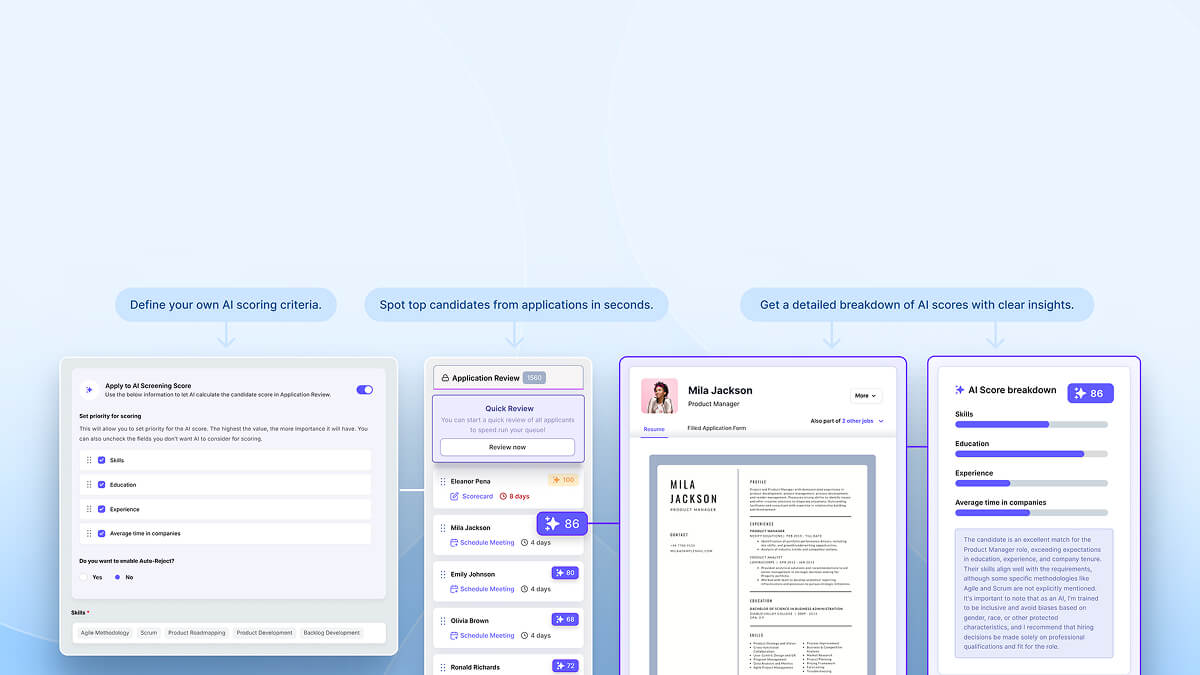
For example, AI screening can automatically filter out candidates who do not meet the minimum qualifications, automated communication flows help keep candidates engaged, and automated interview scheduling allows recruiters to focus on more important recruiting tasks.
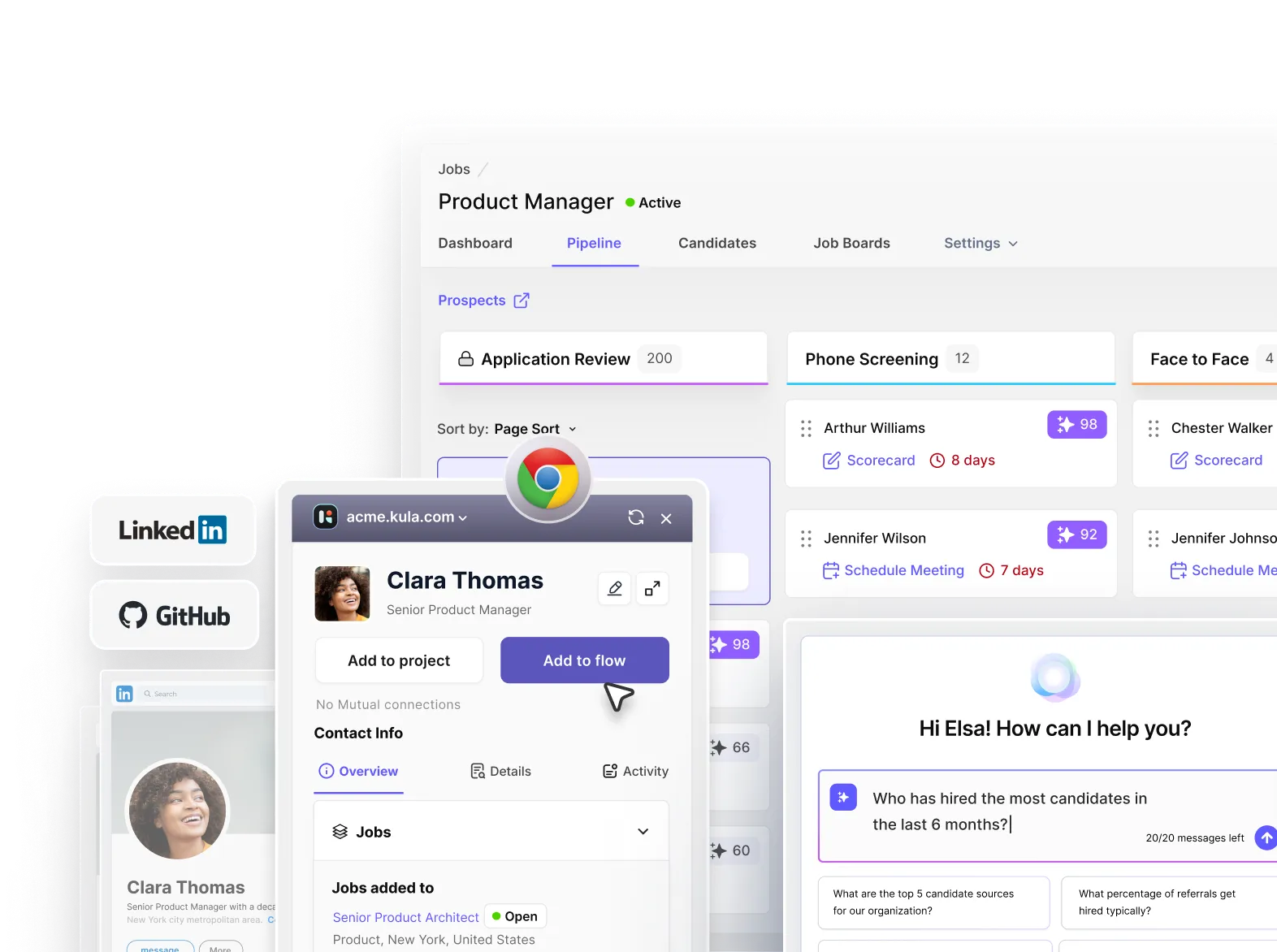
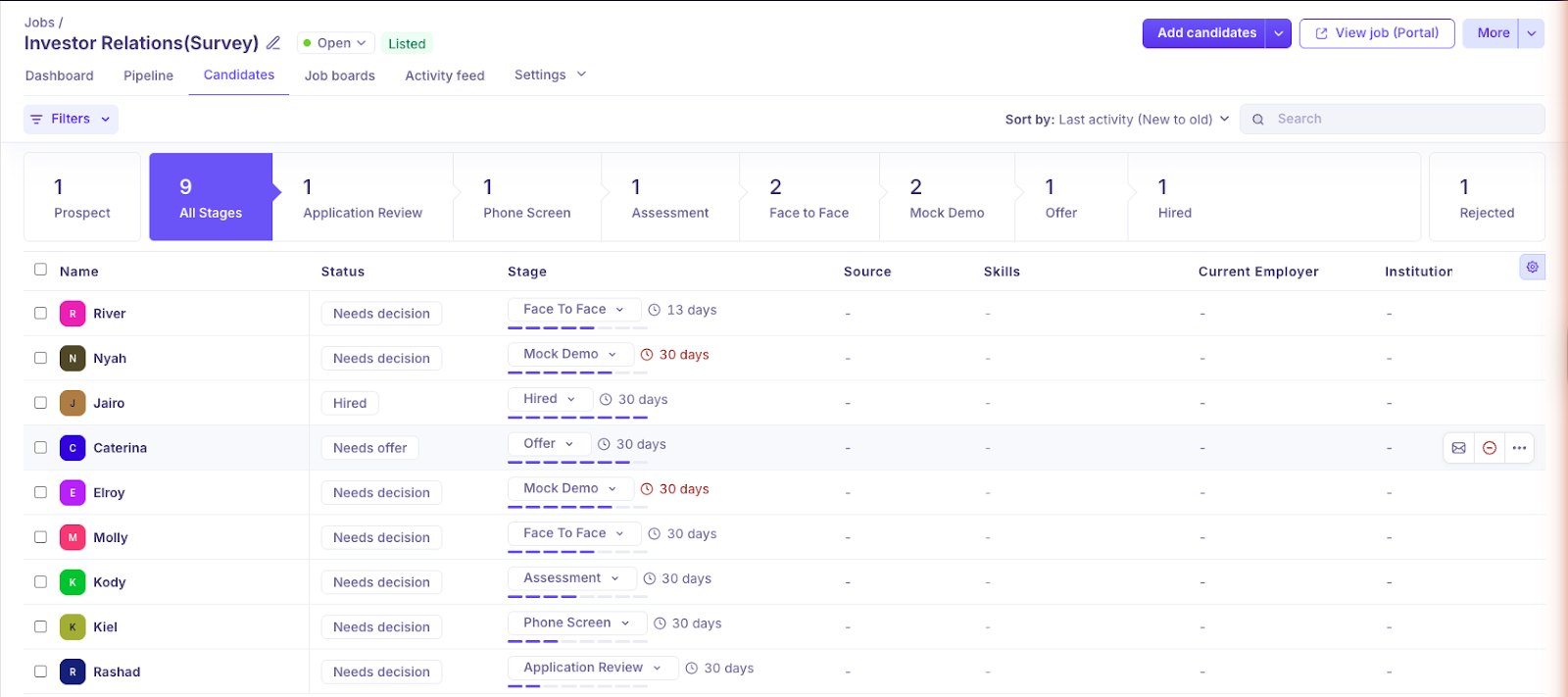
Applicant tracking systems (ATS) are platforms that are designed to manage the entire recruitment process, from job posting to candidate selection.
Further read: 15 best applicant tracking system tools in 2026
2. Building a strong employer brand
A strong employer brand is a powerful tool for attracting top talent, especially during high-volume hiring.
In fact, organizations with a strong employer brand experience a 50% increase in qualified applicants and see a 1-2x faster time-to-hire compared to those with weaker branding.
When candidates are familiar with and have a positive perception of your brand, they are more likely to apply, even if they are not actively seeking a new job.
To enhance employer branding:
- Showcase company culture through social media
- Use employee testimonials and case studies
- Ensure a positive candidate experience throughout the candidate journey
- Consider launching targeted employer branding campaigns
This can significantly reduce the time and effort required to fill open positions.
HubSpot’s success with employer branding in the B2B SaaS industry
HubSpot, a leading company in the B2B SaaS industry, is a prime example of how a well-executed employer branding strategy can significantly enhance a company's hiring and employee retention efforts.
👉Strategies implemented
- Social media marketing and employee advocacy
HubSpot invested heavily in social media, particularly LinkedIn, to promote its employer brand. The company regularly shared content highlighting its commitment to employee growth and development, featuring testimonials from employees who had benefited from HubSpot’s leadership training programs.
- Employee referral program
HubSpot implemented a robust employee referral program, incentivizing current employees to refer potential candidates.
This program accelerated the hiring process and ensured that new hires were culturally aligned with the company.
As a result, HubSpot was able to fill critical positions quickly and efficiently, with referred candidates proving to be a strong cultural fit.
Through its targeted employer branding efforts, HubSpot was able to attract and hire over 1,000 qualified candidates within 12 months. Additionally, these initiatives significantly improved employee retention rates, which increased by approximately 25% over the same period.
3. Expanding your talent pool through referral programs
Referrals tend to bring in candidates who are a better cultural fit and have a higher likelihood of staying with the company long-term.
Moreover, referred candidates typically move through the hiring process faster, reducing time-to-hire by up to 55% compared to candidates sourced through other channels.
For designing an effective referral program:
- Offer meaningful rewards, such as cash bonuses or extra vacation days, to motivate employees to refer qualified candidates."
- Use user-friendly platforms like Boon or Erin to streamline the referral submission process.
- Regularly communicate the benefits of the referral program to employees and encourage their participation.
Some of the best practices for managing referrals at scale:
- Keep employees updated on the status of their referrals.
- Ensure that your referral program includes a robust tracking system to monitor it.
- Make sure that the process is transparent and that all employees have an equal opportunity to participate.
- Consider expanding your referral program to include external networks, such as alumni or business partners.
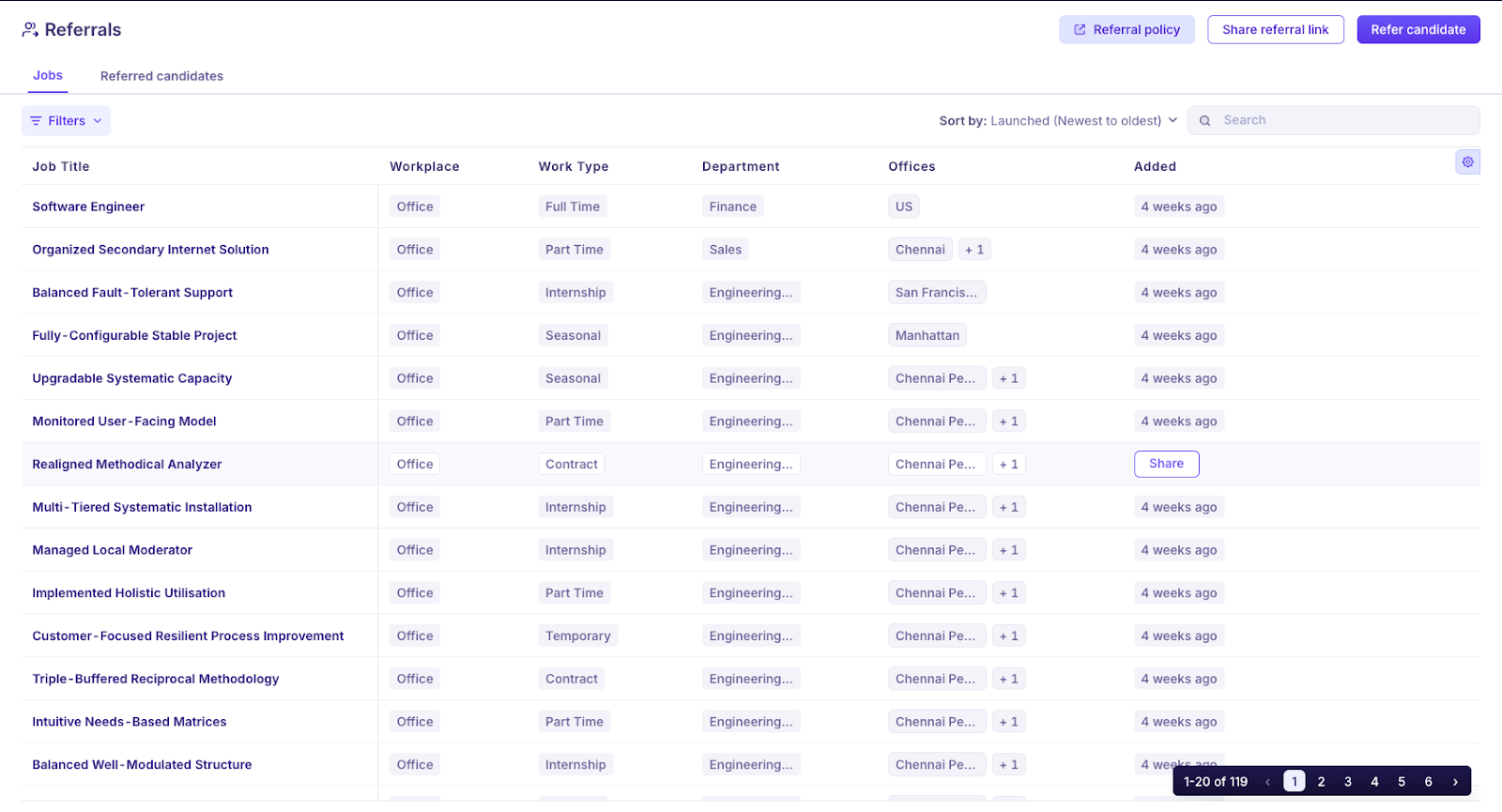
Recommended read: Your employee referral system is broken. Here’s How to Fix it
4. Using social media for targeted recruitment
Social media platforms like LinkedIn, Facebook, and Instagram have become essential recruitment tools, especially regarding high-volume hiring.
With over 1.3 billion users on LinkedIn alone, social media offers unparalleled access to a diverse pool of talent.
Social media is particularly effective in high-volume hiring because it allows companies to cast a wide net while also targeting specific groups of candidates based on factors such as job title, location, and industry. This makes it easier to reach the suitable candidates quickly and efficiently.
For creating effective social media recruitment campaigns:
- Craft targeted posts that speak directly to the types of candidates you want to attract.
- Using platforms like LinkedIn ads or Facebook ads can target candidates based on their job title, location, skills, and interests.
- Engage with candidates through posts and comments, and consider hosting live Q&A sessions or webinars on LinkedIn Live or Instagram Live.
- Use Google Analytics, LinkedIn Recruiter, and social media management platforms to monitor and analyze these metrics to refine your strategy.
5. Build a Mobile-First Application Process
One of the biggest mistakes companies make in high-volume hiring is assuming candidates will complete lengthy applications on desktop devices.
In reality, as per a Glassdoor study, 67% of candidates actively use mobile devices to apply for jobs.
But many ATS applications are still designed like traditional corporate forms.
This is where companies confuse mobile-friendly with mobile-first.
A mobile-friendly application makes your application accessible to mobile users without actually changing anything in it. In contrast, a mobile-first application is shorter and simpler, intentionally designed with the assumption that candidates will complete their applications on their phones.
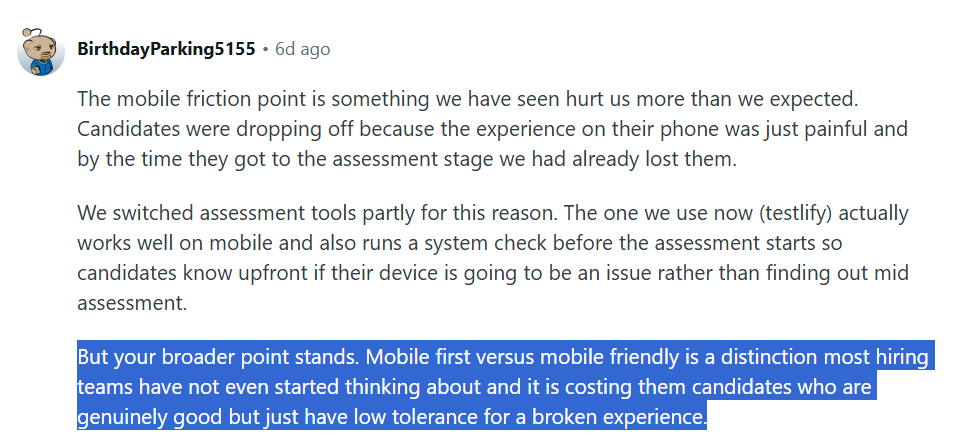
Even small friction points can dramatically increase drop-offs when companies are processing thousands of applications.
To improve completion rates, high-volume hiring applications should focus on:
- Name
- Phone number
- Location
- Availability
- Basic work eligibility
- Quick pre-assessment test (if required)
Additional information can always be collected later in the hiring process. The goal is to make applying feel fast and effortless.
6. Reduce Application Time to Under 5 Minutes
Long applications are one of the biggest funnel killers in high-volume hiring. Around 57% of candidates quit the long application process in the middle due to frustration.
So what should an ideal application look like?
When asked, 1500 US adults, nearly 71%, believed that the application process should take less than 30 minutes. So your application should be shorter and easier to fill.
Most candidates are applying to multiple jobs quickly, often from their phones, and usually move to the next opportunity if the process feels too slow or frustrating.
Some of the common friction points include:
- Mandatory account creation
- Repeated information fields
- Resume uploads on mobile
- Long questionnaires
- Multi-page application flows
In high-volume hiring, companies should focus on collecting only the most important information, such as basic personal information, document submissions, and role-specific questionnaires that will support further assessment.
7. Use SMS and WhatsApp for Candidate Communication
Although email users still outnumber SMS or WhatsApp users, there is a huge difference in the open rates. While emails have an average open rate of 28.6%, WhatsApp has an open rate of nearly 98%.
This knowledge matters in high-volume hiring. Many hourly or frontline candidates who have applied to multiple jobs can easily miss updates on emails, which can lead to candidate ghosting.
It’s a safer bet to use SMS and WhatsApp for sharing updates, particularly for time-sensitive hiring communications.
The best practice would be to use SMS or WhatsApp along with email communications, as some candidates may perceive companies using instant communication channels as less professional and credible.
The goal is not to push candidates away but to make sure your updates reach top talent immediately, so no qualified candidate is lost in the process.
8. Create an Always-On Talent Pipeline
One of the biggest problems in high-volume hiring is reactive recruiting. Many companies begin sourcing candidates only after hiring demand suddenly increases.
This approach becomes especially problematic during:
- Seasonal hiring spikes
- Rapid business expansion
- Sudden employee turnover
Instead of rebuilding the hiring funnel every time demand increases, companies should focus on creating an always-on talent pipeline.
An always-on pipeline allows recruiters to maintain ongoing candidate pools rather than starting from zero during every hiring cycle. To create it:
- Understand your current Talent needs and future goals
- Create a strong employer brand to attract qualified candidates
- Find candidates from different social platforms, referrals, events, and more
- Communicate with them consistently, even when you are not hiring
Once you have a pool of qualified candidates, segment them based on:
- Role type
- Shift preference
- Location
- Experience level
This approach makes it easier for recruiters to quickly identify and reactivate relevant candidates whenever hiring demand increases.
9. Re-engage Past Applicants Instead of Starting From Zero
Recruiters should focus on re-engaging past applicants, often referred to as silver medalists.
Since these candidates have already shown interest in the company and recruiters already have their information in the ATS, they are faster to reactivate.
Modern ATS platforms now make candidate rediscovery even easier by allowing recruiters to search old databases using filters such as:
- Skills
- Location
- Availability
- Previous interview scores
Instead of treating old ATS records as inactive data, companies should view them as warm talent pools that can significantly reduce sourcing effort.
Connect with them through personalized outreach messages acknowledging their history with the company and inviting them for a brief call directly instead of making them fill out the application again.
10. Restructure Recruiters Into Specialized Hiring Roles
In smaller hiring environments, generalist recruiters may be able to handle sourcing, screening, scheduling, interviewing, and offer management simultaneously. But at scale, this model quickly becomes inefficient and overwhelming.
To improve efficiency, many high-volume hiring teams divide recruiting responsibilities into specialized roles instead of relying on one recruiter to handle everything.
Common specialized hiring functions include:
- Sourcing specialists: Focus on finding and attracting candidates through job boards, referrals, databases, and outbound outreach.
- Recruitment coordinators: Handle scheduling, interview logistics, candidate communication, and process management to keep the hiring funnel moving smoothly.
- Closers or hiring recruiters: Focus on interviews, relationship-building, offer discussions, and converting qualified candidates into hires.
This specialization allows recruiters to focus on fewer tasks and develop stronger expertise in specific parts of the hiring funnel. Instead of constantly multitasking, teams can move candidates through the process faster and more consistently.
11. Remove Unnecessary Qualification Requirements
Many companies assume that adding more qualification requirements automatically improves hiring quality. In reality, overly strict requirements often shrink the candidate pool.
This problem commonly appears in the form of:
- Degree inflation for roles that may not actually require a formal degree
- Strict industry experience requirements
- Excessive certification expectations
- Unrealistic “perfect candidate” checklists
Instead of focusing only on rigid qualifications, companies should evaluate candidates based on:
- Reliability and attendance history
- Communication skills
- Problem-solving ability
- Willingness to learn
- Adaptability in fast-paced environments
12. Write High-Converting Job Descriptions
In high-volume hiring, unclear job descriptions create funnel noise by encouraging large numbers of mismatched candidates to apply.
To attract the right talent, differentiate between “nice to have” and “non-negotiable” criteria, and include only non-negotiable requirements in your JD. Also:
- Keep it short and jargon-free
- Avoid any biased vocabulary
- Use engaging subheads
- Clearly mention salary, perks, and benefits
- Mention your company's culture
Such a JD immediately helps eliminate confusion among potential candidates and lets them self-qualify before applying, which improves applicant quality and reduces unnecessary applications.

13. Standardize Interviews With Scoring Rubrics
When there is no standardized interview process, hiring decisions tend to be subjective, inconsistent, and often biased.
To reduce inconsistency, companies should use structured scoring rubrics, which include:
- Defining 4 to 5 core skills on which scoring will be based to make evaluation more focused
- Creating uniform core questions around these competencies and use the same for each candidate
- Designing 2–3 focused interview rounds mapped to these competencies
- Using a standard scoring scale, e.g., 1–5, with defined levels, with 5 being the best.
- Adding descriptive labels to each score, for example, using "partially meets expectations" for a 2 or 3 or "exceeds expectations" for a solid 5.
- Using automated transcripts and summaries for context-rich decision-making and feedback
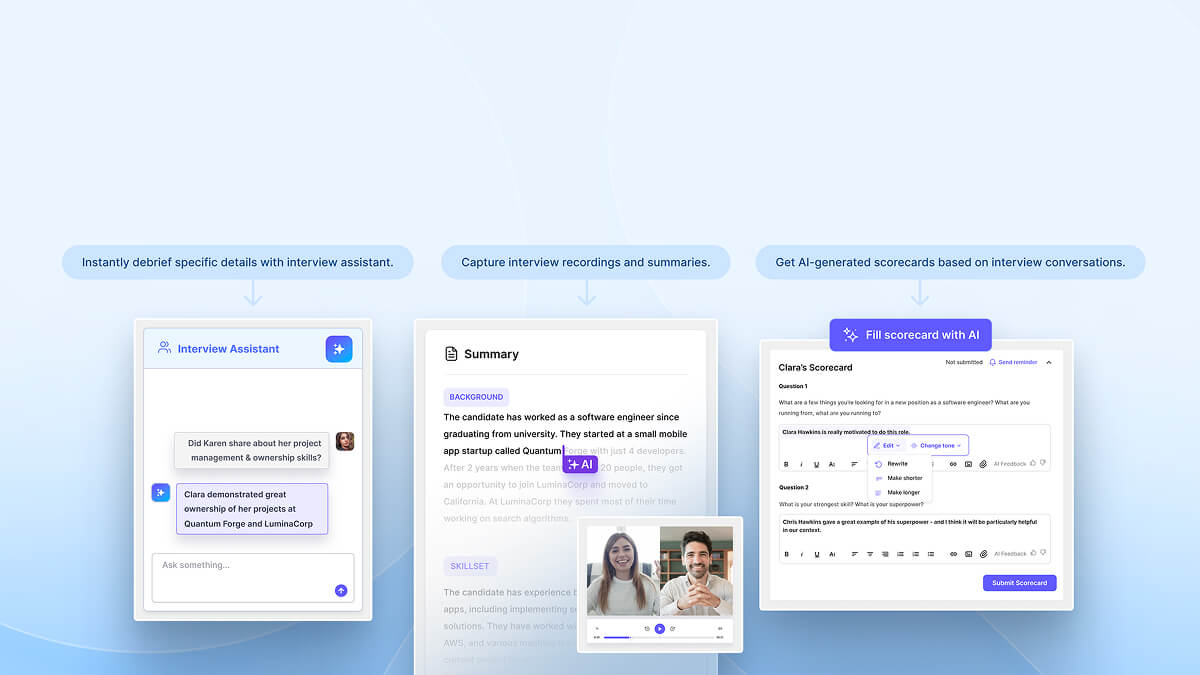
This approach creates a more structured and fair hiring process, which improves decision-making consistency in high-volume hiring.
14. Run Interviewer Calibration Sessions
Even when companies use structured interview rubrics, hiring inconsistency can still appear.
For example, one interviewer may consider a candidate’s answer “excellent,” while another may label the exact same response as average.
To maintain alignment, companies should conduct regular interviewer calibration sessions. These are structured meetings where recruiters and hiring managers review candidate responses together and discuss how scores should be assigned based on predefined criteria.
Calibration sessions typically involve:
- Reviewing interview recordings or transcripts
- Comparing interviewer scorecards
- Discussing why certain responses were scored differently
- Aligning on what qualifies as strong, average, or weak performance
These discussions help interviewers apply evaluation standards more consistently and improves hiring quality because teams become clearer about what success actually looks like for a role.
15. Use asynchronous video interviews
As in high-volume hiring, when recruiters are coordinating across multiple candidates, asynchronous interviews allow candidates to record responses on their own time.
This approach works particularly well for:
- Early-stage candidate screening
- High-volume frontline hiring
- Distributed or remote hiring
- Roles with repetitive screening questions
Asynchronous interviews are not for:
- Executive and senior leadership roles
- Client-facing roles (such as sales or customer-facing team)
- Senior technical roles
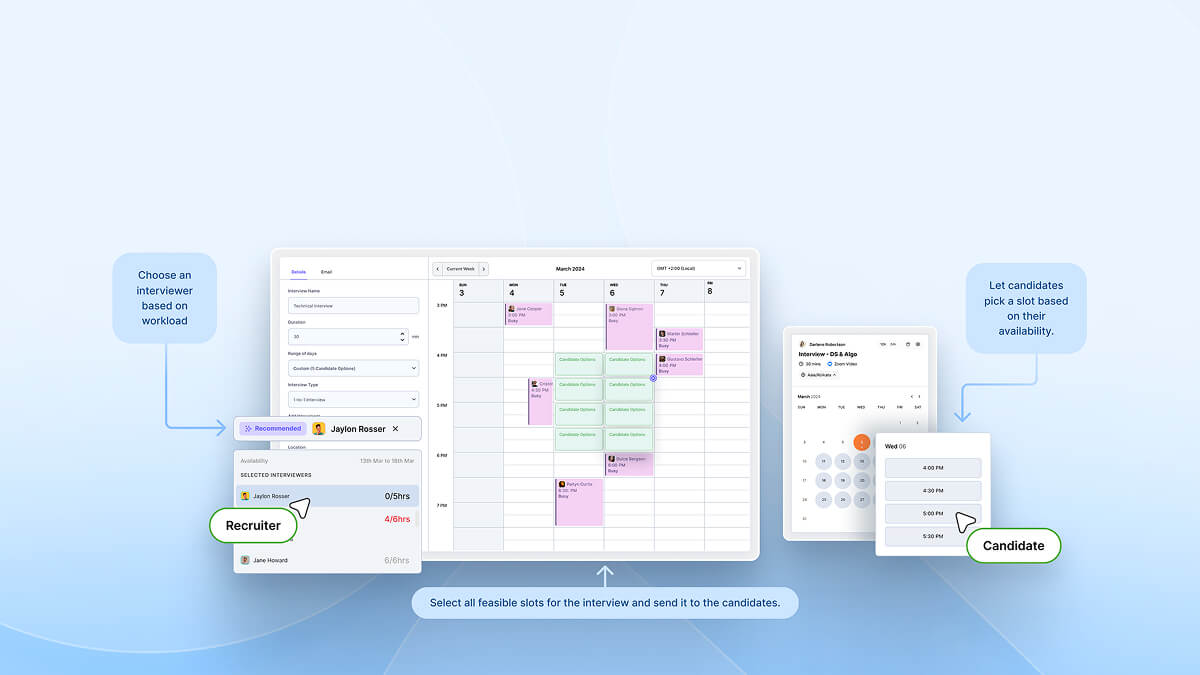
For the latter, the solution is automated scheduling, which saves recruiters from managing scheduling manually.
16. Automate Compliance and Background Verification
Companies should automate compliance and verification workflows directly inside their ATS or hiring systems to prevent operational delays.
For example, the ATS can automatically:
- Send document submission requests after offer acceptance
- Trigger background verification workflows
- Remind candidates about pending forms
- Notify recruiters about missing documents
- Track verification deadlines in real time
17. Build a Pre-Onboarding Retention Workflow
Companies need a structured pre-onboarding retention workflow because candidates may still be interviewing with other companies even after accepting an offer. A retention workflow helps keep candidates engaged and informed before Day 1.
An effective pre-onboarding process may include:
- Sending onboarding documents early
- Sharing joining instructions and reporting details
- Sending reminder messages before the joining date
- Introducing candidates to managers or team members
These small communication touchpoints help candidates feel more prepared and connected to the company before officially joining.
18. Track Location-Level Hiring Metrics
When companies rely only on overall hiring metrics, they hide location-specific problems.
For example, one warehouse location may experience three times higher turnover than another despite operating under the same company policies. Similarly, one hiring manager may consistently lose candidates during interviews while another maintains strong hiring rates.
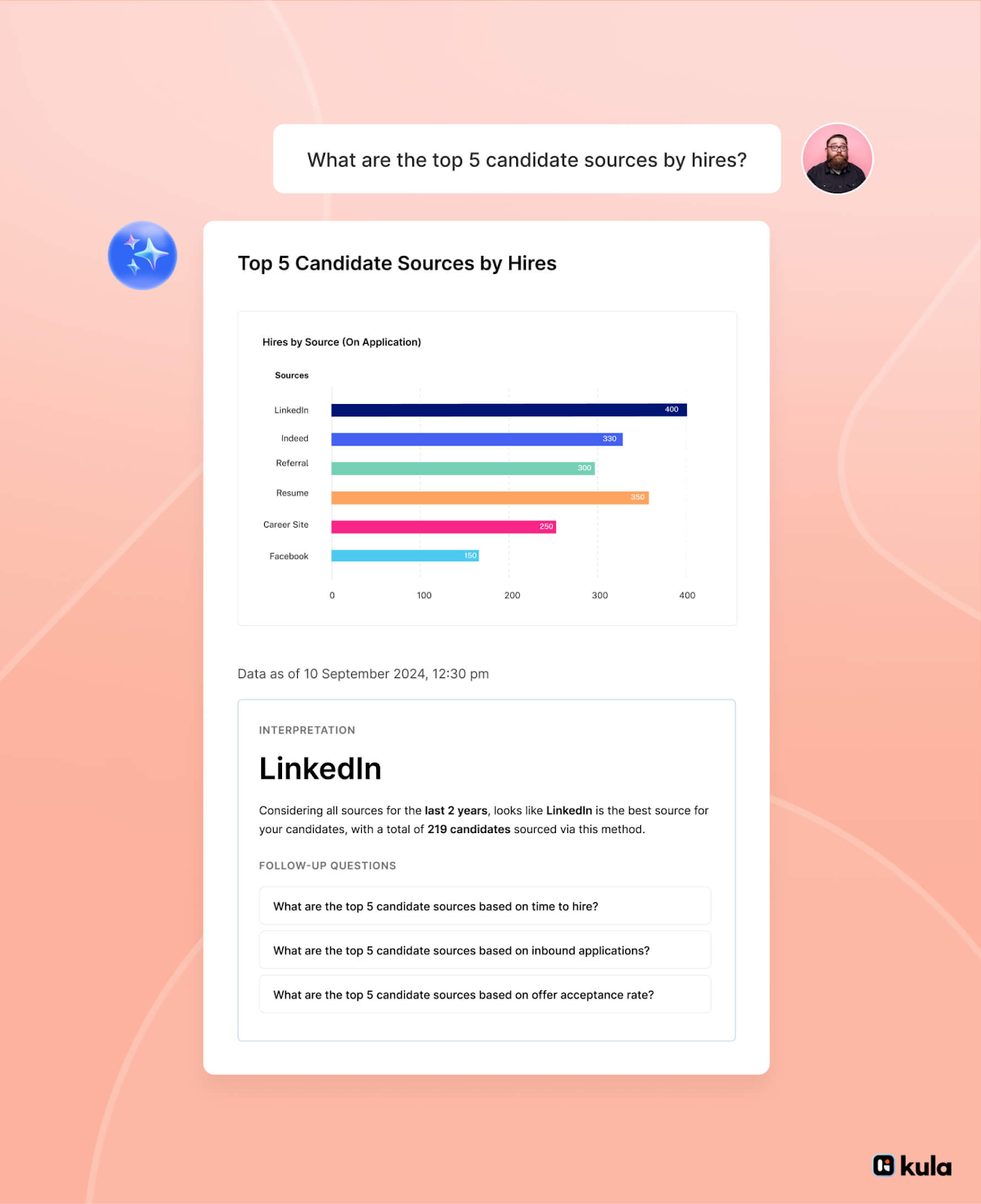
To actually speed up the process, companies should track hiring metrics at a more granular level, including by:
- Store or branch
- Warehouse or facility
- Region or city
- Department
- Hiring manager
- Shift type
This data allows companies to make targeted improvements instead of applying broad company-wide solutions that may not address the real issue.
19. Partnering with staffing agencies and RPOs
Recruitment process outsourcing (RPO) involves partnering with an external provider to handle all or part of your talent acquisition process.
RPOs can be particularly valuable in high-volume hiring because they have the infrastructure and experience to manage large-scale recruitment campaigns effectively.
They can also provide access to advanced recruitment technologies, such as AI-driven sourcing tools and predictive analytics, which can improve the efficiency and accuracy of the hiring process.
When should you consider partnering with staffing agencies?
Staffing agencies can be invaluable partners when you need to fill positions quickly or lack the internal resources to manage high-volume hiring.
Consider partnering with a staffing agency when you need to scale up quickly, fill specialized roles, or access a broader talent pool that may not be reachable through traditional recruitment channels.
Staffing agencies can also provide temporary or contract workers, which is particularly useful in industries with seasonal or fluctuating demand.
By working with a staffing agency, companies can quickly expand their workforce during peak periods and scale back when demand decreases.
When selecting a staffing agency or RPO provider, consider their industry expertise, reputation, technology stack, and ability to deliver on your specific hiring needs.
Final Thoughts
High-volume hiring becomes difficult when recruiters rely on manual workflows, disconnected tools, and outdated hiring processes.
Modern ATS platforms now support many of these strategies through automation, structured workflows, candidate communication, interview coordination, analytics, and compliance tracking.
The right ATS helps recruiting teams reduce candidate drop-offs, improve hiring speed, and scale operations more efficiently.
Book a demo with Kula ATS to see how its automation-driven recruiting platform can help your team hire faster and manage high-volume recruiting more efficiently.

High-volume hiring refers to recruiting several candidates in a relatively short period. It is common in industries with seasonal peaks, rapid expansion, or high turnover rates. High-volume hiring often requires streamlined processes and specialized tools to manage the increased demand effectively.
Small businesses can implement these high-volume hiring strategies to improve recruitment efficiency and attract top talent without overwhelming their resources. Even small companies can scale their hiring efforts effectively by focusing on automation, employer branding, and structured processes. Additionally, partnering with staffing agencies or RPOs can provide small businesses access to resources and expertise they may not have in-house
While recruitment automation offers numerous benefits, there are potential risks, such as over-reliance on technology, which could lead to a lack of personal touch in the hiring process. It’s important to balance automation with human oversight to ensure that candidates feel valued and that the process remains fair and inclusive. Additionally, companies should be mindful of potential biases in AI-driven tools and ensure their algorithms are regularly reviewed and updated to promote diversity and inclusion.
Candidate experience is crucial in high-volume hiring, as it can significantly impact a candidate’s perception of your company and their likelihood of accepting a job offer. A positive candidate experience involves clear communication, timely updates, and a transparent recruitment process. By prioritizing candidate experience, companies can improve their employer brand, reduce dropout rates, and increase the chances of securing top talent.