



By 2026, AI in applicant tracking systems isn’t new. In fact, 79% of organizations have already integrated AI or automation directly into their ATS.
And yet, hiring still feels harder than it should.
Recruiter workload hasn’t dropped in any meaningful way. Hiring decisions still rely heavily on manual judgment. And quality of hire remains inconsistent, even with more automation in place.
The problem is, most ATS platforms apply AI to isolated steps—resume screening, ranking, or routing—without changing how hiring decisions are made end to end. Intelligence is layered on top of legacy workflows, while hiring data stays fragmented across tools and stages.
So despite “AI-powered” claims, recruiters are still stitching together context manually when it matters most.
The issue isn’t missing AI. It’s missing an AI-native architecture.
What an AI-native ATS actually is
An AI-native ATS is a hiring system built around intelligence from the ground up, not one where AI is added later as a feature.
In practical terms, an AI-native ATS is a system where intelligence is embedded into:
- How hiring data is captured
- How signals connect across the hiring funnel
- How decisions are supported over time
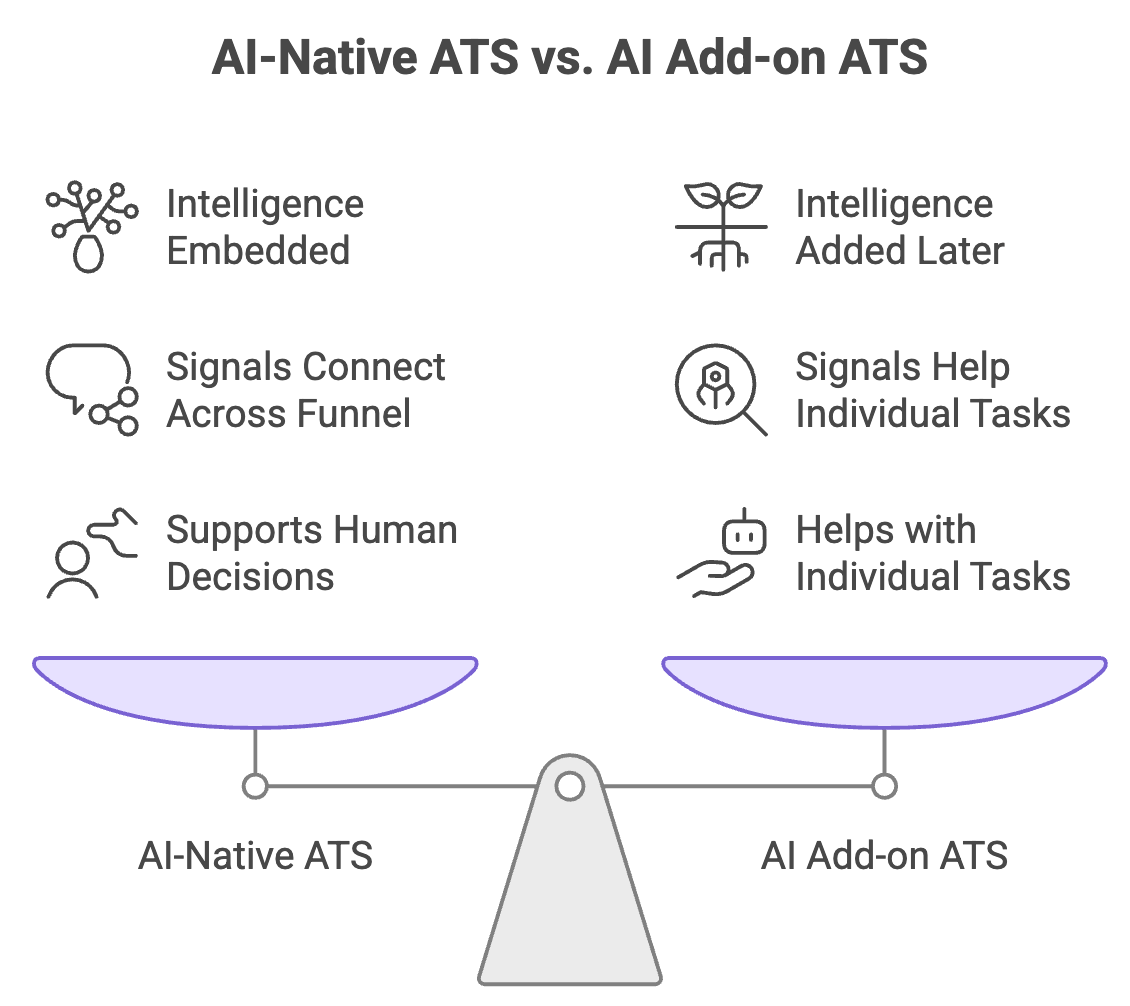
In an applicant tracking system with AI as an add-on, intelligence helps with individual tasks—screening resumes faster or ranking candidates at a single stage. In an AI-native ATS, intelligence shapes how hiring signals work together across sourcing, interviews, feedback, and offers.
This doesn’t mean AI processes decide who gets hired. It simply means AI supports recruiters and hiring managers by reducing blind spots, inconsistency, and decision fatigue, while humans remain fully accountable for every hiring decision.
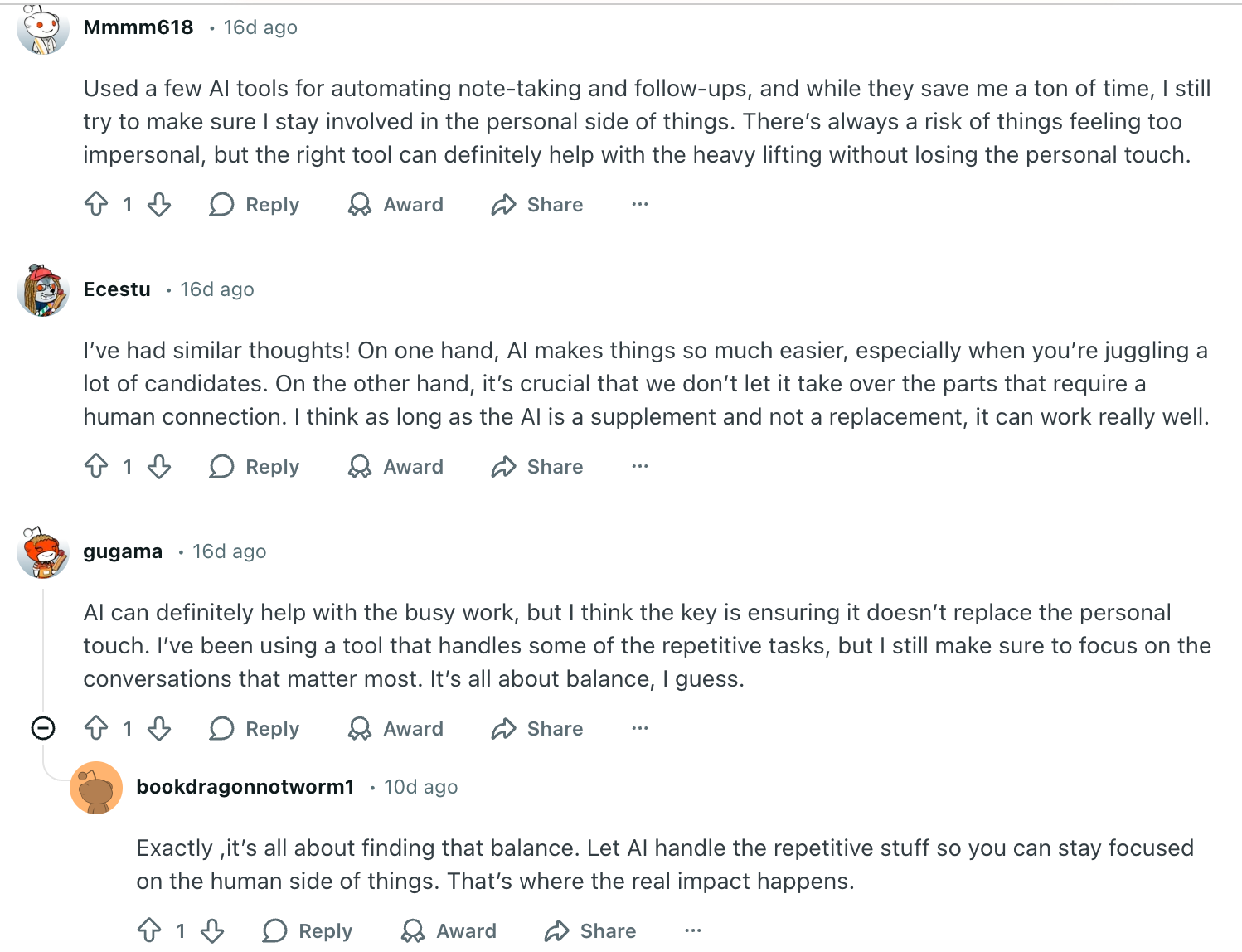
This is a common idea we’ve seen recruiters themselves be very clear about. On Reddit, we’ve seen, many recruiters point out that AI is helpful when it handles repetitive, high-volume work like note-taking, follow-ups, or early screening, but shouldn’t take over the parts of hiring that require human judgment and connection.
The value of AI, in their words, is in support, not substitution.
That same principle applies at the system level. Alexandra Siegel, Chief Equity and Engagement Officer at Salesforce, has pointed out:
“AI is only as good as the data that you input and the processes that you build. It will not fix broken processes.” [Source]
But this is exactly where most “AI-powered” ATS platforms fall short.
What makes an ATS truly AI-native isn’t automation. It’s how intelligence compounds: learning from outcomes, connecting context across hiring, and supporting human decisions instead of replacing them.
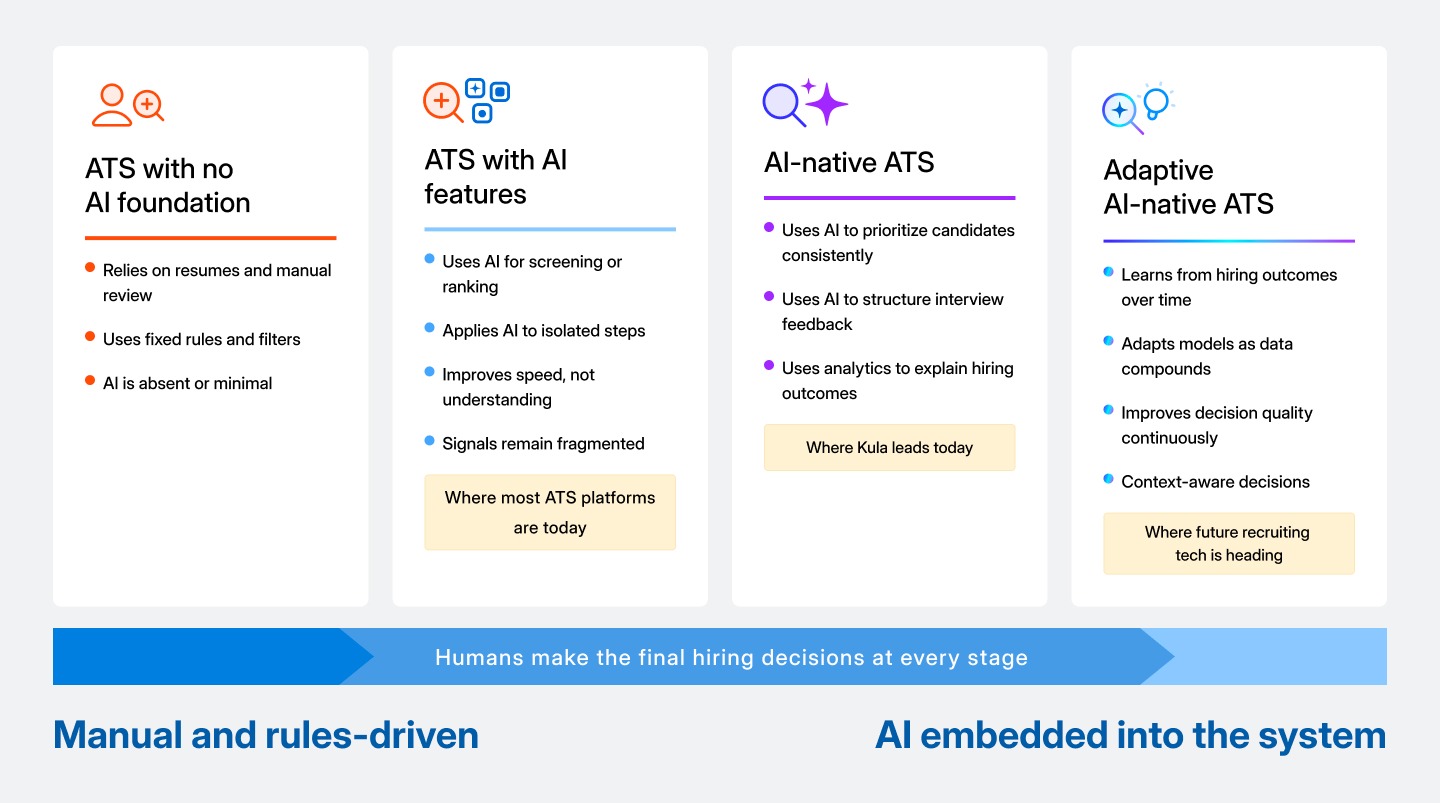
How an AI-native ATS helps with the full hiring lifecycle
1. Turning inbound volume into hiring priorities
Most recruiting teams don’t lack candidates. They lack clarity.
When dozens of applicants meet the basic criteria, recruiters end up rechecking resumes, revisiting filters, and repeatedly validating shortlists with hiring managers. This leads to slow progress, even though the hiring funnel looks “healthy.”
AI-native ATS platforms address this by changing how prioritization works.
Instead of scoring candidates once and freezing the ranking, AI-native systems continuously reprioritize candidates in role-specific context.
As hiring progresses, signals from hiring manager feedback, interview outcomes, and role changes feed back into how candidates are surfaced.
In Ai native ATS tools AI scoring is anchored to explicit hiring criteria defined upfront—what the team actually considers a strong candidate—and reinforced as decisions are made. As candidates move through interviews or get ruled out, prioritization adjusts automatically.
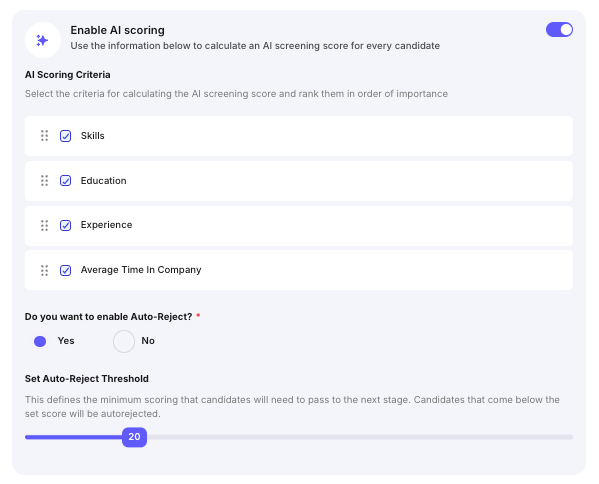
This means, recruiters aren’t forced to constantly re-filter or second-guess the shortlist. The shift from screening to prioritization is what reduces decision fatigue at scale.
2. Making outbound sourcing and referrals intentional, not reactive
Outbound hiring today is still largely reactive. Recruiters rely on guesswork, recycled sourcing lists, and high-volume outreach to compensate for low confidence.
The result is predictable: low response rates, poor signal-to-noise, and a lot of effort spent on candidates who were never likely to convert in the first place.
AI-native ATS platforms change this by bringing intention and evidence into outbound and referrals.
Instead of treating outbound sourcing, referrals, and inbound candidates as separate workflows, AI-native systems evaluate them together. This makes it possible to:
- Identify which profiles are actually worth reaching out to
- Understand which channels convert best for specific roles
- Surface referral signals that have historically led to strong hires
As hiring priorities shift, in December 2025, 83% of recruiters said engaging passive candidates would be their top priority for the next five years.
But passive hiring isn’t about one-off messages. It requires multi-channel engagement, long-term nurturing, and consistent candidate context, all of which become difficult to manage manually.
Because ATS tools combines CRM activity, referrals, and inbound candidate data in a single system, AI can weigh these signals together rather than in isolation.
A good ATS Software can preserve context across a candidate’s entire journey, not just a single touchpoint. Outreach history, referral source, interview progression, and eventual hiring outcomes all feed into the same view.
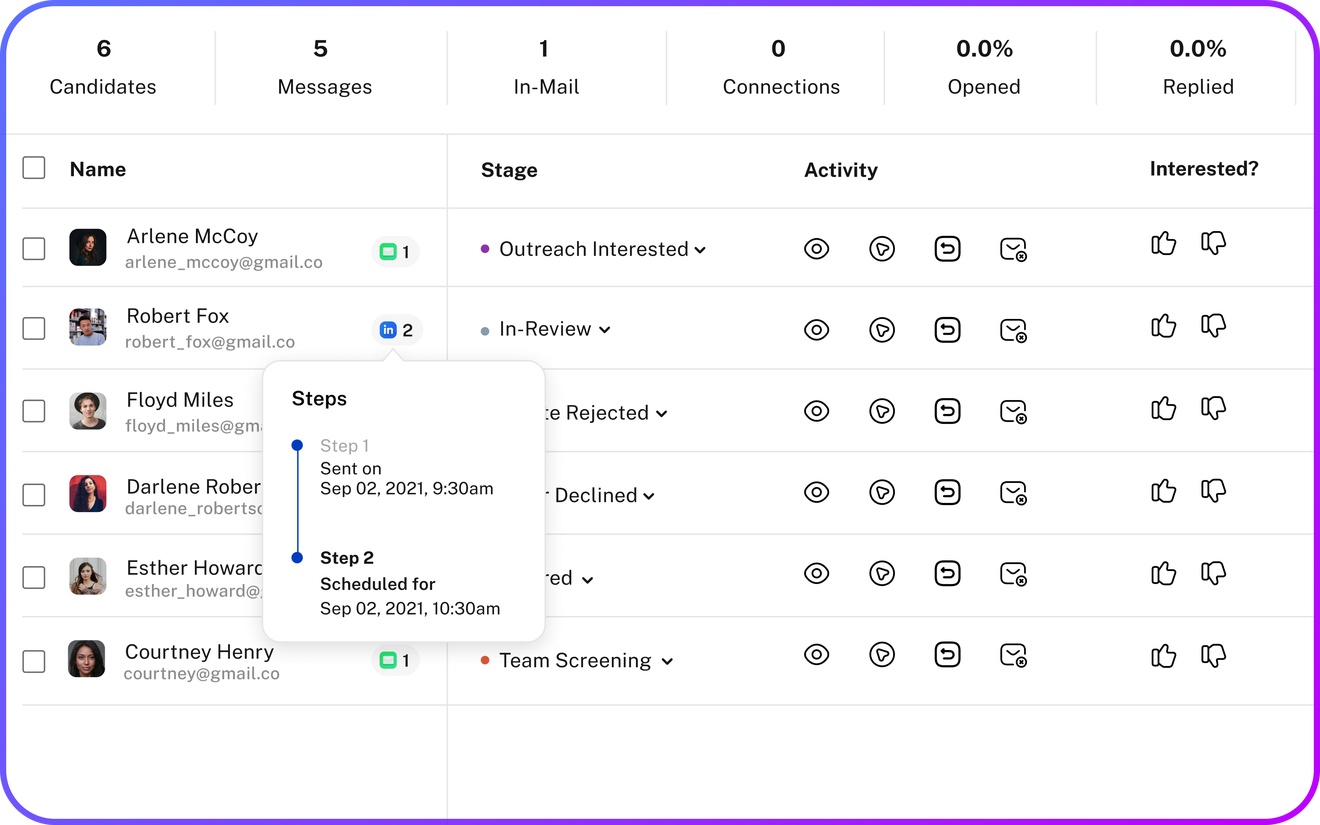
Over time, this makes it easier to see which profiles consistently convert, which channels actually move candidates forward, and which referral paths lead to successful hires.
Instead of guessing who to reach out to next, recruiters get clearer signals on who is worth engaging, when, and why. This allows outbound sourcing and referrals to be guided by real patterns instead of intuition, making outreach more predictable, targeted, and repeatable instead of random.
3. Turning interviews into structured, usable hiring data
Interview data is one of the strongest predictors of hiring success, yet it’s also one of the messiest inputs in the hiring process.
In most teams, interview feedback is:
- Unstructured (free-text notes, personal formats)
- Delayed (submitted hours or days later)
- Inconsistent (different interviewers evaluate different things)
By the time teams reach a debrief, context is already lost. Decisions are influenced by memory, recency bias, or whichever interviewer is most vocal, not by a clear, comparable view of candidate signals.
AI-native ATS platforms change this by redefining what interviews are for.
Instead of treating interviews as note-taking exercises, interviews become structured signal capture. AI helps ensure that:
- Feedback is captured consistently across interviewers
- Summaries are generated automatically and immediately
- Patterns and gaps across interview feedback are visible early
The goal isn’t to script interviews or remove judgment. It’s to make interview data usable.
With an AI native tool, interviews are designed to produce decision-ready data, not raw notes. AI automatically captures and summarizes interview conversations, removing the burden of manual note-taking.
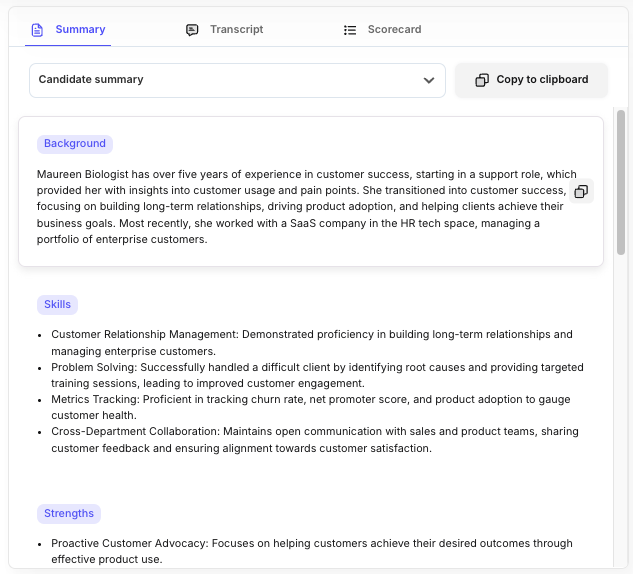
Interviewers submit structured feedback tied to defined evaluation criteria, so candidates are assessed on the same dimensions across the panel.
Plus, if you’re looking for some instant data about a specific candidate, just ask the Interview Assistant, and you’ll get data on your fingertips. No messy reports or follow ups.
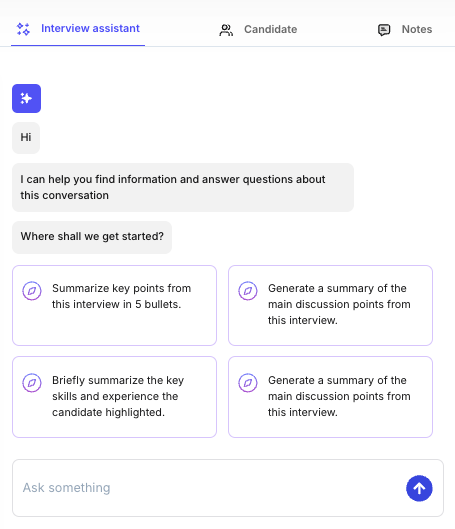
All feedback lives in one centralized space that recruiters and hiring managers can access easily, without chasing responses across Slack, email, or documents. This makes it much easier to:
- Compare interviewer input side by side
- Spot misalignment or contradictory feedback early
- Move decisions forward without waiting on follow-ups
Because feedback is standardized and captured in real time, teams see faster turnaround, better alignment, and less bias introduced by inconsistent evaluation styles.
4. Supporting better decisions instead of automating judgment
Hiring decisions usually break down not because teams lack data, but because they can’t interpret it fast enough or in the right context. Interview feedback conflicts, sourcing signals point in different directions, and traditional analytics arrive too late to influence the decision at hand.
And that’s exactly why AI-native does not mean autopilot hiring. In an AI-native ATS, AI’s role is decision support, not decision replacement.
Instead of automating hiring calls, AI helps surface patterns and risks that are hard to spot manually, especially when signals span multiple stages of the funnel.
This includes patterns across:
- Inbound vs. outbound candidate performance
- Interview feedback from different interviewers
- Past hires compared to current finalized candidates
And early risk indicators such as:
- Strong candidates repeatedly dropping at a specific stage
- Interview feedback that’s unusually misaligned
- Offers from certain sources leading to better long-term outcomes
The key difference is how teams access these insights.
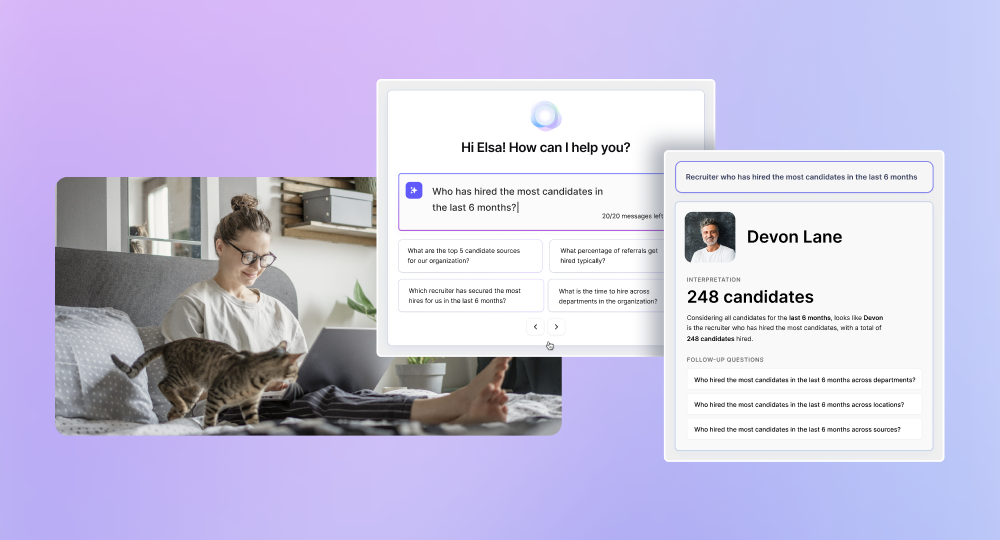
Recruiters and hiring managers can ask natural-language questions directly inside the ATS, and the system responds by pulling together signals across sourcing, interviews, feedback, and offers.
For example, teams can ask:
- Why are senior candidates dropping after panel interviews?
- Which interviewers’ feedback best predicts strong hires for this role?
- Are we moving faster without improving quality?
- Where are candidates consistently stalling, and what’s driving it?
Instead of returning a generic chart, Conversational AI analyzes structured interview data, feedback patterns, and hiring outcomes already captured in the system to explain what’s happening and why, in plain language.
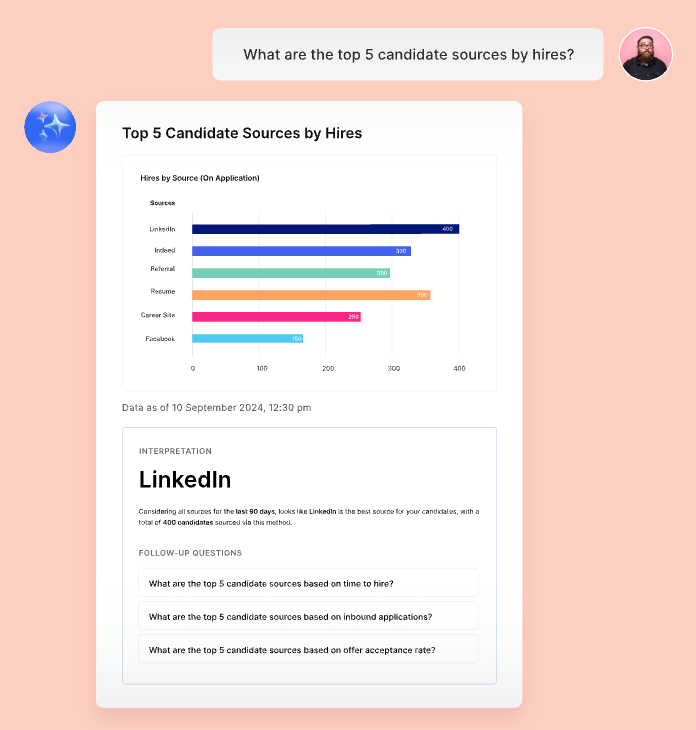
No time spent on manual report building, no exporting data, and no waiting on other teams or stakeholders.
And since these questions can be asked while hiring decisions are still being made, teams can act immediately. Whether it’s recalibrating interview panels, adjusting criteria, or addressing bottlenecks, before they affect outcomes.
So no, AI doesn’t decide who to hire. It helps recruiters and hiring managers make clearer, faster, and more defensible decisions—with full context in front of them.
How to evaluate whether an ATS is truly AI-native
Evaluating whether an ATS is truly AI-native isn’t about labels or features. It’s about whether the system actually behaves differently once hiring is underway.
Start with prioritization, and ask yourself:
- When candidates move forward or drop out, does the system adjust who it surfaces next?
- Or do recruiters still have to manually re-rank and re-filter every shortlist?
If prioritization doesn’t evolve based on real hiring decisions, AI isn’t embedded, it’s just cosmetic.
Next, look at how outcomes connect back to signals.
- When a hire works out (or doesn’t), can you see which interview feedback, sourcing channel, or referral path led there?
- Or does that information live in separate tools with no clear link between them?
If you can’t trace outcomes to inputs, the system can’t learn from them.
Now consider how problems are explained.
- If candidates stall after interviews, does the system surface misaligned feedback, weak interview signals, or role criteria issues?
- Or does it simply show a drop-off number and stop there?
Knowing where things break is table stakes. Knowing why is what helps teams fix them.
Then look at how insights are accessed:
- Can recruiters and hiring managers ask questions in the flow of work and get answers immediately?
- Or do insights depend on dashboards, exports, or someone else pulling together a report?
If insight requires effort, it won’t shape decisions.
Finally, test how reliable your AI-powered applicant tracking system is:
- When the system prioritizes candidates or flags risks, can you explain that logic to a hiring manager?
- Can you defend the decision in a debrief?
If recommendations feel opaque, teams will override them, every time.
Put together these questions and answers, you’ll get the real signal.
An AI-native ATS doesn’t feel like automation layered on top of hiring. It should feel like the system is helping you see patterns, risks, and priorities as hiring happens, so decisions get easier, faster, and more consistent.
Wrapping up: where applicant tracking systems are headed next
By 2026, using AI in hiring won’t be a differentiator. Almost every ATS already does that in some form. What matters now is how AI is used.
Teams that move ahead will be the ones whose systems are built to connect hiring signals, preserve context across stages, and support better decisions, not just move candidates through the funnel faster.
If you want to see what AI-native hiring looks like in practice—from structured interviews to conversational analytics and decision support—book a demo to explore how Kula helps teams hire with more clarity and less guesswork.

An AI-native ATS is built with intelligence embedded into its core architecture, not added later as features. It connects hiring signals across sourcing, interviews, feedback, and offers to support better hiring decisions over time.
No. AI-native ATS platforms are designed to support human judgment, not replace it. Recruiters and hiring managers remain accountable for decisions, while AI helps reduce blind spots and decision fatigue.
A truly AI-native ATS doesn’t require recruiters to constantly reset filters, rebuild shortlists, or pull reports to understand what’s happening. It should adapt as decisions are made, connect signals across sourcing, interviews, and offers, and help explain why outcomes change, not just where they change. If your ATS uses AI only for isolated tasks like resume screening, but still relies on manual interpretation and fragmented data, it’s likely AI-enabled, not AI-native.