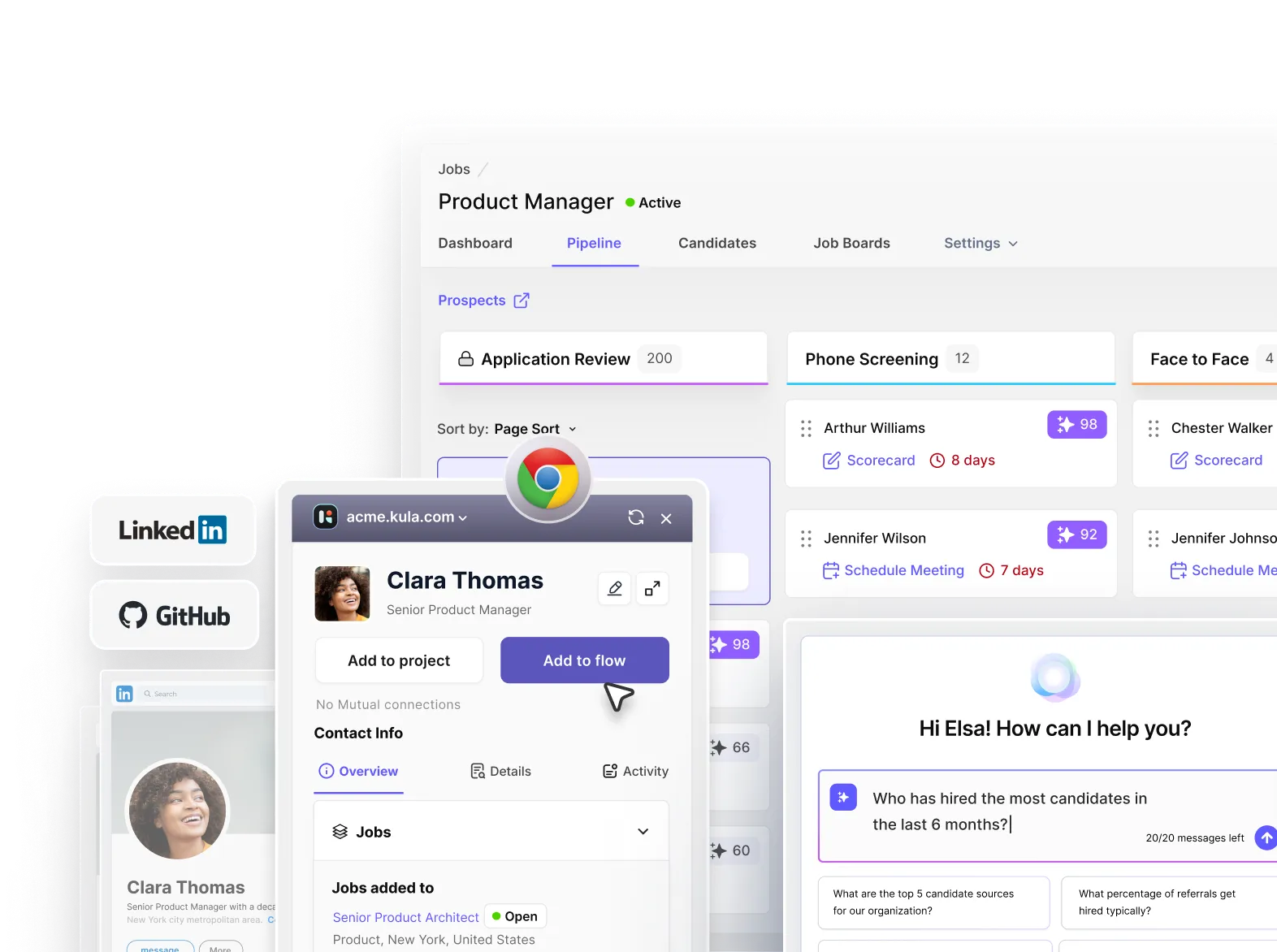




Hiring teams have improved sourcing, screening, and interview scheduling. But hiring timelines still stretch after interviews are completed.
The slowdown usually happens around hiring managers:
- Job descriptions aren’t finalized on time
- Application reviews pile up
- Interview plans take time to finalize
- Feedback comes in late, decisions stall
- Offers sit unresolved
Recruiters follow up repeatedly, candidates wait, and strong profiles drop out.
This blog explains why hiring managers become bottlenecks when hiring collaboration and interview data are fragmented across tools, and how recruiting teams fix this by using an ATS that centralizes feedback, supports shared decision-making, and reduces reliance on manual follow-ups.
The real hiring manager bottleneck and where hiring slows down today
Recruiters today are generally able to move fast at the top of the funnel. Candidates are sourced, screened, and scheduled without much friction.
The slowdown usually starts when hiring managers are involved. Whether it’s for collecting feedback, understanding top candidate requirements, or syncing interview slots.
This is exactly what recruiters highlight in Reddit discussions.
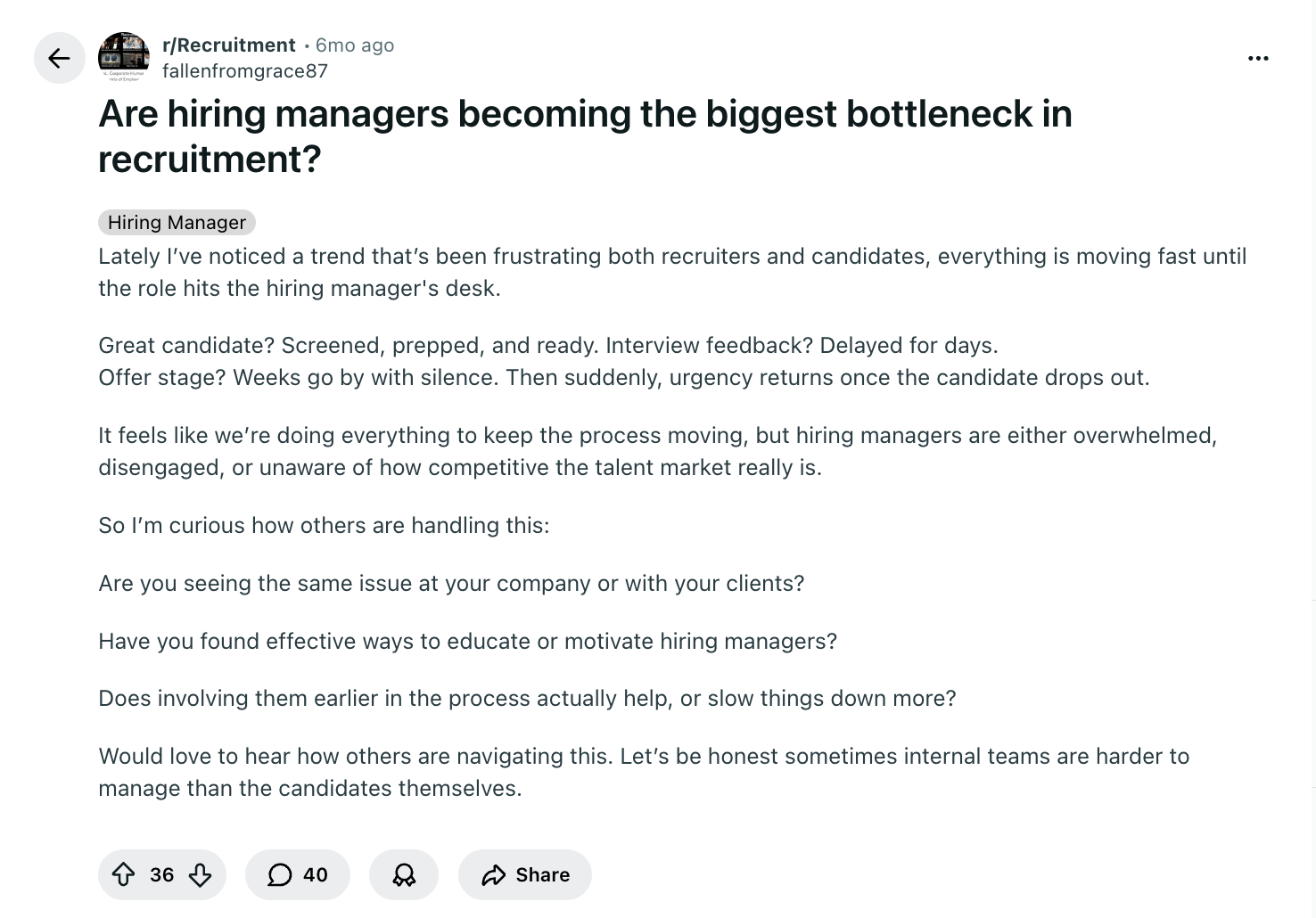
Recruiters describe the same pattern over and over: candidates are strong, interviews are completed quickly, and everyone agrees the role is urgent. Then feedback goes quiet. Decisions stretch from days into weeks. Offers don’t move and candidates drop out.
This gap is what creates decision latency.
Decision latency shows up in very specific, familiar ways:
- Interview feedback comes in late or half-done
- Different interviewers focus on completely different things
- Concerns are raised vaguely (“not sure”, “something felt off”)
- Hiring managers ask for another round without being able to explain what they’re trying to validate
None of this looks dramatic on its own. But together, it quietly kills momentum.
A big reason this happens is how interview feedback is handled.
In most hiring setups, feedback lives in Slack messages, emails, or people’s heads. Interviewers write notes from memory, often long after the conversation ended. There’s no shared structure, no consistent criteria, and no clear way to compare one interviewer’s feedback with another’s.
So instead of a clear signal, hiring managers and recruiters get noise.
They’re left trying to piece together what matters, which concerns are real, and whether the risk of making a bad hire outweighs the risk of waiting longer. When that clarity isn’t there, delaying feels like the safer option.
This is also why adding more interviews rarely helps. More interviews just produce more unstructured feedback. If the underlying problem is unclear signal, volume doesn’t fix it, it only amplifies it.
As a result, recruiters chase clarity, hiring managers hesitate, and jobseekers end up with a negative candidate experience.
Why chasing hiring managers doesn’t fix the problem
When hiring slows down, most teams default to following up more.
Recruiters send Slack reminders, email interviewers, and escalate in meetings. These actions are meant to create urgency. But in practice, they rarely move decisions forward.
The reason is simple: chasing assumes the problem is responsiveness. In reality, the problem is decision clarity.
In most hiring processes, hiring managers are asked to decide with:
- Interview feedback written in free text
- Opinions that focus on different criteria
- No clear way to compare interviewer input side by side
From the hiring manager’s perspective, this creates uncertainty. They’re not deciding between clear options; they’re trying to interpret fragmented signals.
But following up doesn’t change that.
Reminders don’t:
- Clarify which feedback actually matters
- Resolve conflicting interviewer opinions
- Show whether gaps are real or just perceived
- Make the risk of a decision feel any lower
As a result, decisions still stall, even if everyone is responding faster.
This is where collaboration quietly breaks down. Because most applicant tracking systems don't provide a centralized, decision-ready view, recruiters step in to fill the gap. They summarize feedback, interpret concerns, and chase alignment manually. Progress starts depending on recruiter persistence instead of system support.
Over time, this creates a fragile workflow:
- Hiring managers disengage from direct evaluation, and become a bottleneck
- Hiring speed varies based on who is chasing hardest
The issue isn’t a lack of reminders. It’s that hiring systems treat follow-ups as a substitute for collaboration. Until interview data, feedback, and decision context live in one place—and are structured for comparison—chasing will keep treating the symptom, not the cause.
How modern teams remove the hiring manager bottleneck
1. Turning interviews into structured decision data
One of the biggest reasons hiring slows down after interviews is the lack of clarity around what interviews are actually meant to produce.
For most recruiting teams, interviews are treated as isolated conversations. Each interviewer speaks to the candidate, forms an opinion, and later writes feedback in their own way.
There’s no shared structure, no objective evaluation framework, and no consistent way to translate those conversations into hiring decisions.
This creates several problems at once:
- Interviewers assess different things without realizing it
- Feedback varies widely in depth and usefulness
- Concerns are raised without clear evidence
- Hiring managers receive opinions, not decision-ready input
When interviews aren’t designed to capture signals in a consistent way, hiring managers are left guessing what actually matters. That uncertainty is what leads to hesitation, additional interview rounds, and slow decisions.
High-performing teams fix this by redefining what interviews are for.
Instead of treating interviews as standalone conversations, they treat them as signal capture moments. Each interview is designed to evaluate specific criteria tied to the role, and every interviewer contributes structured input to the same evaluation framework.
This changes how interview data is handled:
- Interview context is captured automatically, instead of relying on memory
- Feedback is anchored to predefined, role-specific criteria
- Every interviewer’s input follows the same structure
The result is not more data, but clearer data. Hiring managers can quickly see where interviewers align, where they disagree, and which gaps actually matter. Decisions move faster because the signal is easier to trust.
When this structure is missing, teams often try to compensate by adding more interviews.
But more interviews don’t improve decision quality if the underlying feedback is still unstructured. In fact, excessive interview rounds and slow feedback are one of the main reasons candidates disengage.
58% of candidates report withdrawing from a hiring process because it takes too long or feels overly repetitive.
Some platforms support this shift by capturing interview conversations automatically and turning them into structured summaries immediately after interviews.
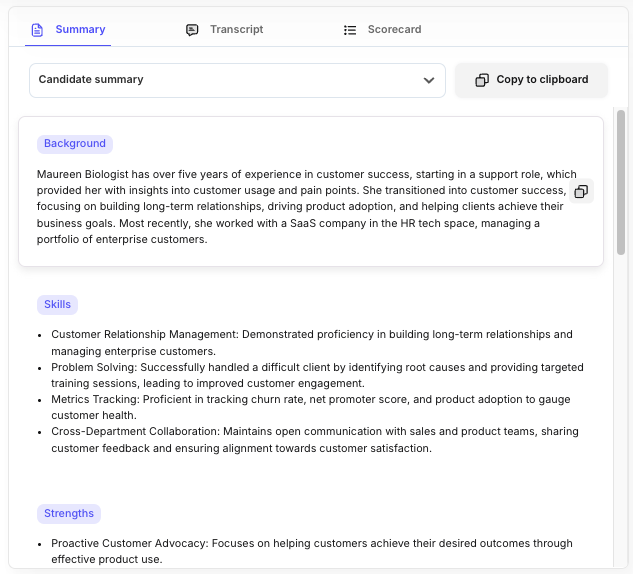
Scorecards are automatically filled based on the role’s evaluation criteria, not free-text recall.
So, instead of reviewing scattered notes, hiring managers see consistent, comparable signals across interviewers, all under one centralized ATS, making it easier to decide without adding more rounds or delays.
2. Removing decision paralysis caused by risk-averse hiring behavior
Hiring decisions often stall because hiring managers can’t clearly justify why one candidate should move forward while another shouldn’t.
When early candidate evaluation is inconsistent, every downstream decision feels riskier. Some candidates are screened loosely, others more strictly, and by the time interviews begin, there’s no shared baseline for what “qualified” actually means.
This creates hesitation later in the process:
- Interview feedback feels mixed because candidates entered at different quality thresholds
- Minor concerns get amplified because the initial signal wasn’t strong
- Hiring managers delay decisions to reduce perceived risk
The best hiring teams reduce this hesitation by tightening decision-making before interviews begin.
A built-in AI Scoring feature in modern ATS platforms helps by applying a consistent, role-specific evaluation model at the application stage.
Hiring teams define what matters for the role upfront (education qualifications, work experience, technical skills, etc), and every candidate is scored against those same criteria. This removes subjective first-pass filtering and ensures that only candidates meeting a clear quality bar move forward.
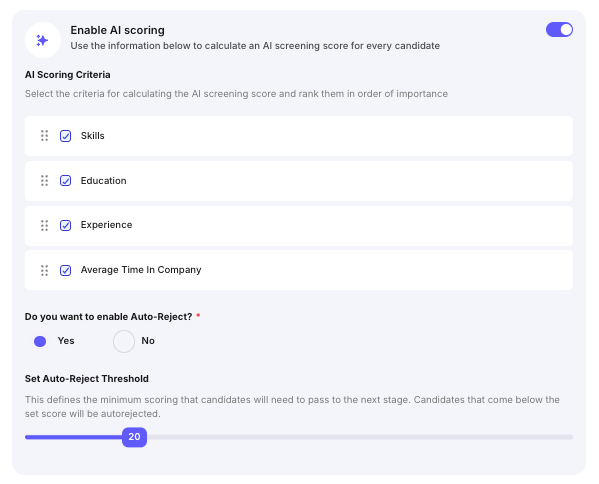
By the time interviews happen, hiring managers aren’t deciding in a vacuum. They’re evaluating candidates who already meet agreed-upon requirements, which makes later decisions easier to justify and less prone to hesitation.
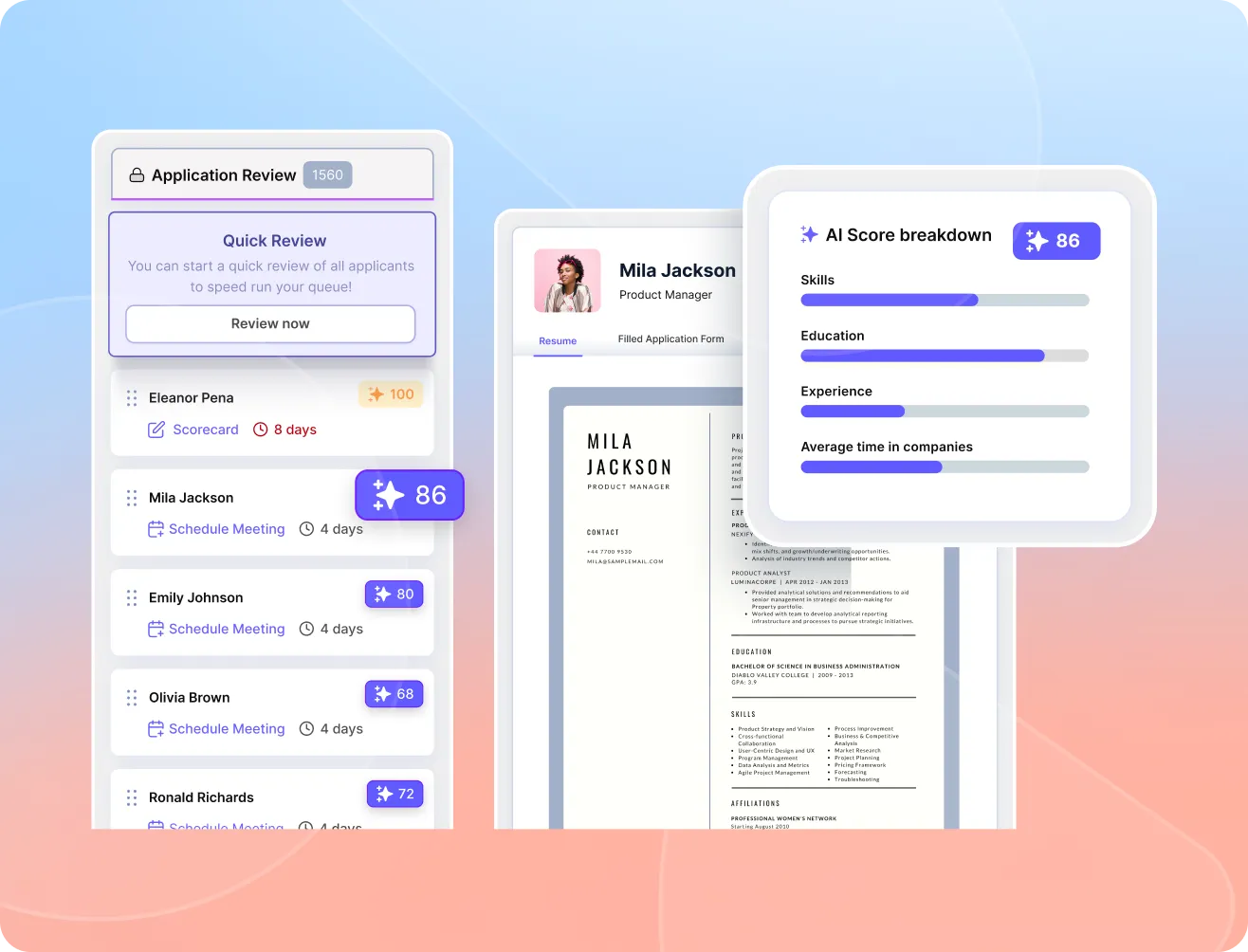
This way, interview feedback is tied directly to predefined role criteria, not gut feel. Hiring managers can see strengths, gaps, and trade-offs clearly across candidates, leading to fewer “just to be safe” interviews and delays.
3. Eliminating recruiter-dependent decision making
For most recruiting teams, recruiters end up acting as translators between interviewers and hiring managers.
This happens because interview information is fragmented. Interview notes live in different formats, feedback quality varies by interviewer, and hiring managers don’t have a single, clear view of a candidate.
As a result, recruiters step in to manually summarize feedback, clarify concerns, and piece together context before a decision can even be discussed.
Over time, this creates hidden bottlenecks:
- Decisions depend on recruiter follow-ups rather than system visibility
- Hiring managers disengage from direct evaluation and wait for summaries
- Progress relies on constant nudging instead of shared ownership
At that point, hiring speed is determined less by readiness and more by how much manual coordination the recruiter can do.
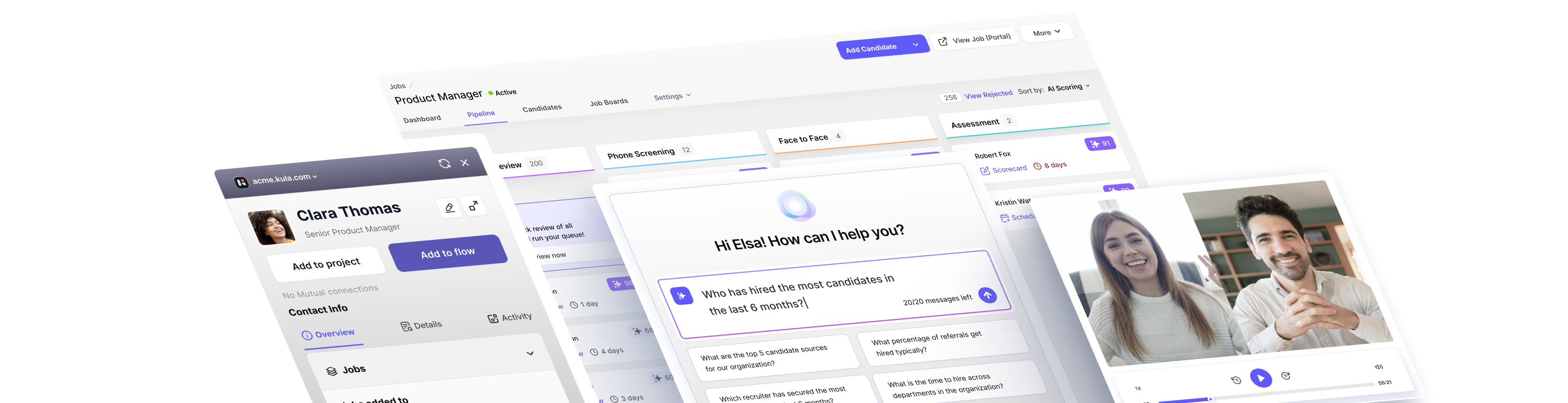
Instead of recruiters chasing updates, the right ATS gives every stakeholder a shared, action-oriented review space.
Interviewers, hiring managers, and recruiters all see the same candidate view—complete with interview notes, questions asked, transcripts, feedback, AI scores, and a consolidated candidate summarym, so no one needs a separate “translation” layer.
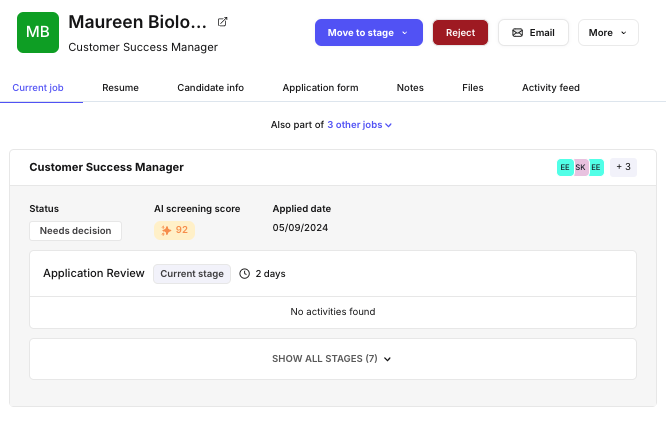
From that same view, actions are explicit and owned:
- Interviewers are nudged when feedback is missing
- Hiring managers are nudged when a decision is pending
- Nudges are triggered by actual blockers (missing feedback, unresolved reviews), not arbitrary timelines
Because next steps are built into the workflow, hiring managers and recruiters can act directly. They can move a candidate forward, schedule another interview, assign an assessment, ask for reviews from other interviewers, all without waiting for coordination.
This is what removes recruiter dependency in practice. Recruiters stop acting as intermediaries and instead oversee flow, while decisions move forward inside the system based on shared visibility and clear ownership.
Ultimately, a modern ATS should surface missing signals, highlight misalignment, and prompt action based on what’s actually blocking progress.
A well-built ATS supports this by making collaboration and next steps part of the same workflow, so hiring doesn't depend on who follows up the most.
How to tell if your recruiting system is creating the bottleneck
If hiring managers feel like the bottleneck today, it’s worth stepping back and looking at how your recruiting system actually works in practice.
Ask yourself:
- Is interview feedback structured, or mostly free-text and inconsistent?
- Can hiring managers easily compare interviewer input without recruiter summaries?
- Is it clear when there’s enough signal to make a decision?
- Do recruiters spend a meaningful amount of time chasing feedback or nudging decisions forward?
If you answered yes to most of these, the slowdown isn’t coming from individual behavior. It’s coming from a system that doesn’t support collaborative, decision-ready hiring.
When feedback is fragmented and ownership is unclear, hiring managers hesitate, recruiters become intermediaries, and decisions rely on follow-ups instead of readiness.
Over time, that’s how hiring managers end up labeled as the bottleneck—when the real issue is how information and actions are organized.
A modern ATS should make decision-making easier by default. It should surface missing signals, highlight misalignment, and clearly show who needs to act next, without relying on manual reminders or escalation.
If you want to see what that kind of system looks like in practice, some modern ATS platforms give hiring teams a centralized review experience where interview context, feedback, candidate scores, and next steps live in one workflow.
👉 See how Kula removes decision bottlenecks and helps teams hire faster, without chasing. Book a demo now.

Hiring managers become a bottleneck when decisions rely on scattered interview notes, inconsistent feedback, and unclear signals. The delay usually isn’t lack of urgency, it’s lack of confidence in the candidate information they’re reviewing.
An AI-native applicant tracking system can reduce bottlenecks when it centralizes interview data, structures feedback, highlights alignment or gaps, and makes next actions obvious to every stakeholder involved.
Hiring processes usually slow down when decision-making isn’t clearly supported. Missing feedback, unclear ownership, and fragmented interview data create delays even when candidates are strong.