



Recruiting is entering a reset phase. Hiring demand is rising, expectations from leadership are higher, and talent acquisition teams are being asked to deliver without additional capacity.
This means, recruiting is no longer just about filling roles. It now directly impacts business continuity, skills readiness, and how competitive a company can stay.
This blog outlines five clear resolutions that help a talent acquisition partner shift from reactive hiring to strategic talent acquisition.
What it means to be a strategic talent acquisition partner in 2026
The role of talent acquisition is shifting because the economics of hiring have changed.
Skills are harder to find, timelines are less forgiving, and leadership expects hiring decisions to be defensible. SHRM reports that more than 75% of organizations struggle to find qualified talent due to ongoing skills gaps.
At the same time, recruiting teams are under pressure to increase hiring velocity without additional headcount or budget. This combination is pushing strategic recruiting from a “nice-to-have” into a must-have skill for talent acquisitions leaders.
The forces reshaping strategic talent acquisition in the market include:
- Persistent skills shortages: Many open roles now require blended skill sets that don’t map cleanly to traditional job titles, making conventional hiring approaches less effective.
- Increased automation across the recruiting funnel: With 25–50% of recruiting workflows now automated in many teams, the expectation is that TA leaders focus on planning and judgment, not manual execution.
- A shift toward skills-based hiring: Companies are moving away from degree-first filters and seeing better hiring outcomes by prioritizing capabilities and transferable skills. 90% of U.S employers already say they find better hires by looking at skills > degrees.
- Rising cost of reactive hiring: Delayed or unplanned hiring directly impacts product delivery, revenue goals, and team productivity.
- Employer brand as a hiring constraint. Passive candidates make up a significant portion of high-quality hires, and their decisions depend heavily on brand clarity and consistency.
As a result, a strategic talent acquisition partner needs to operate more as a business advisor, not a transaction manager. They are:
- Embedded in workforce and business planning, with early visibility into growth plans, role evolution, and skill needs.
- Data-led and predictive, using market insights, funnel metrics, and hiring trends to guide decisions.
- Trusted by hiring managers, advising on role scope, compensation expectations, and candidate availability.
- Fluent in modern recruiting systems and AI, using automation to remove noise and focus on higher-value work.
- Focused on workforce design, balancing external hiring with internal mobility and long-term capability building.
This is what separates traditional recruiting from strategic talent acquisition in 2026.
5 resolutions to help you become a more strategic talent acquisition leader in 2026
Becoming a strategic talent acquisition leader isn’t about adding more tools or processes. It’s about changing how and when you show up in business decisions.
These five resolutions are practical shifts you can apply immediately. Not all at once, but intentionally.
Resolution #1: Shift from reactive recruiting to proactive workforce planning
Reactive recruiting puts TA permanently on the back foot. And the pressure is growing. In 2025, 73% of recruiting budgets froze or shrank, even as hiring demand increased. When resources don’t scale, strategy has to.
Proactive workforce planning starts with earlier involvement. Strategic talent acquisition leaders stay close to business leaders throughout the year, not just when a role opens. That means understanding product plans, revenue goals, and where teams are likely to feel capacity strain before it shows up as an urgent req.
Instead of planning role by role, strategic recruiting leaders work with a rolling 12-month view that involves:
- Expected growth roles tied to business initiatives
- Likely backfills based on attrition patterns
- Skills the business will need more of, not just job titles
This doesn’t need to be perfect. It needs to be directionally right and revisited often.
Skills matter more than titles in this model. Titles vary by company and hide what actually drives performance. Strategic recruiters focus on the capabilities required to do the work and design hiring around those.
That’s where skills taxonomies come in.
A skills taxonomy is simply a shared framework that breaks roles down into core capabilities and proficiency levels. Instead of saying “we need a senior engineer,” teams can say “we need someone strong in front-end architecture and performance optimization, with room to grow into system design.”
Used well, skills taxonomies help TA leaders:
- See gaps before they turn into hiring emergencies
- Identify when internal talent could be developed or redeployed
- Guide better intake conversations with hiring managers
Here’s an example of how a skills taxonomy helps TA hire for a technical role:
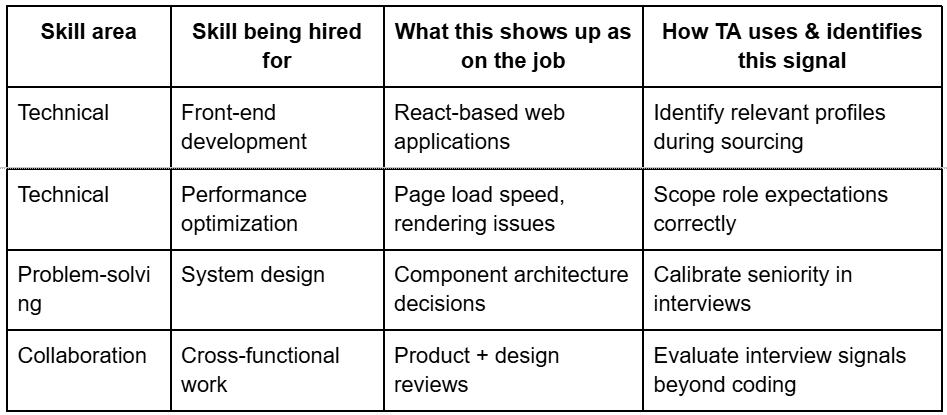
This structure is an example of how a skills taxonomy breaks down a technical role into specific skills, and shows how those skills are used by TA teams at different stages of hiring (sourcing, role scoping, seniority calibration, interviews).
The same structure applies across functions. Once skills are clearly defined, recruiters can hire more consistently for engineering, product, data, or any other role.
In short, a skills taxonomy groups and standardizes skills so TA can plan hiring and pipelines across multiple roles, not just one job. This is the shift from filling roles to designing the workforce the business actually needs.
Resolution #2: Build ongoing, always-on talent pipelines (not just role-based sourcing)
70% of the global workforce is passive, and waiting for inbound applications limits both speed and quality. Strategic talent acquisition leaders plan for this by building always-on pipelines that stay active beyond individual requisitions.
This starts with defining pipelines around skills and capabilities, not job titles. Titles vary across companies, but skills don’t. Skills-based pipelines widen the pool and make talent reusable across multiple roles over time.
Always-on pipelines rely on light, consistent engagement. This can include:
- Community-building around roles or skill areas: Create small, focused groups or Slack communities where candidates can stay connected to how the team works. This might be an invite-only email list, a virtual session, or a shared space where teams occasionally share what they’re building and what skills matter.
- Periodic career content that reflects real work and growth paths: Share short, honest examples of projects, team challenges, or how roles evolve after joining. This helps passive candidates self-qualify and makes future outreach more relevant.
- Referral pipelines that stay active beyond immediate hiring needs: Encourage employees to surface people in their network who match key skills, even when no role is open. Store and nurture these referrals so they’re ready when demand arises.
With AI-native tools like Kula, candidate profiles are continuously scored and organized by skills, so pipelines stay warm and outbound starts the moment hiring demand appears.
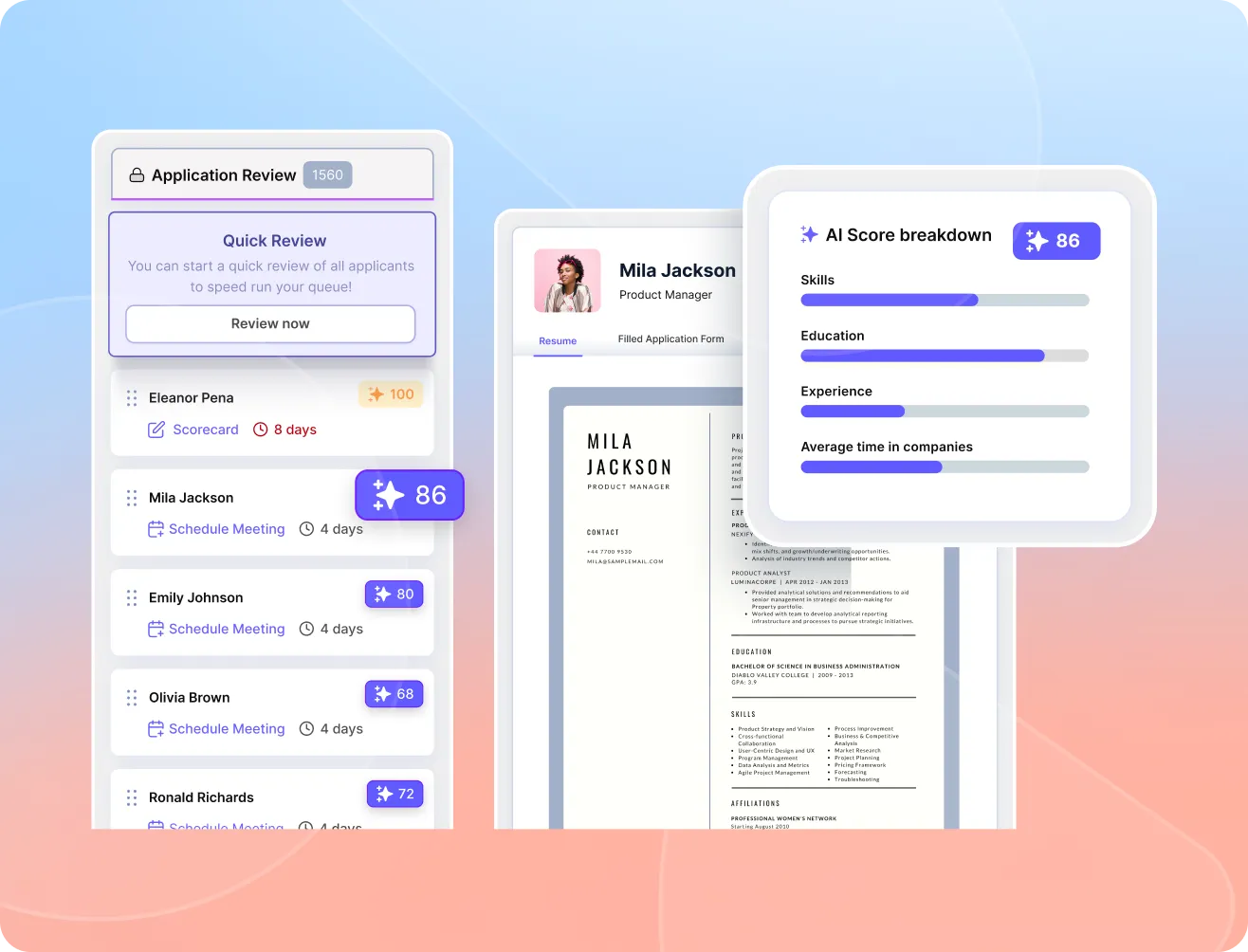
Always-on pipelines give talent acquisition more control over timing and quality.
Instead of starting from scratch with every role, teams already have warm talent to engage, reducing last-minute pressure and improving hiring outcomes.
Resolution #3: Strengthen partnerships with hiring managers through clarity, data, and consistent processes
Role-based sourcing assumes talent will show up when a req opens. That assumption doesn’t hold anymore.
A large share of qualified candidates are passive, and they move on their own timelines. Strategic talent acquisition leaders plan for that by building always-on pipelines tied to skills, not individual jobs.
Instead of starting from scratch every time:
- Pipelines are organized around recurring skill needs
- Candidates stay warm through light, consistent engagement
- Sourcing effort compounds over time instead of resetting
This makes hiring faster when roles open and reduces pressure on recruiters to scramble.
Skills-based pipelines also widen the pool. When you stop filtering purely by job titles, you surface candidates with adjacent experience who can succeed with the right context and support.
AI plays a supporting role here, not by replacing recruiters, but by removing friction. It helps identify relevant passive talent, keep outreach consistent, and surface qualified profiles faster. That gives recruiters more time to focus on judgment, conversations, and alignment with hiring managers.
Always-on pipelines turn recruiting from a series of urgent projects into a system. And systems scale better than heroics.
Resolution #4: Embrace AI and analytics to drive smarter, faster, and more predictable hiring
Strategic recruiting leaders are expected to explain why hiring is slowing down, where quality is dropping, and what needs to change before it becomes a business problem.
This is where AI and analytics stop being “nice to have” and become core infrastructure for a talent acquisition partner.
AI removes low-value manual work that quietly erodes recruiting capacity. Resume screening at scale, interview scheduling, note taking, and feedback consolidation no longer need constant human intervention.
When this work is automated, recruiters regain time for judgment-driven work: role scoping, hiring manager alignment, and evaluating trade-offs between speed and quality.
Analytics then provide something most teams lack today: real-time hiring clarity. Instead of relying on end-of-quarter reports, strategic talent acquisition teams can see:
- Where qualified candidates are dropping out of the funnel
Which stages are slowing hiring velocity for specific roles or skills - How long roles should take to fill given current market supply
This visibility allows TA leaders to intervene earlier, not justify delays after the fact.
This is where Kula’s AI Conversational Analytics improves forecasting.
Instead of digging through dashboards or waiting on reports, TA leaders can literally ask questions in plain English, like “Where are candidates dropping off?” or “Which recruiter has the strongest pipeline?” and get instant, visual answers.
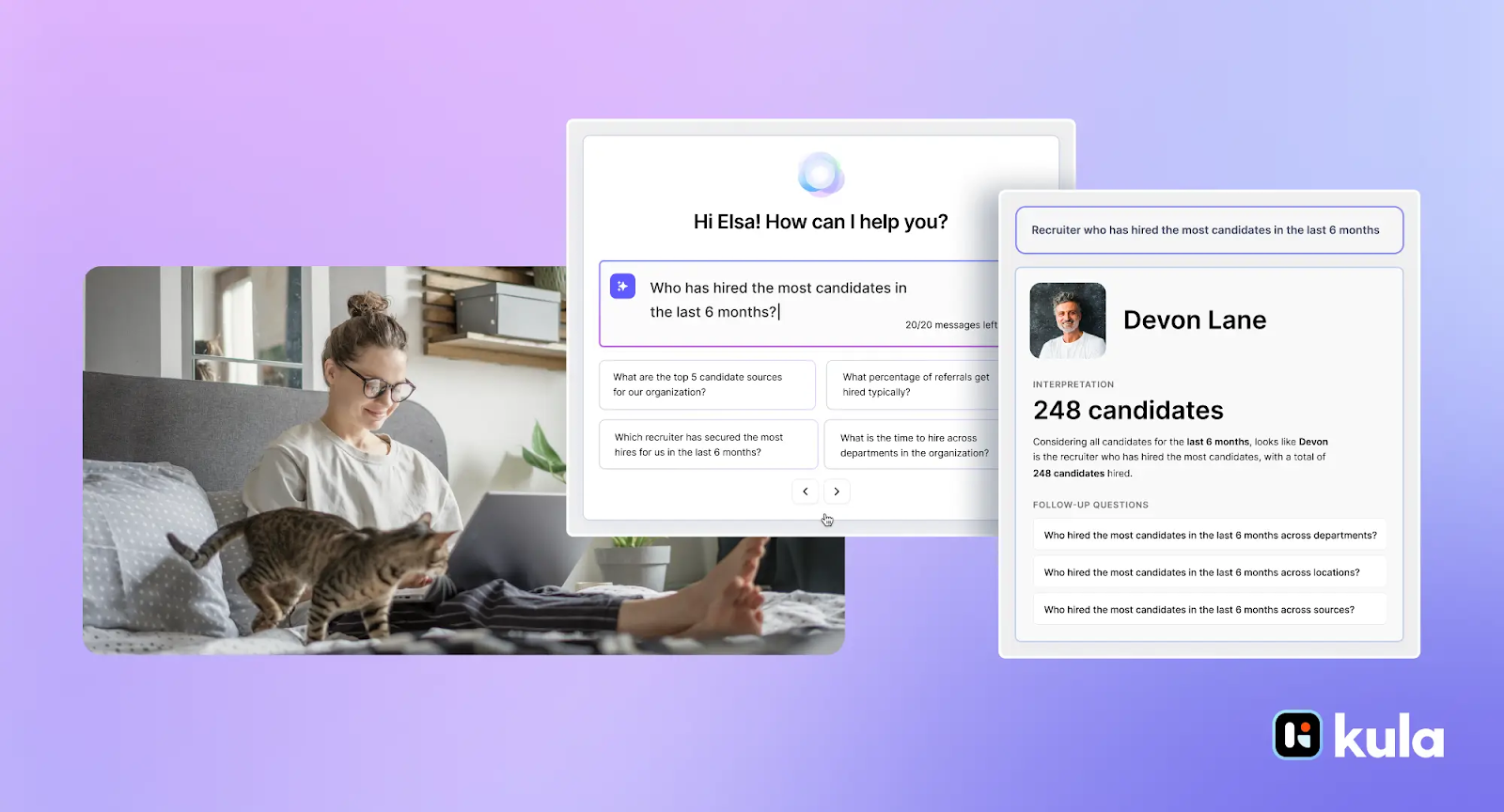
Hiring data becomes something you can interrogate in real time, not decode after the fact.
Even Deloitte reports that organizations using advanced analytics are four times more likely to make faster, better decisions, which is why analytics increasingly define whether TA is viewed as operational support or a strategic function.
Finally, AI-supported interview processes raise decision quality.
Structured interviews, standardized feedback, and summarized insights reduce inconsistency and bias, making hiring decisions easier to compare and defend. When recommendations are backed by data, the talent acquisition partner shifts from opinion-based influence to evidence-based leadership.
Resolution #5: Prioritize candidate experience and employer brand as competitive levers
Strategic recruiting leaders treat candidate experience and employer brand as part of their talent strategy, not as surface-level polish.
That starts with consistency across the entire journey.
Candidates should see the same expectations reflected in job descriptions, outreach, career pages, and interview communication. When these signals don’t align, candidates hesitate, delay decisions, or drop out. But when they do align, decisions move faster.
Personalization is where this becomes a competitive advantage.
Candidates respond better when communication reflects their background and why they’re being approached, not just the role that’s open. Strategic talent acquisition teams personalize outreach, interview touchpoints, and follow-ups so candidates understand why they’re a fit and what success in the role actually looks like.
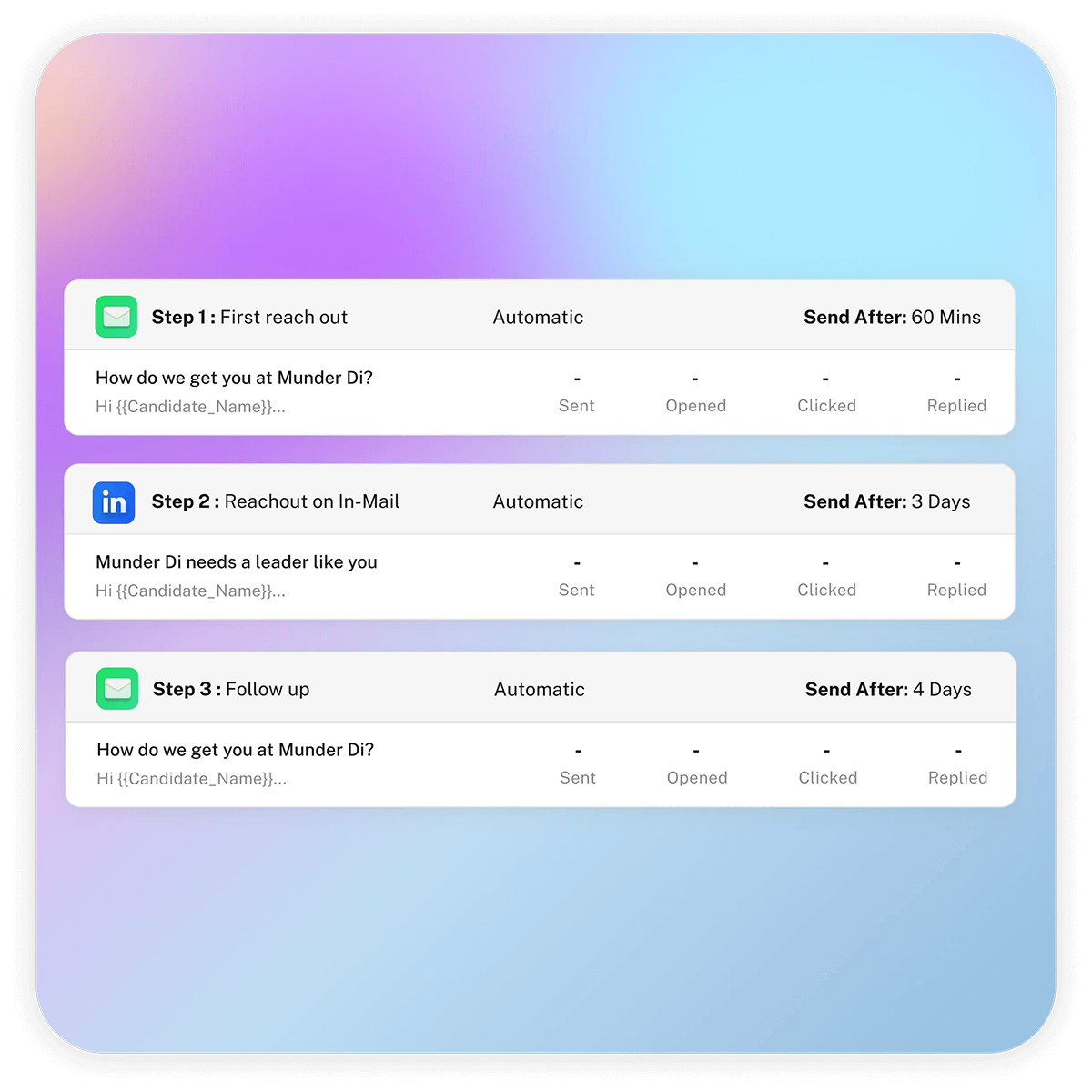
This is where Kula Flows add real leverage to keep passive candidates engaged over time without turning outreach into manual follow-up work.
You can source candidates in one click from LinkedIn, GitHub, or existing lists, and then run automated, multi-stage engagement across email, LinkedIn requests, and InMails from a single place.
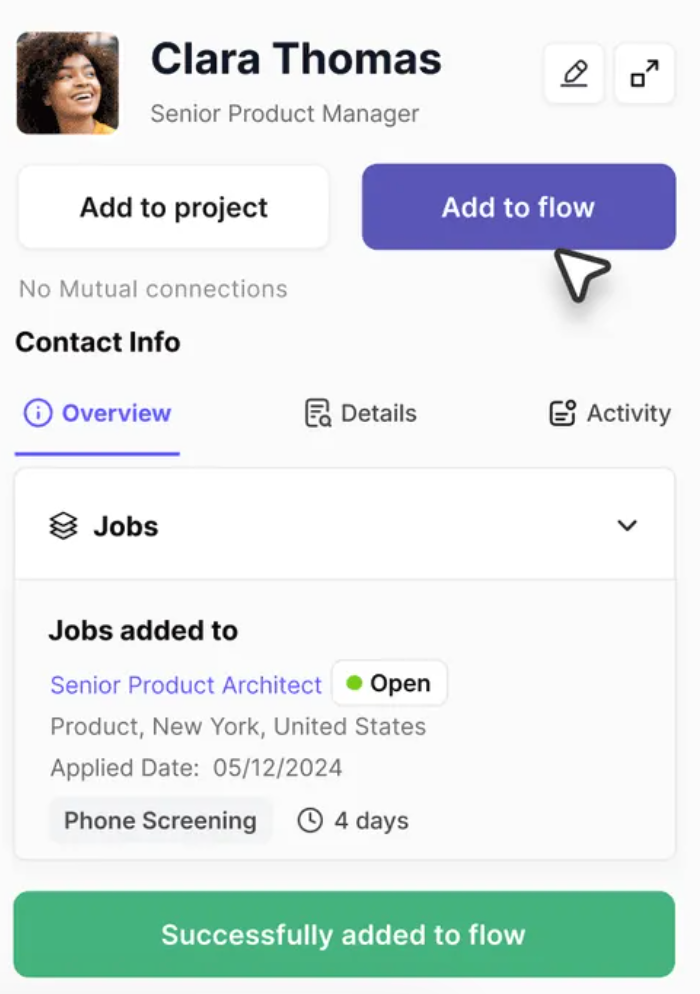
Instead of one-off messages tied to open roles, candidates stay warm through consistent, personalized touchpoints, so when hiring demand shows up, the pipeline is already active and measurable.
Strategic talent acquisition partners also need to work with leadership to ensure what’s promised during hiring reflects the real employee experience.
When brand and reality diverge, acceptance rates suffer and early attrition rises. When they align, trust compounds.
In 2026, candidate experience isn’t about sounding impressive. It’s about being clear, consistent, and credible, which is exactly what strategic recruiting leaders directly control.
Wrapping up
Recruiting in 2026 won’t be defined by how many roles you fill. It will be defined by how early you influence decisions, how clearly you plan for skills, and how predictable your hiring outcomes are.
The shift from recruiter to strategic talent acquisition partner isn’t about doing more work. It’s about doing the work that actually changes business outcomes: workforce planning, pipeline strategy, data-backed decision-making, and intentional candidate engagement.
The teams that adopt these five resolutions won’t just keep up with hiring demand. They’ll shape it.

A strategic talent acquisition partner goes beyond filling open roles. They work closely with business leaders on workforce planning, skills strategy, and hiring decisions that directly impact growth, delivery, and long-term capability.
Traditional recruiting focuses on execution after a role opens. Strategic talent acquisition focuses on planning ahead, anticipating skill needs, building pipelines early, and influencing role design before hiring becomes urgent.
Hiring demand is rising while recruiting budgets and capacity remain tight. This puts pressure on TA teams to deliver predictable outcomes, not just activity. Strategic recruiting helps teams plan for skills, reduce last-minute hiring, and support business continuity.
Key skills include workforce planning, data and analytics literacy, stakeholder management, skills-based hiring, and the ability to translate hiring data into business impact for leadership.
AI supports strategic talent acquisition by automating manual recruiting work, identifying skills-aligned talent, keeping pipelines organized, and providing insights that help TA leaders forecast hiring needs and improve predictability.