


By 2026, AI in hiring is no longer optional, but using it blindly is where most teams go wrong.
Recruiting leaders are under pressure to move faster, hire better, and stay compliant, all while managing higher application volumes with leaner teams.
This guide explains where AI delivers real value across the hiring funnel, what still shouldn’t be automated, and how to apply AI in a way that supports better decisions, not shortcuts.
What AI actually works for in 2026
1. AI for smarter shortlisting (not hiring decisions)
A lot of recruiters' time is wasted on shortlisting job applications. Recruiters usually spend 3-5 minutes per application, which adds up to 5 to 8 hours for 100 applications. This ends up taking unnecessary efforts and time from recruiters.
Despite taking a manual approach to application screening, recruiters can only focus on basic qualifications due to an increasing workload.
AI, when incorporated in application screening, not only scans applications in seconds against preferred criteria but also reduces inconsistencies caused by fatigue, mood, or unconscious bias in early-stage screening.
Further read: How to Build a Fair, Transparent AI Candidate Shortlisting Process
2. AI for Interview Intelligence (not evaluation replacement)
Interviews are where most hiring decisions are actually made—but they’re also where the most information gets lost.
Recruiters and hiring managers juggle note-taking, follow-up questions, time tracking, and candidate evaluation all at once. By the end of the day, important nuances blur together:
- Who demonstrated real problem-solving?
- Who just sounded confident?
- What signals were strong, and what was just good storytelling?
AI makes the interview process more structured and easier for the recruiting teams, as modern ATS allows recruiters to access automated interview transcripts, AI-generated interview summaries, auto-filling scorecards and self-scheduling links.
With this, recruiters can simply forget about scheduling or remembering details for every applicant and focus on making the right final decision.
Recommended read: The Hidden Cost of Manual Interview Scheduling (And How to Eliminate It)
3. AI for Hiring Visibility and Predictability
One of the biggest problems in hiring today is a lack of visibility. Recruiting teams are constantly asked questions like
- Where are we stuck?
- Why is this role taking so long?
- Are we going to hit our hiring goals this quarter?
With the AI, recruiters can continuously analyze hiring activity across the entire funnel and flag early warning signs. This turns hiring from a reactive process into a proactive one.
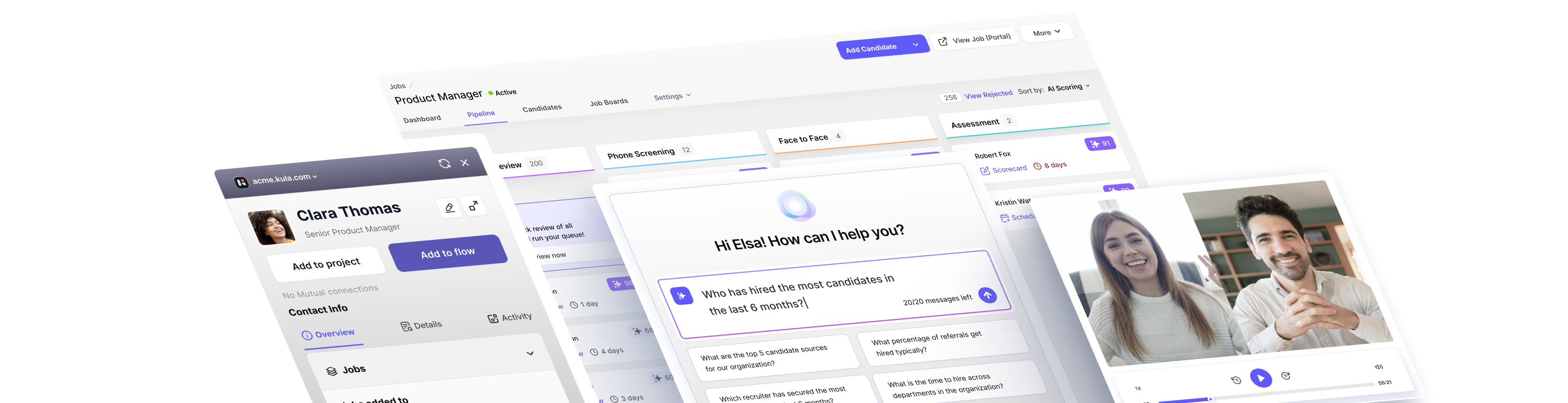
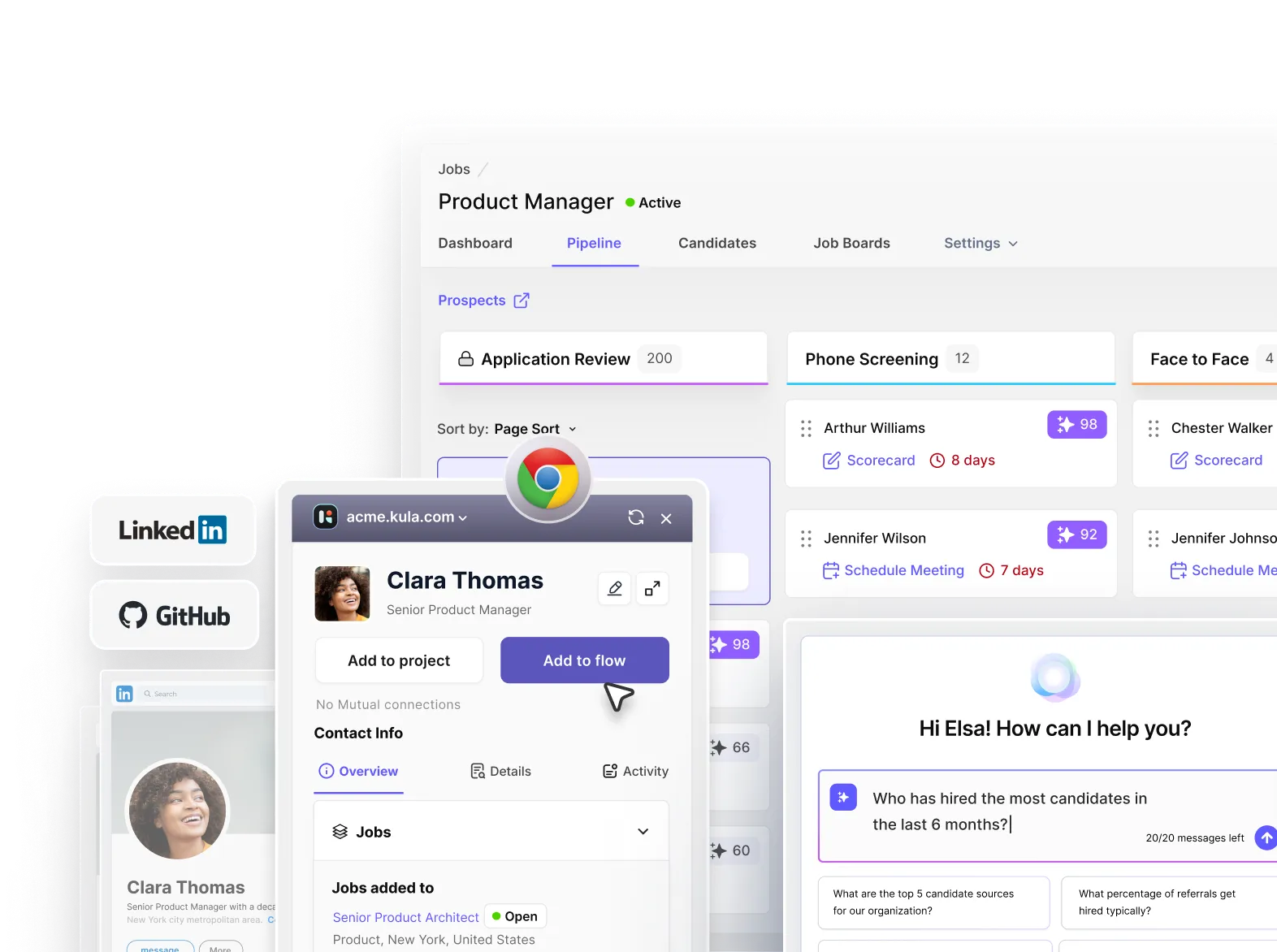
Some modern ATS platforms also offer Conversational AI, allowing recruiters to ask questions in natural language, such as “Why is the backend role stuck?” or “Which roles are at risk this quarter?”, and receive clear, actionable insights in seconds.
4. AI for smarter sourcing (not mass outreach)
Sourcing is where recruiters lose the most time before hiring even begins.
Manually searching profiles, running Boolean strings, switching between platforms, and following up with passive candidates can take hours per role.
With traditional sourcing, recruiters are limited by keywords, job titles, and visible resumes. AI changes this by expanding reach and improving relevance.
Instead of keyword matching, AI sourcing uses semantic understanding to identify candidates based on skills, experience patterns, and context even when titles or terminology don’t match exactly. It scans across job boards, professional networks, internal databases, and passive talent pools in seconds.

What Still Doesn’t Work (And Creates Risk)
1. Fully autonomous hiring decisions
AI still can’t make hiring decisions on its own because hiring isn’t just a data problem.
Every role has a business context: team dynamics, leadership style, growth stage, and trade-offs that change over time. An AI model can’t understand these nuances the way humans can.
More importantly, handing final decisions to AI introduces serious legal, ethical, and trust risks. If a candidate questions why they were rejected, leaders must be able to explain and defend the decision.
2. Generic “Black-Box” AI tools
Many AI tools claim to be intelligent but are still doing basic keyword matching under the hood. They surface results without explaining why a candidate was ranked higher or lower.
This lack of transparency makes it hard for recruiters to trust the output. When recruiters don’t understand why a candidate was shortlisted or rejected, AI becomes something they work around instead of relying on.
3. AI without workflow integration
AI fails when it lives outside the hiring workflow. Tools that require recruiters to switch systems, copy data, or manage separate dashboards add friction instead of removing it.
Instead of reducing workload, this creates more manual steps and cognitive load.
Recruiters end up spending time maintaining the tool rather than benefiting from it.
AI only works when it quietly fits into existing workflows and removes work, anything else just shifts the burden.
How to incorporate AI into hiring for 2026
1. Start with high-friction, high-volume work
Identify where recruiters spend the most time on repetitive tasks such as application screening, interview scheduling, note-taking, and reporting. These are the areas where AI delivers immediate ROI by removing manual effort without making judgment.
2. Anchor AI to clear hiring intent
Before turning on any AI feature, define what success looks like for each role. Use ideal candidate profiles (ICPs), role-specific attributes, and outcome-based criteria so AI evaluates candidates against what actually matters.
3. Integrate AI into existing workflows
AI should live inside the ATS and interview process, not alongside it. When AI insights appear naturally within recruiter workflows, adoption is effortless and value compounds. If it requires context switching, it will be ignored.
4. Use AI to inform decisions, not make them
AI is strongest at surfacing patterns, comparisons, and risks, but final hiring decisions require business context, trade-offs, and human accountability. Recruiters and hiring managers must remain responsible for final decisions, using AI as a decision-support layer rather than an authority.
5. Train recruiters to work with AI, not around it
AI fluency is a core recruiting skill for which your recruiting teams need training. Teams need to know how scores are generated, what inputs influence results, and when human judgment should override AI recommendations.
Further read: How To Scale Your AI Recruiting Strategy In 2026 Without Hurting Quality
Use an AI-native ATS to power your hiring
Kula is an advanced AI ATS tool that offers a complete AI toolkit to support your entire recruiting funnel. From screening, sourcing, scheduling, and follow-ups, it helps recruiters handle all the possible repetitive work.
The main advantage of the platform is that the AI is not just an existing capability but a core layer of the tool. AI makes recruiting faster (with Conversational AI), easier (AI writer), and more efficient (contextual scoring).
Its intuitive design also allows teams to get up and running quickly, with minimal training or onboarding effort.
Want a quick walkthrough of how Kula works for your team? Set up a demo made just for you.

When recruiters can see why candidates get certain scores, test the system against profiles they already know, and change decisions when they need to, adoption happens on its own. Most teams feel more confident when AI consistently saves time without lowering quality.
AI adds value to both, but in different ways. It cuts down on the amount of screening and coordination that needs to be done for high-volume roles. It makes shortlisting and interviews more consistent and clear for specialized roles. The key is to use AI to make work easier, not to replace human expertise.
The most reliable indicators are post-hire outcomes, not AI activity metrics. Teams should track changes in time-to-fill predictability, quality of hire, early attrition, and recruiter capacity per role. If AI is working, recruiters should handle more roles with less coordination effort