




As more companies adopt AI and unified tools, the recruiter’s role is shifting from filling seats to driving strategy. The teams that succeed will be those that treat hiring not as a checkbox, but as a business lever for growth.
In this guide, we explore what being a recruiter in 2026 really means and how you can get ahead of the curve.
The new recruiter mandate: Do more than fill roles—shape business outcomes
As AI automates a growing share of operational tasks, recruiters finally gain the time and mental bandwidth to focus on the work that actually influences business performance. And the expectations are rising accordingly.
Recent data shows that about 67% of companies are already using AI to support hiring, which means operational work like screening, scheduling, and note-taking is no longer where recruiters add the most value.
Another report by SHRM found that organizations using AI for talent workflows report up to a 40% reduction in time spent on routine tasks, allowing teams to reallocate effort toward strategic work.
That shift creates a new mandate. Recruiters are now expected to:
- Identify talent gaps before they affect team performance
- Guide hiring managers with data instead of relying on intuition
- Focus on quality and long-term fit, not just speed
- Maintain a meaningful candidate experience amid increasing automation
In other words, the recruiter of 2026 isn’t the person who takes orders and moves candidates from stage to stage. They’re the person who influences who gets hired, why they get hired, and how those decisions support the company’s goals.
Efficiency: The 2026 standard is “Automate everything you shouldn’t be doing”
1. High-velocity top-of-funnel
By 2026, recruiters will manage more applicants with less time per role. Hiring funnels are getting heavier, not lighter. A report by Select Software found that 27% of talent acquisition leaders say their teams face unmanageable workloads, up from 20% last year.
But the issue isn’t effort. It’s time. No recruiter can manually review hundreds of resumes and still move fast enough to compete for top talent.
Teams that adopt AI-driven screening and matching are already seeing meaningful gains. When these tools are aligned with clear hiring objectives, companies report:
- 30–40% lower cost-per-hire
- Less time spent eliminating unqualified applicants
- More bandwidth for recruiter-led work like talent advisory and channel optimization
The 2026 definition of “efficiency” is simple: Shift repetitive top-of-funnel tasks to automation so recruiters can focus on the high-impact work humans are actually needed for.
2. Zero-manual scheduling and orchestration
Manual interview scheduling is still one of the biggest time drains in recruiting. Coordinating interviewers, confirming availability, handling reschedules, and updating calendars creates hours of back-and-forth work that doesn’t improve hiring quality.
By 2026, this becomes the first workflow teams automate because it’s predictable and high-volume — the exact type of work AI is designed to handle.
Automated interview scheduling takes over tasks like:
- Sending available time slots
- Handling reschedules instantly
- Syncing calendars across teams
- Sending reminders to interviewers
- Reducing drop-offs caused by slow responses
When this workflow is automated, recruiters get back a meaningful amount of time each week — time they can use to prepare interviewers, coach hiring managers, review pipelines, and maintain candidate engagement.
By 2026, manual scheduling won’t be considered an acceptable use of recruiter bandwidth. Teams that automate it operate faster. Teams that don’t fall behind almost immediately.
3. Proactive outbound that isn’t “spray and pray”
Outbound will play a larger role in 2026 because inbound hiring volume alone won’t bring the talent teams need. In fact, 62% of teams using an ATS report finding more high-quality candidates compared with those using traditional inbound-only hiring.
The challenge is that traditional outbound has relied too much on volume. Sending the same message to hundreds of candidates isn’t effective anymore. What teams need instead is outbound that’s:
- Multi-channel
- Personalized
- Based on data signals, not guesswork
This gives recruiters a clearer idea of which channels perform best, which candidates are worth engaging, and where to focus their time.
By 2026, the most efficient teams will treat outbound as a targeted motion — not a numbers game — and use AI to surface the right candidates and the right timing for outreach. The goal shifts from sending more messages to sending effective ones.
Intelligence: The recruiter’s new competitive edge
1. Interview intelligence becomes the new “superpower”
By 2026, interview quality becomes a core differentiator.
As more companies shift toward skills-based hiring, teams need a consistent and reliable way to understand a candidate’s capabilities, not just what’s listed on their resume. AI-powered interview intelligence fills that gap.
AI-powered hiring tools handle the operational side of interviews: capturing notes, summarizing key moments, and highlighting signals that influence hiring decisions. This lets interviewers stay fully present instead of splitting their attention between the conversation and their keyboard.
And Kula users are already seeing this shift. Geetanjali Kumar from Plum shared:
“Our managers love that they can focus on the conversation without worrying about taking notes. It cuts down the cognitive effort. Instead of spending time summarizing conversations, people can focus on genuinely getting to know candidates.”
Rolling out interview intelligence also unlocks practical benefits that reshape hiring workflows:
- More accurate candidate feedback because notes are captured in real time
- Faster decisions — many teams skip debrief meetings because everyone has the same transcript and summary
- Better training opportunities through shadowable call recordings
- Insight into how consistently hiring managers pitch roles
Teams that adopt these capabilities before 2026 gain a clear advantage: interviews become more consistent, bias is reduced, decisions move faster, and candidates get a smoother experience.
2. Reporting that tells you why, not just what
Most teams still operate with reporting that only shows surface-level activity: how many applications came in, how long roles stayed open, or how many candidates moved from one stage to the next.
These recruiting metrics are useful, but they don’t explain why the funnel breaks or where quality drops. By 2026, recruiters will need reporting that diagnoses problems, not just visualizes them.
Teams will expect their systems to answer questions like:
- Which part of the funnel slows down hiring the most?
- Which channels bring applicants vs. which channels bring high-performing hires?
- Where do qualified candidates drop off, and what patterns predict it?
- How does interview quality correlate with offer acceptance or performance?
This shift requires unified data. When sourcing tools, interview notes, candidate activity, and offer workflows live in separate systems, diagnosing issues becomes guesswork.
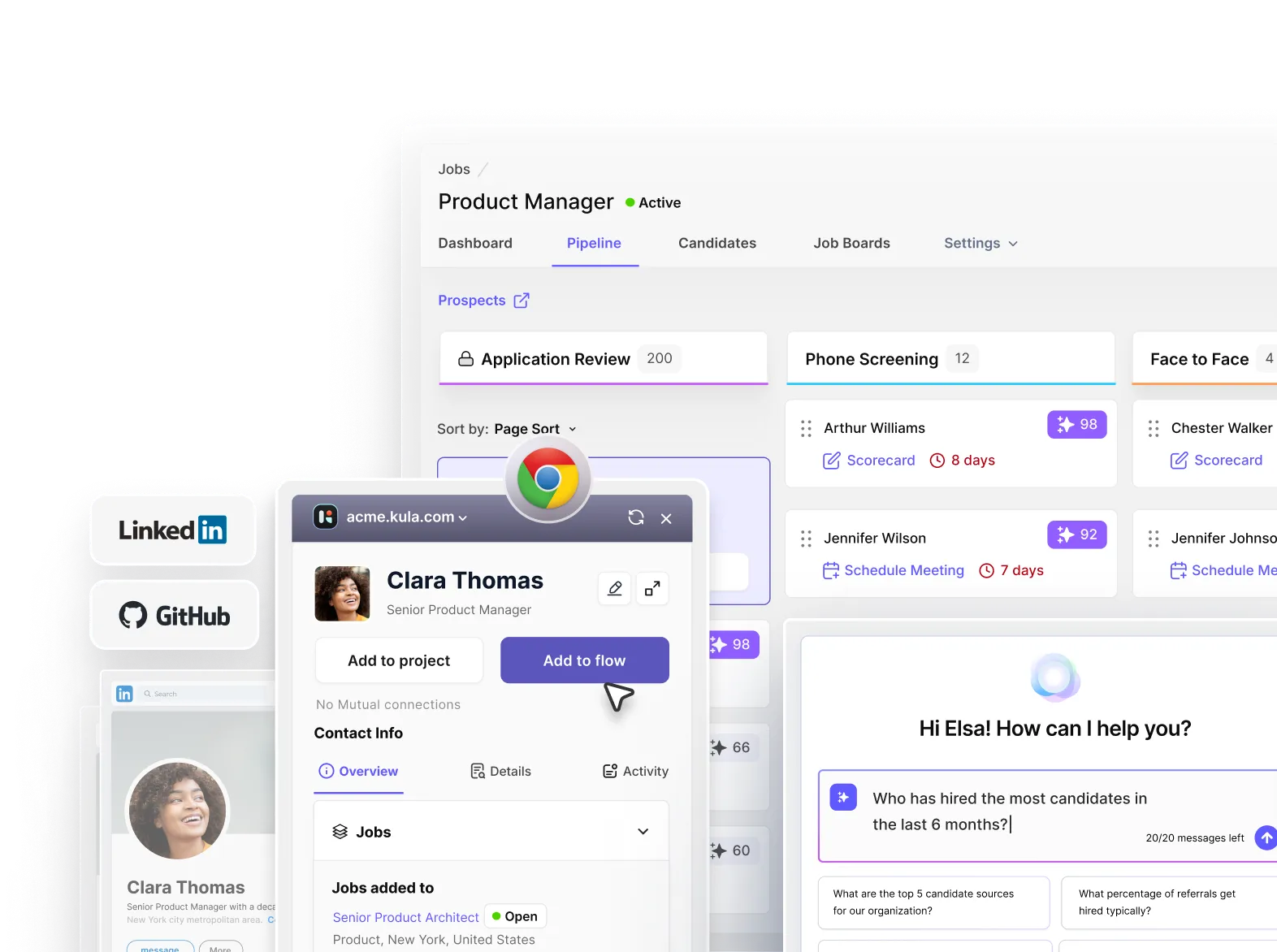
Kula solves this by centralizing all hiring data in one place. Recruiters can ask questions in plain language—for example, — for example: “What caused the drop in offer acceptance last quarter?” — and get a direct answer backed by real-time data.
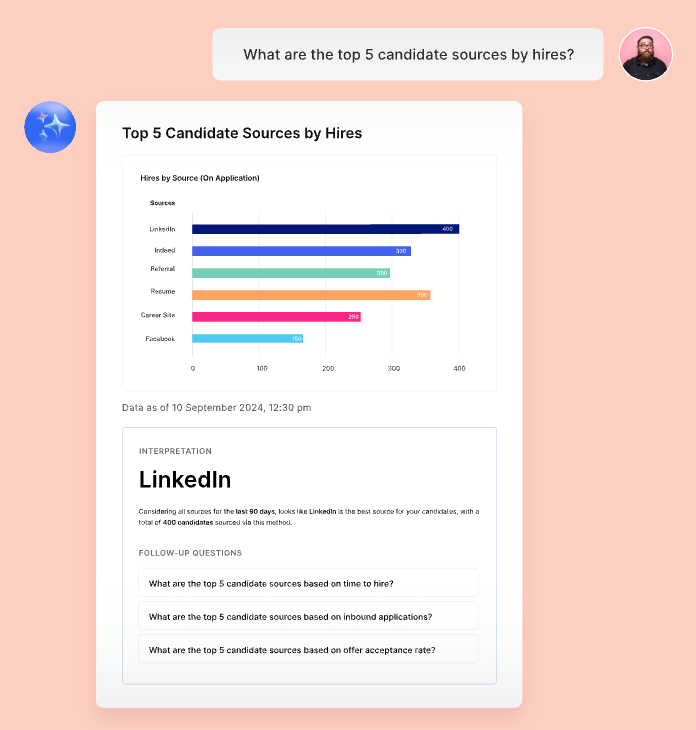
Because the analytics layer pulls from a single system of record, recruiters no longer have to export spreadsheets or manually stitch insights together.
The advantage is straightforward: when you know why your funnel behaves the way it does, you can fix issues before they impact hiring outcomes.
3. Quality of hire becomes the KPI recruiters own
By 2026, recruiting performance will center on outcomes, not activity. Teams won’t only ask, “How fast did we hire?” but “How well did this hire perform once they joined?”
That’s why quality of hire becomes the core KPI. And with 61% of TA professionals saying AI improves how quality of hire is measured, the shift is already underway.
Quality of hire becomes a combination of early performance and long-term impact, using indicators such as:
- 90-day performance and whether new hires meet expectations.
- Time-to-productivity, or how quickly they ramp up.
- Skill match accuracy, based on whether assessed skills translate into real work.
- Retention signals, especially in the first 3–6 months.
- Manager and team feedback around collaboration, clarity, and role fit.
AI plays a key role in strengthening and measuring quality of hire. AI scoring and skills-based hiring models like Kula help teams:
- Evaluate whether the skills identified during hiring align with post-hire performance
- Spot mismatches earlier by comparing interview data with job outcomes
- Understand which channels, profiles, and interviewers consistently lead to strong hires
- Build a feedback loop that improves prediction accuracy over time
This helps frame a clearer picture of what “good hiring” looks like andlike, and a more objective way for recruiters to influence and track the impact of their decisions. And Kula’s AI Scoring is the best way to aim for objectivity.
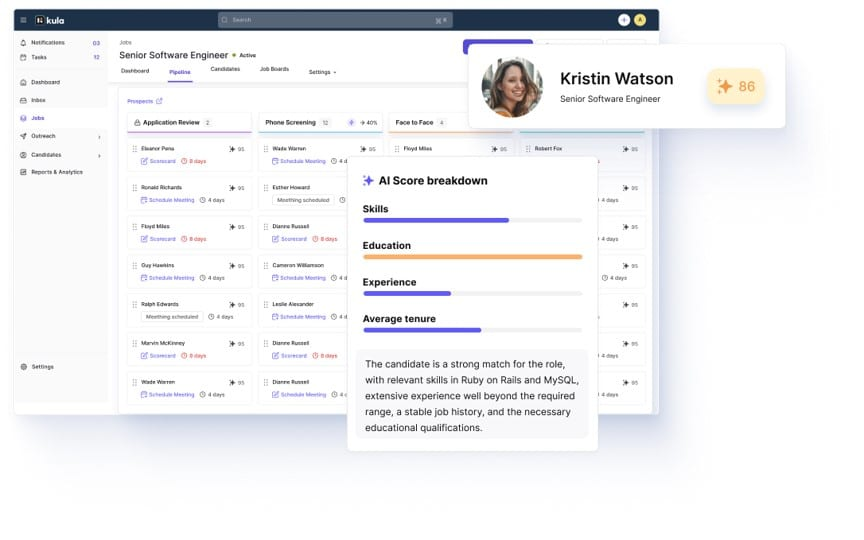
It ranks candidates using criteria you define (skills, experience, and education) so you can skip unqualified profiles, surface top matches instantly, and see a transparent breakdown of why each candidate scored the way they did.
Impact: Unified workflows create recruiter leverage
1. Recruiting becomes a team sport
In 2026, the most effective teams will work from one shared system where recruiters, hiring managers, and interviewers operate with the same information in real time.
Unified workflows change how teams collaborate:
- Hiring managers get clearer visibility into pipelines and next steps
- Interviewers see structured briefs and consistent evaluation criteria
- Recruiters spend less time chasing updates
- Candidates get faster, more coordinated communication
This shift gives recruiters more influence because they’re no longer acting as intermediaries between disconnected tools and stakeholders. They can coach hiring managers, structure interviews properly, and align teams around the decisions that matter, without being slowed down by fragmented processes.
2. Candidate experience becomes measurable
Candidate experience has always mattered, but it becomes a real performance lever in 2026. Slow updates, unclear timelines, and disjointed communication cost teams strong talent, and the data shows the gap clearly.
Only 17% of employers measure candidate experience at every opportunity, while 78% of candidates say they were never asked for feedback during the hiring process.
Unified workflows fix this by making every touchpoint trackable:
- First-response time
- Stage-by-stage drop-off rate
- Sentiment from candidate surveys
- Time-to-contact after interviews
- Offer acceptance patterns
Instead of guessing where experience breaks, recruiters see it directly. And because communication, scheduling, interviews, and feedback live in one system, teams can intervene before a candidate slips out of the funnel.
What leading TA teams will do differently in 2026
1. Adopt AI-native systems rather than “adding AI” on top of legacy workflows
AI-native systems are built with AI at the center of every workflow — scoring, scheduling, reporting, collaboration — all powered by the same intelligence layer and unified dataset.
This is what makes them faster, more accurate, and more consistent than legacy ATS platforms with AI bolted on later.
Kula is designed this way from the ground up.
Its scoring, scheduling, interview intelligence, and analytics all run on a shared AI foundation, which means the system learns from the entire funnel and automates work end-to-end, not in disconnected pieces.
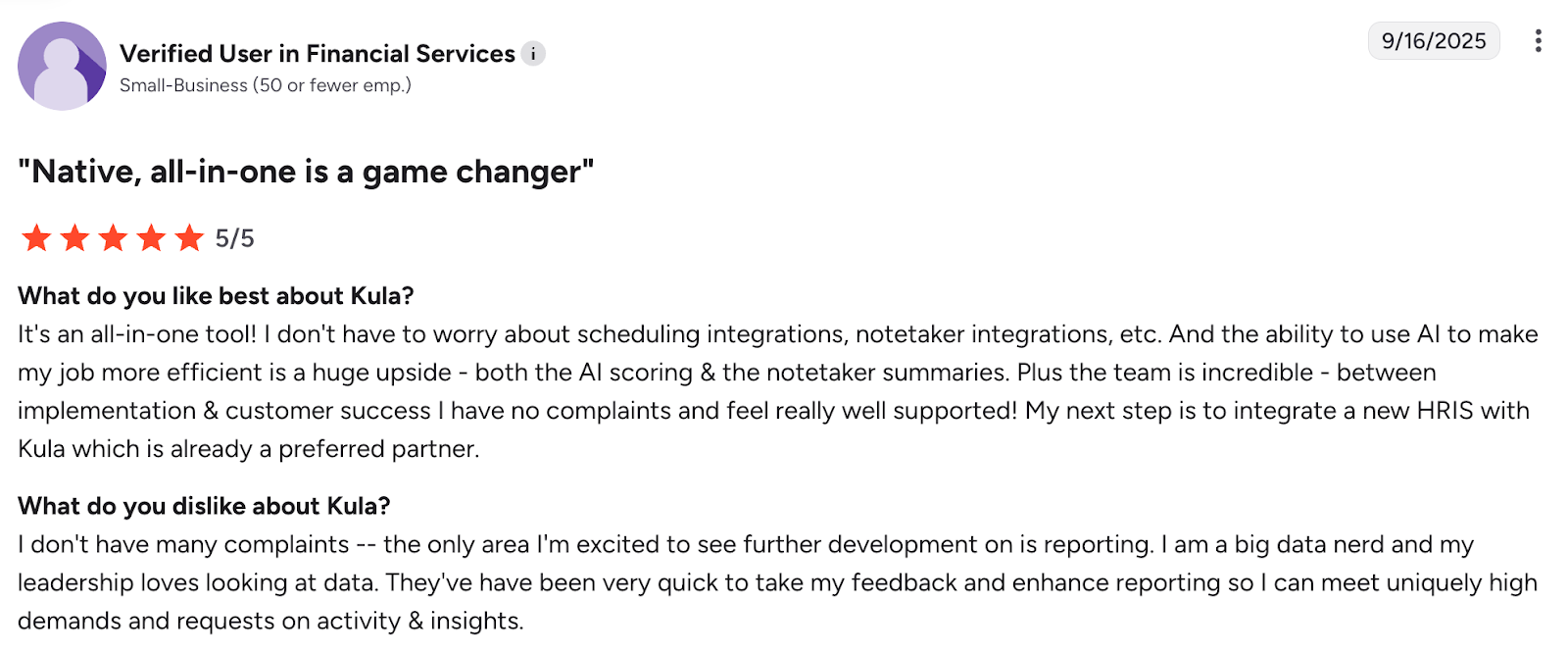
Recruiters get consistent insights, faster workflows, and fewer tools to stitch together.
2. Use data and analytics to guide decisions
Leading TA teams will use analytics to understand where quality drops, what slows the funnel, which traits predict strong performance, and how to plan hiring needs ahead of time, not just report historic metrics.
3. Build recruiting processes around outcomes, not tasks
Workflows will be architected for hiring speed, quality of hire, candidate experience, and cost efficiency. Anything that doesn’t support these outcomes gets automated or redesigned.
4. Shift from “headcount thinking” to workforce design
Leading TA teams won’t treat hiring as a request-and-fill process anymore. Instead of reacting to open roles, they’ll partner with business leaders to design the workforce the company actually needs.
This shift includes:
- Mapping the skills the business will need 12–24 months ahead, not just the titles.
- Identifying gaps created by new products, markets, or team restructures before they impact delivery.
- Evaluating whether a role should be filled externally, or if internal mobility or upskilling would produce better long-term performance.
- Understanding the cost, ramp-up time, and impact of each option — external hire vs. internal move vs. contractor.
- Proactively shaping team structures, instead of waiting for leaders to request headcount.
This is where recruiters shift from operational partners to strategic ones.
Instead of asking, “How many roles do we need to fill?” The conversation becomes, “What mix of skills will help this team hit next year’s goals, and what’s the smartest way to build it?”
The AI-native recruiting OS: What Kula enables today
Recruiters don’t need to wait until 2026 to work this way. Kula already supports the workflows and decision-making that define the future of talent acquisition. Here’s how:
1. From admin to strategic bandwidth
Kula automates the high-volume work that slows teams down — screening, scoring, scheduling, follow-ups, and interview documentation.
With fewer operational tasks, recruiters get more time for the work that actually moves hiring forward: advising hiring managers, fixing funnel issues, and focusing on candidate quality.
2. Smarter decisions, not just faster ones
Because Kula is AI-native, every part of the funnel feeds into one intelligence layer. Conversational analytics, AI scoring, interview insights, and unified reporting give recruiters clear answers to questions like:
- Which channels bring the best-performing hires?
- Where does quality drop in the funnel and why?
- What skills predict success for this role?
- How accurate are our interview decisions?
This shifts recruiters from reacting to data to actively guiding hiring strategy.
3. Impact you can show
Kula gives teams measurable improvements across the metrics that matter in 2026 — time-to-offer, candidate experience, quality of hire, and funnel predictability.
With unified workflows, every signal is trackable: drop-offs, interviewer performance, candidate sentiment, sourcing effectiveness, and more.
Users already see the difference:
“The biggest upside is how much time it saves—especially for roles that require ongoing, high-volume sourcing. Its integrations with LinkedIn, email, and ATS platforms work reliably and make the entire hiring pipeline feel more connected and efficient.” — G2 review
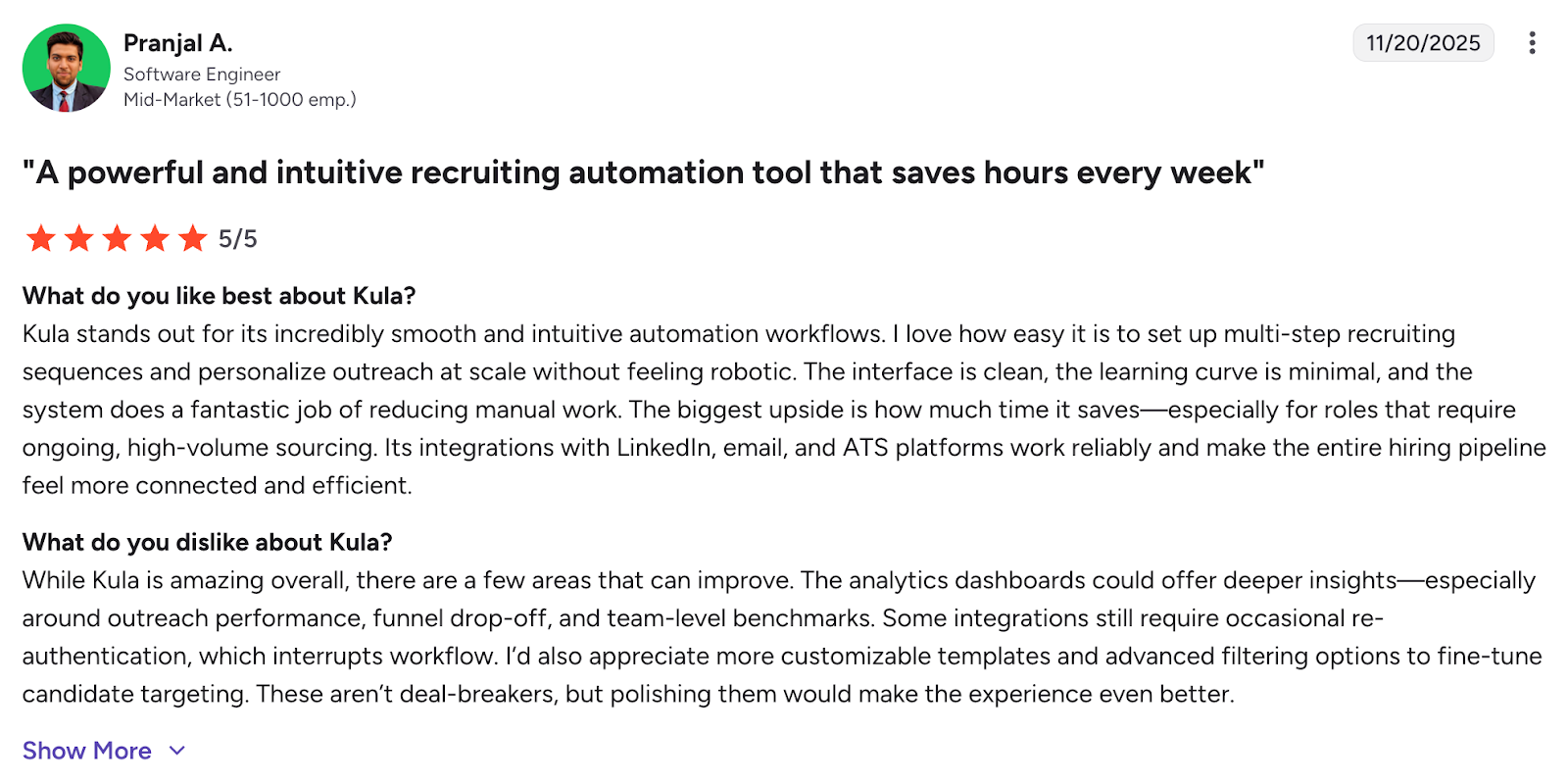
Recruiters don’t just work faster with Kula — they operate with clarity and can show the business where hiring is strong, where it breaks, and what needs to improve next.
The teams that win in 2026 will be the ones who modernize before they’re forced to. Kula gives you the AI-native foundation to do that now.
Book a demo and see what your hiring could look like with a system built for the next era.

AI in recruiting automates repetitive, time-consuming tasks like resume parsing, candidate matching, screening, interview scheduling and follow-ups, allowing recruiters to move faster and spend more time on strategic hiring decisions. By 2026, that means recruiters can handle heavier hiring volume without sacrificing quality, making hiring faster, more data-driven, and more scalable.
A recruiting tech stack is the set of software tools and platforms that together manage sourcing, applicant tracking, scheduling, communications, and analytics. Investing in a modern stack matters because it centralizes data, automates workflows, and replaces disjointed tools, which reduces manual effort, hiring costs, and errors.
By automating high-volume tasks like screening and scheduling, AI reduces the workload on recruiters, like speeding up the pipeline and shrinking time-to-hire. At the same time, AI can help identify candidates who match skill requirements or role criteria more systematically, letting recruiters focus on long-term fit and quality over just speed.
AI tools often rely on historical data, so any biases in that data (gender, race, background, etc.) can get amplified, potentially leading to biased hiring outcomes. Also, over-automating can reduce human judgment or the personal touch that sometimes matters in evaluating soft skills, culture fit, and candidate potential.
Instead of spending most time on admin tasks (scheduling, screening, follow-ups), recruiters become strategic talent advisors. They analyze hiring data, advise business leaders on workforce needs, focus on candidate quality and long-term fit, and shape hiring to drive business outcomes.