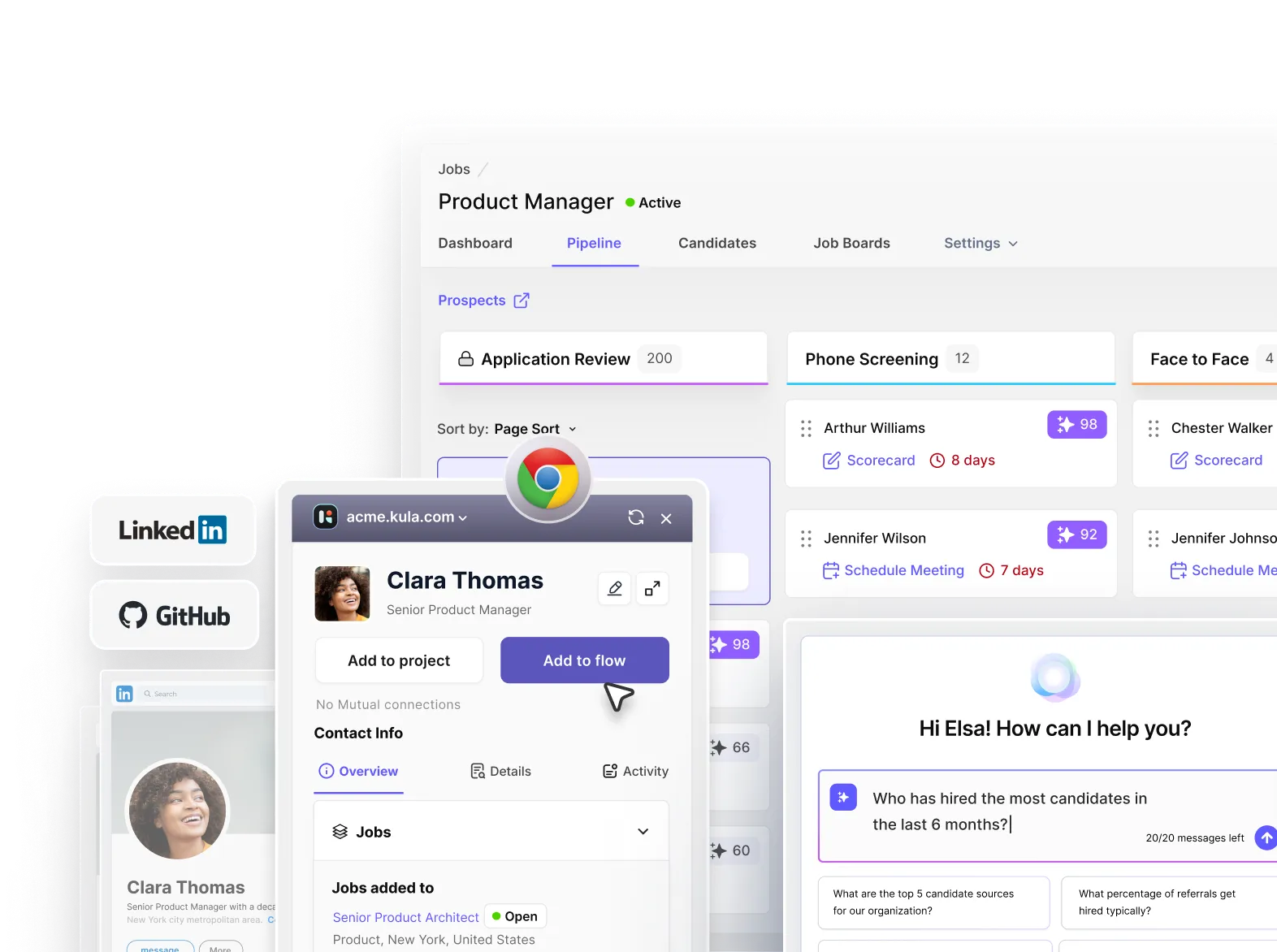



CFOs' expectations are evolving quickly, and in 2026, they will not see recruiting leaders as order followers but as strategic partners.
Several factors contribute to this change, including an unpredictable environment, growing competition, tighter budgets, and fluctuations in hiring.
Hiring departments are no longer expected to fill the role with top candidates, they're expected to do that with greater efficiency and profitability.
As a result, CFOs now count on TA leaders to operate strategically and deliver predictable outcomes.
In this blog, learn about CFOs' expectations from recruiting leaders in the coming time and how TA teams can meet those expectations.
The 3 ROI Areas CFOs expect recruiting leaders to own
1. People: Hiring outcomes that improve long-term business performance
Your CFO isn’t interested in the speed of your hiring, but they care more about whether new hires deliver real value.
What CFOs want under this pillar:
- Quality-of-hire metrics, not just time-to-fill
Filling a role quickly doesn’t guarantee business impact. What really makes the difference is how well they perform, how fast they contribute, and how long they stay.
Recruiters must focus more on recruiting KPIs such as
- New Hire Performance
- Ramp-up times
- New Hire Retention
- Early Turnover Rate
- Hiring Manager Satisfaction
- Candidate Experience NPS
- Offer Acceptance Rate
- Quality-of-Source
CFOs want visibility into how long it takes for new hires to become fully productive because slow ramp-up times delay revenue and slow down teams.
These metrics help CFOs give internal quality perception and understand that recruiting is bringing in talent that drives real results.
- Retention, because turnover is expensive
Replacing an employee can cost a range from 50% to 200% of their annual salary. And the hard truth of losing a top performer is more than just the cost. It is losing the leadership and the momentum they brought to the team.
By hiring individuals who are more aligned, capable, and likely to succeed long-term, CFOs expect recruiting leaders to improve retention.
Better retention = fewer hiring cycles = lower overall cost.
This is a direct form of ROI that CFOs track closely.
- Role prioritization based on revenue impact
Not all roles contribute equally to business growth.
Recruiters should prioritize hiring roles that directly impact revenue, customer outcomes, or cost savings, rather than focusing solely on internal voices.
For example:
- A customer-facing engineer may drive more immediate business value than filling a non-urgent internal role.
- A sales hire who closes deals contributes directly to revenue forecasting.
By aligning hiring priorities with financial impact, TA leaders show CFOs that they understand the business and not just the process.
2. Process: Predictable, efficient hiring pipelines that enable financial forecasting
Predictability is now a financial requirement.
Unpredictable hiring = unpredictable budgets = unstable financial models.
What CFOs expect from the hiring process:
- Predictable pipelines with clear timelines
CFOs expect recruiters to know how many qualified candidates are in each stage and how long it typically takes to move them forward.
This helps CFOs to plan budgets, salaries, and team capacity with confidence instead of waiting on uncertain outcomes.
For this, recruiting leaders must
- Build and maintain always-on talent pools and continuously nurture past candidates to have a pre-qualified pool ready
- Use automated sourcing to maintain a constant inflow of qualified profiles
Instead of manually searching LinkedIn for every role, rely on tools like Kula that automatically identify and engage relevant candidates.

- Use tools that offer a centralized dashboard for analyzing funnel efficiency and advanced data on key recruiting KPIs to forecast hiring timelines. It helps CFOs plan budgets and headcount spending.
- Cost-efficient, automated hiring workflows
As companies operate under tighter budgets, CFOs expect TA teams to embrace cost-efficient, automated workflows that reduce operational overhead.
Manual recruiting tasks such as repetitive sourcing, manual follow-ups, spreadsheet-based tracking, and repetitive scheduling consume a large amount of recruiter time without adding strategic value.
At RecFest in Nashville, many HR and recruiting leaders shared their opinions on how AI is reshaping the future of talent acquisition and why every recruiter should actively experiment with it.
To align with financial expectations, recruiters must adopt tools that automate these repetitive tasks. Kula is one such advanced ATS tool that does it all. With Kula, teams get:
- AI Scoring for applications scoring
- Chrome extension for automated candidate sourcing
- AI Interview Intelligence with automated transcripts, summaries, and scheduling capabilities.
- Automated communication workflows with Gen AI
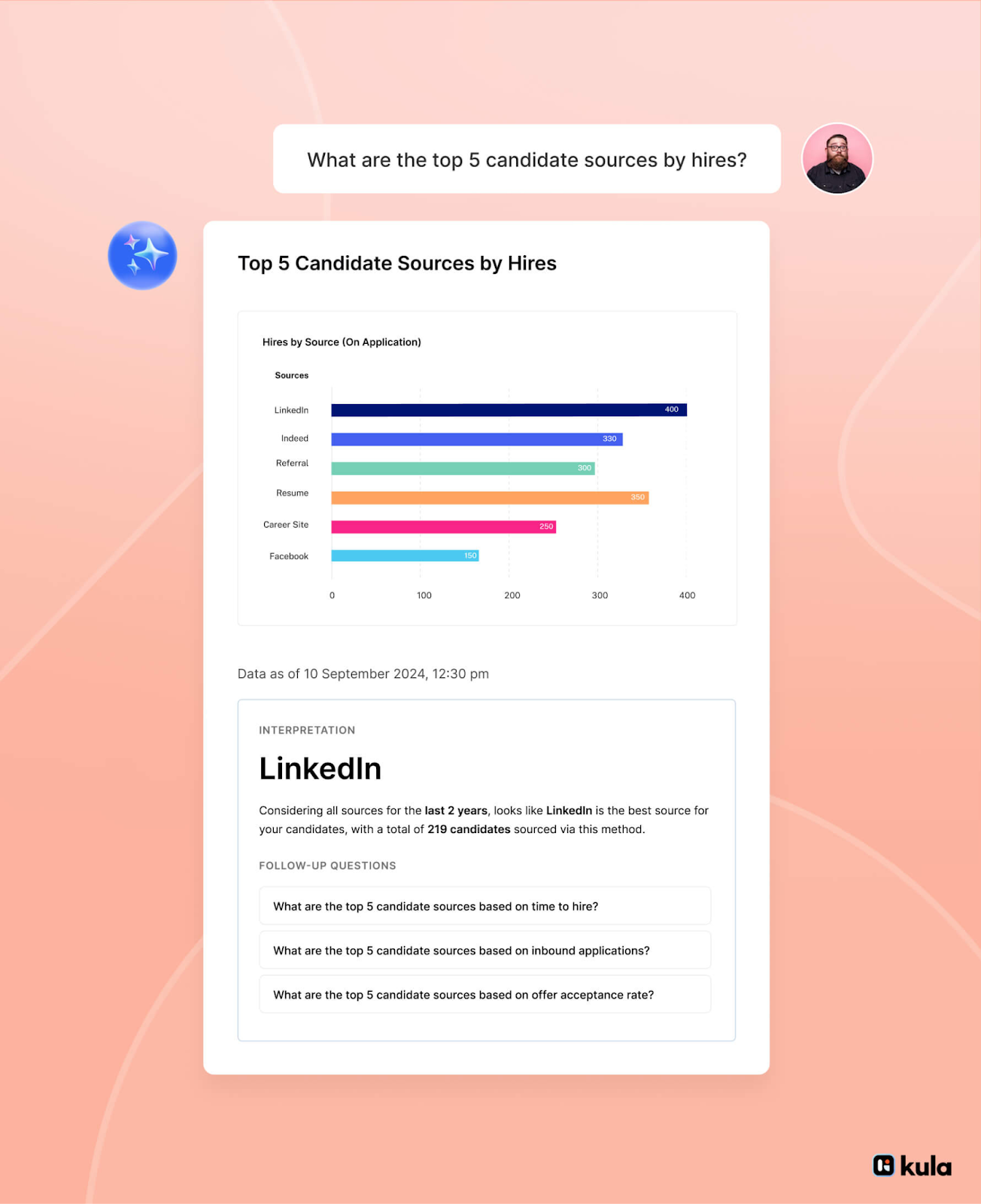
- AI Conversational Analytics to surface insights instantly with a simple prompt
Automation ensures consistent candidate engagement, reduces time-to-hire, and allows smaller teams to handle higher volumes without increasing headcount.
And the results prove it: With Kula automation, Remotely HR was able to hire 66% faster, and DeepScribe was able to cut their hiring costs by 30%. This directly translates into budget efficiency.
Looking to automate manual tasks and hire faster? Book a Kula demo to see how easy it can be.
- Funnel visibility to understand where money leaks
Every drop-off in the recruiting process has a cost.
CFOs expect clear visibility into the hiring funnel so they can understand:
- Which stages take the longest
- Where candidates drop off
- Which channels generate waste
- Which teams or roles require more investment
This transparency helps identify inefficiencies, reduce unnecessary spending, and improve overall cost per hire.
3. Technology: A lean, ROI-driven recruiting tech stack that pays for itself
Recruiters must be able to provide an accurate ROI across every part of hiring, from job ads to post-hire performance.
CFOs evaluate acquisition costs by looking at metrics such as cost per hire, cost per qualified candidate, and the conversion rates of different channels.
If a channel brings a high volume of applicants but very few quality hires, it becomes a financial liability. Similarly, companies view expensive tools that do not meaningfully reduce time-to-hire or improve candidate quality as poor investments.
To meet these expectations, a recruiter must first review their recruitment stack to make sure it's modern and efficient enough.
To audit your recruiting stack:
- Check how often each platform is used, who uses it, and whether teams rely on it for critical tasks. If a tool has low adoption, overlaps with another tool, or adds unnecessary complexity, it becomes a candidate for removal.
- Map tools to specific outcomes, and if a tool cannot be tied directly to a measurable outcome, it likely isn’t delivering ROI.
- Check if the team uses multiple tools that solve the same problem (e.g., two sourcing platforms or overlapping CRM and ATS features).
Once the right tools are in place, the next step is to define a core set of recruiting KPIs to measure, track, and optimize performance across each stage of the recruitment funnel.
Learn 11 recruiting KPIs and how to measure them for hiring success.
Final thoughts
Your CFOs prioritize your results over the methods you used to achieve them.
They want recruiting leaders to be proactive and act as active strategic partners who take up responsibility and make decisions based on both financial and hiring efficiency.
Being a recruiting leader, you need to be diligent about strategies, processes, and tools. You must have accurate data on their performance and an optimization plan.
Also, just focus not only on the speed of the process but also on the kind of candidate your team is finishing with.

CFOs are becoming more involved in the hiring process due to the tighter competition and rising costs. CFOs now expect proactive communication from recruiting leaders, providing data-driven recruiting strategies and accurate insights on recruiting KPIs. This helps finance teams plan hiring and salary budgets.
TA leaders can give insights on recruiting KPIs, such as time to fill, funnel velocity, offer acceptance rate, candidate conversion rate, and many more. CFOs will also want predictable hiring timelines and ROIs on every hiring tool or channel to understand what brings true value to the table.
Confidence comes from insights and results. Recruiting leaders must first start by defining a clear data-driven recruiting strategy and assigning relevant KPIs for measuring progress. When TA teams proactively implement their recruiting strategy with efficiency and bring data-backed insights to finance, they gain credibility as strategic partners