

Ever feel like finding top talent is like searching for a needle in a haystack? You're not alone. Over 52% of talent acquisition leaders say it's the toughest part of the job.
However, an AI-driven ATS tool can be your copilot in the hiring journey, parsing mountains of resumes in seconds, cutting out the grunt work and letting you build relationships with the best candidates.
Of course, the market is flooded with AI recruiting tools. So, choosing the right one can be overwhelming. But don't worry. I've tried out the top tools and put together a clear-cut analysis for you.
You can trust our software reviews because
With nearly a decade of experience in the end-to-end talent acquisition process, I've seen the industry evolve firsthand. From scaling startups like Freshworks and Practo to leading technical hiring at industry giants such as Uber and Stripe, I've gathered proper insights into what truly works in talent acquisition.
Therefore, the reviews are grounded in real-world experience, taking into account the complexities of various recruitment environments, such as:
- Practical application in high-growth scenarios
- Scalability across different company sizes
- Integration capabilities with existing HR tech stacks
- User experience for both recruiters and candidates
- Impact on critical metrics such as time-to-hire and quality of hire
Based on actual implementation experiences, our goal is to give you a clear understanding of each solution's strengths and limitations. Let’s cut through the marketing hype and deliver practical, actionable information so that you can make informed decisions.
What defines good AI recruitment software?
So, I've been taking a good, hard look at our own hiring processes and asking myself: What truly helps us find and hire the best people? And how can the right tools make that happen?
Based on what I've learned, here's the inside scoop on what you should be looking for in an AI recruiting platform to level up your game. Let's break it down:
Comprehensive feature set
Unless you want to be paying for several subscriptions for disjointed solutions, your go-to recruitment software has to consolidate all essential features onto one platform. It should simplify processes, give you a clear view of the whole hiring pipeline, and avoid data barriers (by simplifying complicated metrics into actionable insights).
Look for an ATS that offers:
- Candidate management
- A CRM to build talent pipelines
- Multi-channel job posting tools
- Interview scheduling features
- Collaboration features for hiring AI developers teams to share feedback and make decisions
- Analytics and reporting for data-driven insights into key hiring metrics
Intuitive interface
Setting up new software is time-consuming all by itself. If you add a complicated UI on top of that, it takes even longer. I consider the ideal recruitment tool to be the one with the shortest learning curve so your team can grasp its functionality without any strain at all.
Another aspect of an intuitive interface is customizability and speed, a myth in some clunky applicant tracking systems. Kula offers standard built-in reporting features so you can get started on measuring your hiring campaigns without having to set anything up.
Not only that, but you can customize your reports to focus on the metrics that matter most to you. And forget about hiring a design team for your career page – these platforms come with easy-to-use templates and branding tools, so you can showcase your company culture in a way that truly reflects who you are.
Intelligent automation
Listen, if you're serious about efficient recruitment, AI isn't just a bonus feature anymore – it's the bare minimum. And if you're not using it, guess what? Your competitors are. According to Tidio, a whopping 85% of recruiters believe AI will reshape hiring by automating certain tasks.
So, here's what I recommend: look for AI recruitment software that can handle the heavy lifting for you. We're talking about tools that can parse resumes, match jobs to candidate profiles, and even identify top talent right from the sourcing stage. That way, when it's time for you to step in, you're only dealing with the cream of the crop.
Kula ATS can analyze resumes in over 25 languages to find the best fit. It finalizes these resumes based on pre-defined criteria set by you, making sure not to miss on crucial skills with its advanced understanding of the English language.
To elevate the process, Kula also offers a more “circular” system of automation, which goes something like this:
- Automated candidate stages: It moves your candidates through recruiting stages based on whether they fulfill certain criteria. The simplest example would be successfully getting through a hiring manager interview.
- Streamlined assessments: This feature eliminates the need to manually assign tests after interviews. Candidates automatically receive the right assessments based on their current stage, saving you time and ensuring the tests are relevant to the position. So, no more scrambling to find the perfect test, especially for unfamiliar roles.
- Dynamic assessment delivery: Candidates progress based on their assessment results. They automatically receive new assessments at each stage until you find the perfect fit.
Seamless integrations
For a holistic hiring cycle, your recruitment software should integrate well with your existing HR tech stack. It also needs to offer a marketplace of pre-built connectors with popular tools such as Microsoft Outlook, Workday, or Slack.
To me, this is a kicker: if your AI recruitment software doesn't integrate seamlessly with your existing systems, you'll end up wasting all that time you saved on automation by manually updating multiple databases.
Plus, let's not forget the obvious benefit of integration—it eliminates the risk of human error that comes with manual data entry. So, make sure you choose a platform that plays well with others.
Robust data management
AI recruitment software must prioritize security and compliance since it handles sensitive candidate information.
Choose vendors who comply with GDPR and follow secure data handling guidelines. Centralized candidate profiles and communication history provide a complete picture, while automated data updating and deduplication maintain integrity.
Regular backups and role-based access controls are other key features I’d recommend you look for.
Exceptional customer support
Regardless of how great the software is, migration of this scale doesn’t come with hiccups. Look into how hands-on the company is with its customer support (like Kula ATS is). Here are some questions you can ask based on your interactions:
- Are they responsive to feedback?
- Do they take forever to get back to you regarding your queries?
- Are they prepared to jump on a call with you to walk you through their software?
- Do they offer dedicated success managers or just basic phone call support?
- How intensive is their onboarding?
Proven track record
Now, I know we're all about the potential of an AI model, but you can't just take a vendor's word for it. You need to see how these tools perform in the real world and what other users are saying. Sites like G2 or Capterra are your go-to resources for unbiased reviews and real-world experiences. I've even included common user complaints in the cons section of my review to give you the full picture.
Look for quantifiable results that others have reported, like the amount of time they have saved with the tool or any jumps in relevant application volume or qualified leads.
Enterprise-grade scalability
Remember, your company isn't static, and neither should your recruiting tools. As your organization grows, your AI recruitment software needs to keep pace. That means being able to handle high-volume hiring without slowing down or crashing.
Look for features like guaranteed uptime and fast response times so you can access the platform whenever you need it, without interruptions. Trust me, a reliable platform is worth its weight in gold when you're scaling your hiring efforts.
Transparent pricing
Consider the pricing model and total cost of ownership when selecting an AI recruitment software. Opt for clear and competitive pricing plans that align with your budget and expected usage.
At Kula, we believe in transparency and flexibility. That's why we offer pay-per-user pricing with a detailed breakdown of your package so you know exactly what you're getting. Our scalable pricing is based on your company size and hiring volume, ensuring you only pay for what you actually need.
Other solutions like Workable offer similar plans for different team sizes, but be sure to read the fine print. Watch out for hidden fees and long-term contracts that can lock you in and limit your options.
Top 16 AI recruitment software in 2025 at a glance
Top 16 AI recruitment software in 2025
Now, let’s take an in-depth look at 16 of the top AI recruitment software in the market in 2025:
Kula
Overview
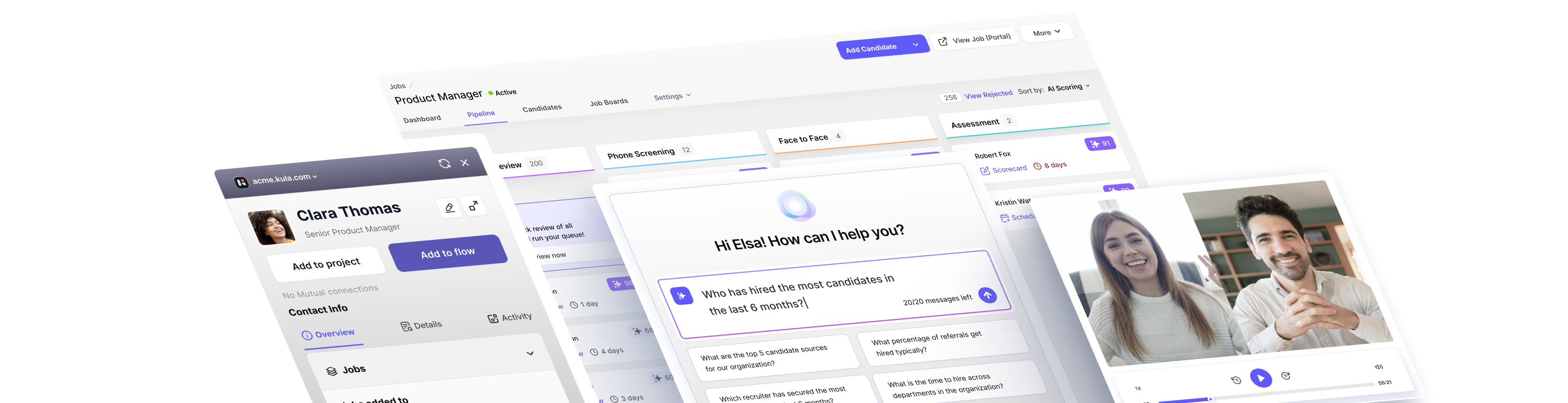
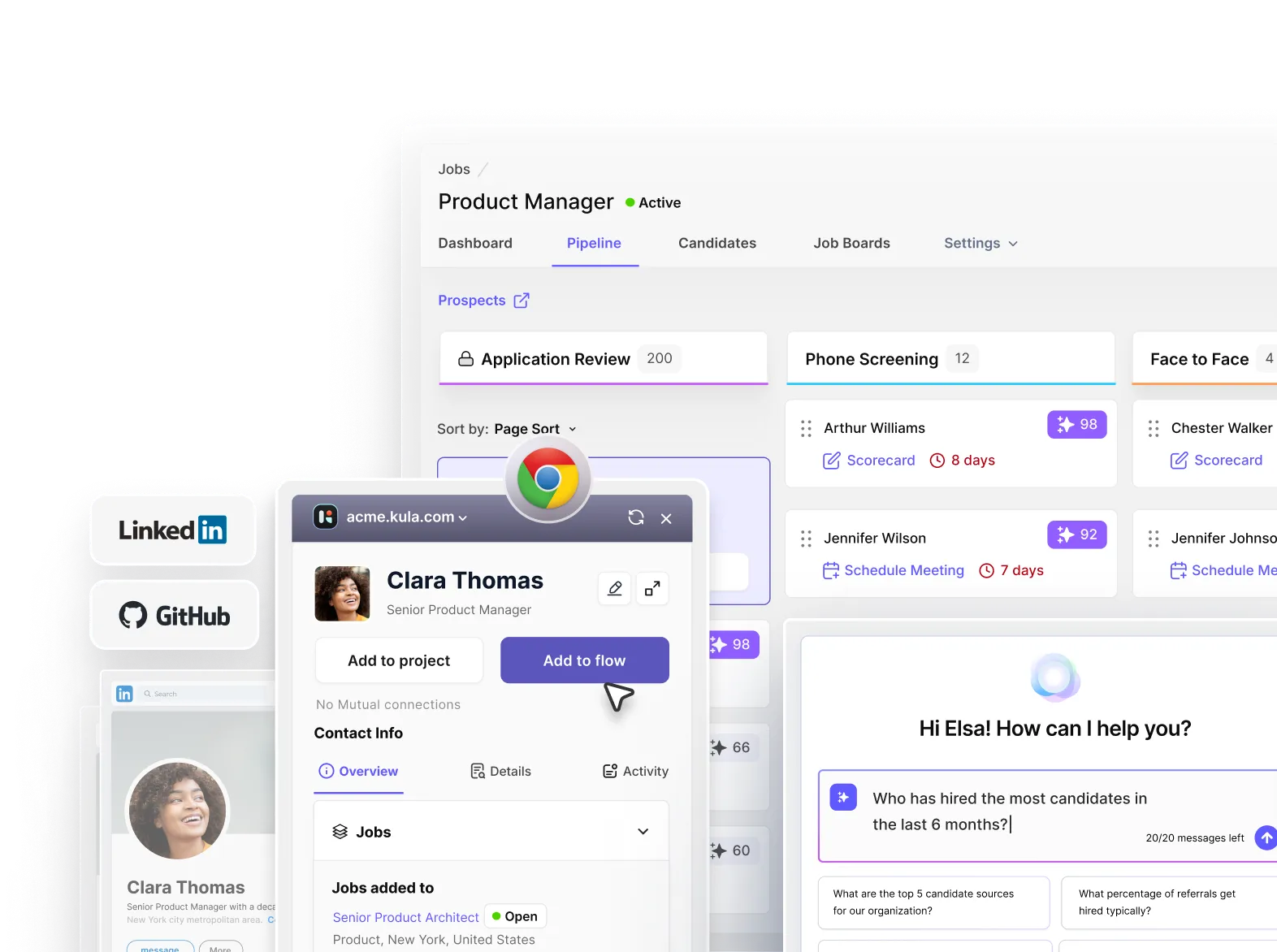
Kula is an all-in-one applicant tracking solution for modern recruiting teams that makes the whole recruitment process simpler and more efficient.
The tool has AI and machine learning component(s) built into platform architecture, so you don't have to worry about any extra integrations or maintenance. Let the platform's intelligence do the heavy lifting by automating candidate progression through your recruiting funnel based on your own custom rules.
You can even trigger automated communication with candidates based on those rules, making the entire process smoother than ever. To top it off, get a glimpse into the future with automatic hire date predictions powered by smart analysis of your funnel and past hiring data.
Here's how Kula can streamline the end-to-end recruitment process:
- Source high-quality candidates, interview and evaluate them, and make a job offer from a single window pane
- Kula ATS streamlines your talent management by letting you build customizable candidate pools based on skills, location, experience, and education
- Leverage advanced search across integrated resume databases to find the perfect fit for your open positions
- Create branded email campaigns to proactively engage passive applicants and nurture your talent pool for future opportunities
- LinkedIn Recruiter System Connect (RSC) integration is also available
- Kula ATS allows for a highly customizable application process tailored to each job, department, or brand. Configure screening questions and seamlessly integrate assessment tools to streamline candidate evaluation
- Gain insights into candidate sources by easily viewing, tracking, and managing them, with the ability to create custom sources for specific recruiting events or campaigns
- Adapt to diverse interview formats by customizing types for non-standard interviews such as coffee screens, lunch interviews, or portfolio reviews
Ideal for
- Any company, regardless of size, that wants an intuitive and efficient way of sourcing talents by leveraging AI and automation
Features
Kula ATS is designed to give you all the tools you need to manage your hiring process from start to finish. These features let you:
- Source and search quickly.
- Organize candidates into talent pools based on skills, location, and experience.
- Search across integrated resume databases to find the best candidates quickly.
- Reach out quickly, with warmth and personalization. some text
- Create and schedule branded email campaigns to engage passive applicants and nurture talent pools for future openings.
- Assess if you’re using resources effectively. some text
- Measure the effectiveness of your sourcing efforts with insight reporting and data tracking.
- Reduce manual entry and error.some text
- Integrate with LinkedIn Recruiter System Connect for enhanced candidate sourcing. After this easy import, you can also use custom tags to categorize and find candidates easily later.
With Kula's recruitment marketing & advertising features, you can:
- Provide a fully mobile candidate experience for job search and application. I’ve seen that serious job-seekers apply round the clock, and offering mobile applications makes it just a little easier for them and more likely to complete and submit the application.
- Kula automatically distributes your job ads to aggregators and search engines at no extra cost—some providers will charge for this provision.
- You can sync ads directly to your career site or webpage without any coding. There’s no waiting around for the engineering or marketing team to do this for you in that case. You can also share job openings on social media and Google Jobs Search for maximum exposure.
Kula's referrals management tools let employees submit referrals to specific jobs and track their progress. Employees can share unique referral links on social networks or via email.
You can track your top referrers on the referrals dashboard and easily run reports, gamifying the system to an extent if you offer rewards at the end of it. I haven’t seen a lot of employees refer others unless they feel strongly about it, because there’s very little recognition or reward involved.
Now, let’s get to the real deal—how great are its ATS features? Kula can help you manage the entire candidate journey from a single record. Here’s how:
- Start with importing resumes individually or in bulk, after which Kula will parse them automatically
- Use advanced search and filters to find and organize candidates after you get a qualified list from the bigger pool of resumes
- Next, customize your application process with screening questions and assessments
- Send personalized messages to candidates as they move through different stages, with all communication history captured. Kula also centralizes all your email communications in one place
- Take bulk actions on applicants, like messaging, rejecting, or setting reminders
- Finally, track candidate sources and create custom sources for specific events or campaigns
Tired of playing email tag and the constant back and forth? Kula ATS simplifies interview scheduling and coordination. You can:
- Review interviewer calendars side-by-side, book rooms and resources, and sync with popular tools such as Google Calendar, Microsoft Exchange, Outlook 365 and MS Office
- Customize interview types and create structured candidate evaluations with scorecards
- Let candidates self-schedule their interviews
Kula ATS also simplifies offer management with customizable templates for quick generation and tracking of signatures. New hire paperwork is automated, and data seamlessly syncs with your HRIS.
The reporting features give you instant insights into key recruitment metrics and trends. With just a few clicks, you can build, schedule, and download on-demand or ad hoc reports in CSV format.
Need insights fast? No problem. Kula comes with pre-built reports on key metrics like time-to-hire, time-to-start, and sourcing performance, so you can analyze your data right away. Our comprehensive dashboards give you a clear picture of your pipeline, upcoming interviews, and other essential information.
But Kula doesn't just give you data—it helps you act on it. Our automation features let you work smarter as you can automate candidate rejection, assessment triggers, notifications, and all-important reminders.
Pros
- All hiring-related tasks can be completed in one place
- Offer anonymous resume screening, reducing bias
- Flexible and customizable
- Offers personalized communications and user-friendly mobile applications
- Reporting features that help you make data-driven choices and measure performance
- Save time with automation
Cons
- Pricing plans are not transparent
Pinpoint

Overview
Pinpoint is applicant tracking software that enables you to attract, hire, and onboard the right talent for your business. It’s a fast, flexible, end-to-end talent acquisition solution with unlimited support — and since any new tool is bound to have hiccups, this is a great pro.
Pinpoint simplifies the hiring process by enabling job posting and candidate sourcing to interviewing and onboarding new hires.
Ideal for
- Perfect for companies who want to get more quality candidates while reducing administrative tasks and engaging hiring managers in recruitment processes.
Features
Pinpoint has an extensive range of features aimed at supporting your end-to-end recruiting process. I found it convenient to publish job listings across multiple boards simultaneously, and the built-in tools for employee referrals were a nice touch.
When it comes to sourcing candidates, you can:
- Create a branded website where potential employees can check out the company culture before applying
- Offer candidates the option to apply in different languages
- Find passive applicants easily using Pinpoint’s sourcing extension
- Centralize all candidate data
- Establish talent pools so as not to waste time when filling future positions.
Alright, let's shift gears and talk about how this streamlines your teamwork. Pinpoint's interview scheduling tools are a lifesaver–no more endless email chains trying to find a time that works for everyone.
You get detailed candidate profiles right at your fingertips, and you can even conduct video interviews directly on the platform. It's all about making communication easy and seamless.
Plus, with features like blind recruitment, you can reduce bias and ensure a fair evaluation of every candidate.
When you’ve found the right candidate, you can create and send offer letters with just a few clicks and use its onboarding features to welcome and ramp up your new hire.
Pros
- An end-to-end talent acquisition software with unlimited support
- Can create talent pools for future hiring
- Blind recruitment features help reduce bias and create a fairer hiring process
- Scorecards make it easy to be more objective when choosing the best candidates
Cons
- Some users find the system complex and difficult to learn, especially for non-tech-savvy users
- Reporting can be complicated to set up and customize according to specific requirements
- Integration with third-party software, like WordPress, is limited and may require manual data input
Manatal

Overview
Manatal is a cloud-based ATS that makes your hiring process simpler and easier. With hiring pipelines, AI-powered suggestions, and applicant matching, the tool helps you manage candidates smoothly from start to finish.
Ideal for
- Manatal is an excellent choice if you're a staffing agency or HR department that wants to find and hire candidates more effectively
Features
The tool offers a ton of features to make your hiring process easier and more organized. For example:
- For those of us who love a visual approach, Manatal’s interactive ATS pipeline is a game-changer. You can track candidates using familiar Kanban boards or list views, making the whole process feel as intuitive as your everyday project management software. The best part is, that you can easily customize data fields and pipeline stages to match your company's unique workflow
- Automated messages and personalized emails keep candidates engaged throughout the process
- With the Candidate Quick-Screen feature, you can review applications faster and keep all important details in one place using candidate profiles and scorecards
Finding the best candidates is a breeze with Manatal's flexible and powerful search tools that work across the entire database.
- Advanced boolean search options and AI-powered candidate matching help you pinpoint the perfect fit
- Plus, Manatal can automatically reformat resumes with your branding and hide personal details to maintain consistency and privacy
Manatal really shines when it comes to staying connected and organized. You can easily sync your email and calendar with Outlook/Office365 or Gmail, so sending group emails or even launching entire campaigns is a breeze, all without leaving the platform.
And for those of us working with global teams, Manatal's multilingual capabilities are a lifesaver–it supports languages that read right-to-left and even those with different alphabets.
Onboarding? Covered. Manatal helps you track those crucial steps for new hires, and it integrates with assessment tools like Codility to make candidate testing a snap. Plus, your data is secure in their SOC II Type 2 compliant cloud system, so you can rest easy knowing your information is safe.
If you need Manatal to do even more, it can connect with over 3,000 other apps through Zapier to make your work easier. It also connects with other HR systems, payroll, and more.
I also thoroughly tested their electronic signatures feature through Adobe Sign; collecting them and sending text messages to candidates was easy, and I could do it without leaving Manatal.
Pros
- Drag-and-drop functionality is easy to learn and use
- AI-powered insights help you with candidate matching and scoring
- Lots of customization options for data fields and recruitment stages
- Supports multiple languages for global recruitment teams
- High-security standards with SOC II Type 2 certification
- Responsive customer support via live chat
Cons
- Some users feel that the software lacks certain features, such as scorecards or more customization options for the career page
- Candidate management can be challenging, particularly when trying to locate archived candidates using the search function
- The pricing model may be expensive for some small businesses, especially when compared to other ATS solutions
GoHire

Overview
GoHire is specifically designed for small and medium-sized businesses. Over 3000 organizations worldwide depend on GoHire to simplify their recruitment processes.
Ideal for
- If you are an SMB seeking to attract more candidates, GoHire has you covered
Features
GoHire has great job posting features. With a single click, I could post a job to over 15 boards. This efficiency is complemented by a library of over 700 job description templates, which I found helpful for creating appealing listings quickly.
The platform's website integration and job widget make it easy to create a branded careers page. While I didn't personally design a page, I could see how this feature would be valuable for HRs looking to enhance their online presence without creating a fuss with the marketing team. That’s why Kula ATS offers an out-of-box career page builder too.
GoHire's hiring pipeline management stood out to me. You can create multiple pipelines and link candidates to specific jobs. The tagging system and search functionality appeared robust, and though I didn't have the opportunity to test them with a large candidate pool, the tests I did run worked well.
GoHire doesn’t lag when it comes to candidate experience. The platform offers automated nurturing emails to keep candidates engaged. I’d see this working out for longer application processes and engaging passive candidates. The interview scheduling feature seemed designed to reduce communication back and forth, which I imagine would be a time-saver for busy recruiters.
One feature that caught my attention was the ability to screen candidates with questions and video questionnaires before reviewing resumes. That significantly reduces initial screening time. The custom scorecards for candidate evaluation work well to promote consistency in the hiring process.
GoHire offers collaboration tools like mentions and notes for team communication, as well as GDPR compliance tools and reporting features. While I didn't delve deeply into these aspects, they cover essential bases for modern hiring needs.
The platform's integration capabilities with Slack and Zapier suggest it can connect well with existing tools.
Overall, GoHire appears to be a comprehensive solution for hiring needs, though as with any software, its true value would likely be revealed through extended use in a real-world hiring environment.
Pros
- Intuitive and easy to use, meaning that you get started right away
- Automation tools save time by reducing manual activities
- Offers customized pipelines, tags, and scorecards that suit your needs are awesome
- Supports GDPR compliance
Cons
- While GoHire offers multiple job listing options, some users feel that reporting capabilities could be enhanced to better align with their internal KPIs and tracking requirements.
- Some users mention that there could be more direct messaging options for communicating with employers or managers within the platform.
Recruitee

Overview
Recruitee is a collaborative hiring software that helps you build winning teams. It brings your hiring teams together, boosts your sourcing efforts, automates manual tasks, and helps you evaluate candidates effectively.
Ideal for
- Suitable for companies looking to improve employer branding, social sharing, and sourcing
Features
Recruitee's got your back with everything you need to simplify hiring. You can tailor it to your unique process by building custom pipelines with stages, filters, and views that make sense for your team.
Their templates for pipelines, emails, and more cut down on the busywork, and roles and visibility settings make team collaboration smooth and efficient. Plus, I think with its user-friendly interface, Recruitee is easy to pick up, so your team can hit the ground running.
I was impressed with how Recruitee automates those tedious tasks, like sending out disqualification emails and evaluation requests. That alone could save recruiters a ton of time.
I also liked the option to schedule job postings ahead of time and get reminders for overdue candidates–those little features can make a big difference in keeping the hiring process moving smoothly.
The CareersHub feature allowed me to create a basic careers site without any coding knowledge, and the multi-language support caught my eye as a potentially valuable feature for reaching diverse candidates.
I tested connecting with a few other tools through APIs and Webhooks, and the process was straightforward. The Single Sign-On feature added a sense of security that I appreciated.
I found the ReferralsHub to be a standout feature, offering an easy way to get employee referral programs up and running. The screening questions feature was another highlight–it could definitely speed up those early stages of recruitment by weeding out unsuitable candidates.
For the mobile app, I was impressed that it allowed unlimited users, which would be great for larger hiring teams. The Event Scheduler and video interview integrations also seemed to simplify the interview process significantly, making it a more streamlined experience for both candidates and recruiters.
When I tried out the custom dashboards and reports, I found them to be quite flexible and informative, giving a clear picture of key metrics. The built-in security and legal features were a big plus, addressing any compliance concerns.
Pros
- Offers collaborative hiring features
- Save time on manual tasks with automation tools
- Extensive job board integrations
- Capable of extensive reporting and analytics
Cons
- Several users report missing features they would like to see, such as more integration options, customizable email templates, or the ability to CC recipients in emails
- Candidate management can be difficult, with limited options for editing or updating information once a candidate has been moved to a specific stage
- Customization options are limited in some areas, such as the career page design or the ability to create multiple scorecards per candidate
Workable

Overview
Workable is your one-stop shop for everything talent-related. It's a complete recruiting and HR management platform that helps you find, hire, onboard, and even manage the right person for every role in your company.
Think of it as a dynamic duo: Workable Recruiting gives you a full-fledged applicant tracking system with AI sourcing tools built right in, while Workable HR provides a customizable HRIS platform to keep your employee data organized and secure.
Ideal for
- Great for companies that want to simplify their HR processes and reduce costs
Features
I found the job posting process to be notably efficient. With a single click, I was able to distribute a job listing to over 200 sites, which could significantly broaden the reach of job postings. The employee referral platform is a potentially useful tool for tapping into passive candidate pools and encouraging referrals.
Let’s dive into Workable's AI capabilities— is it actually helpful? I tested its ability to assist with sourcing candidates, writing job descriptions, generating interview questions, and crafting emails. While the results were satisfactory, I'd love to use these features more extensively to fully gauge their effectiveness in a real-world scenario.
Workable's automation features are a real time-saver, especially the automatic interview scheduling and approvals. And their mobile app is surprisingly user-friendly, so you can handle hiring tasks on the fly, no matter where you are. I also appreciated the flexibility of the customizable pipelines, interview kits, and scorecards–it's easy to tailor them to fit your company's specific hiring process.
You get access to 400 million candidate profiles, which could be a game-changer for companies struggling to find the right talent. The video interviewing feature integrated directly into Workable will save you a lot of time in the interview process, though I didn't have the opportunity to test it with actual candidates.
The onboarding features and free core HR tools like org charts and file storage appeared to offer value beyond just the hiring process. These could be particularly useful for smaller companies.
Workable's integration capabilities with common tools like email, calendars, and CRMs like Salesforce suggested it could fit well into existing workflows. The platform's compliance with GDPR, EEOC/OFCCP guidelines, and ISO 27001:2013 certification provided reassurance about its security and legal standards.
Pros
- Works intuitively and can be implemented quickly
- Responsive global customer support team
- Combines ATS with HRIS into one platform
- AI assists in sourcing, writing job descriptions, and generating interview questions
- Complies with the highest security standards to protect your data.
Cons
- Occasional technical issues and slowdowns
- Limited search functionality
- Reporting could be improved
- Customer service could be better
- Limited customization options
- The blind hiring feature needs expansion
- Candidate filtering could be better
- Integration issues with some HRIS systems
Greenhouse

Overview
Greenhouse is designed to simplify the hiring process right from scratch. It collects applications, keeps applicant data in order, and follows candidates through every stage of the hiring process.
With features for posting jobs, collecting candidate feedback, and reporting, Greenhouse is your one-stop shop to manage your entire hiring process.
Ideal for
- Businesses that seek to minimize errors, prevent repetitions of tasks, and make sure they do not lose candidates along the journey
Features
Greenhouse's interface is definitely user-friendly and well-organized, and the job board functionality is quite comprehensive. It's pretty straightforward to share jobs and collect applications, but the ease of use might depend on how comfortable your team is with applicant tracking systems in general.
One thing I like is that Greenhouse tracks key candidate information like source, role, and stage, so you have a clear picture of where each applicant stands in the process.
The system also collects feedback from assessments and interviews, which could help make decisions, but it depends on how well your team utilizes the feature and the quality of the feedback they input.
Greenhouse also offers features and integrations aimed at identifying effective candidate sources.
While these tools might connect the dots in the reviewing and sorting process for some teams, I’d say their impact would vary based on your existing workflows and the volume of applications you typically handle.
Pros
- Minimizes errors and avoids duplication of work
- Makes it easy to communicate with candidates
- Detailed reporting and analytics are available
- Hiring pipeline management
Cons
- It may take a while for some users to get used to it, especially those unfamiliar with the technology
- It may be too expensive for small businesses or those that infrequently hire
- Occasional bugs or slowdowns are reported, but customer support is prompt in addressing issues
- Reporting and analytics features are detailed but take time to set up and tailor to specific requirements
Ashby

Overview
Ashby is a system for recruitment that brings together an ATS, scheduling tools, CRM, and analytics capabilities into one integrated solution to help companies achieve excellence in hiring.
Designed for ambitious teams from startups to enterprises, Ashby supports structured hiring, automation with a human touch, and real-time visibility into your hiring.
Ideal for
- If you’re a startup with 1-100 employees and looking for an easy-to-use, scalable recruitment solution, then Ashby is the best fit for you.
Features
Ashby offers a centralized dashboard for managing various recruitment tasks. The platform includes built-in scheduling tools for coordinating interviews and meetings. I clicked through the CRM section and noted that it allows users to create and organize talent pools, which could be useful for future recruitment needs.
In the analytics section, I found a range of data visualization tools and custom report options. These features are designed to support data-driven decision-making, though the practical value would depend on how your team interprets and acts on the information.
I tested the integration capabilities by connecting Ashby to a few common recruiting tools. The process was straightforward, but as with any software integration, the smoothness may vary depending on your specific tech stack.
The initial setup process was relatively simple, with a guided tour of basic features. More advanced functionalities are available, but I noticed they required additional setup and familiarity with the platform.
During my session, I navigated through the candidate sourcing, screening, and hiring workflow features. While Ashby provides tools for each stage of the recruitment process, the actual efficiency in finding and hiring candidates would largely depend on your team's strategies and how they utilize the platform's features.
Pros
- Covers the whole cycle of employment
- Reduces manual work while still keeping a humane touch
- Advanced analytics and customizable reporting
- Real-time visibility into your hiring process and help you make informed decisions
Cons
- A learning curve, especially for reporting
- Setup and implementation can be time-consuming
- Occasional bugs or glitches
BambooHR

Overview
BambooHR gives you the tools to discover and onboard new team members in a flash. It's all about saving you time by keeping your applicant information organized so you can zero in on finding those top-tier candidates and creating a hiring experience they won't forget.
Ideal for
- Companies looking forward to providing their candidates with a stress-free hiring experience and simpler working relationships between hiring teams
Features
BambooHR aims to streamline the hiring process from application to offer letter, but its effectiveness depends on how comfortable your team is with using the platform.
The communication features I tried out offer multiple ways to interact with applicants at different stages of review. This is intended to keep candidates engaged, but your team will need to utilize these tools to see results consistently.
The collaboration features include customizable permissions and shared candidate data. I set up a test team and assigned different access levels, which seems like it could foster better teamwork, but it might take some time to get everyone onboarded and familiar with their specific permissions.
I found customizable templates in the offer letter section that automatically fill in candidate information. The e-signature feature and automatic responses are intended to speed up the acceptance process, though I didn't have the opportunity to test these with actual candidates.
Also, I downloaded the BambooHR Hiring mobile app on both iOS and Android devices. It provides access to onboarding tasks, but the utility of this feature would depend on how often your team needs to manage these tasks remotely.
The job posting feature allows for distribution to several major platforms like Indeed, Glassdoor, and LinkedIn. However, I didn't verify if these postings went live on all mentioned platforms.
Next, I explored the reporting section, which analyzes metrics like time-to-hire and process bottlenecks. The depth and usefulness of these reports would vary based on the amount and quality of data input into the system.
You can handle onboarding with BambooHR, with options to customize new hire packets.
Pros
- Facilitates smooth communication during evaluation stages
- Improves candidate experience, which enhances an employer’s brand identity
- Saves time during the offer letter process by providing suitable templates with e-signature capabilities.
- Gives your hiring teams flexibility to review candidates and collaborate on the go.
Cons
- Recruiting tools may not be as advanced as some standalone applicant tracking systems
- Pricing for the hire features can be expensive for firms that want to focus solely on recruiting software
- Limited options for customizing hiring workflows or templates
Lever

Overview
LeverTRM can convert qualified applicants in a way that is predictable, scalable, and repeatable. It has become the trusted partner for thousands of organizations spanning various sectors when it comes to supporting their recruitment process.
Ideal for
- If you are a growing business looking to optimize your talent acquisition functions, then Lever is right for you, particularly if you want to create a more diverse candidate pipeline and workforce
Features
After logging into Lever, I dove into its automation features. The platform aims to streamline sourcing and selection, though the actual reduction in manual work will depend on your specific workflows and usage.
I explored the candidate engagement tools and found pre-set nurture campaign templates, which could be useful for nurturing relationships with potential candidates over time.
In the analytics section, I tested Lever's native tool, Visual Insights. It offers various data visualizations to help inform decision-making, but the value you gain from these insights will hinge on the quality and quantity of data in your system.
I also located the DEI/EEO surveys and dashboards, which seem designed to assist in meeting diversity hiring goals. Additionally, the customizable candidate experience surveys could provide feedback on your hiring process, but this relies on consistent completion by candidates.
Lever claims over 300 integration partners. I tested connections with a few common HR and recruiting systems, finding the process generally straightforward. However, the actual seamlessness of the unified workflow would depend on your specific tech stack and how well Lever interfaces with your other tools.
I navigated through the automated workflows and nurture campaigns. While these features are intended to handle routine tasks and keep candidates engaged, their effectiveness would rely on proper setup and maintenance by your team.
The platform includes integrations with assessment platforms and background check software. I initiated test connections with a couple of these tools but didn't run a complete hiring process to verify full integration functionality. The platforms comes with the best background checks capabilities to ensure thorough vetting of candidates, enhancing the reliability of your hiring decisions.
Pros
- Easy to use
- Automates your workflow
- Built-in nurturing campaigns to engage candidates
- Provides actionable insights
- Surveys like DEI/EEO help companies how inclusive their workforce is
Cons
- Expensive for small businesses, especially if they don't hire frequently
- Less tech-savvy individuals may take more time to try out advanced features due to steep learning curves
- Occasional bugs might occur, but customer support responds promptly
- Reporting and analytics features may require extra hours to configure according to specific needs
Zoho Recruit

Overview
Zoho Recruit is a comprehensive applicant tracking system (ATS) designed to streamline and manage the entire recruitment process. It provides a centralized database for job applications and applicants, empowering organizations of all sizes to automate their recruiting efforts.
Recognized as a top-rated ATS by leading review platforms, Zoho Recruit offers a robust solution for attracting, evaluating, and hiring top talent.
Ideal for
- If you are a recruiter who needs to reduce the time taken to fill open positions by establishing an organized hiring process, then Zoho Recruit is suitable for you
Features
Zoho Recruit offered a streamlined way to organize the recruitment process, and I explored its multichannel sourcing features and candidate management tools. The bias-reducing interview features seemed promising, but I couldn't fully assess their impact on fairness without conducting actual interviews.
I found the team collaboration tools easy to use, with options for communication and task sharing. The real-time reports provided insights into the recruitment process, though their value would depend on how accurately your team inputs data.
The AI-powered recruiting assistant claims to help identify top talent and match behavioral assessments to roles, but I would need to use it in real hiring situations to verify its accuracy and effectiveness.
The mobile app seemed convenient for recruiting on the go, and the career site builder simplified creating and publishing job openings.
Pros
- Automates time-consuming routine tasks
- Centralized all candidate data
- Reduces hiring time
- Offers simple collaboration and communication tools with a short learning curve
- Powerful sourcing techniques to build quality talent pools
Cons
- The interface might be overwhelming initially
- May take time to get used to and learn how to use several diverse tools and options
- Prices may seem high, especially for small businesses or those that do not need frequent recruitment
- Instances of occasional glitches or slowdowns have been reported by a few users, but the customer service desk assists in finding solutions
- Embedding reports and analytics within existing systems requires extra work as they come with standard information output fields
Freshteam

Overview
Freshteam, or Freshservice, covers recruiting, onboarding, days off work, personnel data management as well as workflow optimization. It is built to lower your routine task burden by way of automation, letting you concentrate on more significant things instead.
Freshteam integrates with leading job boards and has over one hundred ready-to-use job description templates, so getting started is easy. It also comes with an automatic resume parser for quick candidate screening.
Ideal for
- Freshteam is the perfect solution for businesses seeking a streamlined and effective hiring process. Its intuitive interface and customizable features make it an ideal choice for small to medium-sized businesses seeking an affordable yet comprehensive ATS
Features
Freshteam is a great starting point, especially for smaller businesses. They offer a free plan and affordable paid options that can grow along with your team. It simplifies a lot of the usual HR headaches and cuts down on manual tasks. The interface is straightforward, which could be a good fit for small to medium-sized companies that don't need a ton of bells and whistles.
I was able to set up a custom career site, which is a nice touch since it's included in all their plans. I also took a look at their interview prep kits, scheduling tools, and scorecards – all designed to help you create a more structured hiring process. And when it came to initial screening, their resume parsing feature worked well for those standard resume formats.
The Forever Free plan includes basic HR features and up to three job posts. Paid plans (Growth, Pro, Enterprise) offer more postings and advanced features. All plans include a customizable career site.
Unlike many competitors, Freshteam has a free plan. The pricing is reasonable compared to other ATS solutions. You get a 21-day free trial for the paid tiers with no obligations.
Freshteam integrates seamlessly with other Freshworks products, and each plan includes a branded career site.
Pros
- Has a free plan—not many competitors offer this
- Three-week trial period without any obligations
- Seamless integration with other Freshworks products (e.g., CRM and helpdesk)
- Includes a branded career site
Cons
- A few features that users expect are missing, such as referral source tracking or payroll functionality
- Candidate management can be challenging, especially when jobs are closed or put on hold, as candidates get unassigned and moved to the talent pool
- There are limitations in email sending, such as the inability to CC recipients or the need to confirm sending even when moving candidates to the next stage
SmartRecruiters
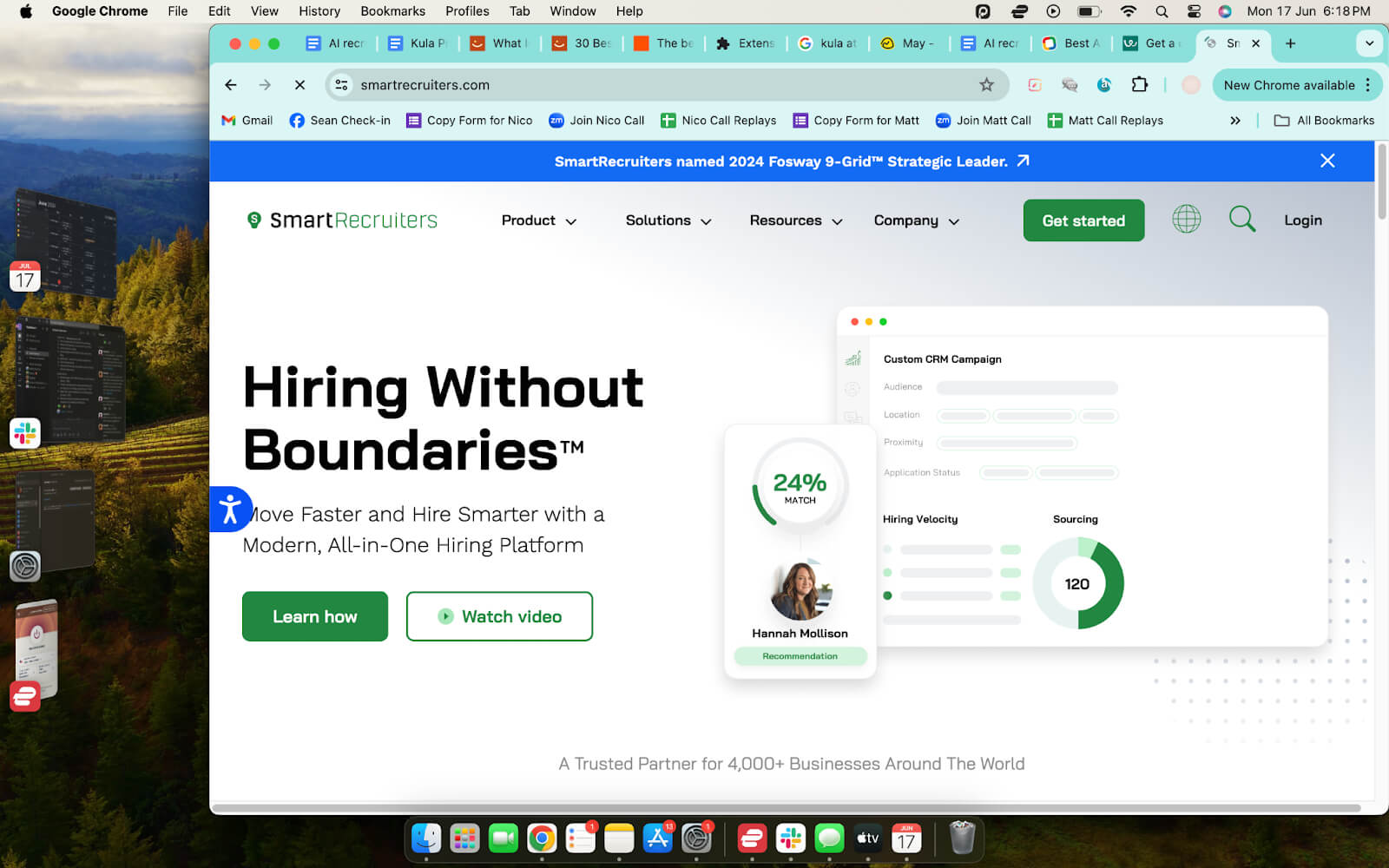
Overview
SmartRecruiters is a notable talent acquisition platform designed to optimize the hiring process for businesses of all sizes. The company offers a suite of recruiting tools and solutions that help organizations attract, engage, and hire top talent more efficiently.
Ideal for
- SmartRecruiters is ideal for companies of all sizes aiming to enhance their hiring process
Features
If SmartRecruiters is already your go-to, then their ecosystem is like the cherry on top to optimize your hiring. Their applicant tracking capabilities are solid, and I was easily able to create job requisitions and post them across multiple platforms.
The ability to customize hiring workflows to fit your exact needs is a huge plus, and you can even let the system automate your pipeline management.
I tried out their candidate self-scheduling feature for interviews, which could save a lot of back-and-forth. And the collaboration tools like notes and feedback forms are great for keeping the team on the same page.
One thing I really appreciate is the direct integration with email and Outlook. No more jumping back and forth between platforms–everything's in one place.
The data reporting tools offer some good insights into how your recruitment is performing, but remember, the value you get out of those reports depends on how well your team is tracking and entering data.
Pros
- Offers a variety of apps, technologies, and service providers to choose from
- Tailored solutions for your unique hiring needs and maximize your ROI
- Integrates with leading HCM and HRIS systems
- Gain access to a large community of talent acquisition professionals with their customer webinars and co-marketing opportunities
Cons
- Integration with other HR systems, such as HRIS platforms, can be challenging and may require additional resources or workarounds
- Customization options are limited in some areas, such as reporting, dashboard widgets, or email templates
- The platform has a learning curve, particularly for advanced features, which may require additional training and support
Loxo

Overview
Loxo is like the Swiss Army knife of recruiting–it combines your ATS, CRM, outbound recruitment, data, and sourcing tools all into one AI-powered platform. It's designed to streamline your entire workflow, keeping your data accurate and accessible from start to finish.
Loxo aims to save you a ton of time, money, and effort compared to juggling multiple tools.
Ideal for
- If you’re a recruiting agency looking to increase productivity, Loxo is perfect for you
Features
Loxo Source boasts a vast database of professional profiles, though your success in finding the right candidates will hinge on your search terms and how well the database aligns with your target talent pool.
I experimented with Loxo Connect's data enrichment feature, and it did automatically populate some extra details on candidate profiles, which could save some time.
I also tested Loxo Outreach & Outreach GPT for creating personalized engagement campaigns. While it offers templates and AI-assisted writing, the effectiveness of these campaigns would ultimately depend on your messaging strategy and how well you tailor the content.
The ATS within Loxo allows for comprehensive candidate management. I found tools for tracking candidates through various stages.
The Recruiting CRM and Sales CRM sections act as centralized databases for managing client relationships, which is great as not all ATS tools provide features for client management.
In the Reporting section, I generated some automated performance reports and analytics. These provide an overview of recruitment activities, making it easy for you to start right off the bat.
Pros
- Feature-rich platform
- AI capability to automate manual tasks
- A huge database of over 1.2 billion professional profiles
- Integrates with more than 100 software tools
- Offers great customer service alongside comprehensive functionalities
- Reduces time-to-hire and total tech costs too
Cons
- Integration issues with some tools reviewers use
- Issues with LinkedIn integration
- Ineffective search feature that returns irrelevant results
- Slow customer service response times in some cases
Gem

Overview
Gem is a scalable recruiting platform that brings sourcing, CRM, ATS, analytics, scheduling, and e-signature together. The idea behind it is to make hiring simpler and at the same time bring down costs by combining different tools into one platform. Gem’s successful product set has been loved by over 1,200 companies.
Ideal for
- Works well for recruiters who need a user-friendly platform to simplify their workflows and improve efficiency.
Features
For Gem, I logged in and tested the job posting feature. It claims to connect with over 25K job boards, which could potentially maximize reach. I used the advanced filters, Boolean search, and resume highlights to review some sample applications.
These tools could speed up the review process, but their efficiency would depend on the volume of applications and the specificity of your search criteria.
The interactive dashboard provided a visual overview of a sample candidate pipeline. This is visually appealing and a great way to gain a bird’s eye view of your systems.
Gem's consolidation of multiple recruiting tools into one platform could potentially simplify workflows and reduce costs, but the actual impact would vary based on your current tech stack and processes. I noted the high user ratings on G2 but couldn't independently verify these claims.
I tested Gem's integration with calendar and video conferencing tools. The connection process was straightforward, but this could change with the specific video conferencing tools you use.
Pros
- Consolidates multiple recruiting tools into one platform
- Reduces your costs by not forgetting and simplifies workflows
- Provides reporting and analytics features
- Integrates with your calendars and video conferencing tools
Cons
- May be more expensive than some other recruiting platforms, particularly for small businesses with limited hiring needs
- Occasional bugs or glitches are reported, but customer support is generally responsive in addressing these issues
- Extensive features and customization options may come with a learning curve
- First-time setup and interpretation of reporting and analytics features can be complicated, though powerful
iSmartRecruit

Overview
Do you want to seamlessly automate and manage your end-to-end recruitment process? Then, without a doubt, iSmartRecruit is your one-stop AI recruitment software solution. 10000+ hiring professionals in 70+ countries are trusting this user-friendly recruitment solution to solve their hiring hurdles.
iSmartRecruit offers a highly scalable Applicant Tracking System (ATS) to easily manage all your recruitment activity and a Recruiting CRM Tool to build strong relationships with your candidates and clients. This cutting-edge recruitment technology is designed to unearth the perfect talent match and enable efficiency and precision in recruitment. It has an intuitive interface, and intelligent automation features will allow smooth team collaboration and seamless communication.
Ideal for
- iSmartRecruit provides a recruitment solution that is affordable, customizable and has every feature the recruiting team requires. It helps recruiters, hiring managers, staffing agencies and corporates to automate manual and repetitive hiring tasks.
Features
AI-powered profile & job matching feature is very interesting. I found that it automatically identifies the best candidates for your job openings while also suggesting the most relevant roles to candidates based on their profiles and preferences.
I also found advanced database search features that quickly find and match candidates to job requirements with precision using robust search features like Boolean, fuzzy, semantic, and proximity search.
The analytics & reporting feature helps to easily track key recruitment metrics with advanced analytics and reporting tools, all while staying GDPR compliant.
The interview management feature automatically schedules candidate interviews with the calendar integration and I also found that it adds feedback and updates all the stakeholders about the status of the interview.
Now, you can hire the best ones like a pro by using iSmartRecruit's automated features.
Pros
- Use out-of-box customization features in the software to create personalized workflows as per your hiring needs.
- You can effortlessly migrate data from your existing system to iSmartRecruit without affecting your recruitment operations.
- iSmartRecruit delivers monthly product updates as per the requirement of their clients and current market needs.
- iSmartRecruit provides a flexible pricing model to suit every business, whether it is a small business or a well-established organization.
Cons
- The system is user-friendly, but you may need to train from iSmartRecruit to get the maximum advantage of the system.
- Can integrate with other tech platforms
Finding the right AI recruitment software for your agency
When selecting AI recruitment software, I recommend you consider your specific requirements carefully:
- If you're a startup with high-volume needs, choose user-friendly platforms like Recruiterflow or Zoho Recruit for affordable pricing and easy scalability.
- If you're an established enterprise wanting advanced features and extensive integrations, opt for Loxo or Gem's powerful AI sourcing, automation, and analytics.
- If you have an existing ATS needing seamless integration, go for TargetRecruit, built on Salesforce, for extensive customization that aligns with your current processes.
For those of you who want an all-in-one platform and prioritize engaging with active, most suitable job seekers along with passive candidates, Kula ATS is the clear winner.
Our AI-powered platform helps you effortlessly discover top talent across multiple sources so you can expand your reach as much as possible while maintaining the pace and quality of hiring.
Besides our single window pane for all things recruiting and extensive integration capabilities, Kula's automated email sequences and personalized candidate nurturing tools empower you to build and maintain strong relationships with all candidates, even at scale. It’s a win-win for all stakeholders in the hiring process.
With our advanced AI features, you can refine your sourcing strategies, boost candidate engagement, and ultimately connect with the most qualified talent, even if they're not actively looking for jobs.
To see Kula ATS in action, schedule a demo now!