



A recruitment CRM helps recruiters build relationships with passive talent, automate outreach, and maintain talent pipelines long before a role opens.
In this guide, we'll cover how recruitment CRM software works, how it differs from an ATS, and the best recruitment CRM platforms to consider in 2026.
What is a recruitment CRM?
A recruitment CRM helps recruiters build and manage relationships with candidates before they apply for a job.
Most recruiting teams already have valuable candidate data sitting across past applicants, sourced prospects, referrals, event attendees, and silver-medalist candidates. Without a structured system, those relationships are difficult to maintain and even harder to revisit when a new role opens.
Recruitment CRM software solves that problem by helping teams organize talent pools, automate outreach, track candidate engagement, and re-engage candidates over time.
The growing focus on proactive hiring is one reason CRM adoption continues to rise.
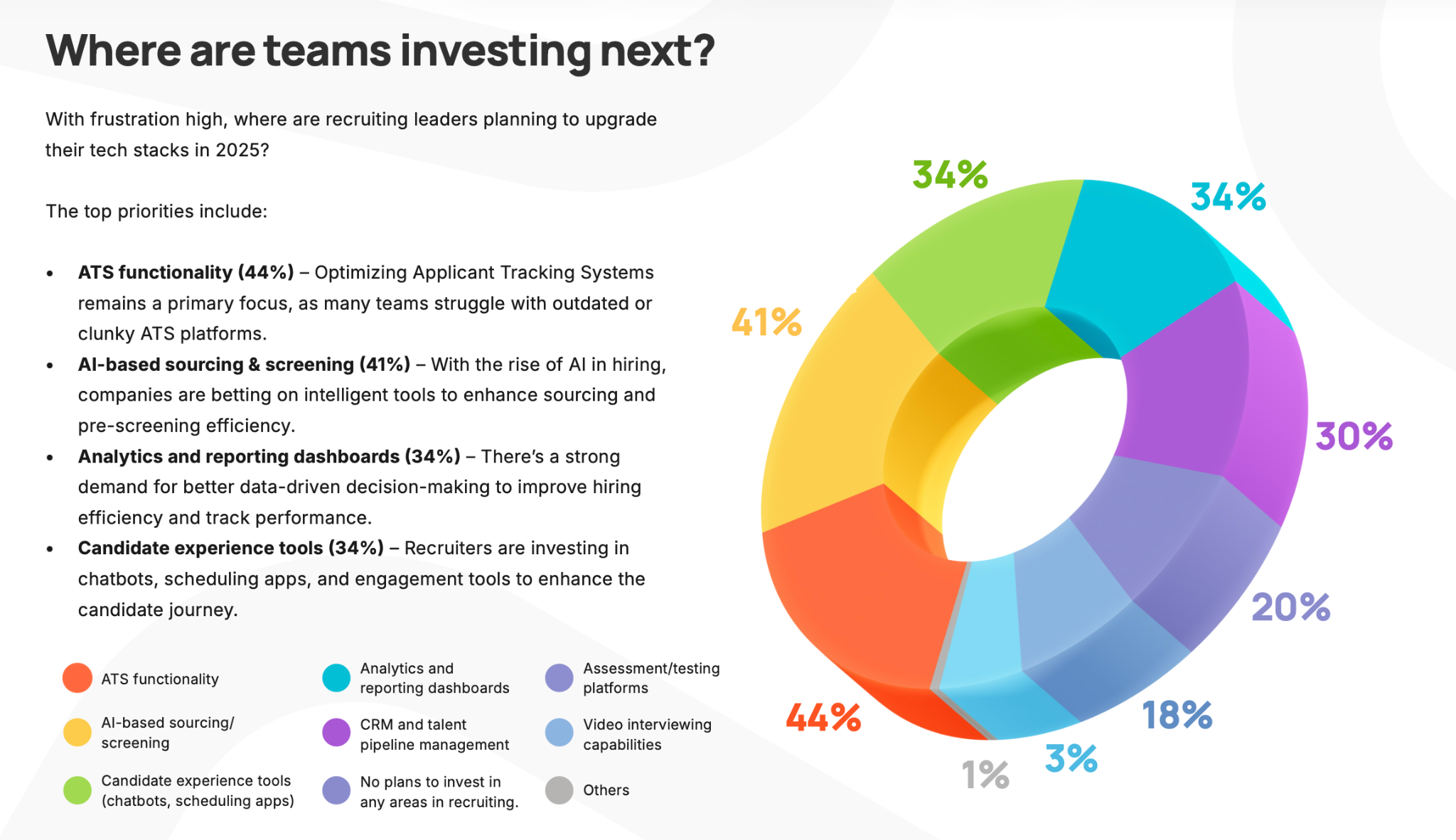
According to Kula's 2025 State of Recruiting Report, 30% of recruiting leaders plan to invest in CRM and talent pipeline management software in 2025, making it one of the most common areas of planned recruiting technology investment.
Modern recruitment CRM software typically includes:
- Talent pool management
- Candidate sourcing
- Automated outreach campaigns
- Candidate engagement tracking
- Event and referral management
- Recruiting analytics
The goal is straightforward: build a pipeline of qualified candidates before a role becomes urgent.
That investment can have a measurable impact. Research also shows that organizations using candidate relationship management software often reduce time-to-hire by 30–40% for roles where they've already built strong talent pipelines.
Recruitment CRM vs ATS: what's the difference?
Recruiting CRM software and applicant tracking systems are both terms that are often used interchangeably, but serve different purposes.
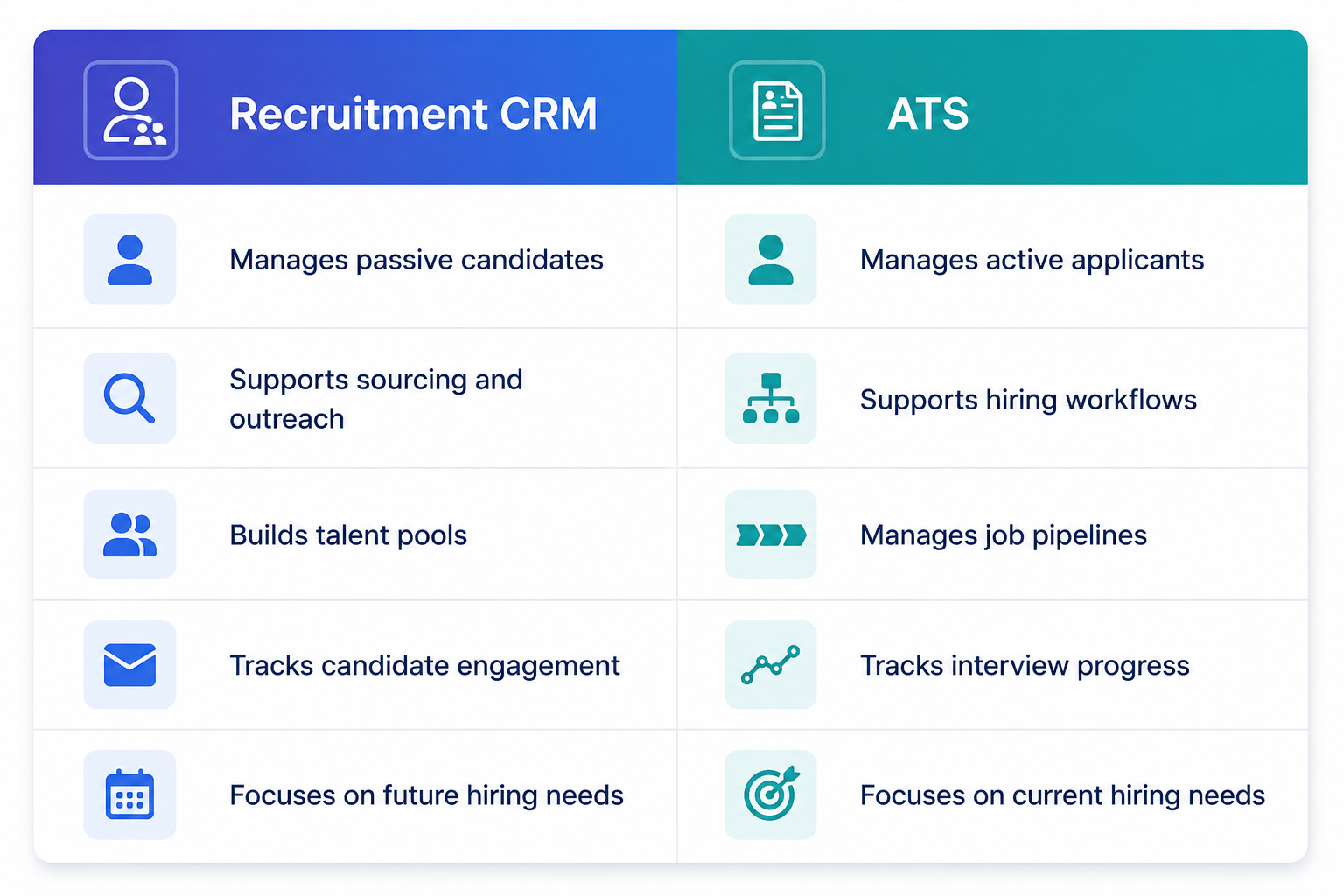
A recruitment CRM helps recruiters source, engage, and nurture candidates before they apply for a role.
On the other hand, an ATS helps recruiters manage candidates after they've entered the hiring process. Here are some quick differences between an ATS vs. CRM:
A CRM is most valuable for teams that regularly source candidates, hire for hard-to-fill roles, or want to build talent pipelines before positions open. If most of your hiring comes through inbound applications, an ATS may be enough.
But most applicant tracking systems today already include built-in CRM capabilities such as talent pools, outreach campaigns, candidate nurturing, and sourcing workflows. As a result, most companies today aren't choosing between a CRM and an ATS—they're evaluating how well a platform handles both.
Who should use a recruitment CRM?
A recruitment CRM is most valuable for teams that spend significant time sourcing, engaging, and nurturing candidates before they apply.
Internal talent acquisition teams
Companies with dedicated recruiting teams can use a recruitment CRM to build talent pipelines, automate candidate outreach, and maintain relationships with passive candidates over time.
High-growth companies
Organizations hiring across multiple roles simultaneously often struggle to keep candidate engagement organized. A recruitment CRM helps recruiters scale sourcing efforts and build a predictable hiring pipeline.
Companies hiring for hard-to-fill roles
When qualified candidates are scarce, recruiters need ongoing engagement rather than waiting for applications. A recruitment CRM helps identify, nurture, and re-engage talent for specialized or competitive positions.
Recruiting agencies and staffing firms
Agencies manage large candidate databases and multiple client requirements at once. A recruitment CRM helps organize talent pools, track interactions, and run personalized outreach campaigns at scale.
Who doesn’t need a recruitment CRM?
A recruitment CRM may be unnecessary if your organization hires infrequently, relies primarily on inbound applications, or fills most roles through referrals. In these cases, a standalone applicant tracking system tool is often enough to manage applications and hiring workflows.
If your recruiting goals focus on proactive sourcing, talent pipelining, and candidate relationship management, a recruitment CRM becomes much more valuable.
Key features to look for in recruiting CRM software
1. Talent pools and candidate relationship management
Most CRMs can store candidate profiles. The better question is whether recruiters can actually find and reuse those candidates six months later.
Look for features that make talent pools searchable and actionable. If recruiters can't quickly identify previous applicants, silver-medalist candidates, referral prospects, and sourced talent for a new opening, the CRM becomes little more than a database.
2. Multichannel outreach and campaign automation
Candidate engagement rarely happens through a single channel anymore. A prospect may ignore an email, respond to a LinkedIn message, and schedule a call through a text reminder.
The strongest recruiting CRM tools bring those touchpoints together so recruiters have a complete engagement history instead of fragmented conversations across different systems.
3. Candidate engagement tracking
Response rates don't tell the whole story.
For example, a recruiter may see low reply rates and assume messaging is the problem. In reality, candidates may not even be opening emails. Engagement tracking helps identify where outreach is breaking down so teams can improve campaigns based on actual behavior rather than assumptions.
4. AI-powered sourcing and screening
Many vendors now market themselves as AI recruiting CRM platforms, but not all AI features create meaningful value.
The most useful applications of AI tend to be candidate rediscovery, resume screening, talent matching, and prioritization. These capabilities help recruiters work through larger candidate pools without increasing manual effort.
5. Interview scheduling automation
Scheduling often becomes a bigger problem as recruiting teams scale.
A recruiter filling two roles can manage interview coordination manually. A recruiter managing 20 open requisitions can't. Built-in scheduling automation removes one of the largest sources of administrative work and helps reduce delays between interview stages.
6. Analytics and reporting
Most recruiting teams can tell you how many applications they received.
Far fewer can tell you which sourcing channel generates the highest-quality hires or which outreach campaigns consistently drive responses.
A recruitment CRM should help answer those questions. Otherwise, recruiting decisions are based on intuition rather than data.
7. Integrations with your recruiting stack
This is where many CRM implementations fail.
Our in-house research also shows that 40% of recruiters cite poor integrations as a major pain point.
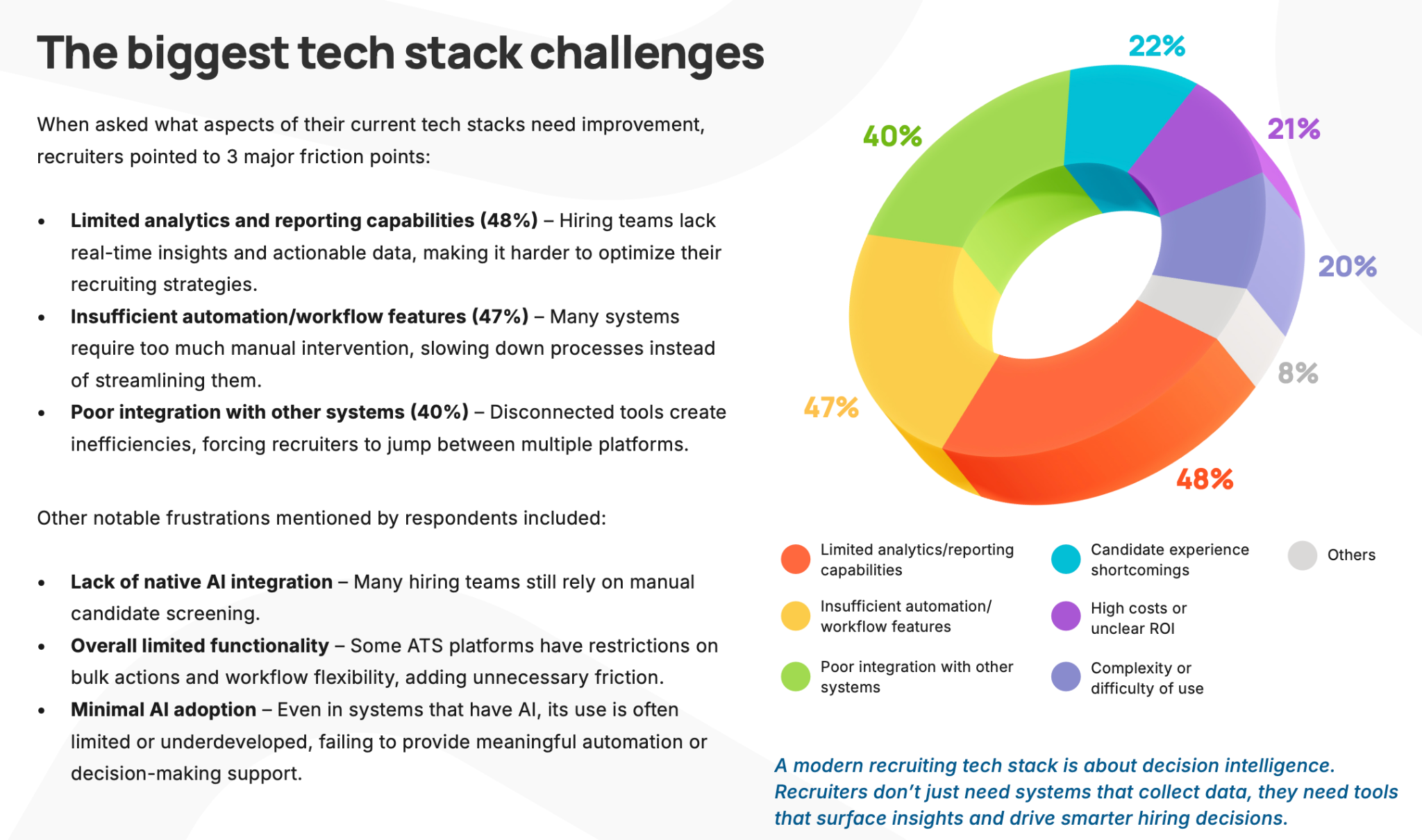
When candidate data lives in one platform, outreach activity lives in another, and interview information lives somewhere else, recruiters spend more time updating systems than engaging candidates.
That's one reason many buyers now prefer platforms where CRM and ATS features are built into the same system rather than connected through multiple integrations or third party tools.
8. Security and compliance
Recruitment CRMs contain candidate contact information, resumes, interview feedback, and hiring decisions. Strong access controls, audit logs, consent management, and compliance support should be baseline requirements, not premium features.
9. Ease of adoption for recruiters
The best recruitment CRM software isn't necessarily the platform with the most features.
It's the platform recruiters actually use.
If common tasks require multiple clicks, constant manual updates, or extensive training, adoption drops quickly. And when adoption drops, candidate data becomes unreliable, automations stop working, and the value of the CRM declines with it.
The best recruitment CRM softwares in 2026
Some recruiting CRM tools are built exclusively for staffing agencies. Others are designed for internal talent acquisition teams. Some are pure CRMs that require you to keep your existing ATS. Others bundle everything together.
Getting that distinction wrong is expensive. Before you look at recruiting CRM systems, here's the most important question to answer: are you an agency or an in-house team?
- Staffing and recruitment agencies need client portals, job order management, placement tracking, and often back-office billing.
- Internal talent acquisition teams need passive candidate pipelines, employer brand tools, and ATS integrations with their existing tech stack.
- Teams that need both (or want to avoid managing two systems) need an all-in-one platform that handles sourcing, CRM, ATS, and analytics natively.
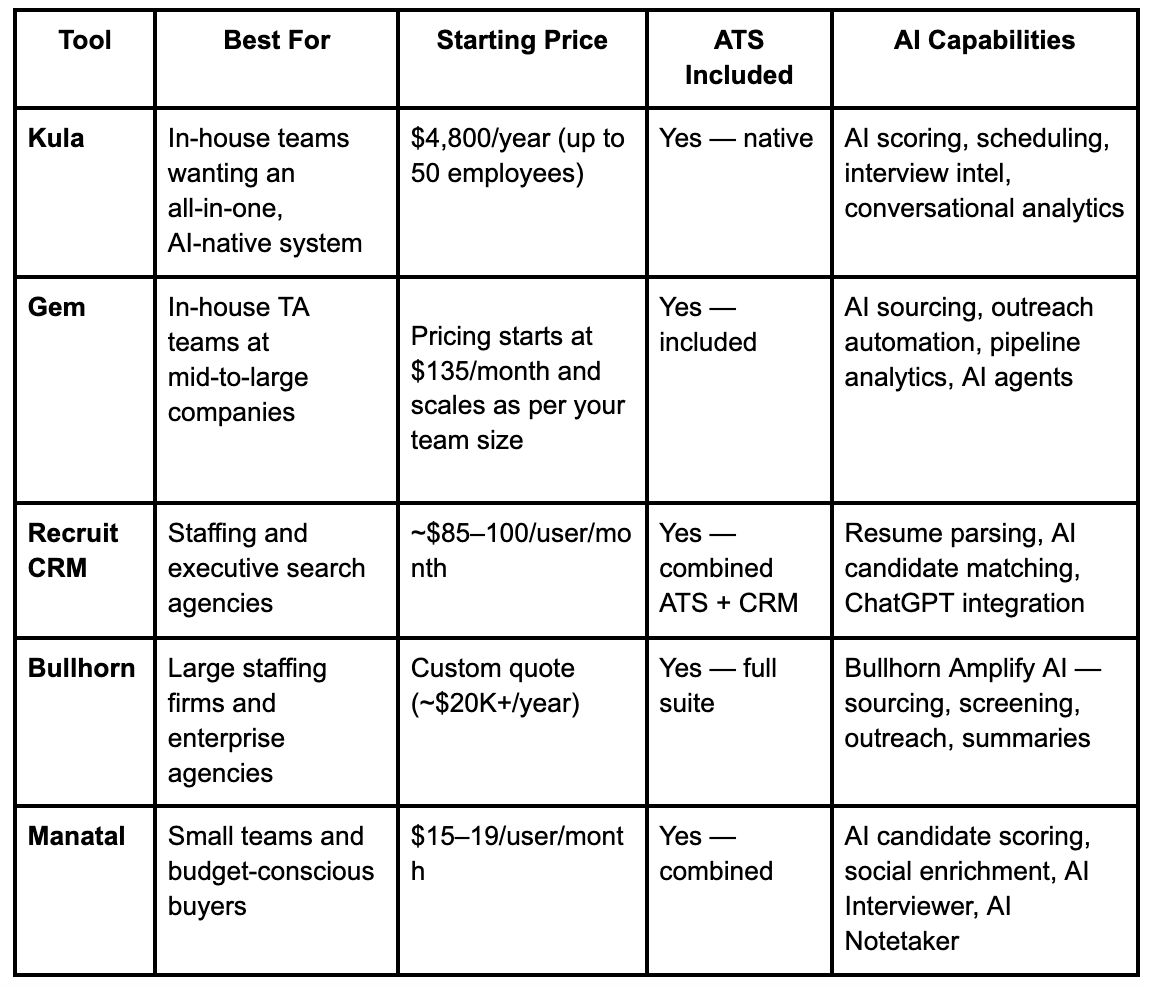
The tools below cover the full spectrum. Here's a quick comparison before we go deeper:
1. Gem
Best for: Mid-to-large in-house talent acquisition teams that run heavy outbound recruiting processes and need deep analytics, multi-channel outreach automation, and a strong passive candidate pipeline.
Starting price: Pricing starts at $135/month and scales as per your team size. AI sourcing features use credits which can scale costs further for the Startups plan.
$99/user/month (Essentials plan for staffing). The in-house Startups plan starts at ~$135/month. Enterprise and Growth tiers are custom.
ATS included: Yes. Gem now includes its own ATS alongside CRM and sourcing tools. Teams can also use it as a CRM layer on top of an existing ATS.
AI capabilities: AI sourcing, automated outreach sequencing with A/B testing, AI pipeline analytics (Talent Compass dashboards), rediscovery AI to surface past candidates, AI agents on higher tiers for sourcing, screening, and personalization.
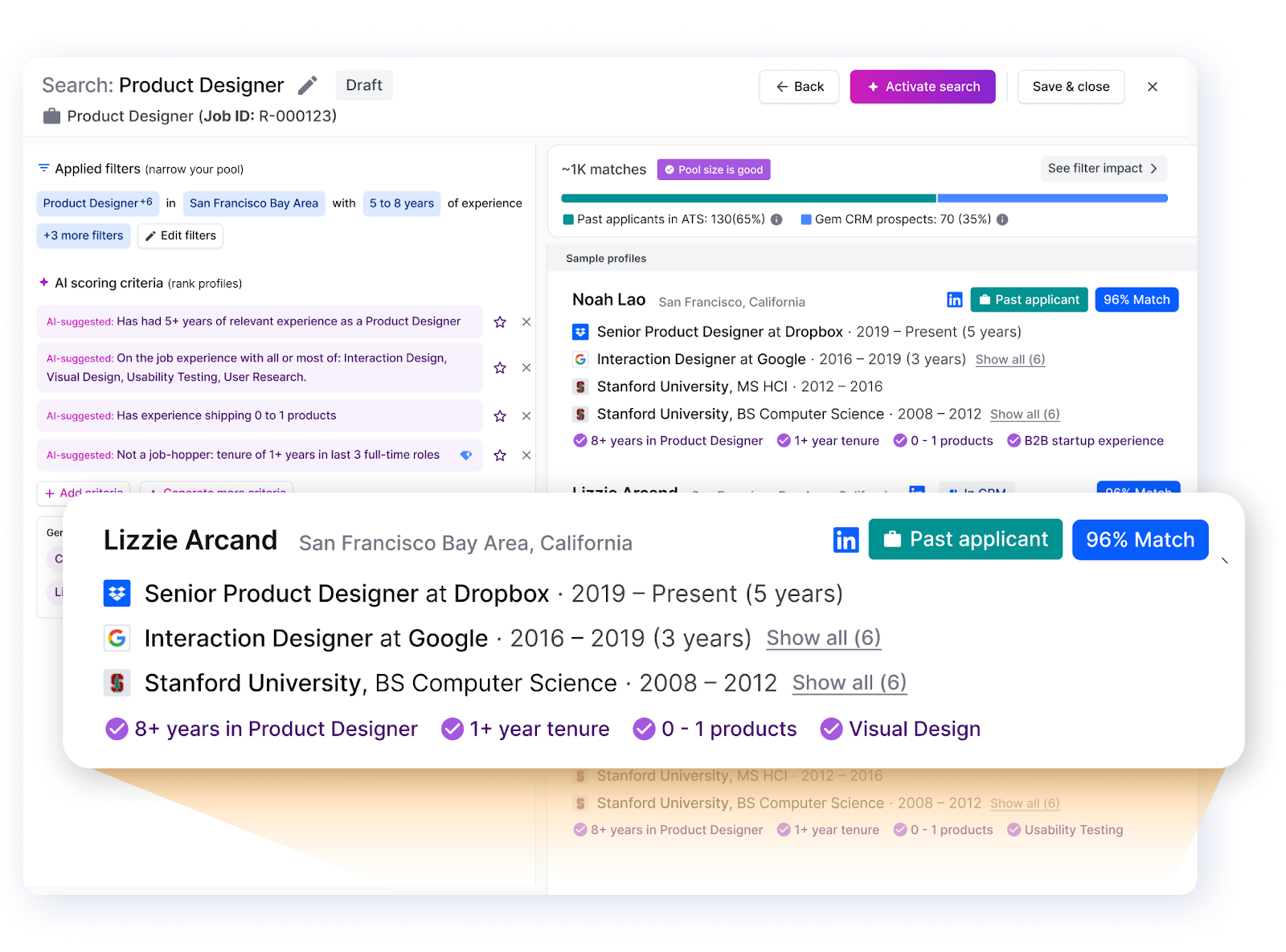
Gem built its reputation as a CRM and AI sourcing tool for internal TA teams, and it's evolved into a full-stack recruiting platform.
The platform's core strength is outreach. Multi-channel sequences, automated follow-ups, personalization, and A/B testing are genuinely well-built, not just at a surface-level.
If you have an existing ATS and want to use Gem as a CRM add-on—you can use the ATS connector integration.
Gem's analytics are also a differentiator. Its Talent Compass dashboards give real funnel visibility into data points like which sourcing channels convert, where candidates drop off, and what the pipeline looks like for future quarters.
For TA leaders making headcount forecasts, this is the kind of reporting that typically requires a data team to build manually.
Key strengths:
- Strong outreach automation: Multi-channel sequences with A/B testing and personalization at scale.
- Deep analytics and forecasting: Reporting that goes beyond basics—sourcing ROI, funnel conversion, and capacity planning in one place.
- Rediscovery ROI: The platform is built to surface candidates from existing talent pools before you spend time on new candidate sourcing.
- Now includes its own ATS, so teams can use it as a true all-in-one rather than a CRM layer.
Potential limitations:
- Credit limits on lower plans. The Startups plan caps AI usage at 500 credits/month—heavy sourcers will hit that ceiling quickly.
- Built for in-house teams. It doesn't have the client portal, job order management, or placement tracking that staffing agencies need.
- Email-focused outreach. Gem doesn't offer phone number enrichment, which matters for teams that rely on direct call outreach.
2. Recruit CRM
Best for: Staffing agencies, executive search firms, and recruiting agencies of any size that need ATS and CRM in one system, along with client management, placement tracking, and invoicing.
Starting price: ~$85/user/month on the Pro plan. Business and Enterprise plans are higher. Monthly and annual billing options available. Free trial offered.
ATS included: Yes. Recruit CRM is specifically designed as a combined ATS and CRM. Both are built natively into the platform.
AI capabilities: AI resume parsing, AI candidate matching, email sequencing, ChatGPT integration for outreach and summaries. GPT-powered features are available but some require higher-tier plans.
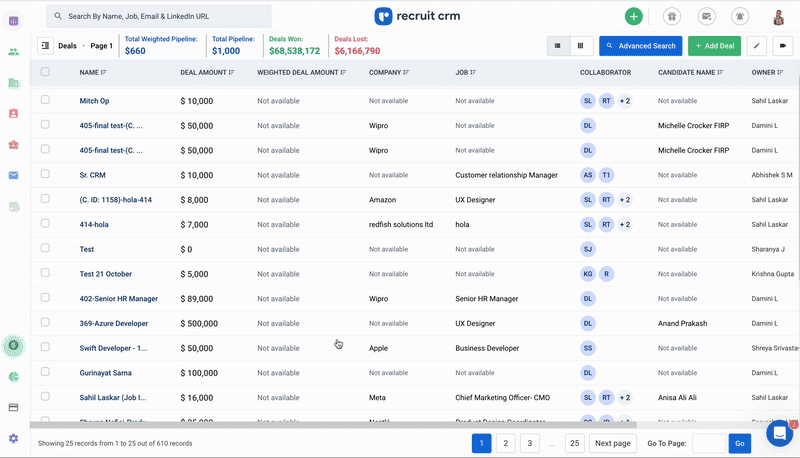
Recruit CRM solves a specific, real problem: agencies that are managing candidate pipelines in one tool and client relationships in another (or worse, in spreadsheets).
What makes it work well for agencies is the built-in invoicing and placement fee tracking.
Most CRMs ignore the business development side of agency recruiting, but Recruit CRM treats it as a first-class workflow so you can track client accounts, manage job orders, run placements, and generate invoices without switching tools.
The interface is also genuinely easy to use for an agency platform. Kanban-style pipeline views, client dashboards, and drag-and-drop candidate management are intuitive enough that new team members can get productive quickly.
Key strengths:
- Built specifically for agencies: Client portals, job order management, placement tracking, and invoicing are all native, not bolted on.
- Combined ATS + CRM: No need to manage two platforms or reconcile data across systems.
- Strong customer support. Consistently mentioned in user reviews. Important for agencies running revenue-generating operations that can't afford slow support response times.
- Flexible pricing. Monthly subscription with no long-term contracts makes it easier to scale up or down.
Potential limitations:
- Pricey per seat: At $85+/user/month, costs scale quickly as the team grows. A 10-person agency is looking at $10,000+/year at the entry tier.
- ATS depth has limits: The ATS component is solid for agency use, but less feature-rich than dedicated enterprise ATS platforms for complex hiring workflows.
- Reporting lacks advanced customization: Data-driven agencies that want drill-down dashboards and custom metrics may find the reporting constrained.
- AI features are on higher tiers: Some of the more advanced AI functionality requires upgrading from the base plan and overall lacks AI native features.
3. Kula
Best for: Startups and scaling companies (50–1,000 employees) that want candidate sourcing, CRM, ATS, scheduling, interview intelligence, and analytics in one system, without stitching together separate tools.
Starting price: $4,800/year for teams up to 50 employees. All features included, no plan-based feature gating. Pricing scales for larget teams.
ATS included: Yes, natively built in. Not a bolt-on or integration.
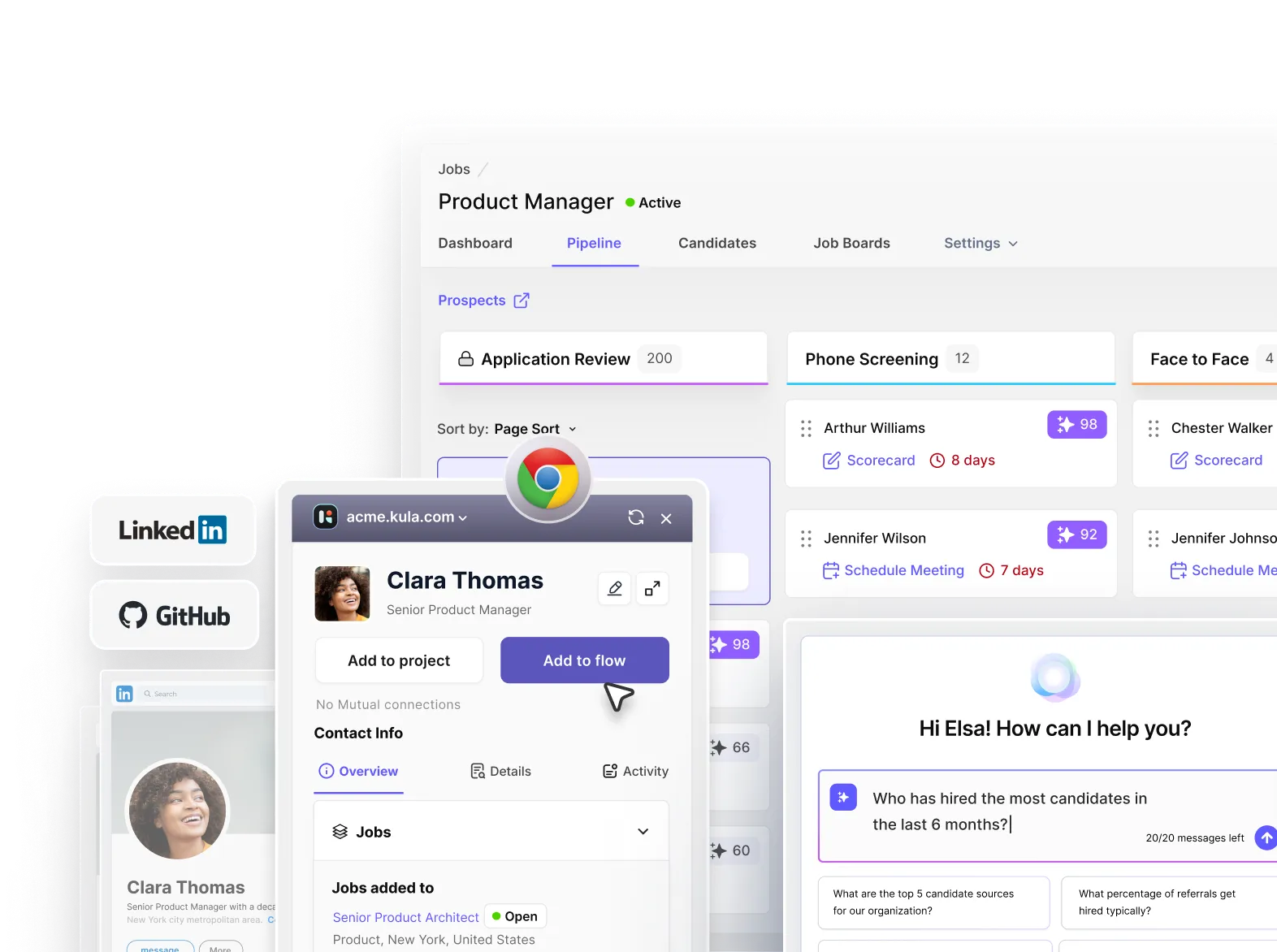
AI capabilities: AI candidate scoring, automated interview scheduling, AI interview notetaker and scorecard auto-fill, conversational analytics (ask questions, get KPIs instantly), AI-powered job descriptions and outreach, and data enrichment.
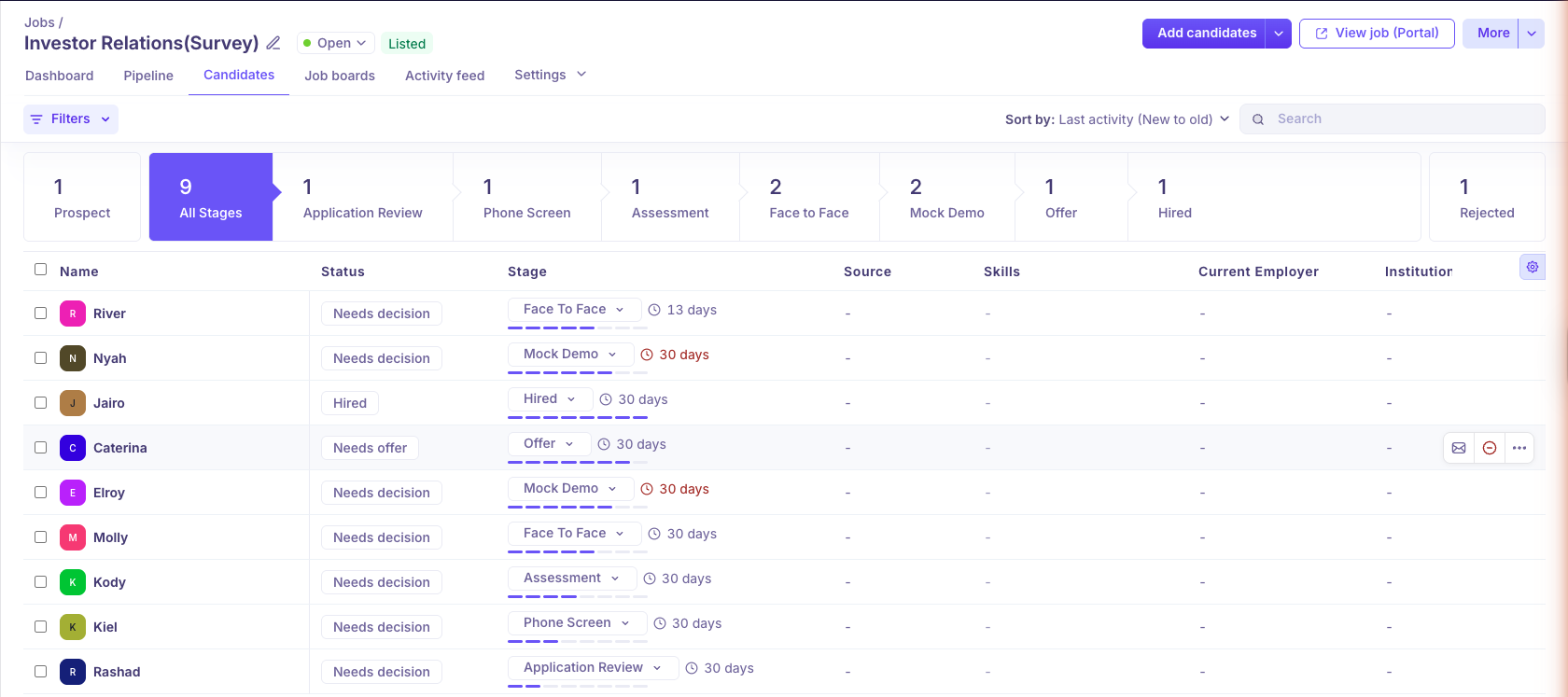
Kula is built around a single premise: recruiting teams shouldn't have to manage a different tool for every step of the process. The platform combines sourcing and CRM, applicant tracking, interview scheduling, interview intelligence, and analytics into one connected system.
The key difference from most platforms is where AI sits.
In most recruiting tools, AI is layered on top as a feature you add on.
But this ATS + CRM platform bakes AI into every step of the workflow. Candidate scoring happens as profiles come in. Scheduling is automated based on interviewer availability. Interview notes are captured, transcribed, and used to auto-fill scorecards. Analytics are conversational. So instead of building reports and searching for them later, you can ask questions and get answers at your fingertips.
Key strengths:
- No franken-stack required: Everything from sourcing to offer letters lives in one system. Candidate profiles, outreach activity, interview feedback, and hiring metrics are all connected—no data fragmentation across tools.
- Built for multiple stakeholders: Hiring managers, recruiters, and TA leaders all have visibility into the same workflows. No chasing feedback across Slack or email.
- Headcount-based pricing: Unlike most platforms that charge per seat or gate features behind higher tiers, Kula prices by company headcount with all features included. For growing teams, this matters — you're not penalized for adding users.
- Fast migration: Designed to be up and running quickly, even for teams moving from legacy platforms. The UI is clean and requires minimal onboarding. Just requires an API key if you’re migrating from other recruiting tools.
- Integrations with DocuSign and PandaDoc: for automated offer letters, and 100+ integrations across HRIS, job boards, and communication tools.
Potential limitations:
- Newer platform compared to legacy tools like Bullhorn or Greenhouse.
- Not built for staffing agencies as there's no client portal, job order management, or back-office billing.
4. Bullhorn
Best for: Established staffing agencies, recruitment firms, and MSPs that need a full recruitment operating system from sourcing and candidate management through to timesheets, billing, compliance, and back-office operations.
Starting price: Custom quote-based pricing. Based on user reviews, entry-level pricing starts around $99/user/month. For a small to mid-size agency, annual costs typically start in the low five figures ($20,000+) and scale up significantly for global operations requiring the full suite.
ATS included: Yes. Bullhorn combines ATS and CRM in one system, with back-office modules available as an add-on at higher tiers.
AI capabilities: Bullhorn Amplify—an embedded AI suite that covers sourcing, screening, outreach, and candidate summaries directly within the recruiter's workflow. Automation keeps pipelines moving without manual data entry.
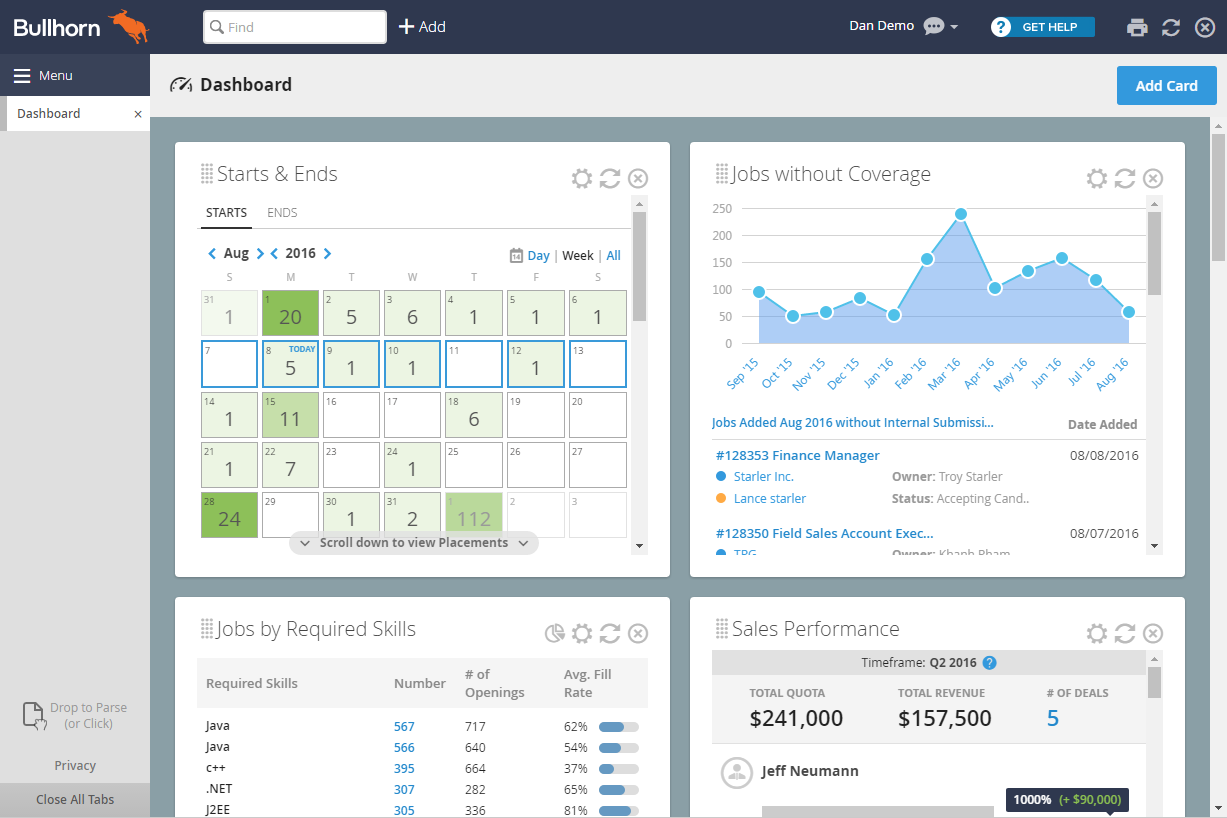
Bullhorn doesn't just manage candidates and clients — it runs the entire placement lifecycle. Sourcing, tracking, client management, job orders, placements, onboarding, timesheets, invoicing, and compliance all live in one system.
For agencies billing on placements and managing large contractor workforces, that integration eliminates significant operational overhead.
Key strengths:
- Full back-office integration: Timesheets, pay and bill, invoicing, and compliance in one system—not something most CRMs offer.
- Scale: Handles thousands of users, global operations, and high-volume temporary staffing without performance issues.
- Vast ecosystem: 100+ marketplace integrations purpose-built for staffing agencies, covering everything from VMS connections to background checks and job boards.
- Database speed: Recruiters managing tens of thousands of candidate records can search, filter, and match at a speed that standalone ATS platforms can't match.
- Industry standard: Easier to hire for and onboard into because most experienced agency recruiters already know the platform.
Potential limitations:
- Expensive to implement: Implementation costs can be significant depending on the level of customization required. Contracts are typically annual, and users report 20% price increases on renewal.
- Complex setup: Bullhorn requires proper implementation and data governance to get ROI. It's not a plug-and-play tool. Teams that treat it as one will struggle.
- Not for in-house teams: The platform is built entirely around the agency business model. Internal corporate TA teams would find it over-engineered for their needs and missing features they actually need.
- Data migration takes time: Moving from a legacy system to Bullhorn ( especially with 50,000+ candidate records) typically takes 4–8 weeks of migration work. Vendors who promise 48-hour go-lives are usually referring to the bare UI, not a fully populated, functional workflow.
- Learning curve: New users consistently flag the initial complexity. It takes training to use Bullhorn efficiently.
5. Manatal
Best for: Small to mid-sized in-house teams and recruitment agencies looking for an affordable, easy-to-set-up ATS and CRM with genuine AI features — without the overhead of enterprise platforms.
Starting price: $15/user/month on the entry plan. The Professional plan starts at $19/user/month. Enterprise plans are $35–59/user/month. One of the lowest price points in the category.
ATS included: Yes. Manatal is a combined ATS and recruitment CRM with applicant tracking, pipeline management, and client management in one system.
AI capabilities: AI candidate scoring and matching, multilingual CV parsing, social media enrichment from 20+ platforms (automatically builds candidate profiles from LinkedIn and beyond), AI Interviewer for asynchronous screenings, AI Notetaker, and direct integration with ChatGPT, Claude, and Gemini.
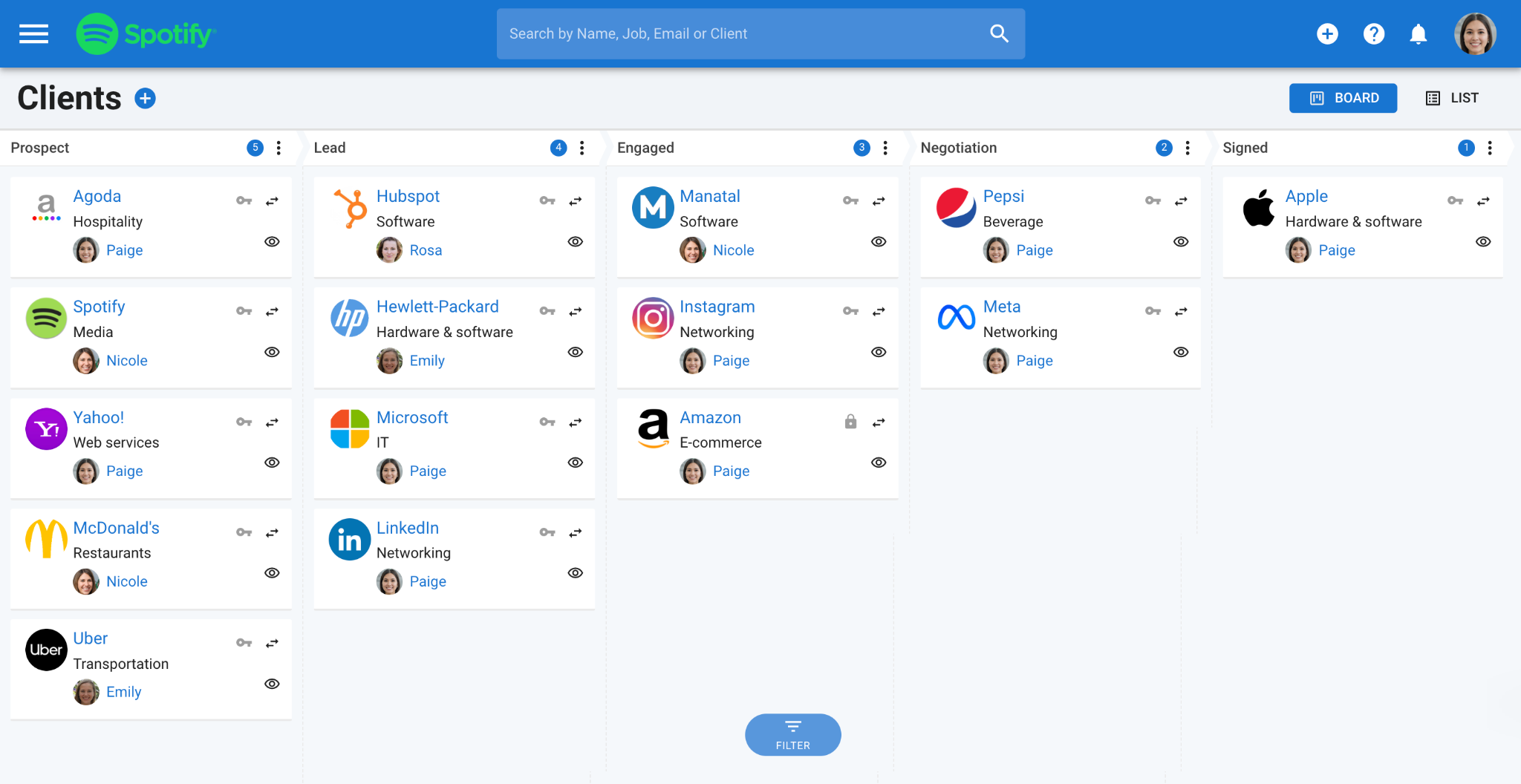
Manatal is designed to be operational fast. Most teams are running real searches the same day they start. Drag-and-drop pipelines, bulk imports, and simple integrations mean minimal onboarding friction offers a meaningful advantage for lean teams without a dedicated ops person.
The social enrichment feature is genuinely useful.
When a candidate applies, Manatal automatically pulls data from 20+ social platforms to build a 360-degree candidate profile, without requiring separate data enrichment subscriptions. For teams sourcing from LinkedIn, the People-Match Chrome extension enables one-click sourcing directly into the platform.
Key strengths:
- Fast setup: Designed to be operational in under an hour. No heavy onboarding process required.
- Social enrichment without extra tools: Automatic profile building from 20+ platforms saves both time and money on third-party data subscriptions.
- Integrations with LLMs: One of the very few ATS’ to offer direct integration with ChatGPT, Claude, and Gemini, giving teams flexibility to build AI-assisted workflows.
- Good for inbound-heavy workflows: AI scoring and candidate recommendations are valuable when managing large applicant volumes.
Potential limitations:
- Entry plan has a 15-job posting cap: Teams with multiple open roles simultaneously will hit this limit quickly and need to upgrade.
- Outbound sourcing is limited: Manatal tracks and scores candidates in your pipeline but doesn't proactively search external databases or run multi-channel outreach the way dedicated sourcing tools do.
- Reporting lacks depth: Data-driven TA teams will find the analytics constrained — limited filtering, few customizable dashboards.
- Not designed for enterprise complexity: Complex approval workflows, global compliance requirements, or multi-region hiring at scale are areas where Manatal will reach its limits.
- Some advanced features are plan-gated: Compliance tools and custom reporting are only available on higher-tier plans.
How to evaluate recruitment CRM software for your team
Don't pick a recruitment CRM based on a feature checklist. Pick the best recruiting CRM system based on where your hiring is actually breaking:
If you're a staffing or executive search agency → Start with Recruit CRM for mid-size agencies, or Bullhorn if you need full back-office operations and are willing to invest in implementation.
If you're an in-house team focused on sourcing and passive candidates → Gem if your primary need is outreach automation and pipeline analytics, or Kula if you want everything — ATS, CRM, scheduling, interview intelligence, and analytics — in one system.
If cost is the priority → Manatal is the most affordable option with genuine AI features. Understand its limits before committing, especially if you're planning to scale outbound sourcing.
If you're unsure between CRM and ATS → The short version: an ATS manages the active hiring funnel (applications to offer). A recruiting CRM manages relationships with passive candidates before they apply. Most modern teams need both — which is why all-in-one platforms like Recruit CRM have grown quickly.
One practical framework before you sign anything: run a 14-day pilot with a real open requisition. Track the actual number of steps it takes to complete your daily tasks.
Ask the vendor for a written data migration plan, not just a go-live timeline. And request references from companies with similar headcounts and hiring models to yours.
Here’s a more detailed framework to help you pick the best recruiting CRM tool for your needs:
Step 1: Start with your recruiting bottleneck
Before comparing CRM vendors, identify the problem you're trying to solve.
- Not enough qualified applicants?
- Low outreach response rates?
- Weak talent pipelines?
- Slow hiring cycles?
- Too much manual work?
The right CRM for a sourcing-heavy team may look very different from the right CRM for a company focused on improving recruiter productivity.
Step 2: Run a real-world pilot
Avoid evaluating software in a sandbox environment. Instead, test the platform using:
- One active requisition
- Real recruiters
- Real candidates
This quickly reveals whether workflows hold up in day-to-day recruiting.
Step 3: Measure recruiter adoption
A recruitment CRM only creates value if recruiters actually use it.
During the trial, pay attention to:
- How long common tasks take
- How many clicks are required
- Workflow friction
- Training and onboarding requirements
If recruiters avoid the system after a few weeks, the implementation will likely struggle.
Step 4: Validate integrations
Many CRM projects fail because data ends up scattered across multiple systems.
Review how the platform integrates with:
- Your ATS
- Email providers
- Calendar tools
- HRIS platforms
- Analytics and reporting tools
The less manual syncing required, the better.
Step 5: Talk to existing customers
Vendor demos highlight best-case scenarios.
Customer reviews often reveal what daily usage looks like after implementation. Look for feedback on product adoption, support quality, implementation experience, reporting, and recruiter workflows—not just feature lists.
Go through YouTube reviews, G2, Capterra, or Select Software reviews and pay attention to the reviews by similar use case teams. You’ll also find a goldmine of real user opinions on user forums like Reddit or even LinkedIn.
CRM implementation and migration checklist
Buying a recruitment CRM is usually the easy part. Getting recruiters to adopt it and ensuring your candidate data is accurate is where most implementations succeed or fail.
Before you buy
A little preparation can save weeks of cleanup later.
- Audit your existing candidate database and identify outdated records
- Remove duplicate candidate profiles
- Review custom fields, tags, and hiring workflows you'll need to migrate
- Define ownership for implementation, training, and ongoing system administration
During implementation
The goal is to get recruiters working in the new system with as little disruption as possible.
- Migrate candidate records and historical activity
- Configure talent pools, workflows, automations, and permissions
- Test ATS, email, calendar, and sourcing tool integrations
- Train recruiters using real hiring workflows rather than generic product demos
After go-live
Implementation doesn't end when the platform goes live. After you’ve implemented your recruiting CRM system, monitor:
- Recruiter adoption and login activity
- Talent pipeline growth
- Outreach response rates
- Time spent on manual recruiting tasks
- Recruiter productivity and hiring velocity
These recruiting KPIs often reveal whether the CRM is improving recruiting outcomes or simply adding another tool to the stack.
How long does CRM implementation take?
The timeline depends largely on data quality, integrations, and the complexity of your recruiting processes. But it’s quite similar to ATS implementation timelines:
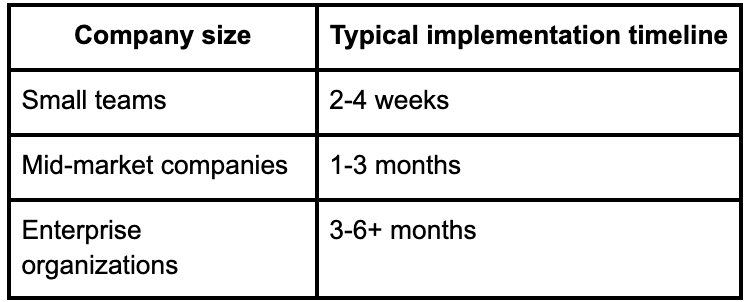
In most cases, cleaning and migrating candidate data takes longer than configuring the software itself. Teams that invest time in data preparation upfront typically see faster adoption and fewer issues after launch.
How to calculate recruitment CRM ROI
The easiest way to measure recruitment CRM ROI is to compare recruiter output before and after implementation.
Start by tracking metrics such as:
- Time-to-fill or time-to-hire
- Time-to-first-candidate contact
- Candidate response rates
- Number of qualified candidates sourced per recruiter
- Recruiter productivity (hires per recruiter)
- Agency spend
- Cost per hire
For example, let's say a recruiting team spends 15 hours each week manually sourcing candidates, sending outreach, and coordinating follow-ups.
If a recruitment CRM reduces that workload by just 5 hours per recruiter per week, a team of five recruiters would save more than 1,200 hours annually.
The ROI becomes even more noticeable when talent pipelines are already in place. Instead of launching a new search every time a role opens, recruiters can re-engage existing candidates and fill positions faster.
Some of the biggest CRM and ATS benefits are also harder to quantify but equally important:
- Less recruiter burnout from repetitive administrative work
- Better candidate experience through consistent communication
- Higher recruiter capacity without increasing headcount
- Reduced reliance on external agencies
- More predictable hiring outcomes
Ultimately, the best CRM software should help with recruitment automation by allowing recruiters to spend less time managing processes and more time building relationships with candidates.

The best recruitment CRM software depends on your hiring goals, team size, and recruiting process. Platforms such as Kula, Gem, Ashby, Lever, Workable, and Pinpoint all offer CRM capabilities, but they differ in areas like sourcing automation, analytics, AI features, reporting, and ATS functionality. Rather than focusing on feature count alone, evaluate how well the platform supports your specific recruiting workflows.
In most cases, yes. Recruiting agencies manage large candidate databases, multiple client requirements, and ongoing candidate relationships. A recruitment CRM helps agencies organize talent pools, track candidate interactions, automate outreach, and quickly identify suitable candidates for new client openings.
An AI recruiting CRM combines traditional candidate relationship management features with artificial intelligence capabilities. Depending on the platform, AI can help with tasks such as candidate matching, resume screening, candidate rediscovery, outreach personalization, interview insights, and recruiting analytics. The goal isn't to replace recruiters but to reduce manual work and help teams make faster, more informed hiring decisions.
Pricing varies significantly depending on company size, features, and whether the platform includes ATS functionality. Smaller teams may pay a few hundred dollars per month, while larger organizations often invest several thousand dollars per month for enterprise-grade recruiting CRM software. Some vendors also charge separately for implementation, integrations, data migration, or premium AI features, so it's important to evaluate the total cost rather than subscription pricing alone.
Usually no. A recruitment CRM and an ATS are designed for different parts of the hiring process. A CRM helps recruiters source, engage, and nurture candidates, while an ATS manages applications, interviews, approvals, and offers. That said, many modern recruiting platforms now combine ATS and CRM capabilities in a single system. For many organizations, the question is no longer whether they need a CRM or an ATS—it's whether one platform can effectively handle both.