




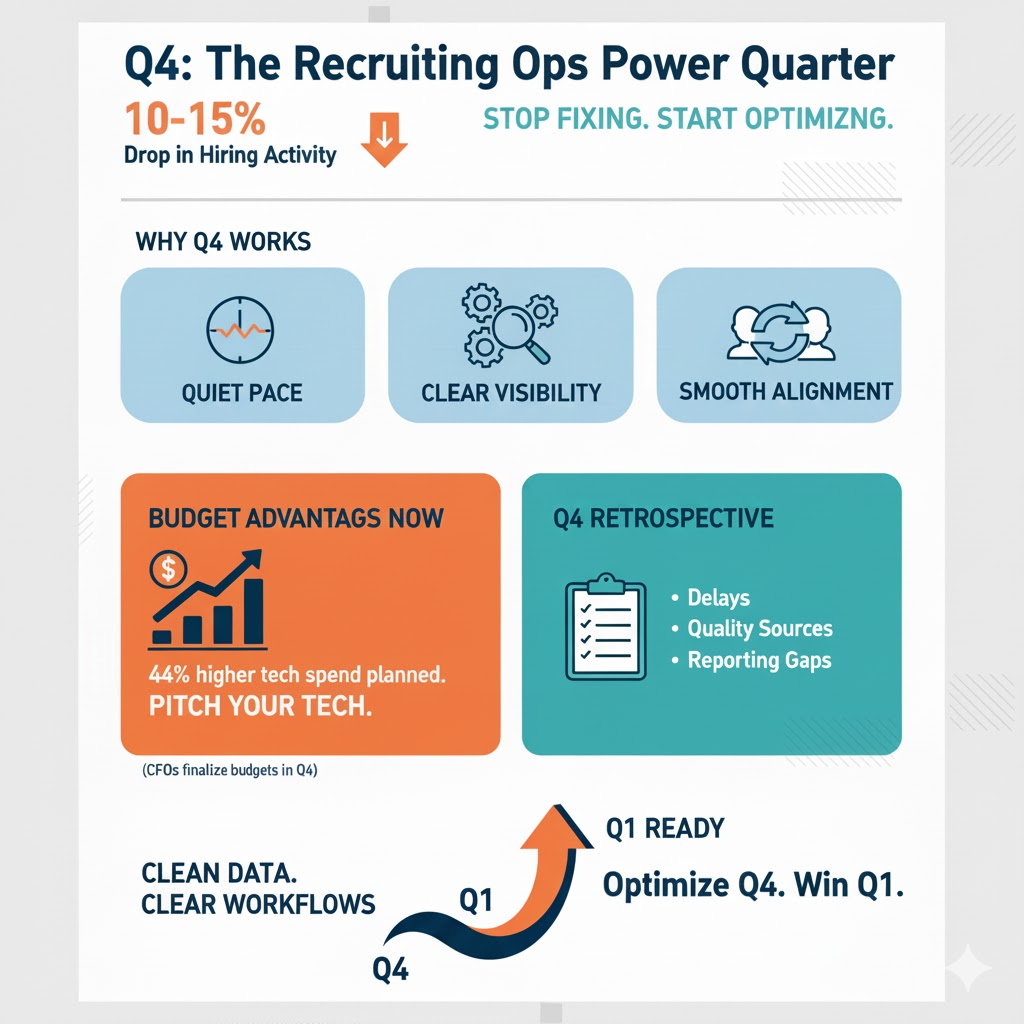
Q4 naturally slows down hiring activity. With fewer new openings and a 10–15% drop in job postings, recruiters aren’t juggling as many screens or interviews. That quieter pace creates space for deeper operational work that’s hard to prioritize during peak hiring periods.
This is why many companies use the end of the year for internal improvements.
When calendars finally open up, teams can focus on things they normally push aside, like workflow cleanups, better documentation, training, or tools they’ve been meaning to evaluate.
A few things make Q4 especially effective for this kind of work:
- Less hiring pressure: Fewer active candidates means fewer coordination and scheduling demands.
- Clearer visibility into issues: You can see broken or slow workflows that get masked during busier months.
- Smoother internal alignment: Stakeholders are more available to discuss process changes, gaps, and improvements.
Budgeting timing also works in your favor during this time of the year. CFOs tend to finalize next-year budgets in Q4. And with 44% of CFOs planning higher tech and services spend this year, Q4 is simply the right moment to bring forward a recruiting tech proposal.
Budget conversations are already happening, so decisions move faster.
It’s also the best time to run a thorough retrospective. With fewer deadlines to chase, you can review:
- Where delays usually happen
- Which sources are actually driving quality
- How long each stage takes
- Where reporting breaks or requires manual work
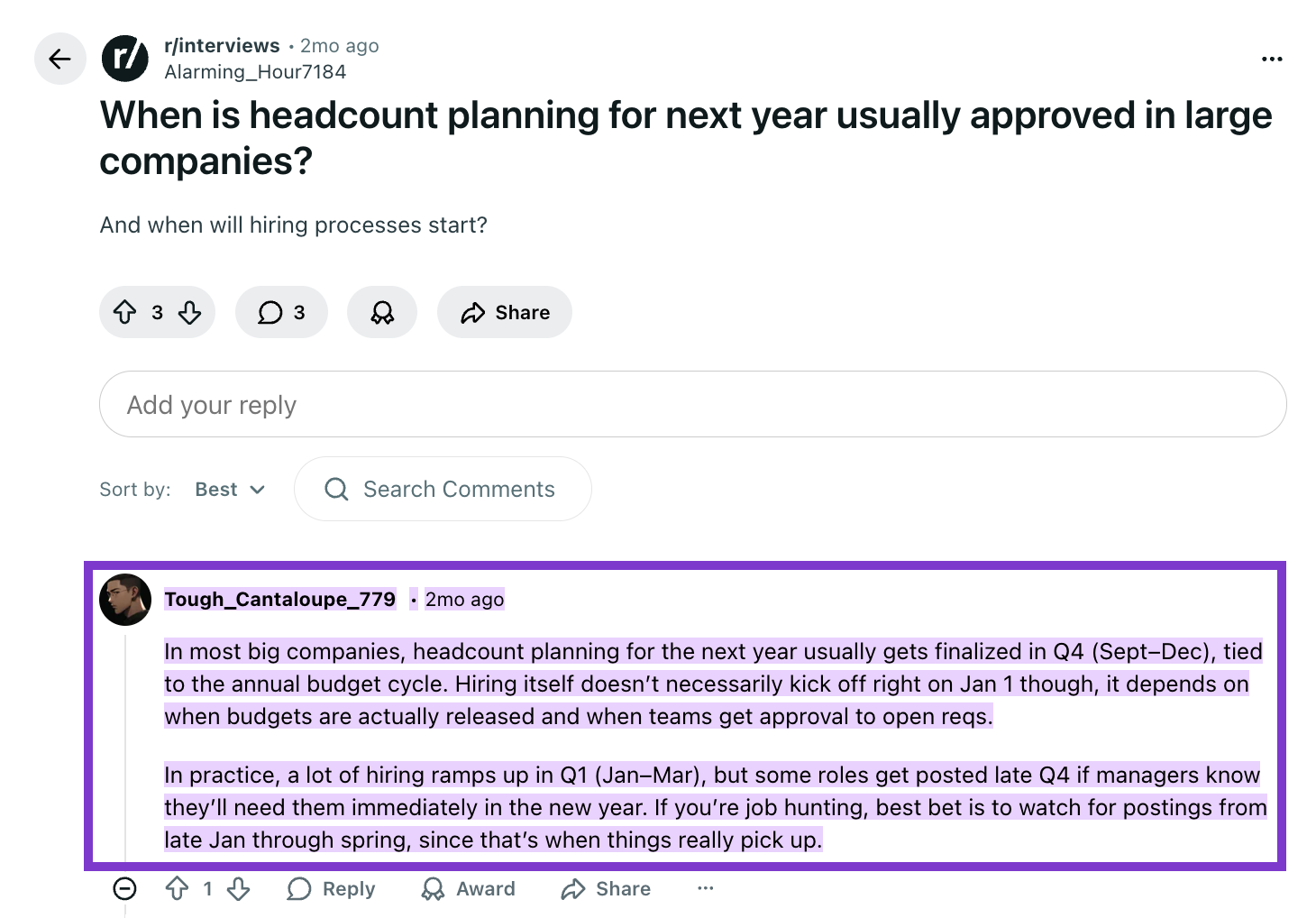
All of this gives you a clean baseline going into the new year. Instead of scrambling to fix issues during peak hiring in January, you walk into Q1 with a more organized stack, clearer workflows, and better data.
The real cost of waiting until January
Waiting until January to revamp your recruiting tech stack feels intuitive, but it creates more friction than most teams expect. Here’s why Q1 is the hardest moment to make system-level changes:
1. January is the busiest hiring month
Data from LinkedIn and Glassdoor show that job postings and applicant activity spike at the start of the year. It’s when the market wakes back up, and teams rush to fill roles opened or approved during annual planning.
Trying to migrate an applicant tracking system (ATS) or rebuild workflows in that period means:
- Overloaded inboxes
- Longer response times
- A higher risk of missing qualified candidates
Even small delays compound quickly when volume is high.
2. Hiring managers have limited time
Stakeholders are juggling kickoff meetings, team planning, and their own Q1 targets. This makes it tough to:
- Get timely scorecard approvals
- Train team members on new workflows
- Introduce new scheduling or feedback processes
Many times, new tech adoption drops not because the system is bad, but because no one has the bandwidth to learn it.
3. Implementations require weeks, not days
Even streamlined applicant tracking system (ATS) implementations take 2–6 weeks, and larger organizations may need close to 90 days before everything is fully stable. Doing this in January can lead to:
- Pipeline slowdowns
- Scheduling gaps
- Incomplete data migration
- Longer time-to-offer for qualified candidates
These slowdowns matter more during peak hiring than at any other time of year.
4. Budget flexibility tightens
Budget approvals are typically finalized by the end of the year. When tool upgrades or consolidation conversations start in January, teams often need to:
- Wait for the next approval cycle, seasonal quarter or
- Stretch existing tools further than planned
Either scenario delays improvements that could have supported Q1 hiring goals.
Ultimately, January adds pressure to every part of the hiring process. But making a tech stack switch in Q4 gives you the time and space to make meaningful changes so that you enter the new year with smoother workflows, a stronger tech foundation, and fewer operational fire drills.
What most teams fix when they revamp their stack in Q4
1. Clunky ATS workflows
Q4 is when teams finally notice how much time they lose to outdated, fragmented workflows. During busy months, these issues get buried under daily demands. But when hiring slows, the friction becomes obvious.
Most legacy and subpar applicant tracking systems force recruiters to jump between multiple dashboards, spreadsheets, and emails to complete basic tasks. Simple actions like updating a candidate stage, checking source quality, or reviewing feedback take longer than they should.
Over time, this slows down the entire funnel and adds unnecessary manual work that doesn’t show up in productivity metrics until you look closely.
2. Manual interview scheduling and coordination
Manual interview scheduling is one of the biggest hidden time drains in recruiting. Many teams only realize how much time it consumes when things finally slow down toward the end of the year.
67% of recruiters spend 30 minutes to 2 hours coordinating a single interview, and 35% say scheduling is the most time-consuming part of the entire hiring process.
That time goes into finding common availability, waiting for interviewer responses, handling reschedules, and manually updating calendar invitations.
During Q4, teams have the space to review these patterns and ask:
- How often do interviews get delayed because calendars don’t line up?
- How many follow-ups happen before an interviewer confirms a slot?
- How much time do recruiting coordinators spend on logistics instead of candidate-facing work?
This is usually when teams decide to automate scheduling.
The benefit becomes even more obvious as we head into January. When applicant volume rises, teams that automated scheduling in Q4 avoid the surge of logistical work that typically slows down hiring in Q1.
3. Weak reporting and gaps in answering CFO questions
Reporting issues usually surface when teams look back at the year’s performance in Q4. Many applicant tracking systems require manual exports, spreadsheet cleanup, or stitching together multiple tools just to answer basic questions.
That creates delays when finance teams ask for metrics like pipeline velocity, cost-per-hire, or forecast accuracy.
This is also the period when CFOs want clear numbers to finalize next-year plans. If the recruiting team can’t quickly pull accurate data, it stalls budgeting and makes it harder to justify new headcount or tools.
Teams that switch to modern ATS in Q4 can easily avoid this bottleneck.
Because everything—from sourcing to offers—lives in one system, leaders get real-time dashboards without manual work. It becomes much easier to walk into Q1 with clean data and a clearer picture of what’s working.
Plus, you can get instant insights on recruiting metrics using conversational AI-powered analytics. Just ask and get instant analytics whenever you need them. No more juggling through notes and old folders in your system.
4. Too many tools and constant tab switching
Q4 is when teams finally step back and see how many tools they’re juggling: scheduling apps, candidate sourcing tools, outbound automation tools, separate reporting platforms, and sometimes multiple extensions.
Many organizations rely on 2 to 5 paid talent acquisition tools, and 25% already rely on only one, indicating a growing push toward consolidation.
Managing several disconnected tools leads to higher spending, scattered data, and a more complicated workflow than necessary. When hiring slows, the inefficiencies become obvious—especially when each tool requires separate logins, onboarding, and integrations that don’t always sync data correctly.
This is often the moment teams evaluate whether an all-in-one platform like Kula can replace most of the point solutions they’ve collected over time. Consolidation not only simplifies workflows but also reduces tool spending heading into the new year.
5. Hiring volume noise and lack of automated screening
Recruiters often spend 30–90 seconds reviewing each resume, and when hundreds of applications come in, manual screening quickly becomes unmanageable.
This is also when teams notice a pattern: good candidates slip through simply because recruiters don’t have the bandwidth to review every profile thoroughly.
Q4 gives teams enough breathing room to assess where these drop-offs happen and whether manual screening is slowing them down more than they realize. Many organizations use this period to adopt automated screening so they can walk into January without the backlog that usually builds in the first few weeks of the year.
With AI application scoring, recruiters can instantly surface the top percentage of high-fit candidates and reduce time spent filtering through unqualified resumes. It keeps teams focused on quality rather than volume and helps avoid the strain that comes with Q1 hiring surges.
Why an AI-native ATS makes the biggest impact when introduced in November
1. AI scoring gives you a clean, high-quality pipeline before Q1 begins
Q4 is the best time to switch to modern ATS because with its advanced features such as AI Scoring, you’ll get a system that’s trained, calibrated, and fully adopted before inbound volume increases.
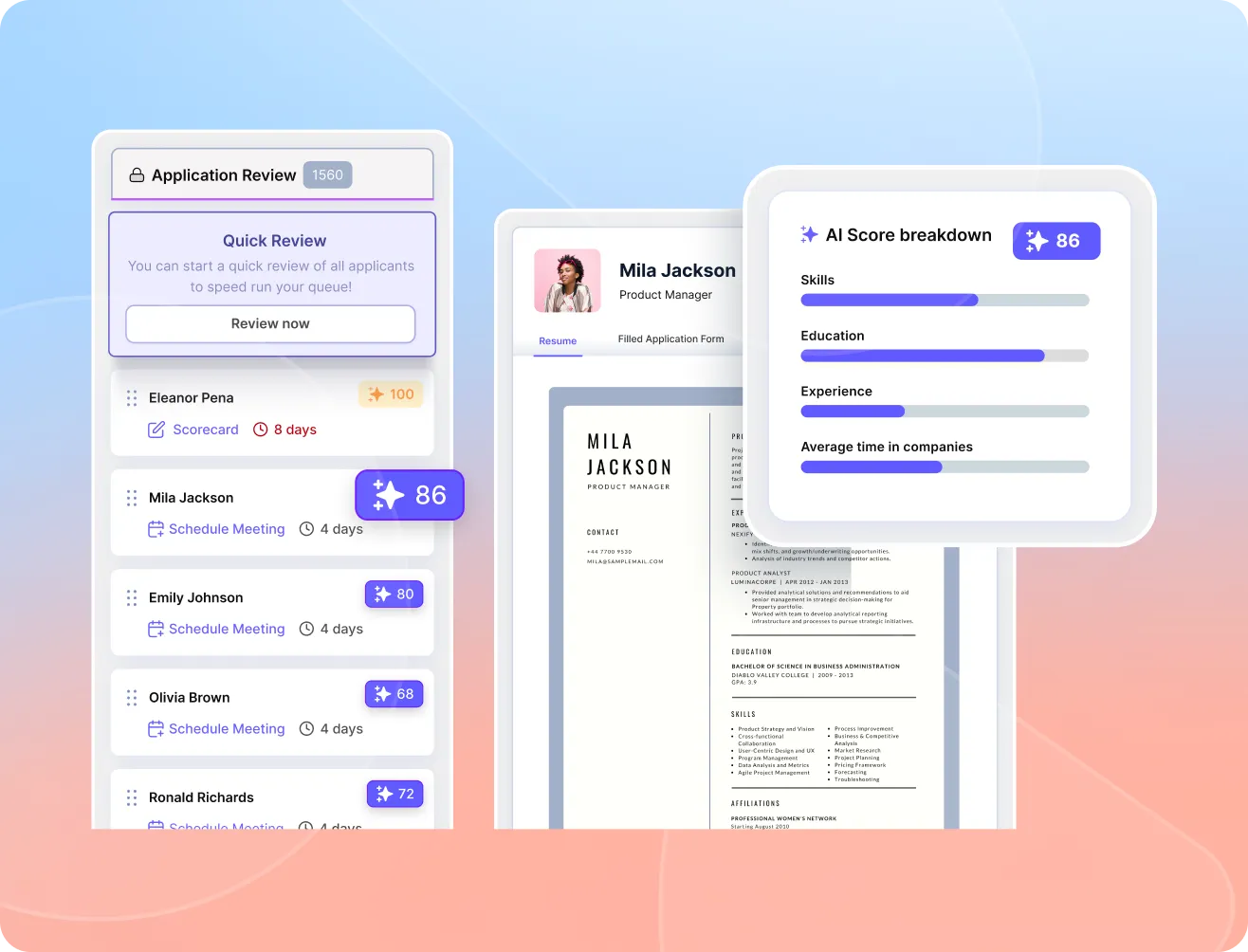
Unlike generic resume filters, AI scoring models learn from your hiring patterns and role requirements with human-level nuance.
Making the switch in Q4 means:
- AI scoring is already tuned to your org by the time applications spike
- Strong candidates surface instantly without manual review
- Your team enters Q1 with a system that handles volume automatically
- Recruiters avoid the “first week of January backlog” that usually slows them down
Instead of reacting to Q1 volume, you walk into the new year with a pipeline that’s already organized, scored, and prioritized.
2. AI notetaker creates instant alignment across interviewers
The end of the year is the most seamless time to introduce AI Notetaker into your system because interview loads are lighter and teams can adopt it without pressure.
This matters because most companies struggle with timely feedback. Only 44% of applicants receive feedback within a few weeks, and just 37% hear back within one week. Slow or incomplete notes are usually the reason behind these delays
With AI notetaker, you can automatically capture notes, key moments, and structured summaries directly within the platform, so documentation stays consistent and complete within your ATS database. The best part is, you don’t have to lose focus by writing your own notes.
Switching in Q4 leads to immediate advantages going into January:
- Interviewers already know how to use the tool
- Every interview generates standardized notes automatically
- Hiring managers start the year with reliable, comparable summaries
- Recruiters don’t spend the first weeks chasing feedback
By the time Q1 kicks in, your entire interview loop runs on clean, automated documentation — not late notes or inconsistent scorecards.
4. Unified dashboards make next-year planning easier
Q4 is when teams look back at the year and try to understand what actually worked. But that’s difficult when data sits across multiple tools — sourcing platforms, scheduling tools, spreadsheets, and a legacy ATS that can’t connect the dots.
Switching to modern ATS in Q4 gives you a clean starting point for the new year. Every stage of the funnel, from job distribution, sourcing, screening, interviews, to offers, lives in one system. That means you can walk into January with:
- Clear visibility into pipeline health
- Accurate time-to-hire, conversion, and source-effectiveness metrics
- Real-time insights instead of manual exports
- Customizable dashboards that are already set up for Q1 forecasting
By the time planning conversations start, your data is organized, consistent, and ready to share with hiring managers and finance — without scrambling to pull numbers from five different places.
5. Consolidation reduces tool spend heading into the new year
We know that Q4 is also the period when CFOs finalize spending for the next year, making it the most practical time to streamline your tech stack.
Many teams realize they’re paying for multiple overlapping tools like scheduling platforms, reporting add-ons, and sourcing extensions, simply because their ATS can’t support these functions well.
Switching to all-in-one ATS in Q4 helps teams consolidate 4–7 tools on average, reducing both cost and operational complexity. And since everything is built directly into the Kula— sourcing, referrals, AI scoring, scheduling, reporting, and interview intelligence — you start the new year with:
- Fewer vendors to manage
- Lower total tool spend
- Less context switching
- Stronger adoption across the team
By the time January arrives, you’re not just working faster — you’re working with a simpler, more cost-efficient stack that’s aligned with next-year budgets.
Overhauling your recruiting tech stack in Q4 gives you enough space to evaluate what’s slowing the team down and make upgrades without disrupting active hiring.
When you enter January with cleaner workflows, better data, and tools that are already adopted, you start the year with fewer bottlenecks and a clearer path to hitting your hiring goals.
Ready to walk into January with a stronger stack? Book a demo now and see how Kula can make that happen!

Because Q4 usually means less hiring activity, lighter interview loads, and more free time, giving recruiting teams the breathing room they rarely get during busier months. It’s also the time when budgets get finalized, which speeds up tool-buying decisions and approvals.
The end of the year is an ideal time to implement a new recruiting tech stack. Implementing when things are quieter lets you migrate data, update workflows, and train teams without risking missed candidates during a hectic hiring season.
Red flags include: juggling too many unconnected tools, spending lots of time on manual scheduling, poor visibility into pipeline and hiring metrics, slow time-to-hire, and heavy reliance on spreadsheets or email just to keep track of candidates.
You get faster workflows, centralized candidate data, automated scheduling and communications, better reporting and analytics, fewer manual tasks. This lets recruiters spend time on sourcing and engaging candidates rather than admin work.