


Technical hiring is a different sport.
Generalist recruiting frameworks do not apply at the engineering pipeline level.
Why? Resume inflation is worse, signal-to-noise is harder to separate, hiring manager calibration is more complex, and AI is reshaping how technical assessments are conducted.
Every tech company knows this, but most ATS comparison articles do not.
This article takes the actual problems of technical hiring as the starting point and works backward to what an ATS needs to do. It also compares the best ATS tools for mid-market tech companies.
Why technical hiring breaks generalist ATS workflows
Five things about technical hiring that change ATS evaluation:
1. Volume is higher, and the signal is worse
Engineering roles attract more applicants than almost any other category, but only a small percentage are genuinely qualified. A 200-applicant engineering pipeline produces maybe 15 to 20 candidates worth a real conversation.
The rise of AI-generated resumes has made it more difficult to differentiate strong candidates from those who simply match keywords.
The ATS has to make finding them tractable.
Technical hiring teams need AI-assisted screening, intelligent ranking, and flexible filtering that surface qualified candidates without sacrificing review quality.
2. The pipeline structure is fundamentally different
Engineering hiring is more complex than a typical sales or marketing role. Its hiring pipeline includes technical assessments, take-home projects, system design interviews, panel rounds, and bar-raiser interviews.
ATS platforms that are built around generic five-stage pipelines struggle to accommodate these workflows without extensive customization.
3. The hiring manager is also doing the screening
Unlike many business functions, engineering managers participate heavily in candidate evaluation.
An ATS can't be designed only for recruiters, it has to be intuitive enough for people who are not professional ATS users.
The Webflow VP of Engineering put it directly: "When I visit an engineer's profile, I can see, oh, Anna has already emailed this person. It eliminates the multiple-reachout problem, which is such bad form."
Shared visibility and seamless collaboration become operational requirements rather than nice-to-have features.
4. Sourcing happens outside the ATS by default
Most engineers are sourced proactively through GitHub, Stack Overflow, conference speaker lists, and niche developer communities.
The ATS needs Chrome extensions and integrations that capture candidates from these sources, not just LinkedIn.
5. Technical hiring requires a structured evaluation
Engineering candidates are evaluated across multiple dimensions, often by several interviewers with different areas of expertise.
Without standardized scorecards and competency-based rubrics, feedback becomes subjective, calibration discussions take longer, and hiring decisions become inconsistent.
The five problems tech recruiting teams are actually trying to solve
Problem 1: Resume inflation at the junior level has made screening unreliable
Engineering roles attract hundreds, sometimes thousands, of applications. Keyword-based resume screening is no longer enough because many candidates optimize their resumes to match ATS filters. The real hiring signal comes from structured assessment data, not the resume.
As one recruiter shared: "I've been hiring early-career professionals... a significant amount of resume inflation, skill exaggeration, and domain knowledge gaps that only become obvious during technical interviews. It's becoming increasingly time-consuming to filter genuine talent from embellished profiles."
The answer is ATS with comprehensive screening workflows that incorporate structured assessment data, recruiter judgment, and technical signals rather than relying primarily on resume keywords.
Problem 2: AI screening tools fail badly on technical roles when they fail
When generic AI screening is applied to engineering pipelines, the results can be catastrophic.
Generic resume-screening models often fail to understand the nuances of engineering roles, seniority, and specialized skills, leading to inaccurate recommendations.
One recruiter described the experience: "I noticed one guy flagged as fit and when I started looking further, he was a journalist... his CV didn't even mention a lick of anything we asked for... I thought maybe it was a glitch, then it flagged a junior frontend dev as fit for the senior backend role. It was a complete disaster."
The lesson is to use AI that was actually built for technical evaluation, not generic resume scoring.
Problem 3: Technical assessments are being gamed by AI tools
Take-home assignments are rife with opportunities to use AI and cheat. Live technical assessments are great to avoid that.
One CoderPad user described the pattern: "Out of 30, maybe 3 are total stars with 99%, but when I watch a recording, 1 left the screen on multiple occasions, so I can't rely on that this person didn't just cheat."
The ATS has to support proctored assessments, live interview integration, and tracking of which candidates completed what kind of evaluation.
Problem 4: Engineering managers reject candidates on subjective criteria
The recruiter-versus-engineering-manager calibration problem is the single biggest political friction in technical hiring.
One talent acquisition partner described: “Engineering managers reject 90 percent of candidates based on a subjective coding exercise with 'no score card, no clear checklist. It's simply that they needed too much prompting, or I don't think they're seniors, and a rejection."
When the ATS does not enforce structured scorecards and competency-based rubrics, interview feedback quickly becomes subjective, this pattern becomes inevitable.
Problem 5: Sourcing happens in multiple places, and the ATS cannot capture it
GitHub is the most cited source for engineering hiring, but the hardest to operationalize.
GitHub profiles are not standardized, so recruiters need to spend more time understanding each candidate's experience and skills. Also, there is limited contact information.
Most ATSs treat LinkedIn as the default source and require workarounds for everything else.
Look for an ATS that solves a real problem and lets recruiters capture a GitHub profile in one click.
The five things tech companies should actually evaluate when picking an ATS
Buying framework specific to technical hiring.
1. Structured scorecards and rubric enforcement.
The ATS must support role-specific scorecards, competency-based rubrics, standardized rating scales, and the ability to require interview feedback before candidates move to the next stage.
This is the mechanism that resolves the engineering manager calibration problem.
As one recruiting leader advised:
"Propose a rubric pilot, not a process change. Ask them to add a structured scorecard for the next 10 interviews. That alone usually surfaces how subjective the current scoring is."
2. Technical assessment integrations
Native integration with CoderPad, HackerRank, Codility, CodeSignal, TestDome, and others is a must. The integration should pull scores, completion data, and recordings back into the candidate profile automatically. If the recruiter has to manually log assessment results, the ATS has failed at the integration level.
3. Multi-source sourcing capture
Technical sourcing rarely starts inside the ATS. Recruiters discover candidates across GitHub, LinkedIn, personal portfolios, open-source projects, conference speaker lists, referrals, and developer communities.
An ATS should support browser extensions and sourcing integrations that allow recruiters to capture candidates with a single click while automatically importing available profile information.
4. Engineering manager UX
Engineering managers are some of the most important users of an ATS, but recruiting software is rarely their primary tool. If reviewing candidates, completing interview feedback, or collaborating with recruiters feels cumbersome, adoption suffers.
Look for an interface that enables hiring managers to review pipelines, submit structured feedback, collaborate with recruiters, and even participate in sourcing without extensive training.
5. Historical candidate data mining for evergreen technical roles
The most valuable engineering candidates are often people you spoke to 12 months ago and did not hire. Your ATS must make it easy to surface them using interview scores, technical competencies, recruiter notes, and hiring outcomes.
Ramp's recruiting team highlighted this advantage:
"Say we spoke to a Joe Smith last year and didn't hire that person because their technical communication was one mark off of what we felt comfortable with. With our ATS, we can look at all the folks who scored similarly to Joe, draw a big list, and reach out to them all again."
This is the difference between an ATS that stores candidates and one that helps you rediscover them.
Top 5 ATS tools: Tool-by-tool honest assessment for tech companies
1. Greenhouse
Best for: Tech companies with mature engineering hiring processes and dedicated TA ops capacity.
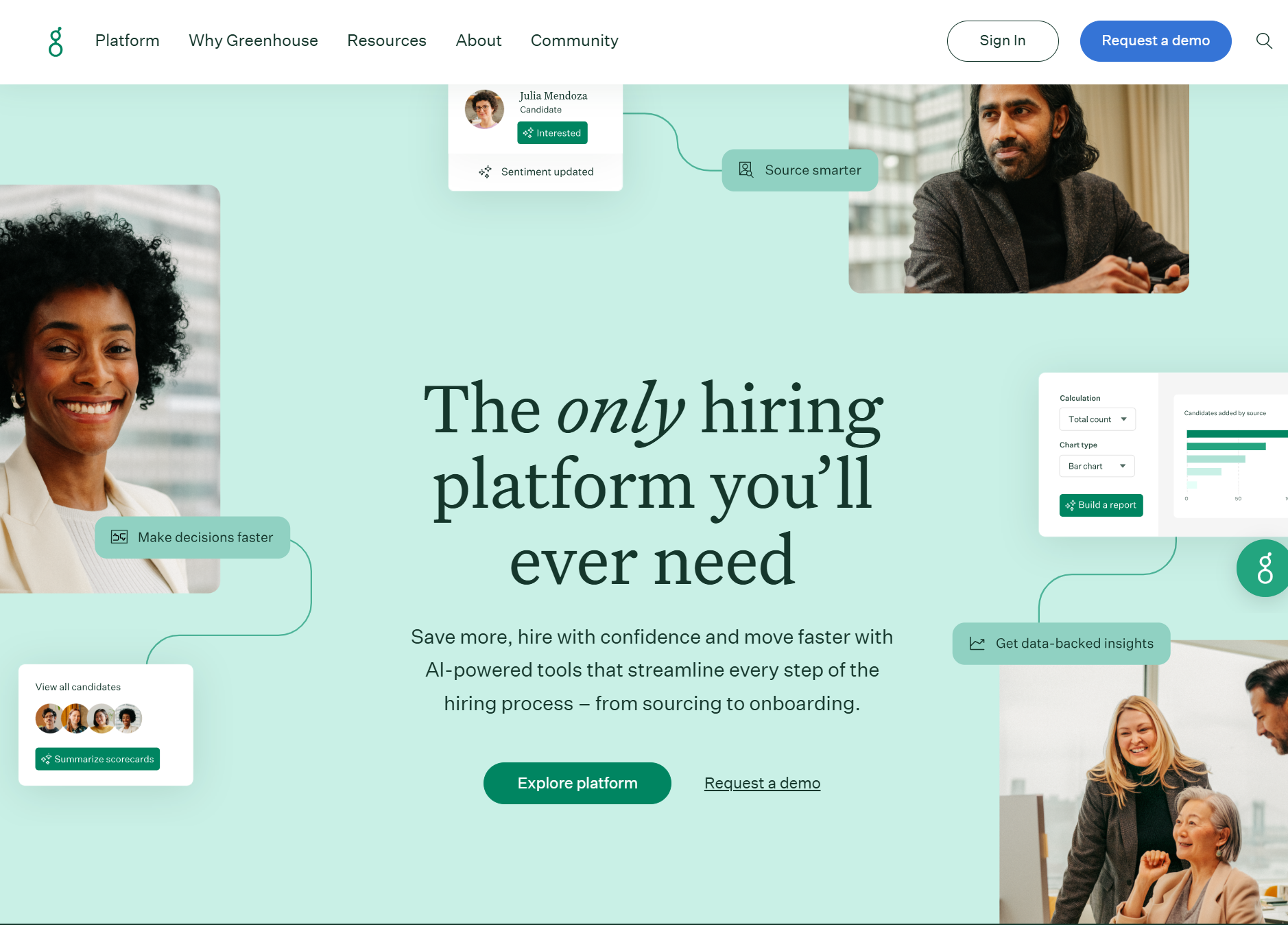
Greenhouse is one of the strongest technical ATS tools. Structured hiring is at the core of the platform. It offers role-specific scorecards, interview kits, predefined competencies, structured feedback, and scorecard summaries.
For sourcing, Greenhouse offers a comprehensive sourcing toolkit, including a Chrome extension, automated outreach, referral management, and integrations with hundreds of sourcing tools.
However, specialized engineering capabilities such as coding assessments, live programming interviews, GitHub integration, and developer evaluations rely on third-party integrations.
Why tech teams choose it: Structured hiring methodology is genuinely engineering-friendly, the scorecard system is robust, the integration ecosystem with technical assessment platforms is mature, and brand credibility with technical executives is high. Many large engineering organizations standardize on Greenhouse.
Why teams struggle: Implementation is heavy, the UI has not kept up with modern engineering tools, product velocity is slow, and the engineering manager's UX has aged poorly. Pricing at scale is also high.
Honest verdict: A legitimate choice for tech companies with TA ops capacity and a methodology-driven engineering recruiting culture. Wrong fit for fast-moving tech teams that want product velocity.
2. Lever
Best for: Tech companies with relationship-driven recruiting and lower engineering hiring volume.
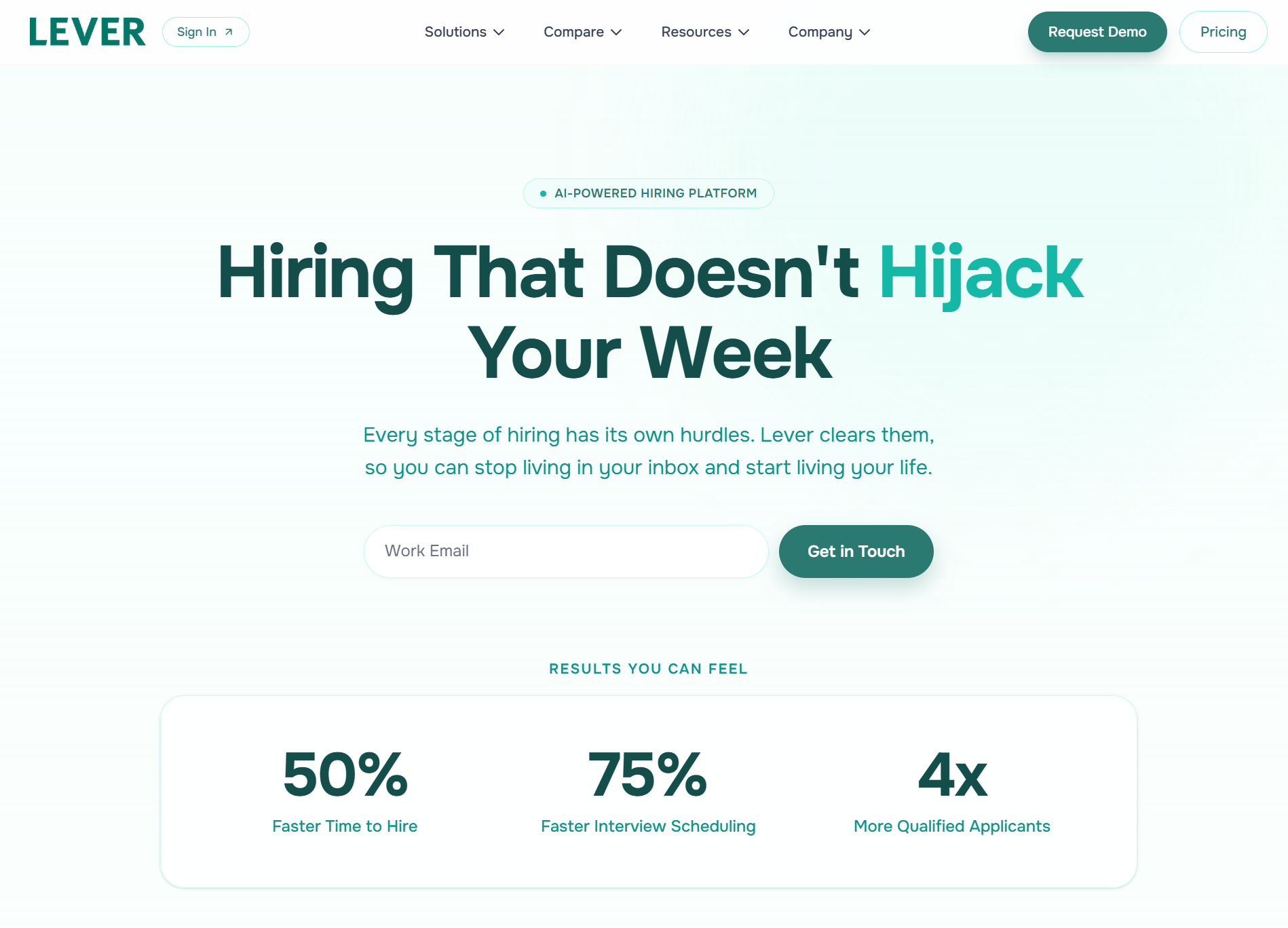
Lever combines ATS and CRM capabilities in one platform and offers automated workflows for sourcing, interviewing, communication, and reporting.
It supports consistent hiring decisions, though Greenhouse still has a slight edge because structured hiring has been its core philosophy for years.
Lever offers an intuitive interface with a comprehensive AI interview intelligence toolkit, and engineering and hiring managers can easily navigate the ATS and submit feedback without excessive training.
The platform integrates well with HRIS, payroll, communication tools, and LinkedIn. It still lacks native GitHub integration. Users can connect using third-party platforms or Lever’s open API.
Why tech teams choose it: CRM-first design is good for nurturing senior engineering candidates over time.
Why teams struggle: Stagnant product, especially noticeable to technical teams that compare it to other tools in their stack. API issues are real and frequently cited: paid but unreliable. Per-seat pricing penalizes scale. Workflow rigidity is a problem for engineering teams that hire across multiple specializations.
Honest verdict: Works for a small engineering team. Becomes a constraint quickly.
3. Ashby
Best for: Technically sophisticated engineering recruiting teams with TA ops capacity.
Ashby combines native sourcing, CRM, and ATS capabilities in a single platform. Recruiters can source candidates using a native Chrome extension, multi-channel integrations, and manage outreach without switching tools.
Interview intelligence is one of Ashby's biggest strengths. Ashby’s structured interview plans include competency-based scorecards, custom feedback forms, AI-generated feedback summaries, and more.
Ashby does not offer native GitHub integration. Users can easily connect it via a third-party platform.
Many users on G2 note that the platform uses highly technical terminology and is less intuitive than other tools on the list. Adoption can suffer in this case.
Why tech teams choose it: Deep analytics, robust API, exceptional scorecard customization, fast implementation. The Ramp archetype-based hiring approach is specifically enabled by Ashby's customization: Historical candidate mining is best-in-class. Engineering teams praise the technical depth and the speed of search.
Why teams struggle: The depth that makes Ashby powerful creates a learning curve. Best for technically sophisticated teams.
Honest verdict: The best tool in the market for teams that want to engineer their recruiting process. A strong choice for engineering-led tech companies with the capacity to invest in configuration. Less of a fit if your TA team wants intuitive over configurable.
4. Gem
Best for: Tech companies where engineering managers source their own candidates and need a unified outreach platform.
Gem is an intuitive platform that allows hiring managers to quickly review applicants, collaborate with recruiters, and make informed hiring decisions without navigating multiple systems.
Sourcing is one of Gem's biggest strengths. Recruiters can source from 800M+ profiles, import candidates from LinkedIn, GitHub, and 20+ sourcing sites using its native browser extension.
The platform integrates with assessment tools (HackerRank, CodeSignal), DocuSign, Checkr, and HRIS platforms.
Gem also supports structured interviews with competency-based scorecards, interview feedback summaries, and automated reminders.
Why tech teams choose it: Strong AI sourcing and sequencing built in, and engineering manager democratization works well. Webflow's engineering managers source directly. CRM functionality is mature.
Why teams struggle: Gem is fundamentally a CRM and outreach layer rather than a full ATS. Teams that use it heavily often pair it with another ATS, which creates a two-system problem. Also, pricing is high.
Honest verdict: A strong outreach and sourcing layer. Less of a complete ATS solution at scale.
5. Kula
Best for: Tech companies consolidating their recruiting stack and prioritizing native AI for engineering pipelines.
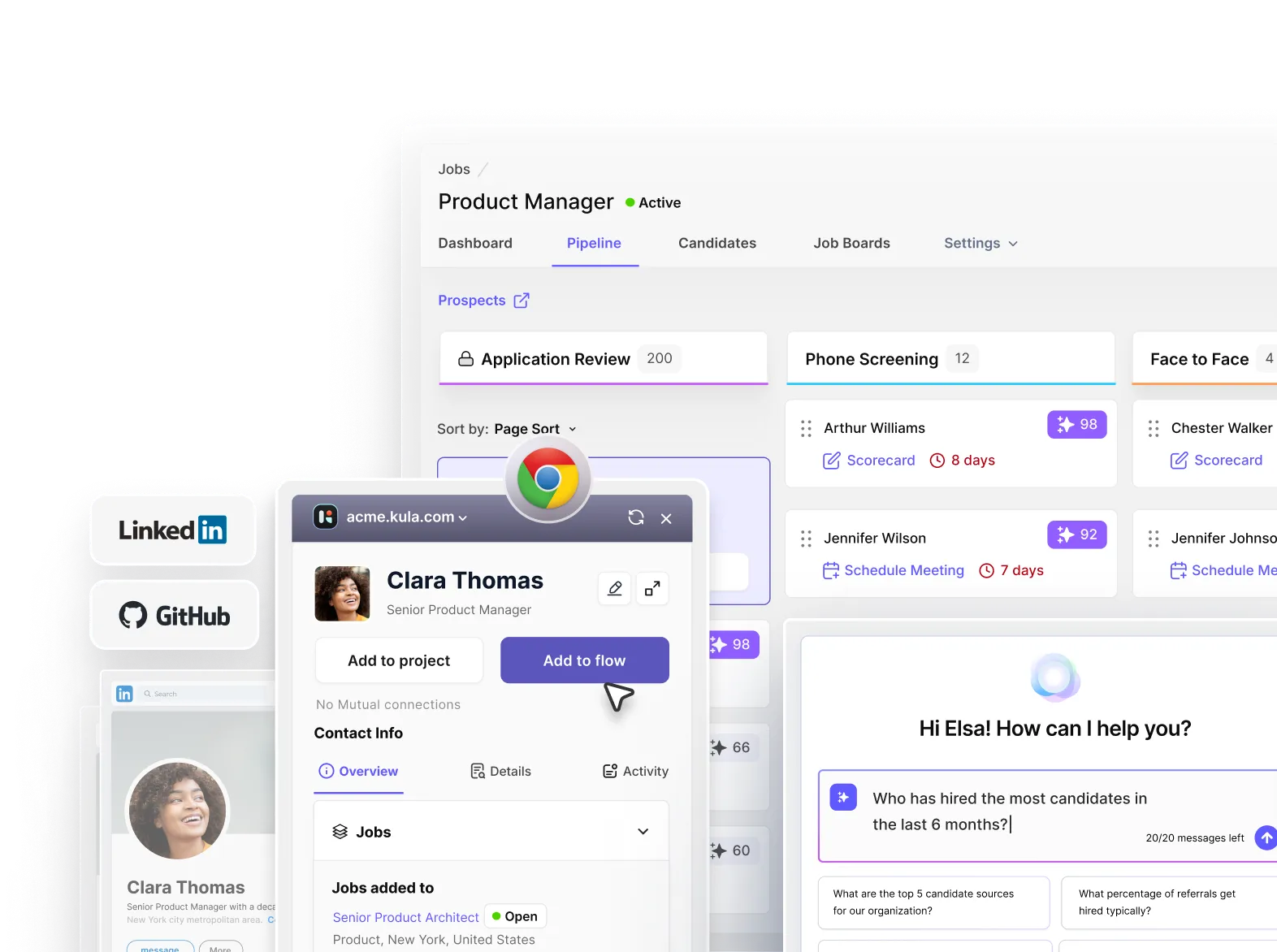
Kula is a native all-in-one platform that consolidates ATS, sourcing, scheduling, and outreach.
Kula stands out for its AI, which is embedded across every stage of the hiring process, from sourcing to onboarding.
For engineering teams, Kula makes hiring and collaboration easier with AI interview transcripts, automated feedback reminders, structured scorecards, GitHub integration, and an open API.
The platform is widely recognized for its intuitive interface with drag-and-drop functionality, helping hiring teams adopt it more quickly.
Why tech teams choose it: All-in-one AI native. Chrome extension for LinkedIn and GitHub. Fast implementation, typically under three weeks. Specifically positioned for technical hiring teams that want consolidation without enterprise overhead.
Why teams struggle: Organizations with highly customized recruiting workflows or broad enterprise requirements may find Kula less configurable than platforms built for extensive customization.
Honest verdict: Built for tech companies that have outgrown lightweight ATS systems, do not have the capacity to configure like Ashby, and want AI-native screening that does not flag a journalist as a backend engineer fit.
How to fix the recruiter-versus-engineering-manager calibration problem
The ATS role in fixing it:
Structured scorecards by role: Require scorecards for every interview round with specific dimensions and 1-to-5 ratings. This makes the rejection criterion legible.
Calibration baselines: Ask the HM to have 2-3 of your current best engineers take the same test, anonymously. Comparing candidate scores against proven employees creates a realistic hiring benchmark rather than relying on subjective opinions. The ATS makes this experiment trackable.
Pass-through rate visibility: When the recruiter can show the engineering manager that their stage of the funnel rejects 90 percent of candidates while every other stage rejects 30 percent, the conversation changes.
The ATS does not solve calibration disagreements. It makes them visible enough to resolve.
The decision framework: three questions that determine the right tool for your tech company
Question 1: How heavy is your engineering hiring relative to other functions?
If engineering is more than 50 percent of hiring volume and engineering managers are heavy users of the ATS, the answer narrows to Ashby or Kula. Both were built with engineering-led recruiting in mind.
Question 2: How much TA ops capacity do we have?
If you have a dedicated person who will own the ATS configuration, Ashby's depth is an asset. If your TA team is lean and you need the tool to work without configuration overhead, Kula's all-in-one architecture fits better.
Question 3: Is sourcing or screening the bigger bottleneck?
If your team's bottleneck is finding candidates, Gem-style sourcing-heavy platforms are worth considering. If your bottleneck is filtering signal from noise at high application volume, AI-native screening platforms become more valuable.
Final thoughts
Technical hiring exposes weaknesses that general-purpose ATS platforms often hide. The right choice depends less on feature checklists and more on where your recruiting bottlenecks actually exist.
For teams looking to consolidate their recruiting stack, an AI-native platform like Kula combines AI scoring, a GitHub Chrome extension, and fast implementation into a single workflow.
As one Web3 engineering company reported, this reduced manual recruiter work while helping surface stronger candidates more quickly.
Book a demo to see how Kula helps engineering teams hire faster and smarter.