

SaaS companies evaluate every piece of software they buy the same way: API access, integration depth, product velocity, and whether the tool feels like it was built in the last three years.
Yet many ATS platforms still fall short on one or more of those dimensions, forcing SaaS companies to compromise between recruiting functionality and modern software expectations.
For instance, most legacy ATS tools were built before modern APIs were standard, ship product updates at the pace of an enterprise vendor, and treat customization as a paid add-on.
That mismatch is why ATS selection has become a strategic software decision for growing SaaS companies, not just a recruiting one.
This article maps out what SaaS companies actually need, the four tools that come up most often in real SaaS recruiting stacks, and the specific reasons teams pick or reject each one.
Why SaaS companies need a different ATS
1. SaaS companies expect their software to ship updates
SaaS recruiters usually work inside Linear, Notion, Slack, Figma, and modern CRMs. Every other tool in their stack ships feature updates regularly.
When the ATS does not innovate, the contrast becomes obvious.
One Tropic recruiter named the problem directly: "The previous ATS vendor's resistance to innovation was a problem. Simple requests like customizing scorecard ratings were not met. The inability to innovate is holding me back from delivering results."
Solution is a modern ATS that adapts to competitive hiring and compliance needs by rolling out new features frequently.
2. APIs and customization are baseline, not premium
SaaS engineers are expected to read the API docs of any tool the company buys. If the ATS has no public API or hides it behind an enterprise upgrade, the company has effectively excluded itself from the SaaS buyer pool.
3. Engineering hiring is the primary use case, not a side use case
At most SaaS companies, engineering hires represent 40 to 60 percent of total headcount and 80 percent of the recruiter's time. The ATS needs to handle technical hiring with the same fluency it handles general hiring.
SaaS teams require an ATS that offers structured assessments, code review workflows, technical interview panels, and engineering manager participation.
4. Speed is a competitive advantage, not a nice-to-have
SaaS companies compete for talent against larger tech companies and other startups. Time-to-hire is a real differentiator.
An ATS should support multiple department pipelines, interview scheduling, async communications, and easy collaboration so teams can make hiring decisions quickly.
5. The recruiting stack is part of the broader software stack
SaaS companies evaluate an ATS the same way they evaluate any other business software: by its ability to fit into their tech stack, scale with the business, and deliver long-term value.
CTOs look for integration capabilities and continuous product updates. CFOs care about the total cost of ownership, while founders want software that will keep pace with the business instead of becoming legacy technology.
They prioritize API access, deep integrations, customization, and a strong product roadmap.
The five problems that force SaaS teams to switch their ATS
Problem 1: The ATS cannot keep pace with the company's hiring scale
SaaS companies grow in non-linear bursts: funding rounds, product launches, and market expansion. The ATS that works for 20 hires a quarter often starts breaking when hiring volume triples.
Recruiters end up relying on spreadsheets, manual workflows, and disconnected tools to manage applications, approvals, and interviews. Instead of supporting growth, the ATS becomes the bottleneck.
Problem 2: Engineering hiring requires customization, the ATS cannot support
SaaS engineering teams hire on archetype, not pedigree.
Most legacy ATS systems force engineering pipelines into the same template as sales pipelines, which do not work for engineering teams.
They want custom scorecards, structured technical assessments, and screening questions specific to the role.
Problem 3: Reporting cannot produce numbers the CEO trusts.
SaaS leaders don't make hiring decisions based on how many applications came in. They need to understand what's slowing hiring, which sources consistently produce top performers, where candidates are dropping off, and whether recruiting is meeting business goals.
If reporting can't drive decisions, it's just record-keeping.
They need an ATS that surfaces actionable insights, identifies pipeline bottlenecks, forecasts hiring progress, and helps leaders decide where to intervene.
Problem 4: The Franken-stack has become operationally expensive
SaaS teams typically end up with multiple hiring tools such as an ATS, a sourcing tool, a scheduling tool, a notetaker, and a sequencing tool. It leads to five vendors, five contracts, and five integrations.
This stack creates additional operational complexity.
As a SaaS company scales, consolidation is not just a cost decision. It is an operational need.
Problem 5: The recruiter is doing manual work that the rest of the company has automated.
Every other department at a SaaS company has automated its workflow. Sales has automation. Customer success has automation. Marketing has automation. When the recruiter is still manually emailing 20 hiring managers a Google Form quality-of-hire survey every week, the gap is obvious.
An ATS must support automation from sourcing to onboarding with built-in AI for speed and efficiency.
The five things SaaS companies should evaluate when picking an ATS
1. API access and developer documentation
The first question to ask any ATS vendor selling to a SaaS company should be "show me your API docs." If the docs are not public or the API is gated behind an enterprise tier, that is a signal.
SaaS companies build internal tooling around their core systems, such as custom dashboards, pipeline reports, and integrations into Slack and Notion. The ATS API has to support that.
2. Customization without vendor intervention
SaaS teams want to configure their own workflows, scorecards, pipeline stages, and approval rules without filing a support ticket. The ATS that requires vendor involvement for routine configuration is the wrong tool.
3. Product velocity from the vendor
SaaS companies care about how often the ATS vendor ships meaningful product updates. If the last significant feature shipped 14 months ago, that tells you something.
Ask the vendor to walk through their last six product releases. The pattern tells you whether the tool will look modern in 18 months.
4. Native AI built into the workflow
AI in recruiting is no longer optional for SaaS companies. The question is whether it is built into the foundation or bolted on.
Bolt-on AI features from legacy vendors generally underperform compared to native AI capabilities in modern hiring platforms.
Ashar Samdani shares his views on the difference between the two:
It’s kind of like comparing an old gas car converted into electric to an EV built electric from the ground up. Bolt-on AI works well when you’re enhancing existing tools. Built-in AI, though, is a different game. This is where AI becomes the core of how your system thinks, learns, and adapts.
For the right ATS, features such as native AI scoring, automated outreach, interview intelligence, and conversational analytics are baseline expectations.
5. Integration depth with the rest of the SaaS stack
The ATS has to integrate with the tools the company already runs on—Slack, Notion, Linear, HRIS, and Google Workspace. Also, Webhook support and Zapier coverage are baseline.
Other than that, out-of-the-box integrations should not require an integration consultant.
Top 5 ATS for SaaS teams: Tool-by-tool honest assessment
1. Greenhouse
Best for: SaaS companies with dedicated TA ops headcount and a compliance-heavy hiring process.
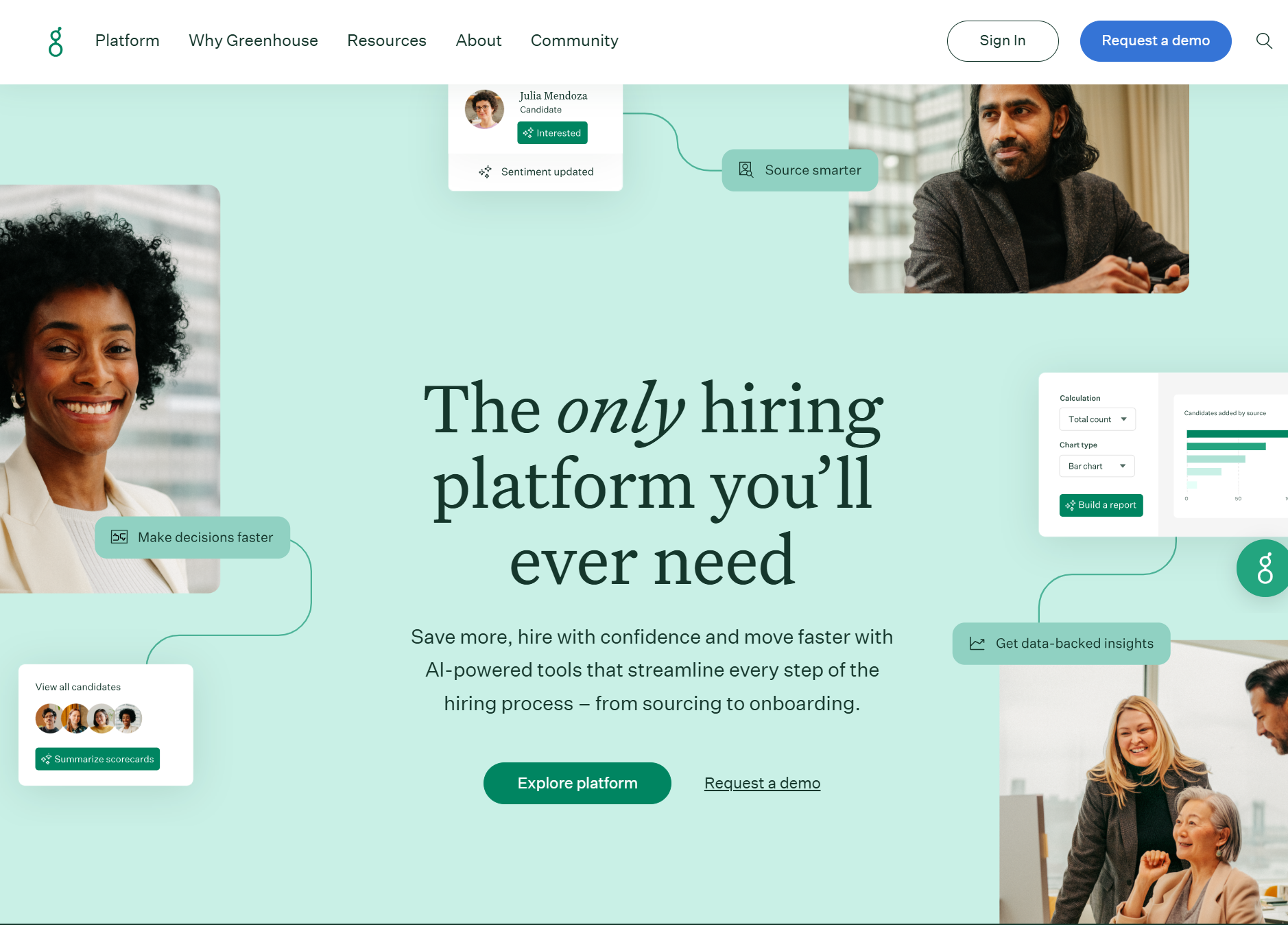
Greenhouse is a modern scaling ATS that offers different pricing plans to support growing startups to global enterprises.
The platform supports the entire hiring lifecycle with a comprehensive set of features and offers automated and customizable workflows from sourcing to onboarding with native AI.
Greenhouse ships monthly product updates. Its June 2026 release introduced 10 product updates, which make it a perfect choice for SaaS teams that value continuous innovation.
Integration is one of Greenhouse's biggest strengths. It offers an open API, developer sandbox, webhooks, and 500+ pre-built integrations, including native Slack integration.
Greenhouse also offers competency-based scorecards, anonymized take-home assessments, and integrations with leading coding assessment platforms specifically for engineering teams.
Pricing: Greenhouse is an all-in-one platform, so there is no need to add a different one-point solution. Greenhouse doesn't publish fixed pricing. Instead, it offers Core, Plus, and Pro plans with custom pricing based on company size.
Why teams choose it: Structured hiring methodology aligns with engineering-led companies, integration ecosystem is mature, brand credibility with engineering executives, and compliance features are strong for regulated SaaS verticals like fintech and healthtech.
Why SaaS teams struggle: Implementation is heavy, and the product velocity is slow by SaaS standards. The UI feels dated to teams coming from Linear or Notion. API access is real but limited at lower tiers. Advanced DE&I analytics is for higher plans.
Honest verdict: A legitimate choice if you have someone to own it. Wrong fit for fast-moving SaaS teams that want product velocity from their vendor.
2. Lever
Best for: SaaS companies with relationship-driven recruiting and lower volume.
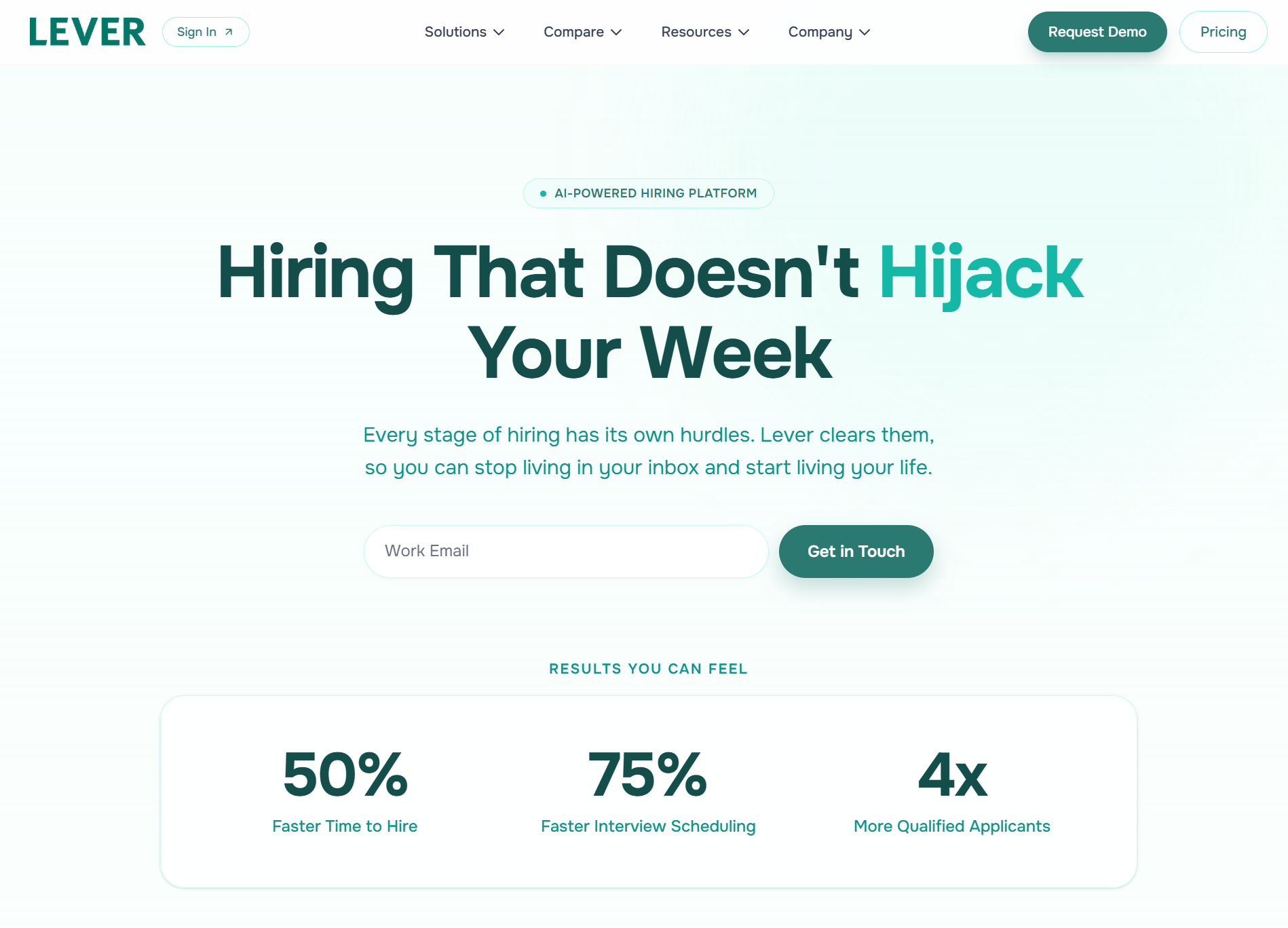
Lever is an intuitive hiring tool and comes with ATS and CRM capabilities as core capabilities. It is particularly best for supporting high-volume hiring, which makes it well-suited for Series A–D SaaS companies expecting rapid hiring growth.
Lever integrates with more than 300 HR and recruiting tools, including Slack. Its APIs make it easy to fit Lever into an existing SaaS tech stack.
AI is embedded as a core capability in Lever. It supports structured hiring with customizable workflows and seamless multi-department collaboration.
Lever also allows engineering teams to build technical interview workflows through interview scorecards, AI-powered interview intelligence, and native integrations with HackerRank and Codility.
Pricing: Lever uses custom pricing based on your company size, hiring needs, and selected add-ons. The core platform includes ATS + CRM, reporting, AI-powered screening, AI interview transcripts, and fraud detection, while capabilities such as Candidate Insights, AI Screening by VONQ, and Onboarding are available as optional add-ons.
Why teams choose it: CRM-first design works well for nurturing passive candidates, familiar to recruiters coming from larger SaaS companies.
Why SaaS teams struggle: Product stagnation is the biggest issue at this stage. A nine-year user said it "looked very similar nine years later and didn't feel like there were substantial or impactful additions or iterations in the product." API access is paid and reportedly unreliable.
Honest verdict: Works for a SaaS team of 100 to 200 employees with one workflow. Becomes a constraint quickly past that point.
3. Ashby
Best for: Analytically sophisticated SaaS teams with engineering-heavy hiring and TA ops capacity.
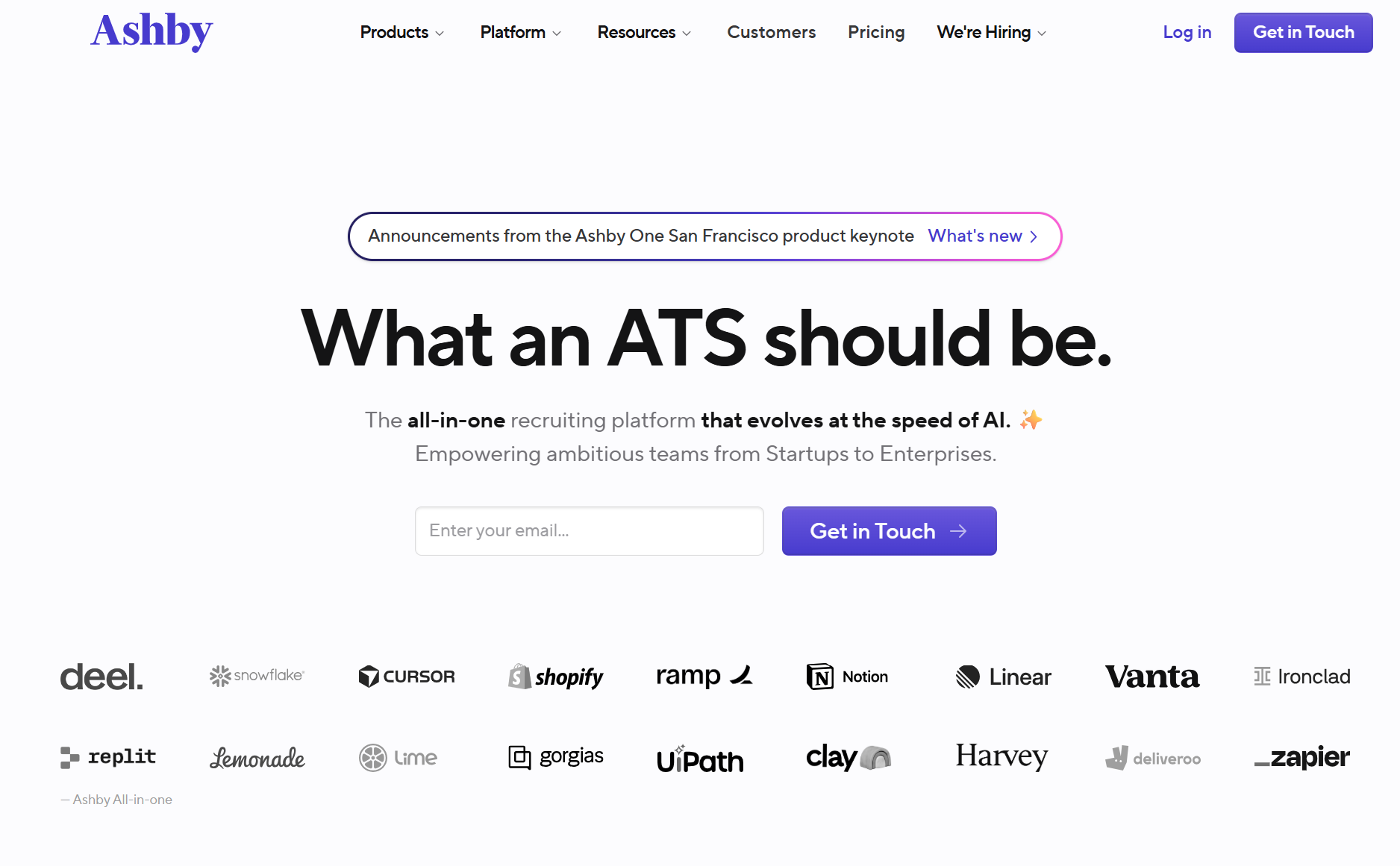
Ashby's all-in-one platform combines ATS, CRM, sourcing, scheduling, analytics, AI, customizable workflows, and recruiting automation into a single system with a technical edge.
Ashby has one of the fastest product release cadences in the ATS market. The company consistently ships AI capabilities updates.
Ashby provides an open API, extensive integrations, a Chrome extension, and Slack integration.
Ashby is also particularly strong for technical recruiting. It supports structured interview plans, customizable technical workflows, custom fields, and permissions.
Pricing: Ashby offers transparent startup pricing starting at $400/month for companies with up to 100 employees. Growth and Enterprise plans use custom pricing based on company size, usage, and contract terms, while advanced capabilities such as Advanced Scheduling and AI Notetaker are available as optional add-ons.
Why SaaS teams choose it: Deep analytics, robust API, genuine workflow flexibility, fast implementation. SaaS teams specifically praise the API and custom fields.
Why SaaS teams struggle: The depth that makes Ashby powerful creates a learning curve. Pricing is not transparent and tends to be high at scale.
Honest verdict: A strong choice for engineering-led SaaS companies with TA ops capacity. Less of a fit for SaaS teams that want intuitive over powerful.
4. Kula
Best for: SaaS companies consolidating a Franken-stack, especially those that need AI-native screening and outreach without a six-week implementation.
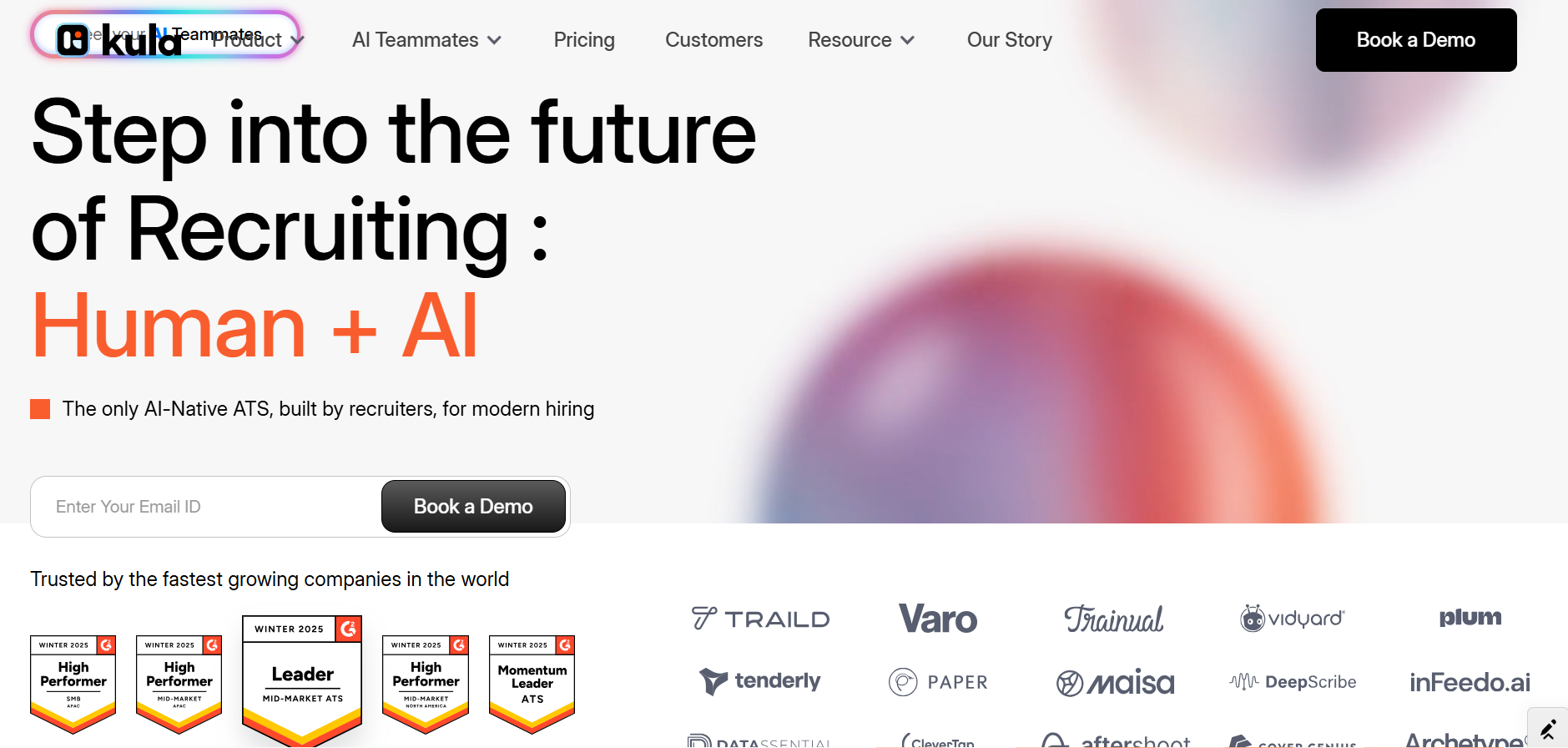
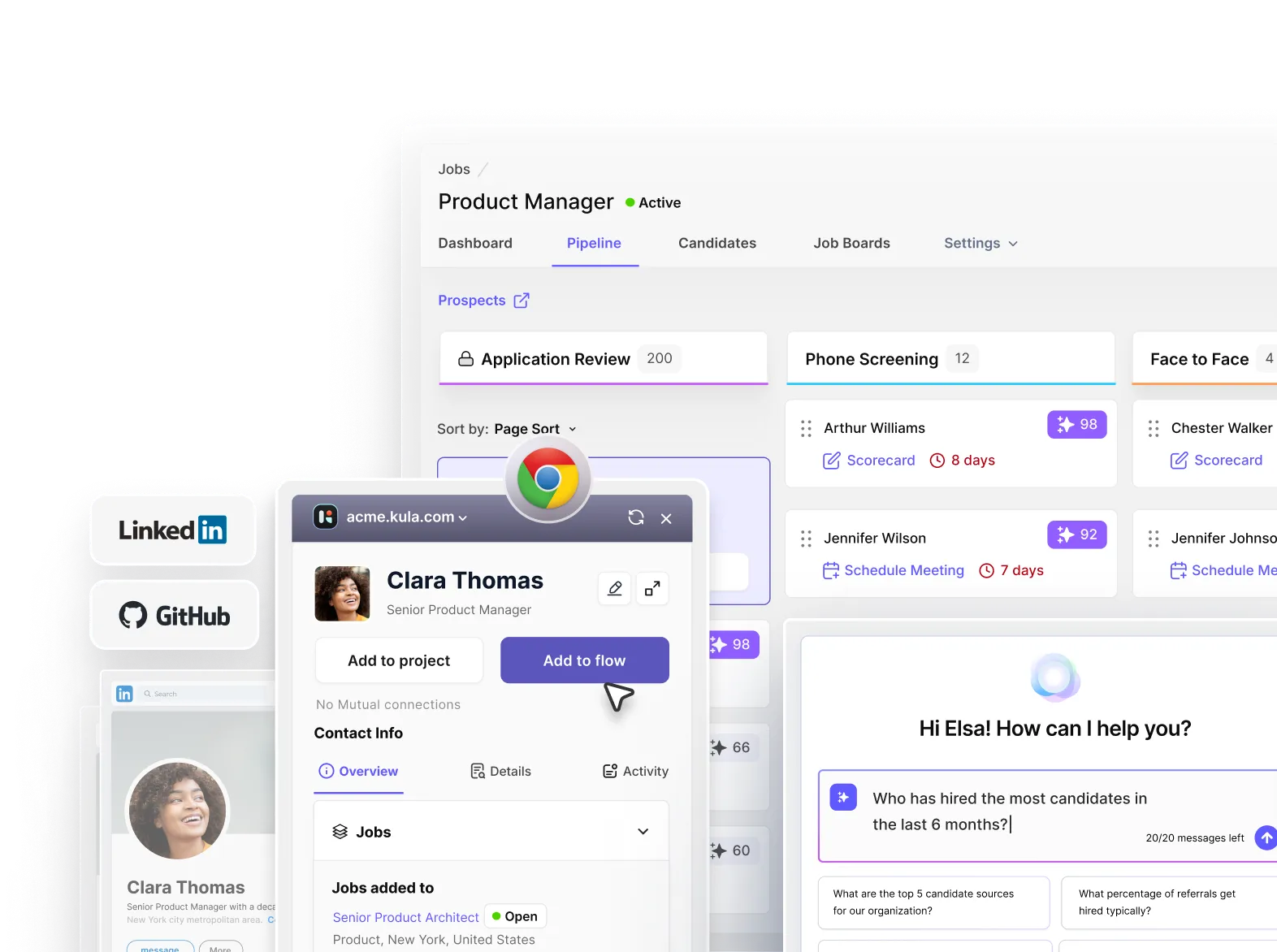
Kula is a true all-in-one modern hiring tool that consolidates ATS, sourcing, scheduling, and analytics. AI is built into the foundation of the platform along with all-inclusive pricing that includes every add-on.
Kula integrates with over 100 recruiting and HR tools( including Slack integration), while also offering APIs, webhooks, and an MCP server for custom integrations and AI workflows–a key advantage for SaaS companies that prioritize extensibility.
Engineering teams can easily run more structured hiring with Kula's AI interview transcripts, GitHub integration, automated feedback reminders, and structured scorecards.
Pricing: Kula offers predictable, all-inclusive, headcount-based pricing starting at $4,800/year for 1–50 employees, $7,200/year for 51–75 employees, $9,600/year for 76–100 employees, and custom pricing for organizations with 101+ employees, with every plan including all ATS features, unlimited AI, data enrichment, integrations, and support without add-ons or usage-based fees.
Why SaaS teams choose it: Kula is known for fast implementation, with Lever-to-Kula migrations reported in under three weeks. Customers such as Dapper Labs chose it over Ashby and Greenhouse because it felt more lightweight, AI-native, and easier for lean recruiting teams to adopt. Mission Cloud also credits Kula's automation with helping recruiters manage roughly three times as many roles while keeping the workload nearly the same.
Why SaaS teams struggle: Wrong fit for enterprise SaaS with complex governance requirements.
Honest verdict: Built for the SaaS company that has outgrown Workable or Lever, does not want the implementation overhead of Greenhouse or Ashby, and wants native AI from day one.
How SaaS companies actually use their ATS: the productivity question
SaaS recruiting teams measure productivity in ways traditional companies do not. The shift is from measuring activity to measuring impact.
The right ATS for a SaaS company supports this kind of measurement natively with funnel analytics by role, pass-through rates by stage, time-in-stage tracking, hiring manager interview load, and recruiter-to-hire ratios.
In SaaS companies, hiring demand grows much faster than recruiting headcount. A modern ATS answers that question by automating the administrative work so the workflow management happens with minimal manual effort.
Productivity also depends on how fragmented the recruiting stack is. When sourcing, scheduling, interview notes, analytics, and candidate communication are spread across different tools, recruiters spend their day switching between systems, maintaining integrations, and duplicating information.
The best ATS platforms solve this by bringing recruiting workflows into a single system.
Ultimately, the value of an ATS isn't measured by how many dashboards it offers or how many AI features it includes. It's measured by one simple question:
Does it give recruiters more time to do the work that actually leads to better hires?
The decision framework: three questions that determine the right tool for your SaaS company
Question 1: How important is API access and customization to our recruiting strategy?
If the team is building internal tooling around the ATS or wants to customize workflows without vendor intervention, the answer narrows to Ashby or Kula. Greenhouse and Lever fall behind on this dimension.
Question 2: How much TA ops capacity do we have?
Ashby offers greater flexibility for teams that have the time and resources to configure and maintain complex workflows. Kula is better suited to teams that want powerful functionality with minimal setup and maintenance.
Question 3: How fast do we need to move?
If you need to be live in three weeks, Greenhouse and traditional Lever implementations are off the table. Ashby and Kula both deliver fast implementation. The differentiator becomes whether you want depth-with-configuration or AI-native simplicity.
The answers to these three questions narrow the choice to one or two tools, not five.
Final thoughts
There isn't a single best ATS for every SaaS company. The right choice depends on your hiring stage, recruiting complexity, engineering hiring needs, and the way your team prefers to work.
For SaaS companies looking to replace a fragmented recruiting stack, adopt native AI without adding point solutions, and get up and running quickly, Kula offers a compelling alternative.
It's all-in-one platform, predictable pricing, and fast implementation have made it a practical choice for high-growth SaaS teams that want to simplify hiring while improving recruiter productivity.
Book a demo to see how Kula can help your recruiting team hire faster with an AI-native platform built for modern SaaS companies.