



Recruiters are dealing with 93% more applications per role than they were just a few years ago. Yet only 8% of applicants make it past initial screening. That leaves recruiting teams spending hours reviewing resumes that were never likely to move forward in the first place.
AI candidate screening promises to fix that by helping recruiters identify qualified candidates faster than manual review or traditional ATS filters.
The challenge is, achieving that speed is easy. But no one wants to miss out on a great candidate.
In this article, we'll look at how AI candidate screening works, how it differs from ATS filtering, where it improves hiring outcomes, and where recruiters still need to rely on human judgment.
What AI candidate screening actually is and how it differs from ATS filtering
A lot of recruiting teams already believe they're using AI screening. But in reality, many are still just using advanced keyword filtering.
And yes, there’s a difference.
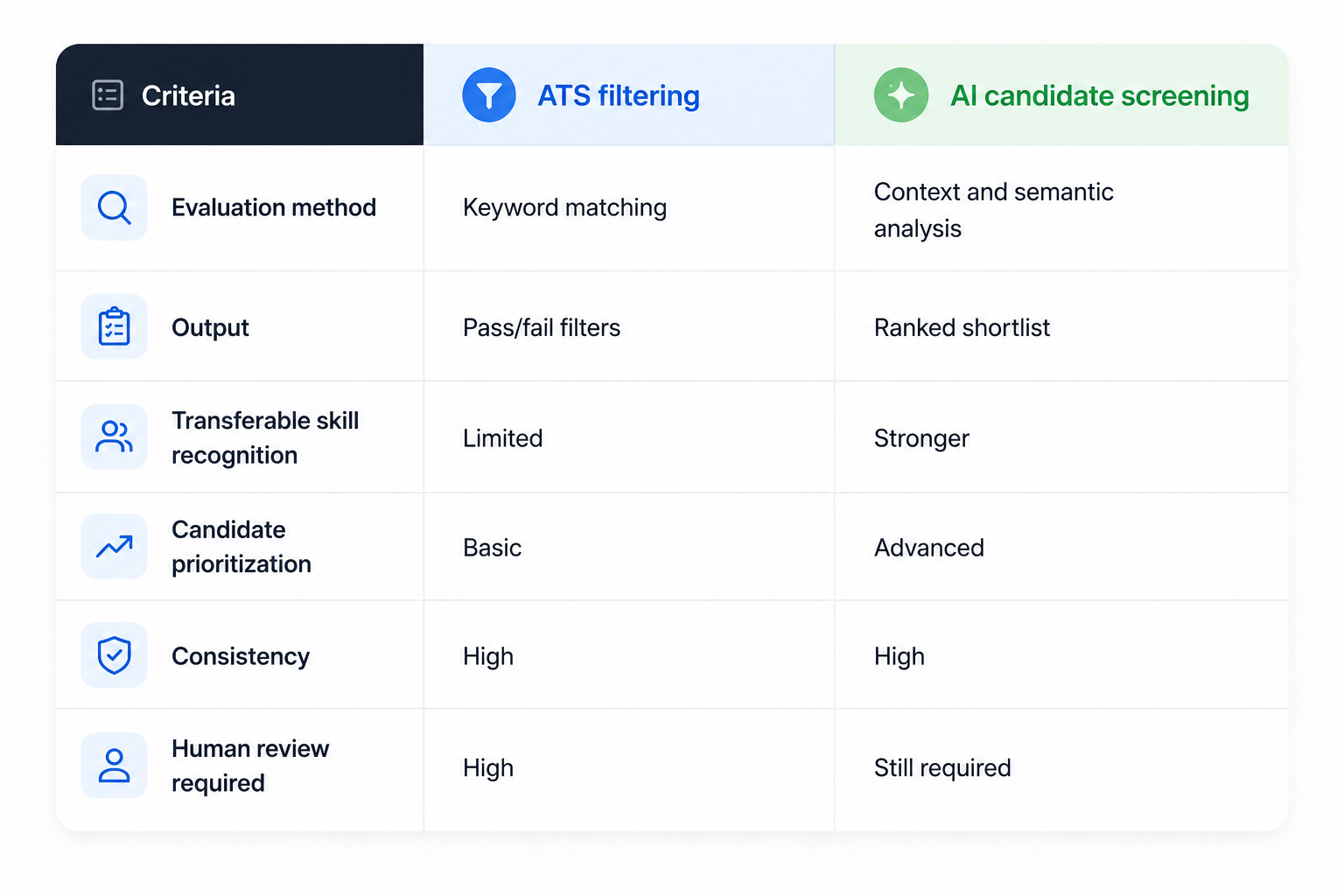
Traditional ATS screening works like a search query. Recruiters define a set of requirements, the system looks for matching terms, and candidates either pass or fail those filters.
This process might be fast, but it’s not always accurate.
Imagine you're hiring a sales leader. One candidate writes that they grew a team from 5 people to 40 and opened two new territories. Another explicitly lists "sales leadership" and "people management" as skills.
A keyword filter may prefer the second profile. But most recruiters would want to speak to the first one.
AI candidate screening is designed to close that gap.
Instead of matching exact words, it evaluates the meaning behind a candidate's experience. It can recognize that scaling a team, owning a revenue target, or launching a new function are signals of leadership, even if those exact keywords never appear on the resume.
That's why modern AI screening tools don't just filter candidates, but they rank them.
Rather than producing a yes-or-no list, they score applicants across multiple dimensions such as skills fit, experience depth, career progression, and role alignment. Recruiters then review the strongest matches firs
Keep in mind, good AI screening isn’t supposed to make final hiring decisions.
It just removes the first layer of manual triage so recruiters can spend less time sorting resumes and more time evaluating the people most likely to succeed in the role.
Where the time actually goes: The real cost of manual screening
Most recruiting teams aren't struggling to attract candidates.
They're struggling to process them.
Recruiters spend an average of 23 hours screening resumes for a single hire. The frustrating part is that most of those resumes are eventually deemed unqualified. In other words, recruiters spend days reviewing applications that never make it past the first stage.
The bottleneck doesn't end once a promising candidate is identified.
Scheduling an initial phone screen can take anywhere from 30 minutes to two hours per candidate when you factor in calendar coordination, reschedules, and stakeholder availability. That might not sound significant until you're hiring for multiple roles simultaneously.
Meanwhile, candidates are moving fast.
Research shows top candidates are often off the market within 10 days. At the same time, 62% of job seekers lose interest if they don't hear back within two weeks. Every day spent manually sorting resumes increases the risk of losing qualified candidates before the hiring process even begins.
This creates a difficult tradeoff.
Recruiters can review every application manually and slow the process down. Or they can move faster and risk overlooking strong candidates hidden among hundreds of resumes.
Neither option scales well.
At a certain application volume, the challenge is no longer finding talent. The challenge is identifying the right candidates quickly enough to engage them before someone else does.
How AI screening works: Step by step
Despite the hype, AI screening doesn't hire candidates. It helps recruiters decide where to focus their attention first.
Most AI screening systems follow three core steps:
1. Parsing and understanding candidate information
The first step is understanding the application itself.
AI screening tools analyze both structured information, such as job titles, skills, certifications, and years of experience, and unstructured information, such as project descriptions, achievements, and resume content.
Unlike traditional applicant tracking system filters, which rely heavily on exact keyword matches, AI models evaluate context. A candidate doesn't need to use the same language as the job description for relevant experience to be recognized.
2. Scoring and ranking applicants
Once candidate data is analyzed, the system compares applicants against the role requirements.
Candidates are typically evaluated across factors such as skills alignment, experience depth, career progression, industry background, and overall role fit.
Instead of generating a simple pass-or-fail outcome, the system produces a ranked shortlist. Recruiters can see which candidates appear most relevant and, in many cases, why they received a particular score.
3. Delivering recommendations recruiters can act on
The final output is a prioritized list of applicants along with explainable scoring data.
Recruiters review the recommendations, inspect candidate profiles, and decide who moves forward. They can adjust criteria, override rankings, and apply their own judgment at every stage.
That's an important distinction.
The AI handles the repetitive triage work. The recruiter still makes the hiring decisions.
The goal isn't to replace human judgment, but to ensure recruiters spend their time evaluating qualified candidates rather than searching for them.
What AI screening gets right and where it can fail
Most AI candidate screening discussions focus on speed. But faster screening doesn’t always lead to better hiring decisions.
AI can definitely improve shortlist quality, but only when it's used thoughtfully. Like any screening method, it has failure modes recruiters need to understand. Let’s start with a few:
1. Catastrophic inaccuracy can destroy trust
AI screening tools are only useful if recruiters trust the recommendations they produce.
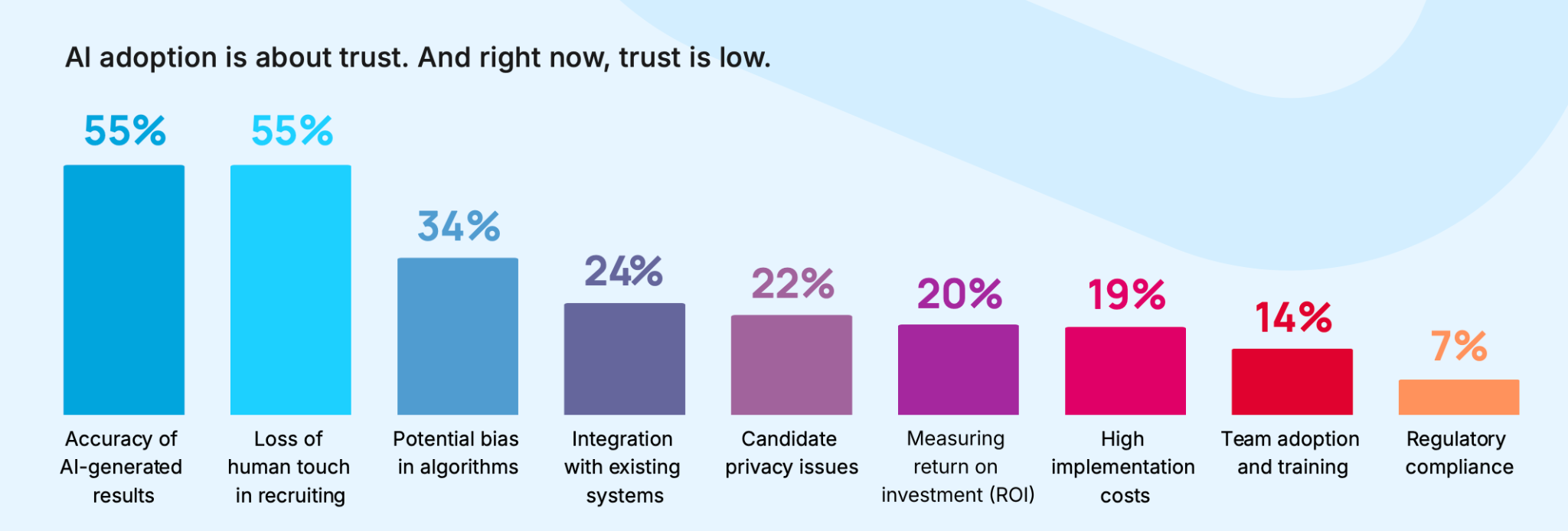
That trust can disappear quickly when the results are obviously wrong. And it’s a growing concern among many recruiters. According to Kula’s 2025 State of Recruiting Report, 55% of recruiters believe AI-generated screening results are not yet accurate enough to be fully reliable.
For example, an AI screening tool might flag a journalist as a strong fit for a software development role despite the candidate having no relevant technical experience. The same system may also surface several other poorly matched profiles while overlooking candidates who appeared far more qualified.
When recruiters can't understand why a candidate received a particular score, these mistakes become even harder to accept.
This is one of the biggest challenges with black-box AI recruiting software. If the reasoning behind a recommendation isn't visible, recruiters have no way to validate whether the result is accurate or simply an algorithmic mistake.
2. Bias in training data can reinforce existing hiring patterns
AI models learn from data.
If that data reflects historical hiring preferences, the model can unintentionally repeat them.
That’s why, an Assessio study about AI in HR found that 72% of HR leaders believe AI can reproduce or amplify human bias.
Candidates from non-traditional backgrounds, career changers, or applicants with unconventional experience may be disadvantaged if the system overvalues patterns found in previous hiring decisions.
But the irony is that traditional ATS filtering often suffers from the same problem.
Keyword-based screening tends to favor candidates who use the "right" terminology while overlooking qualified people whose experience doesn't fit a predefined template. AI has the potential to reduce that issue, but only when it's designed to evaluate context rather than replicate past decisions.
3. AI can hallucinate candidate information
Many AI screening tools summarize resumes, generate candidate insights, or explain why an applicant was ranked highly.
The problem is that AI-generated summaries are not always accurate.
In some cases, systems may infer skills, achievements, or qualifications that the candidate never explicitly mentioned. Recruiters who rely too heavily on generated summaries risk making decisions based on information that isn't actually present in the application.
This is why resume summaries should be treated as a starting point for review, not a replacement for reviewing the candidate's actual experience.
4. Candidates are already learning how to optimize for AI screening
Recruiters spent years optimizing hiring processes around keyword-based ATS filters.
Candidates responded by optimizing resumes around those same keywords.
The same pattern is emerging with AI screening.
Job seekers are increasingly using AI tools to tailor resumes, rewrite experience descriptions, and align applications with job requirements. Some are genuinely improving how they present their qualifications. Others are simply becoming better at appearing qualified.
This means recruiters still need validation steps beyond the initial screening process. AI can help identify promising candidates, but it cannot independently verify whether a candidate can actually do the job.
What good AI screening does differently
The best AI candidate screening tools are designed to support recruiter judgment rather than replace it.
They provide transparent, criteria-based scoring that recruiters can inspect, challenge, and override when necessary. They apply the same evaluation framework to every applicant, reducing the inconsistency that naturally occurs during manual review.
They also help surface candidates who might otherwise be missed because their experience doesn't perfectly match a list of keywords.
The goal isn't to let AI decide who gets hired, but to let it automate repetitive triage work while recruiters focus on the decisions that require context, judgment, and human insight.
What to look for in an AI screening tool
Not all AI candidate screening tools work the same way.
Some simply add AI branding to traditional keyword filtering. Others genuinely help recruiters identify qualified candidates faster without sacrificing quality.
If you're evaluating AI screening software, focus on these five criteria:
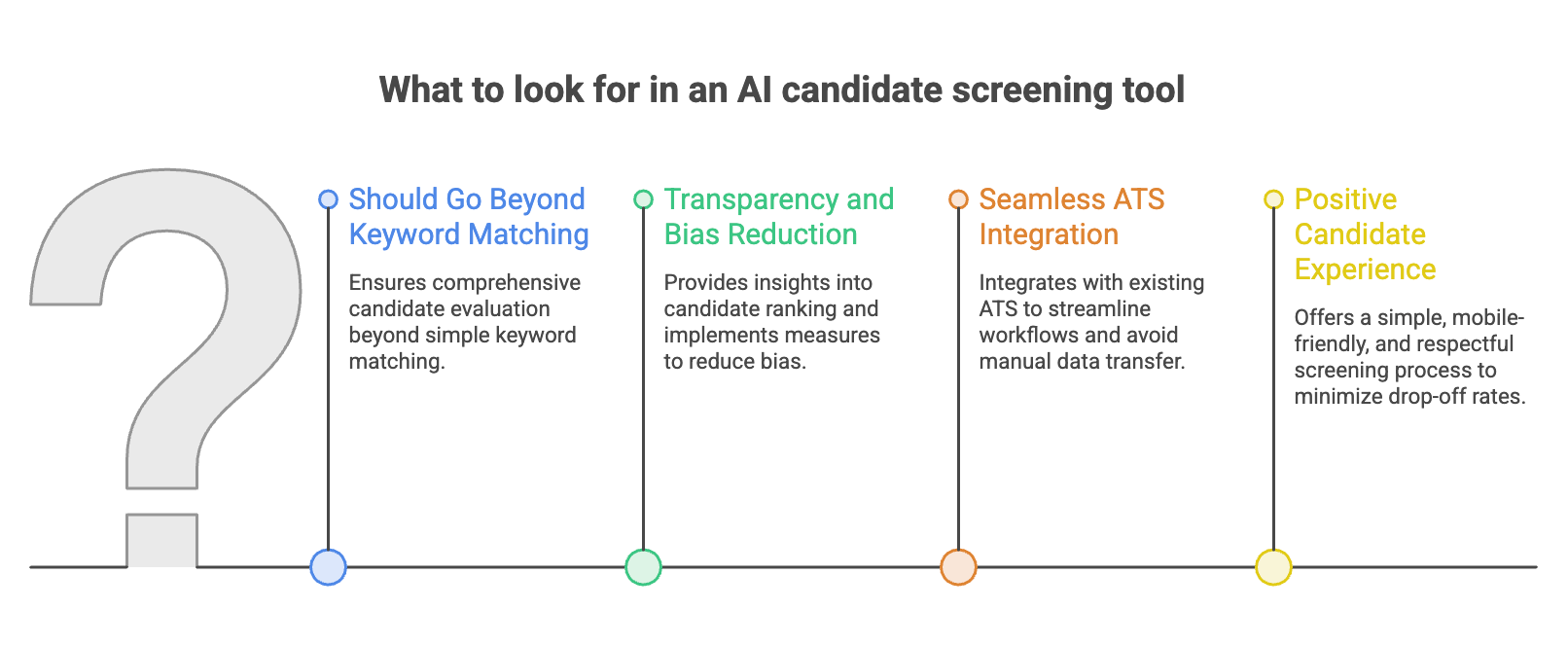
Does it go beyond keyword matching?
This is the most important question to ask.
A candidate screening software should evaluate the meaning behind a candidate's experience, not just whether their resume contains specific keywords.
For example, a recruiter hiring a customer success leader should be able to identify candidates who scaled teams, improved retention, or built customer programs, even if they don't use the exact terminology listed in the job description.
If the system only rewards exact keyword matches, you're just getting ATS filtering with a new label.
Can you see why candidates were ranked?
Recruiters need to be able to explain their decisions.
A good AI screening tool should show how candidates were evaluated and why they received a particular score. Ideally, recruiters should be able to review the factors that influenced a recommendation rather than relying on a black-box ranking.
This becomes especially important when hiring managers ask why one candidate was shortlisted over another.
If the system can't explain its reasoning, it's difficult to trust its recommendations.
Does it integrate with your existing ATS?
The best screening tool is the one recruiters will actually use.
If recruiters have to switch between multiple platforms, manually export candidate data, or maintain duplicate workflows, any efficiency gains disappear quickly.
Screening results should flow directly into your ATS so recruiters can review recommendations, move candidates through stages, and collaborate with hiring managers without leaving their existing workflow.
What safeguards are in place to reduce bias?
Every screening process has the potential to introduce bias, whether it's powered by AI or humans.
The question is whether the vendor actively addresses it.
Look for ATS features such as transparent evaluation criteria, audit trails, bias testing, and compliance with emerging AI recruiting regulations such as NYC Local Law 144 and the EU AI Act. Vendors should also be able to explain how candidates are evaluated and what measures are in place to ensure fair and consistent assessments.
If a vendor can't clearly explain how their system makes decisions, that's a red flag.
What is the candidate experience like?
Screening tools are often evaluated from the recruiter's perspective, but candidate experience matters too.
A complicated screening process can create friction and increase drop-off rates, especially in competitive hiring markets.
Look for experiences that are simple, mobile-friendly, and respectful of the candidate's time. If the screening process takes 30 minutes to complete or requires multiple unnecessary steps, qualified candidates may abandon the application before they're even evaluated.
The best AI screening tools improve efficiency for recruiters without making the hiring process harder for candidates.
A good AI screening tool should help recruiters review fewer resumes while increasing confidence in the candidates they choose to engage.
If the system only makes screening faster, it's solving half the problem. The real goal is to improve both speed and shortlist quality at the same time.
When AI screening is and isn't the right tool
AI candidate screening isn't a requirement for every hiring team.
Its value depends largely on hiring volume, workflow complexity, and the type of roles you're filling.
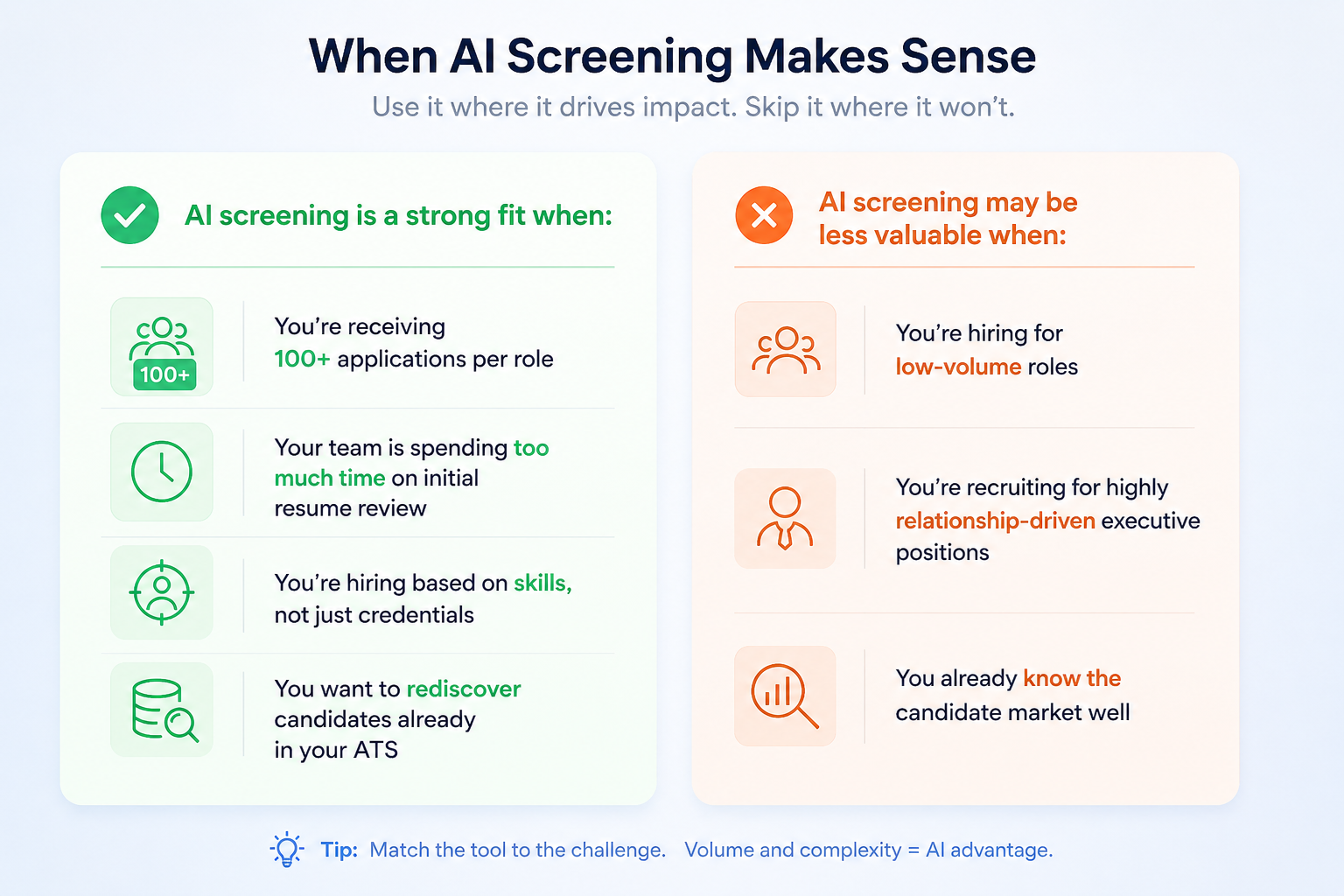
AI screening is a strong fit when:
- You're receiving 100+ applications per role. Manual review becomes difficult to scale, especially when recruiters are managing multiple open positions at once.
- Your team is spending too much time on initial resume review. If recruiters are spending hours sorting through applicants before they can engage qualified candidates, AI can help prioritize who deserves attention first.
- You're hiring based on skills, not just credentials. AI can identify transferable skills and relevant experience that keyword-based filtering often misses.
- You want to rediscover candidates already in your ATS. Many companies already have qualified talent sitting in their database. AI can help surface past applicants before recruiters spend time and budget sourcing new candidates.
AI screening may be less valuable when:
- You're hiring for low-volume roles. If a role receives fewer than 20 applications, recruiters can usually review candidates manually without creating a bottleneck.
- You're recruiting for highly relationship-driven executive positions. Senior leadership hiring often relies heavily on reputation, networks, referrals, and market knowledge that aren't easily captured in a screening model.
- You already know the candidate market well. In niche industries where recruiters have deep domain expertise and a small talent pool, manual evaluation may provide enough context on its own.
The key question isn't whether AI screening is good or bad. It's whether your biggest hiring challenge is evaluating candidates or simply finding the time to review them.
Get started with AI candidate screening for your hiring team
The biggest mistake companies make with AI screening is treating it like a replacement for recruiter judgment.
The best hiring outcomes happen when AI handles the repetitive work—reviewing applications, identifying patterns, surfacing qualified candidates—and recruiters make the final decisions.
And that's the approach Kula takes.
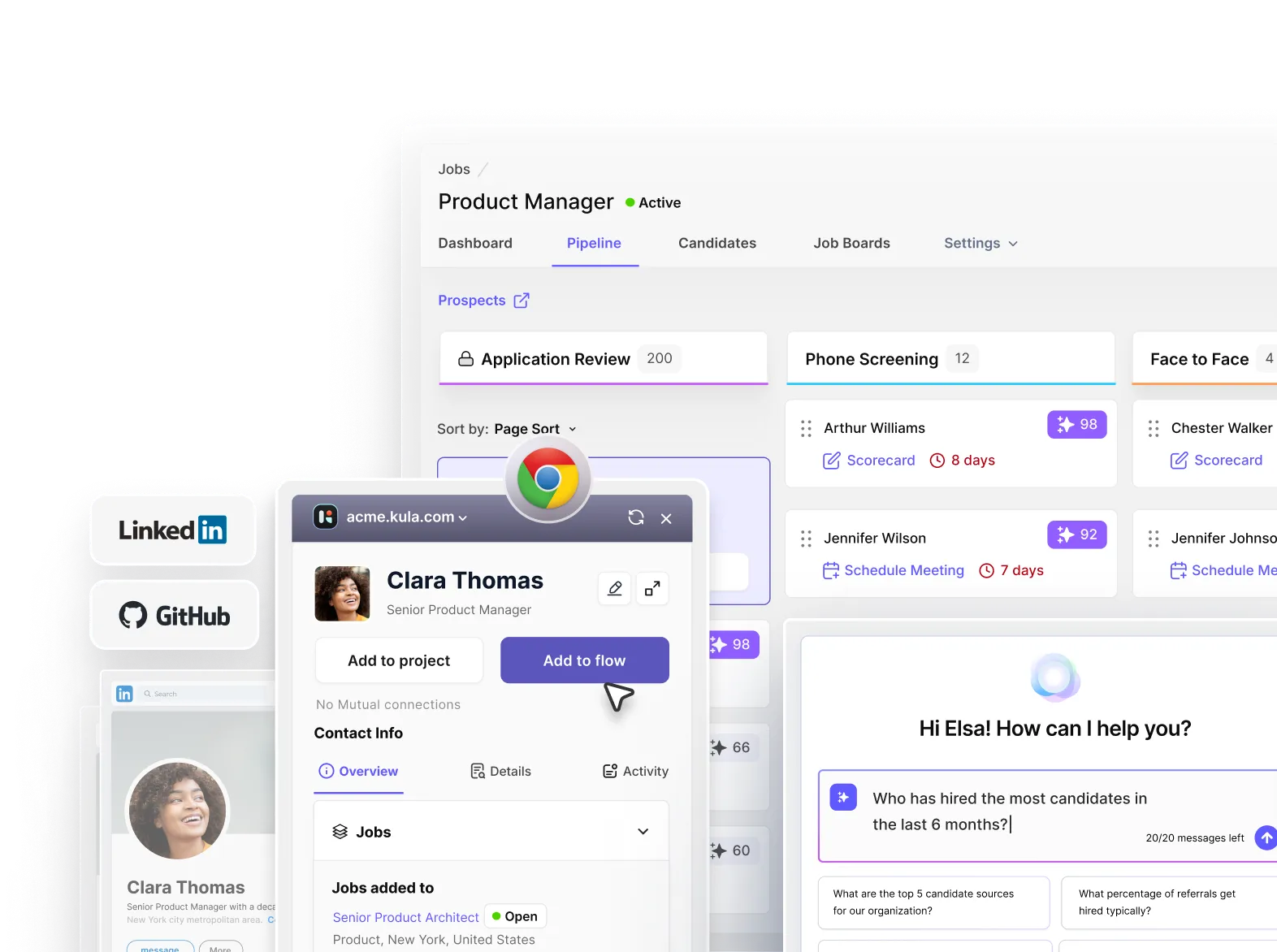
Instead of forcing recruiters to review hundreds of applications manually or rely on keyword filters that miss qualified talent, Kula automatically evaluates applicants against the role, highlights why candidates are a strong match, and surfaces the most relevant applicants directly inside the ATS workflow.
Recruiters can see the reasoning behind recommendations, review candidate profiles themselves, and decide who moves forward.
No black-box decisions. No separate screening platform. No guessing why one candidate was ranked above another.
The result is faster screening, better shortlists, and more confidence that qualified candidates aren't getting lost in the pile.
If you want to see how you can fit AI candidate screening seamlessly into your recruiting process, see Kula's AI-native ATS in action with just a quick demo.