weekly conversations
users onboarded with Product Tours
engagement with marketing campaigns

AI / revenue technology
~330 employees
Santa Barbara, CA (Remote)
Invoca is the data and AI platform that unites marketing, digital, and contact center teams to grow revenue in high-stakes purchase categories. Leading organizations including Mayo Clinic, Mutual of Omaha, and Verizon rely on Invoca to tie advertising to revenue, deploy AI agents that engage and convert prospects, and give human and AI agents the context to close more sales. With a distributed team of roughly 330, Invoca hires selectively and competitively, focused on raising the bar with every hire.
That same standard shapes how Invoca operates internally: as an AI company, it expects every team, including talent, to work in an AI-native way. For a long time, its recruiting tools weren’t keeping up.
Before Kula, Invoca ran recruiting on Greenhouse, stitched together with BrightHire and Tofu. Three systems meant three bills, plus the integrations and IT support needed to make them talk to each other — a lot of cost and overhead for a team that wanted to move fast.
The spend didn’t buy the leverage the team needed. Sourcing was almost entirely manual, so recruiters never had enough time. The pipeline was flooded with fraudulent applicants, and there was no way to rank candidates beyond keyword search. Scheduling was a slog. And there was almost no visibility into where searches stood — hiring managers were constantly pinging recruiters on Slack for manual status updates. There was no AI in the workflow, and no way to connect their ATS to the AI tools the rest of the company was adopting.
“On Greenhouse, hiring was difficult. Sourcing was extremely manual, we were flooded with fraudulent applicants, and we had no way to rank candidates beyond keyword search. Worst of all, we lacked visibility into the pipeline.”
— Katherine Starros, SVP, People, Invoca
Katherine Starros isn’t easily impressed by an ATS. She started her career as a hands-on recruiter for a decade, has led talent teams for twelve years since, and has used or demoed nearly every system on the market. So when she met the Kula team at HR Transform, her reaction stuck with her.
“I immediately realized — this is actually different. I remember joking, ‘Wait, it’s not even a report, it’s just the default view? This is so simple, it doesn’t require 20 clicks or a download.’ This product is clearly built by recruiters.”
— Katherine Starros, SVP, People, Invoca
Invoca weighed Ashby as well, judging the options mostly on price and functionality. What tipped the decision to Kula was the all-in-one nature of the product. For a company that prizes productivity over growth-at-all-costs, folding sourcing, screening, scheduling, and reporting into a single AI-native platform — and managing one vendor instead of three — was exactly the simplification the team wanted.
The team mattered too. Meeting Achu and John at HR Transform, and working with Phil since, left Invoca confident they’d picked a partner that was responsive, genuinely cared about their feedback, and was shipping fast. No product is perfect, but the trajectory was unmistakable.
Implementation went smoothly, with no major issues, and the team was up and running quickly. The pleasant surprise was how fast hiring managers took to it — the simple UI and native Slack integration meant adoption didn’t require a change-management campaign. People just used it.
The headline is hard to miss. Since switching to Kula, Invoca spends roughly 20% of what it used to on its recruiting tech stack — about an 80% reduction — while being measurably happier with the product it’s paying far less for.
The savings didn’t stop at recruiting. By moving requisition and headcount approvals into Kula, Invoca expects to retire a separate tool the finance org was using — saving another $15K and keeping approvals in one place rather than scattered across systems.
Underneath the cost story is a day-to-day that looks entirely different. AI sourcing automations and applicant scoring have given recruiters their time back and let a lean team manage a high volume of searches without lowering the bar. The built-in notetaker and Slack integration mean interviewers can submit feedback directly from Slack — not just get nagged to do it — which matters for a team often working from mobile devices on the road. Kula’s LinkedIn integration lets recruiters send outreach “from” hiring managers, and its AI Teammates handle the automated updates that used to be a manual chore.
“It took them about 10 minutes to set up, and it’s met hiring managers where they are without any manual effort. Greenhouse could never.”
— Katherine Starros, on the Slack update agent her recruiters built with Kula’s MCP and Claude
That last point is a glimpse of where AI-native hiring is going. Like most companies, Invoca is embracing AI across every team — and because Kula exposes its data through an MCP, Invoca’s recruiters built their own automated Slack-update agents on top of Claude in minutes, with no engineering project required.
“We’re literally spending about 20% of what we used to spend on our recruiting tech stack since we switched to Kula — and we’re way happier with the product. Pretty sure that’s the headline.”
— Katherine Starros, SVP, People, Invoca
Invoca’s next focus is raising the bar further — measuring and growing talent density over time — and the team sees Kula as central to bringing that vision to life. The AI Voice Coordinator is on the roadmap for the next phase, too, once internal calendar habits catch up to what the product can already do.

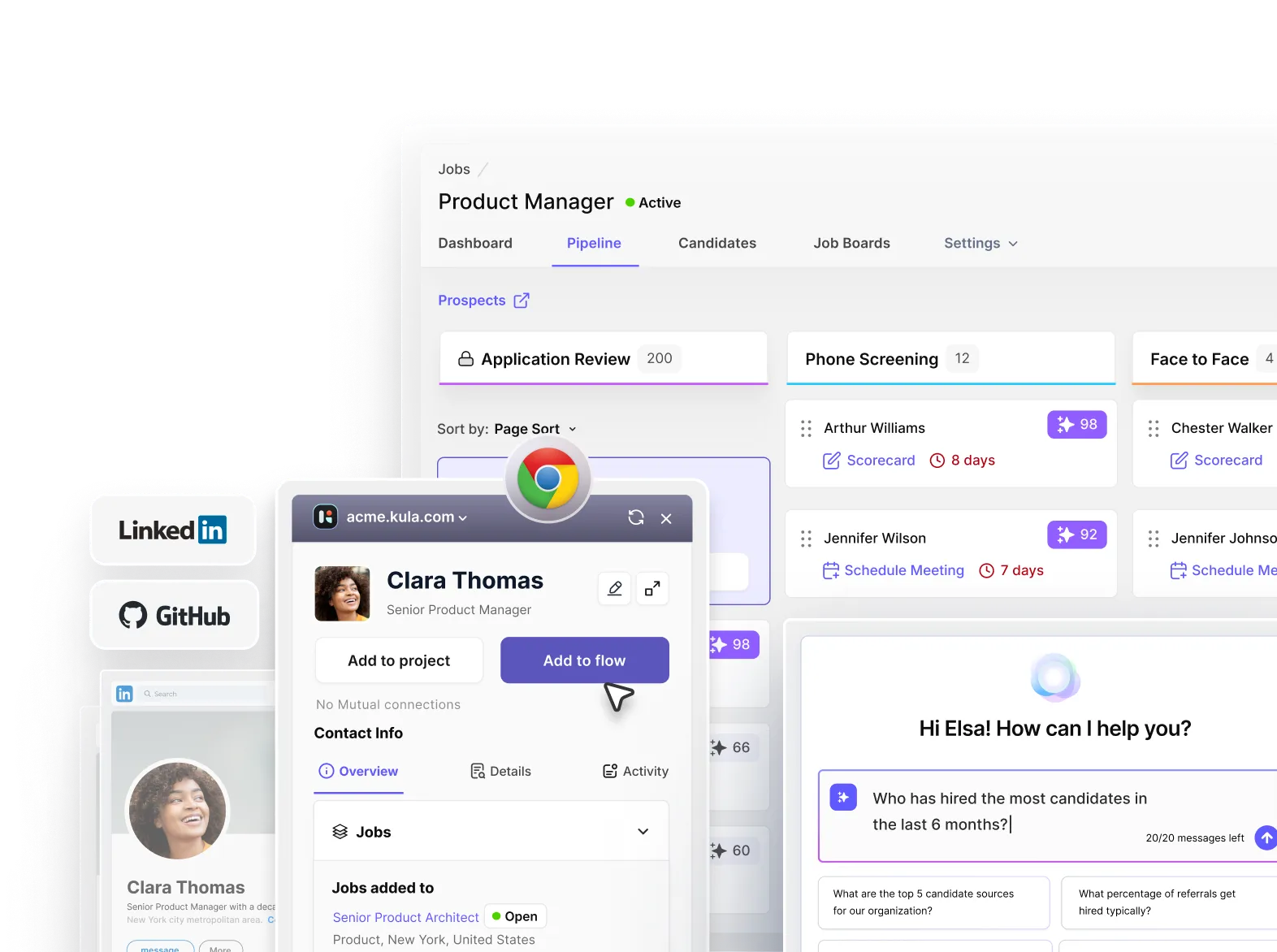
Kula is an AI-native operating system for hiring that brings sourcing, screening, scheduling, and reporting into one platform — and connects to the AI tools teams already use. High-growth teams use Kula to move faster, spend less, and raise the bar on every hire.
Get started today