




ATS resume parsing is how applicant tracking systems extract and organize resume data. Learn how AI has made parsing more accurate, contextual, and recruiter-friendly and what to look for in a modern ATS.
Every applicant tracking system parses resumes. But not every ATS parses them well.
When a resume is parsed incorrectly, skills go missing, job titles get misread, work history ends up in the wrong fields, and recruiters are left searching incomplete candidate profiles. Those errors don't just affect candidate experience, but also affect search accuracy, matching, reporting, and every workflow built on that data.
This guide explains how ATS resume parsing works, why parsing errors happen, and what both recruiters and candidates can do to improve parsing accuracy.
How an ATS parses resumes and what it doesn't do
At its core, resume parsing is an applicant tracking system’s way of turning an uploaded resume into structured candidate data.
Whether the file is a PDF, DOCX, or plain text document, the parser extracts information like a candidate's:
- Name and contact details
- Work history
- Education
- Skills
- Certifications
Instead of storing the resume as a document, the applicant tracking system stores this information as structured fields inside the candidate profile.
That's the data recruiters search, filter, report on, and use throughout the hiring process.
When ATSs first emerged, they were generally seen as resume parsing tools. But today, resume parsing is just another ATS feature that has become the foundation of a good recruiting software.
There are two broad generations of resume parsing technology:
Generation 1: Rule-based parsing
Most legacy resume parsing software still rely on predefined rules and ATS keyword filtering.
They're essentially looking for familiar patterns:
- An Experience heading followed by dated job entries
- An email address in a recognizable format
- Job titles that match predefined lists
- Skills written exactly as expected
This works well when resumes follow standard templates. But when resume layouts become more creative or candidates describe their experience differently, accuracy starts to fall.
Generation 2: AI-powered parsing
Modern ATSs use natural language processing (NLP) and semantic matching instead of relying solely on patterns.
Rather than asking, "Does this resume contain the exact phrase?" the parser asks, "What is this candidate actually saying?"
For example, AI-powered resume parsing would be able to understand that "data wrangling" and "data preprocessing" refer to closely related skills, even though the wording is different.
The focus shifts from matching text and keywords to understanding actual meaning behind phrases and words.
It’s important to remember that resume parsing isn’t the same as candidate screening.
Parsing extracts information from a resume.
Screening evaluates whether that information makes someone a good fit for a role.
Older resume parsing software often blurred the line by using parsed keywords as the screening criteria. If a resume didn't contain a phrase like "SolidWorks" exactly as written, but has written "Solid Works" instead, the candidate could be filtered out before a recruiter ever reviewed their application.
As a result, most applicant tracking system resume screening tools today treat resume parsing and candidate screening as separate steps. The parser extracts accurate data first, then the screening layer evaluates it using context instead of literal keyword matches.
That's an important distinction because many complaints about ATS resume screening are actually complaints about poor parsing combined with rigid keyword filtering. Fixing one without the other rarely improves hiring outcomes.
Where resume parsing breaks down
No resume parser is perfect. Even the best systems occasionally need manual corrections. The difference is how often those corrections happen and whether they affect hiring decisions.
Here are four of the most common ways parsing breaks down and what recruiters should keep an eye out for:
1. Small formatting differences become big matching problems
Legacy resume parsing software relies heavily on exact text matching.
That means something as simple as writing "SolidWorks," "Solidworks," or "Solid Works" can produce different results, even though they're the same software. The parser treats them as separate terms instead of recognizing they're equivalent.
The same problem applies to job titles, certifications, and skills that can be written multiple ways.
Modern AI-powered parsers use semantic understanding to recognize these variations as the same concept. But many organizations still rely on older parsing technology, making exact wording more important than it should be.
2. Resume formatting doesn't always survive extraction
Resume parsing doesn't just read resumes. It restructures them.
If that process goes wrong, information can end up in the wrong place or disappear altogether. Employment dates might be assigned to the wrong role, job titles can become disconnected from employers, and entire sections may fail to populate in the candidate profile.
Recruiters reviewing the ATS record often have no indication that the parser made these mistakes. They simply see an incomplete profile and make decisions based on inaccurate data.
The problem becomes more common with resumes that use tables, multiple columns, graphics, or unconventional layouts.
3. Small parsing issues can become large hiring risks
Parsing errors aren't always just data quality problems. They can influence hiring outcomes through un-intended biased hiring.
A recent example is the lawsuit against Workday, where a federal judge allowed claims to proceed alleging the company's AI-powered hiring tools discriminated against applicants based on disability, race, age, and gender.
The plaintiff claimed he applied to more than 100 jobs using employers that relied on Workday's screening technology and was rejected, often within minutes of applying.
The case focuses on automated screening rather than resume parsing alone.
But it highlights a broader point: when inaccurate or inconsistent candidate data feeds automated hiring decisions at scale, the impact extends far beyond a single resume. Small differences in how candidate information is extracted and interpreted can compound into systemic hiring risks.
4. Duplicate resumes create duplicate problems
Most ATS tools try to prevent duplicate candidate records by matching email addresses. If the same person applies again using the same email, the system typically updates the existing profile instead of creating a new one.
The problem is that this approach only works when the email address stays the same.
Candidates often apply with different email addresses, use personal and work accounts interchangeably, or reapply months later after updating their resume. Without stronger duplicate detection, the ATS can create multiple profiles for the same person.
Over time, duplicate records clutter the database, make candidate searches less reliable, and create unnecessary work for recruiters trying to determine which profile is the most up to date.
Why old-style ATS screening no longer works
ATS keyword filtering is probably the biggest reason applicant tracking systems developed a bad reputation. The irony is that it wasn't a bad idea when it was first introduced.
Back then, resumes were written by humans, job descriptions changed infrequently, and recruiters needed a way to narrow hundreds of applications quickly. The idea was to compare the keywords in a resume against the keywords in the job description, filter out non-matches, and review the rest.
It saved time. At least for a while.
Then the hiring market changed and ATS resume parsing presented two challenges:
- Candidates quickly figured out how ATS filters worked
- Recruiters ending up reviewing rejected candidates instead of focusing on candidates cleared by the ATS
For candidates, instead of writing resumes that accurately reflected their experience, many started optimizing for ATS keyword matches. They copied phrases directly from job descriptions, repeated important skills throughout their resumes, and adjusted wording to mirror exactly what the ATS was looking for.
Then generative AI made the process almost effortless.
Today, candidates can paste a job description into ChatGPT or another AI resume tool and generate an ATS-friendly resume in seconds.
According to Robert Half's 2026 survey of 2,000 U.S. hiring managers, 84% of HR leaders say AI-tailored applications have increased their workload, while 67% say reviewing AI-generated applications has slowed hiring, with one in five reporting delays of more than two weeks.
And it’s a common TA challenge we’ve seen many recruiters talk about on forums like Reddit:

The irony is that this ends up creating more work for recruiters.
When AI-generated, keyword-optimized resumes dominate the shortlist, genuinely qualified candidates can get filtered out. Recruiters are often forced to revisit rejected applications just to make sure they haven't missed someone worth interviewing.
Meanwhile, qualified candidates who use different terminology or describe their experience in their own words can be filtered out before a recruiter ever sees their application.
Research highlights just how costly that can be. 88% of employers said highly skilled candidates had been rejected because they didn't exactly match stated hiring criteria, while 94% reported the same for middle-skilled candidates when screening relied heavily on ATS resume matching without human review.
And this isn’t something candidates should be blamed for.
It's actually a system design problem. Because when optimizing for keywords becomes more important than communicating real experience, applicants naturally adapt to the system they're given.
Why semantic screening matters
Keyword filtering asks, "Did the candidate use the exact words?"
Modern AI candidate screening asks, "Does the candidate have the required skills, even if they described them differently?"
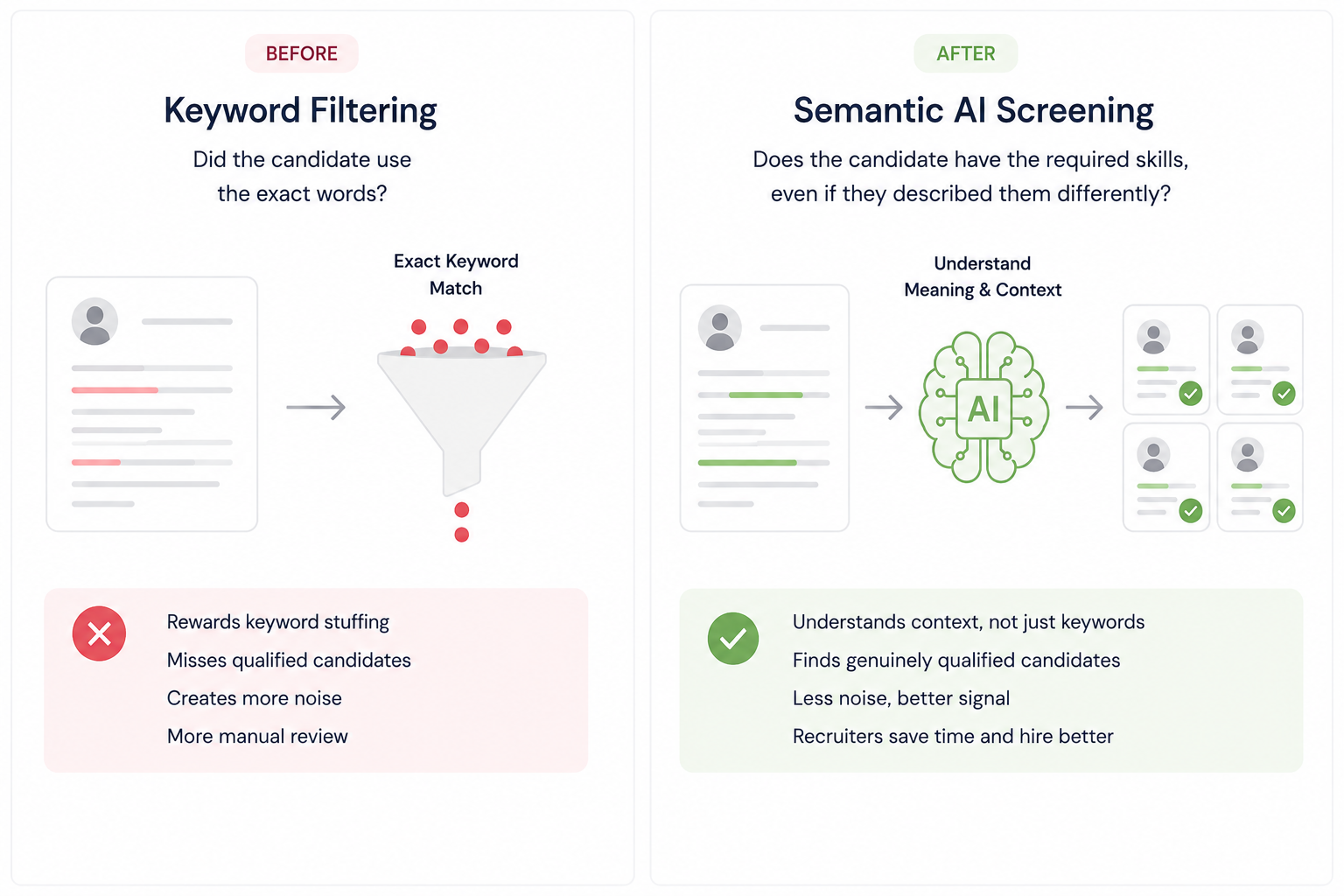
Semantic screening evaluates context instead of literal keyword matches, making it much harder for candidates to succeed through keyword stuffing alone and much easier for recruiters to identify genuinely qualified talent.
As AI-generated resumes become the norm, relying on keyword filtering as the primary screening method only creates more noise. The ATS isn't finding the best candidates. It's finding the best-optimized resumes.
What to look for in ATS resume parsing in 2026
If you're evaluating a new ATS, don't just ask whether it supports resume parsing.
Ask how it parses resumes and what happens after the data is extracted. Here’s what separates modern parsing from legacy systems:
1. Semantic understanding, not just keyword extraction
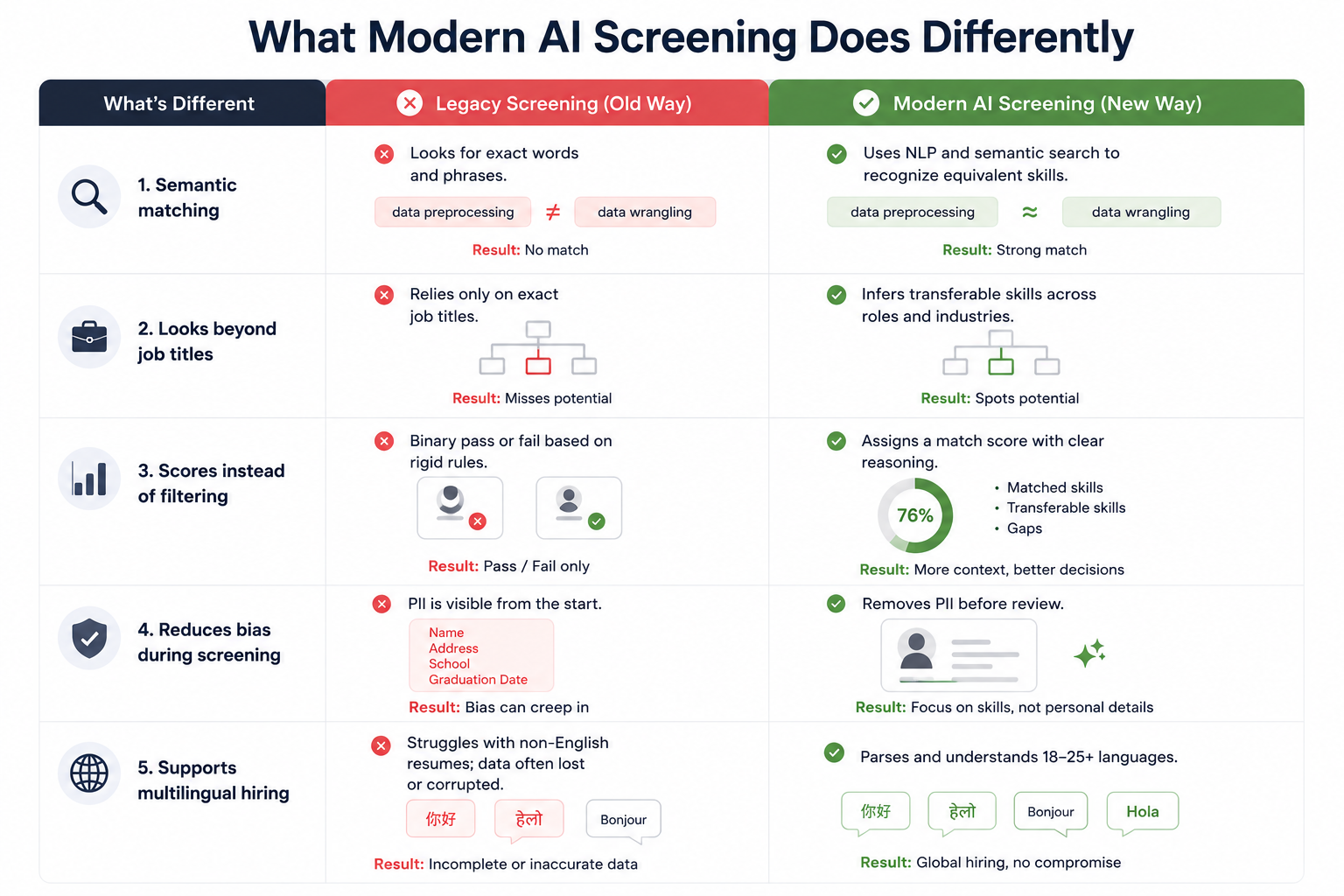
Older systems often looked for exact words and phrases. If a job description asked for "data preprocessing" but a resume mentioned "data wrangling," the candidate could be overlooked even though both describe similar work.
Modern screening uses natural language processing (NLP) and semantic search to recognize equivalent skills, responsibilities, and job titles.
Ask vendors whether their system understands synonyms and skill equivalents, or if it simply extracts keywords from a resume. If the answer is "we extract keywords," you're looking at a first-generation parser. If it uses NLP to understand meaning and context, you're looking at a much more capable system.
2. Multilingual support
If you're hiring globally, multilingual parsing is no longer a nice-to-have. Look for AI recruiting software that can accurately process resumes in at least 18 languages without requiring candidates to translate them first.
For example, Kula supports resume parsing in 18 languages, making it easier for global hiring teams to build a consistent candidate experience across regions.
3. Looking beyond job titles
Modern AI also considers transferable skills instead of relying only on previous job titles.
Someone who led supply chain optimization at a manufacturing company may have the analytical and operational experience needed for an operations analyst role, even if they've never held that exact title.
A keyword-based system would miss that connection. AI models are better at recognizing how skills carry over across industries and roles.
4. Duplicate detection
Duplicate applications quietly pollute your database over time. A good parser should automatically identify duplicate resumes, regardless of where they came from, so recruiters don't waste time reviewing the same candidate twice.
5. Format resilience
Candidates upload resumes in every format imaginable. Your parser should reliably handle PDFs, DOCX, and TXT files while stripping out formatting artifacts like tracked changes, comments, hidden metadata, or other elements that don't belong in a candidate profile.
6. Scoring candidates instead of filtering them out
Legacy systems often worked like a gatekeeper: candidates either passed or failed based on predefined rules.
Modern screening is more nuanced. Rather than simply rejecting a candidate, it assigns a match score and explains the reasoning behind it. Recruiters can see which qualifications matched the job requirements, which skills were inferred as transferable, and where genuine gaps exist.
That makes it much easier to review candidates with context instead of relying on a black-box decision.
7. Bias-aware screening
Many modern screening platforms also remove personally identifiable information (PII), such as names, addresses, graduation dates, and sometimes schools, before a recruiter reviews a profile.
The goal is to keep the initial evaluation focused on skills, experience, and qualifications rather than details that could unintentionally influence hiring decisions.
Look for platforms that can remove personally identifiable information, such as names, addresses, and graduation dates, before recruiters begin reviewing candidates.
8. Transparent scoring, not black-box filtering
If AI is ranking candidates, it should also explain its reasoning. Recruiters should be able to see which skills matched the role, which transferable skills were identified, and where genuine gaps exist. A simple "matched" or "not matched" doesn't provide enough context to make confident hiring decisions.
9. Candidate capture beyond uploaded resumes
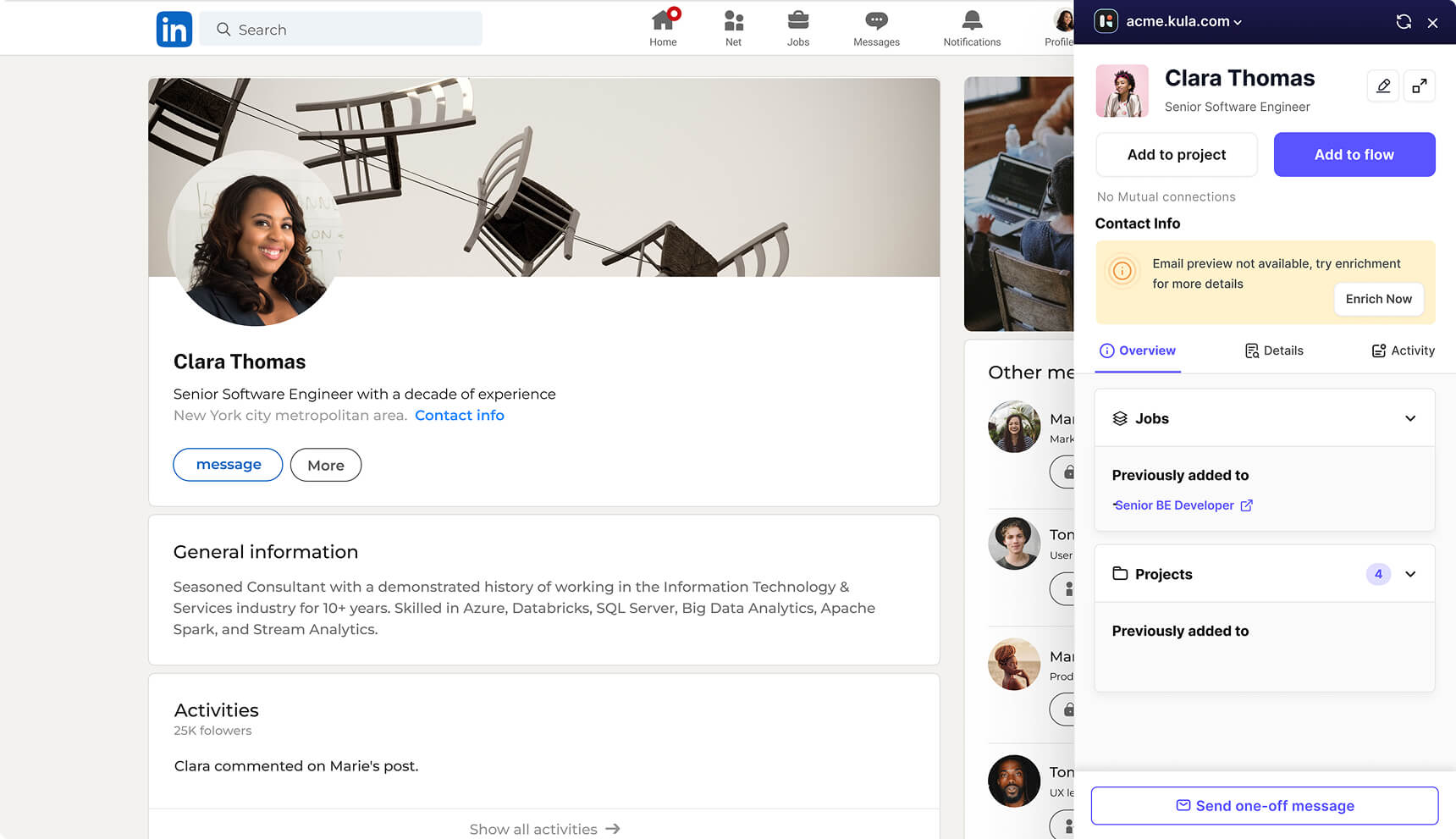
Look for platforms that offer browser extensions to source candidates directly from those sites and automatically parse their profile information into your ATS.
For example, Kula's Chrome extension lets recruiters capture candidates from LinkedIn and GitHub while its AI parses uploaded resumes, auto-populates application fields, prompts candidates to review any extracted information before submission, and automatically detects duplicate profiles.
What parsing failures really cost your recruiting team
1. Candidates abandon the application
The first problem shows up before a recruiter even opens the pipeline.
Around 60% of candidates abandon job applications because the process is too long or complicated. When an ATS fails to pull information accurately from a resume, candidates are asked to manually re-enter details that already exist on the document they just uploaded.
For many job seekers, that's enough reason to leave and apply somewhere else instead.
2. Slow screening means lost candidates
Parsing errors end up creating extra work for recruiters, who now have to compare resumes against candidate profiles, fix missing information, or manually correct parsing mistakes before they can even begin evaluating applicants.
Those delays matter because nearly 62% of job seekers lose interest in a role if they haven't heard back within two weeks, and the strongest candidates are usually the first to accept another offer.
3. Candidate experience affects the business
A poor hiring experience can have consequences beyond recruiting.
Virgin Media estimated it lost £4.4 million in annual revenue after discovering that many rejected candidates were also customers, and some chose to switch providers because of the negative experience.
This proves that parsing quality isn't just a recruiter efficiency issue, but it can influence how people perceive your brand long after they've left the hiring process.
4. Recruiters stop trusting their own database
The damage is internal, too. When candidate profiles are incomplete or inaccurate, recruiters gradually lose confidence in the ATS itself. Instead of rediscovering existing talent, they start every search from scratch, relying on external sourcing because it's easier than trying to untangle unreliable data.
Over time, that becomes the most expensive way to recruit. You spend more on sourcing while qualified candidates remain buried in your own database.
Good parsing has the opposite effect. It creates cleaner candidate records, which improve screening, speed up hiring, and give recruiters confidence that the people they're searching for are actually in the system.
Those gains compound over time, just as poor parsing compounds the cost of every hire.
The three questions that decide whether your ATS parsing is good enough
You don't need a technical audit to tell whether your ATS is doing its job. Start with these three questions:
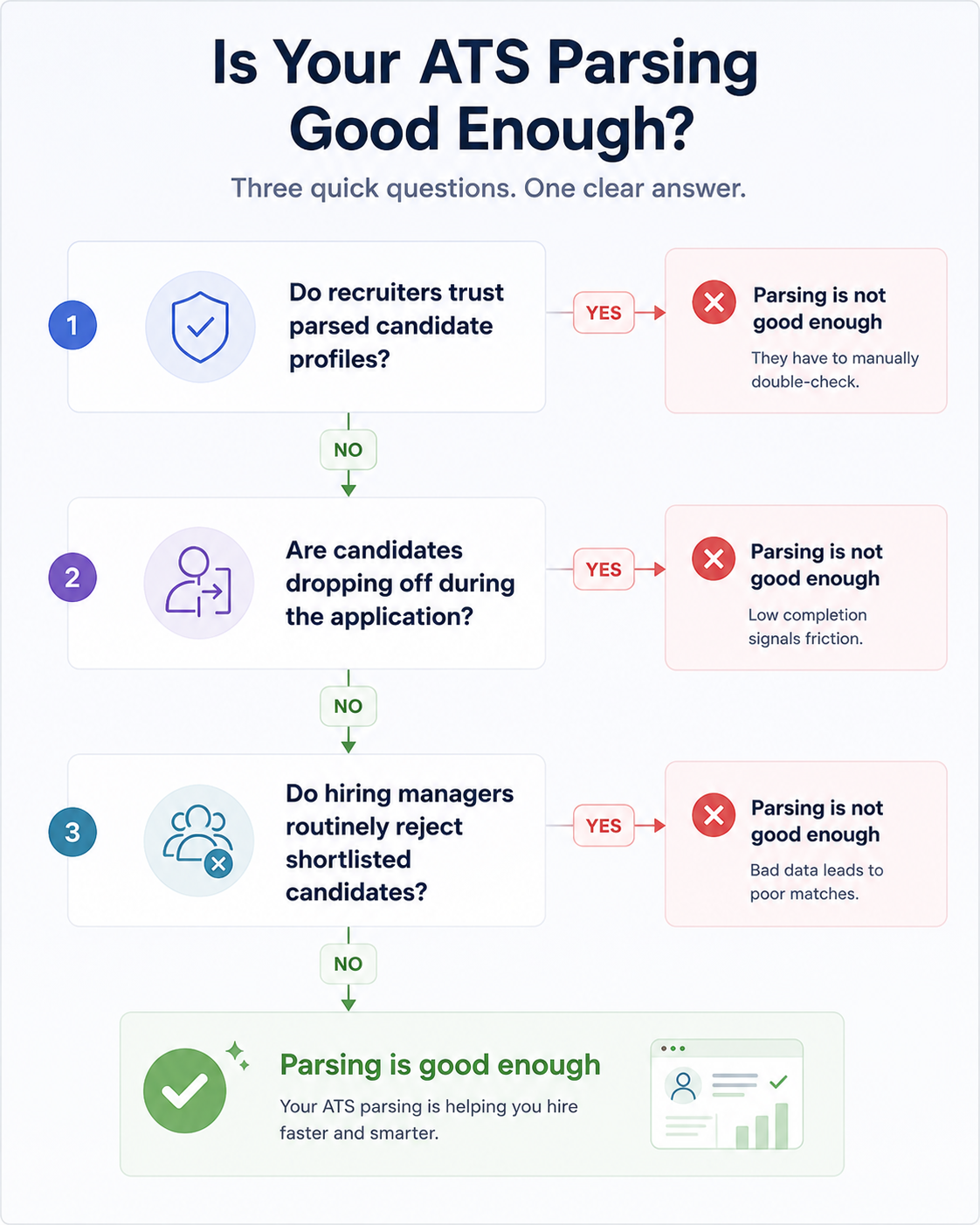
1. Do recruiters trust the parsed candidate profiles?
If your team routinely opens the original resume to verify work history, skills, or education before reviewing a candidate, your parser isn't saving time. The whole purpose of resume parsing is to eliminate manual data entry. If recruiters still have to double-check everything, it's not working.
2. Are candidates dropping off during the application?
A low application completion rate is often a warning sign. Every field candidates have to manually fill out because the parser failed to populate it adds friction, increasing the chances they'll abandon the application before submitting it.
3. Do hiring managers reject candidates your ATS recommends?
If hiring managers regularly dismiss candidates that your ATS surfaces as strong matches, it's worth looking at the data feeding the screening process. Poor parsing often results in incomplete or inaccurate candidate profiles, making even the best screening models less effective.
If you answered yes to any of these questions, your ATS resume parsing is probably holding your hiring process back. The sooner you identify the gaps, the sooner you can start improving both recruiter efficiency and candidate experience.
Build a hiring process on data you can trust
Better hiring starts with better candidate data. When resumes are parsed accurately from the start, recruiters spend less time fixing profiles, candidates complete applications faster, and hiring teams can make decisions with greater confidence.
Kula brings together semantic matching, support for 18 languages, duplicate detection, and PII removal to help create cleaner candidate records throughout the hiring process.
Book a demo today and see how Kula's AI-powered resume parsing can help your team hire with confidence.

The main purpose of ATS resume parsing is to automatically extract information from resumes and organize it into structured candidate profiles. This eliminates manual data entry, speeds up candidate screening, improves searchability, and helps recruiters evaluate applicants more efficiently. Modern AI-powered parsers also understand context and skill relationships, making candidate matching more accurate.
Traditional ATS platforms scanned resumes by matching exact keywords from the job description. Modern ATS resume parsing uses AI and natural language processing (NLP) to understand skills, job titles, and experience in context. This allows recruiters to identify relevant candidates even when resumes use different terminology or phrasing.
The best ATS resume parsing software for small businesses should offer AI-powered parsing, semantic matching, multilingual support, duplicate detection, and seamless integrations with sourcing and HR tools. Platforms like Kula, Greenhouse, Lever, and Workable provide resume parsing capabilities, but the right choice depends on your hiring volume, budget, and workflow requirements.
Most modern ATS platforms integrate with HRIS, payroll, onboarding, assessment, and interview scheduling tools through native integrations or APIs. Before choosing a solution, verify that it supports your existing HR tech stack, offers reliable data synchronization, and can migrate candidate data without creating duplicate records or disrupting hiring workflows.
A good ATS parse rate is generally 90% or higher, meaning most resumes are converted into accurate, structured candidate profiles with little or no manual correction. However, parse rate alone doesn't tell the full story. A modern AI-powered parser should also correctly interpret skills, job titles, and experience across different resume formats and languages, while minimizing duplicate records and missing information. The best way to evaluate parsing quality is by measuring how often recruiters trust the parsed profile without needing to refer back to the original resume.