



AI is showing up in more parts of the interview process than most recruiters probably expected. It can book the interview, take notes during it, summarize the conversation, and even handle early-stage screening.
For recruiting teams, that can mean less time spent chasing calendars and typing notes. But saving time isn't the same as improving the hiring process. The real question is where AI helps and where it starts getting in the way of good hiring decisions.
In this guide, we'll look at the main types of AI interview tools, what they're actually useful for, and what recruiters should consider before handing more of the interview process over AI.
Where AI interview tools help hiring teams
AI interview tools aren't one type of software. The category spans several parts of the interview workflow, from scheduling the conversation to documenting it and, in some cases, conducting or evaluating the interview itself.
In Greenhouse's 2025 AI in Hiring survey, 54% of surveyed U.S. job seekers said they had encountered an AI-led interview. Let’s look at what sits behind the label "AI interview tools" before you consider evaluating a platform:
1. AI interview notetakers
AI notetakers record or transcribe live interviews and can turn those conversations into summaries, highlights, or structured feedback drafts. Their primary role is documentation and decision support, rather than independently deciding whether someone should be hired.
The main considerations here are consent, transcript accuracy, data retention, and whether recruiters rely too heavily on an AI-generated summary instead of reviewing the underlying conversation.
2. Asynchronous video interviewing
With asynchronous video interviewing, candidates record responses to predefined questions on their own time instead of meeting with an interviewer live. Depending on the platform, the workflow may include recording, transcription, structured review, or AI-based scoring.
Not every platform analyzes facial expressions, personality, or other behavioral signals. When evaluating one, check exactly what the AI analyzes and how that output is used in the hiring process.
3. Conversational AI screening
Conversational AI screening uses an AI agent to ask candidates questions through text, voice, or video. The technology can collect information through a structured conversation, but some systems also analyze or rank candidates.
That distinction matters. A tool that gathers responses is a different proposition from one that makes evaluative judgments about those responses. Because this category is newer, teams should pay particular attention to how its outputs are generated, reviewed, and explained.
4. AI interview scheduling
AI interview scheduling focuses on coordination rather than candidate evaluation. These tools can manage interviewer calendars, time zones, panel availability, reminders, and rescheduling.
Scheduling is generally a lower-risk application because the software isn't assessing candidate quality. But it still involves personal data and can create problems if it handles time zones, accessibility needs, interviewer availability, or rescheduling poorly.
AI recruiting agents can work across broader recruiting tasks, including sourcing, screening, and taking actions on a recruiter's behalf. AI interview tools are narrower: they focus specifically on the interview workflow, from scheduling and screening to documentation and feedback.
The distinction is useful because the right tool depends on the bottleneck you're trying to solve. Automating calendar coordination is a very different use case from asking AI to evaluate a candidate.
How recruiters today are using AI interviewing tools
AI interviewing tools are most useful when they take repetitive work off a recruiter’s plate without taking the recruiter out of the process. Today, that tends to mean four things: documenting interviews, coordinating schedules, standardizing early-stage screening, and giving candidates more flexibility.
1. Administrative compression
One of the simplest and most helpful uses for AI in interviews is automating notetaking so recruiters don’t have to rely on manual note taking.
We all know that AI notetakers like Fathom and Fireflies.ai can transcribe an interview, summarize the conversation, and turn discussions into structured notes.
But now we all have applicant tracking systems with built-in note taking features that recruiters can later use for preparing interview feedback or a candidate submission.
That means the interviewer can focus more on what the candidate is actually saying instead of constantly switching between listening and typing.
We also found this the most common use case among recruiters in various Reddit threads.
For example, we found someone describing their workflow using Microsoft Teams to transcribe candidate screens, then feeding the transcript and job description into an AI tool to create structured notes against the role requirements.
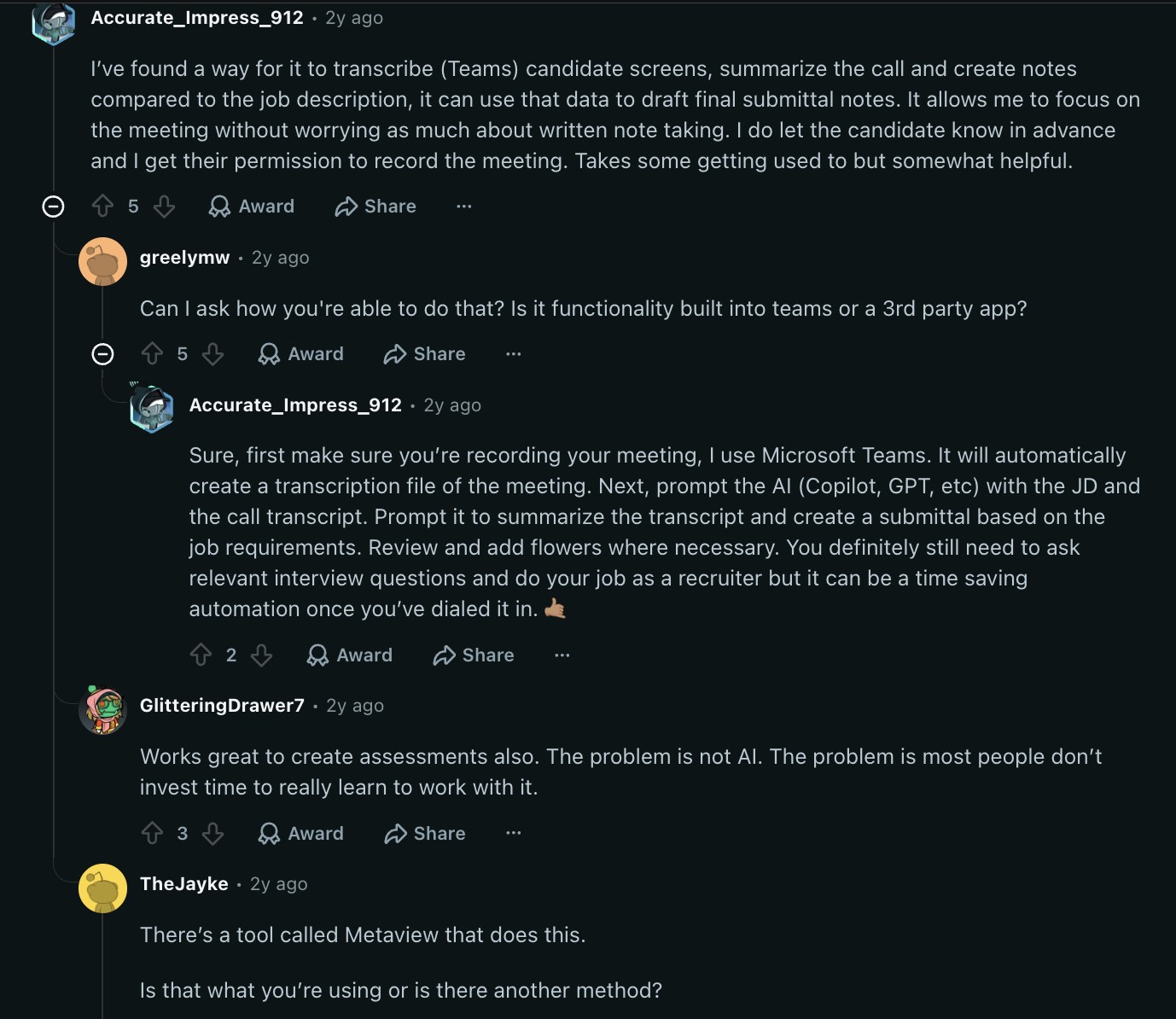
This makes it easier to focus on the conversation, while still reviewing the AI-generated output and adding context where needed. They also said candidates were informed in advance and asked for permission to record.
Keep in mind, a transcript or summary isn't automatically useful hiring evidence. If the output isn't connected to the competencies you're actually assessing, you may simply end up with a faster way to produce generic notes.
A structured interview scorecard makes the difference. Instead of asking AI to summarize an interview and decide whether the candidate seems good, recruiters can use it to organize what the candidate said against the specific requirements they already use to evaluate the role.
2. Scheduling friction
Interview scheduling is another area where AI can remove a disproportionate amount of administrative work. Coordinating calendars, panel availability, time zones, reminders, and rescheduling can take several back-and-forth messages for a single interview, especially when multiple interviewers are involved.
Unlike automated candidate evaluation, scheduling doesn't require the tool to make a judgment about a candidate. That makes it a relatively straightforward place to introduce automation.
The useful question isn't simply whether a scheduling tool can book an interview. It's whether it actually reduces friction for recruiters and candidates.
Teams can measure that by looking at:
- Time from interview request to confirmed slot
- Number of recruiter messages per scheduled interview
- Time required to complete a reschedule
- Candidate drop-off before the interview
- Calendar conflicts and interviewer workload
- How well the system handles time zones and accommodation requests
Those measures give recruiting teams a clearer picture of whether AI scheduling is solving a real bottleneck rather than simply adding another tool to the stack.
3. Consistency in structured screening
AI can also help recruiters run more consistent early-stage interviews, but the consistency comes from the structure of the process, not from AI itself.
A well-designed screening workflow uses job-relevant questions, applies the same core rubric across candidates, preserves the candidate's responses, and gives a recruiter enough evidence to understand how an assessment was reached.
That last part is particularly important. An AI-generated score without the underlying evidence is difficult for a recruiter to evaluate. A useful system should let the reviewer see the response, qualification, or criterion that contributed to the output rather than presenting an unexplained recommendation.
This is also why it's too broad to say that AI interviewing tools simply "reduce bias." A standardized process can reduce some forms of inconsistency, but automation can introduce other problems through inaccurate transcription, language differences, accessibility issues, or model errors.
The goal should be a more consistent process that remains reviewable by a person, not an automated judgment that happens to produce the same output every time.
4. Candidate flexibility
Not every candidate can easily coordinate a live interview during a recruiter's available hours. Asynchronous interviews can give candidates more flexibility by allowing them to record responses when they have the time and setup to do so.
That flexibility only works when the process is designed around the candidate, though. A recorded interview can quickly become frustrating if candidates don't know what they're being evaluated on, whether AI is analyzing their recording, or whether anyone will actually review what they submit.
A candidate-friendly asynchronous process should provide:
- Clear instructions on how the interview works
- Transparency about AI use, including whether the recording is being analyzed
- Reasonable preparation time before responses are due
- Accessibility options for candidates who need them
- A human contact for technical problems or questions
- Clear information about re-recording, including whether candidates can redo an answer
- Confirmation that a person will review the result
The common thread across these use cases is that AI works best as a support layer. It can take care of transcription, coordination, and structured documentation, giving recruiters more time to focus on the parts of interviewing that still require context and judgment.
What works and what doesn’t with AI interviewing
AI interviewing isn't inherently a better or worse way to hire. Instead, AI works better when it structures or collects information, while trust and fairness become bigger concerns when candidates aren't sure how the technology is judging them.
Ultimately, AI used in interviewing affects candidates just as much as it does for recruiting teams. So before you consider investing in AI interview platforms, remember that there are two sides to the coin, and how you can accommodate both recruiting goals and a positive candidate experience.
What seems to work for recruiters
AI can make structured interviews more consistent:
A 2026 natural field experiment conducted by the University of Chicago Booth School of Business, involving 70,000 job applicants compared interviews conducted by human recruiters with interviews conducted by AI voice agents.
The experiment found that AI-led interviews were more structured and consistent and collected more hiring-relevant information. Applicants interviewed by AI were 12% more likely to receive a job offer, with higher job starts and retention and no detected decline in the productivity of those hired.
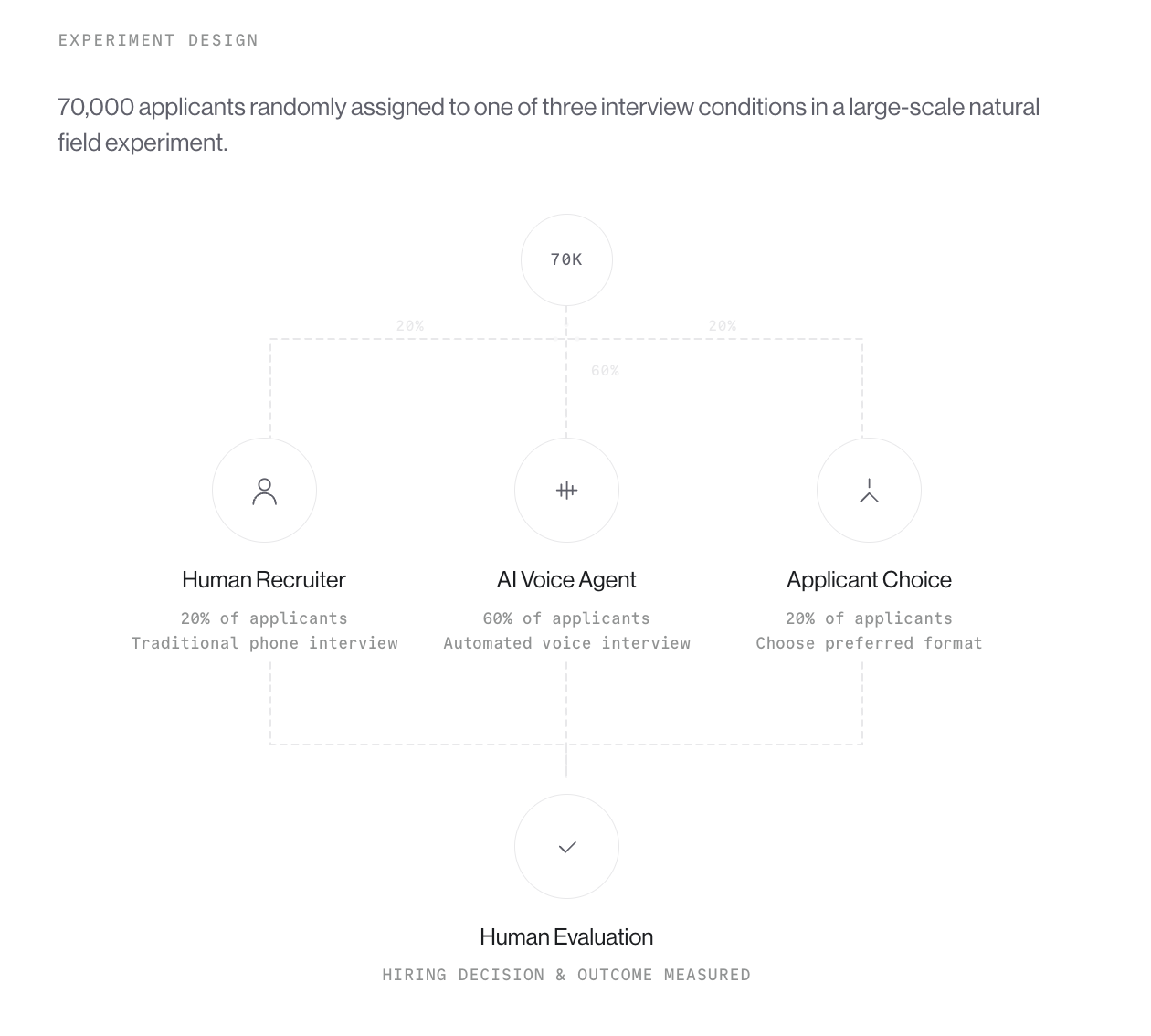
The important caveat here is that human recruiters still evaluated the interviews and made the hiring decisions. The study tested AI as an information-collection layer, not as an autonomous hiring manager.
That makes the finding more useful for recruiters than the usual "AI can replace interviews" claim. The evidence supports using AI to ask structured questions and collect comparable information while keeping a human responsible for the decision.
A more consistent candidate experience:
AI can ask the same core questions and follow the same interview structure instead of leaving every candidate's experience to an individual interviewer's style. That's particularly useful for high-volume first-round screening, where consistency can otherwise be difficult to maintain.
Flexibility for candidates:
AI-led or asynchronous interviews can give candidates more control over when and where they complete an interview. But flexibility only helps if candidates understand the process and have reasonable alternatives when the technology doesn't work for them.
What doesn't work as well for candidates
Candidate trust drops when AI evaluation isn't transparent:
Gartner's 2025 survey of 2,918 job candidates found:
- Only 26% trusted AI to fairly evaluate them
- 32% were concerned AI could cause their application to fail
- 25% said they trusted employers less when AI was used to evaluate their information
That doesn't mean candidates universally reject AI interviews.
It suggests that the evaluative role of AI matters. Candidates are more likely to question a system when they don't understand what it is assessing or how much influence it has over the outcome.
A 2025 study published in Discover Artificial Intelligence also found that participants perceived AI-driven hiring as less trustworthy, less procedurally just, and less attractive than human-driven hiring, with those perceptions also reducing their stated interest in applying.
The experiment involved 210 participants, so it shouldn't be treated as representative of the entire candidate population, but it provides controlled evidence that the way AI is introduced can affect employer perceptions.
The biggest practical risks
When your candidate experience and hiring quality is at stake with AI interviewing, here are three areas recruiters should be particularly careful with:
- Opaque evaluation: If an AI tool produces a score or recommendation, recruiters should be able to see the evidence behind it. "Strong candidate" isn't useful if nobody can explain why.
- Accessibility: The EEOC warns that AI and algorithmic tools can unintentionally screen out people with disabilities. It specifically recommends processes for reasonable accommodations and alternative assessment formats when an AI tool doesn't accurately measure someone's ability because of a disability.
- Lack of transparency: Candidates should know when AI is involved, what it is being used for, and where human review happens. Without that information, even a technically effective tool can make the hiring process feel arbitrary.
The dividing line is therefore fairly practical:
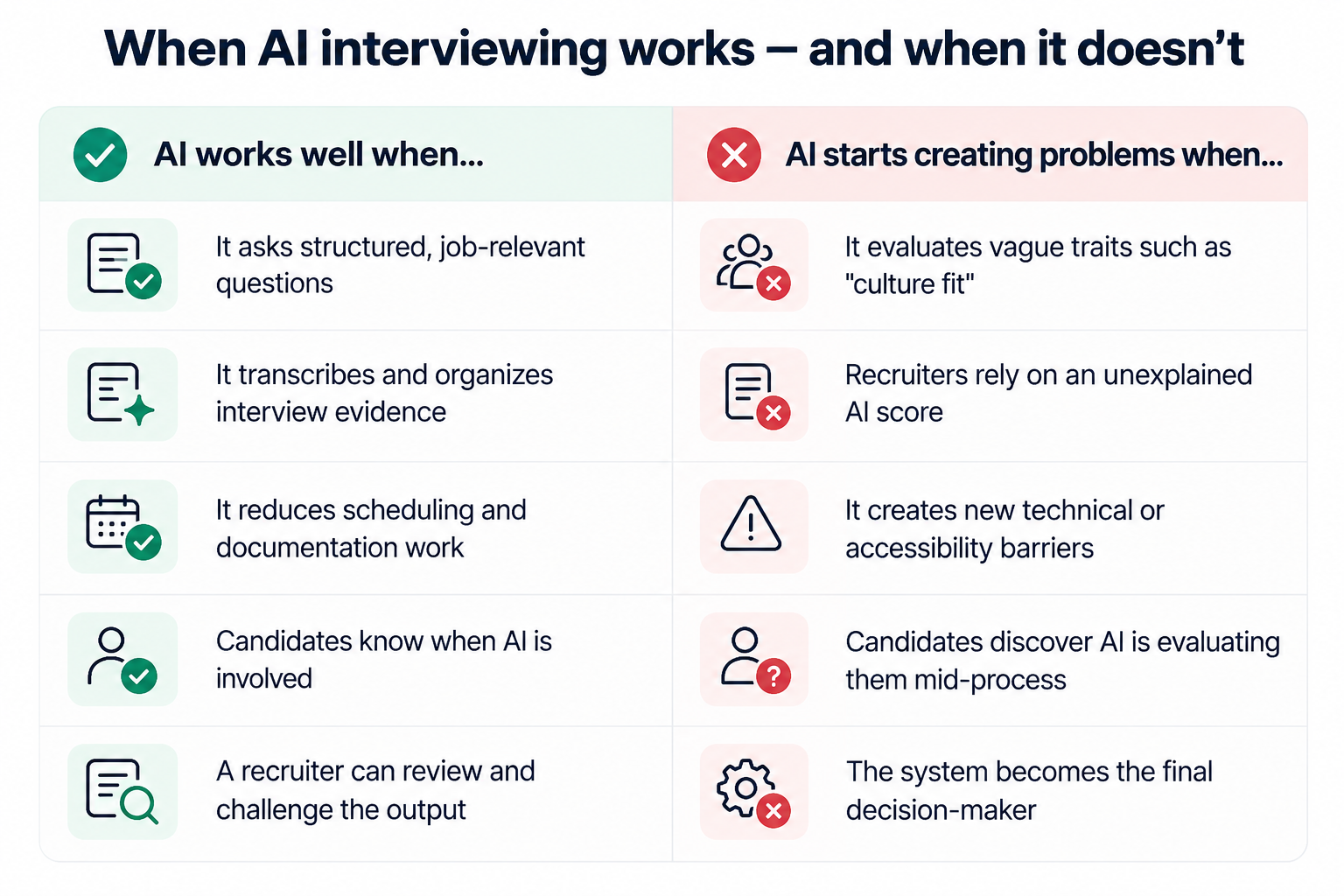
The strongest use of AI interviewing isn't removing humans from the interview. It's giving recruiters better-structured information while keeping the hiring decision explainable and accountable.
Lessons from real-world AI interviewing failures
AI interview tools can take repetitive work off a recruiter’s plate, but they are not neutral observers of candidate potential. The problems that have surfaced so far fall into four areas:
- Questionable evaluation methods
- Candidate-data security
- Discriminatory automation
- The growing use of AI on both sides of the interview
Facial analysis shows the limits of “reading” candidates
One of the clearest examples is HireVue’s decision to remove facial analysis from its assessments.
The company said it discontinued the feature in March 2020 after internal research found that advances in natural-language processing meant visual analysis no longer added significant value to its assessments.
The feature had analyzed applicants’ facial expressions during video interviews as part of its assessment process.
The decision matters because it raises a broader question about what an AI interview tool can actually infer from a candidate’s face. Facial expressions can vary with culture, context, disability, and individual communication style. For recruiters evaluating AI interview software or AI interview platforms, that is a useful warning sign:
Be skeptical of tools claiming to infer traits such as honesty, personality, enthusiasm, emotional intelligence, or “culture fit” from facial expressions or micro-expressions.
Candidate data can become a security problem
AI interviewing also creates another responsibility: protecting the information candidates hand over.
In July 2025, security researchers reported vulnerabilities in McDonald’s McHire platform, an AI-powered recruiting system developed by Paradox.
The researchers said weak administrator credentials and an insecure API allowed them to access applicant records, potentially exposing data associated with around 64 million applications.
Paradox said the researchers actually accessed seven records, five of which contained personal information, and said it found no evidence that other unauthorized parties had obtained the data. The vulnerability was subsequently fixed.
But the lesson applies to any AI interview tool, including an AI notetaker: candidate data does not become less sensitive simply because AI processes it.
Recruiters should know where transcripts and recordings are stored, who can access them, how long they are retained, whether they are used for model training, and how vendors handle security vulnerabilities.
Candidates are using AI too
The final complication is that employers aren't the only ones using AI in interviews.
A 2025 Gartner survey of 3,000 job candidates found that 6% admitted to interview fraud, defined by Gartner as either posing as someone else or having someone else pose as them during an interview. And by 2028, one in four candidate profiles worldwide will be fake.
Another study of 245 participants found that candidates who used ChatGPT-generated answers in asynchronous video interviews received higher overall and content ratings than candidates who did not use ChatGPT, although they received lower honesty ratings and viewed the process as less procedurally fair.
That creates a new problem for AI interview platforms as the system is no longer evaluating candidates in isolation. Candidates can use AI to prepare, generate answers, or potentially assist them during the interview itself.
This means employers use AI to automate evaluation, candidates use AI to optimize their performance, and both sides have to work harder to establish what the interview is actually measuring.
The best AI interview tools top hiring teams are using today
Here are the tools worth shortlisting, depending on what you actually need:
If interview feedback is the bottleneck
Start with an AI notetaker.
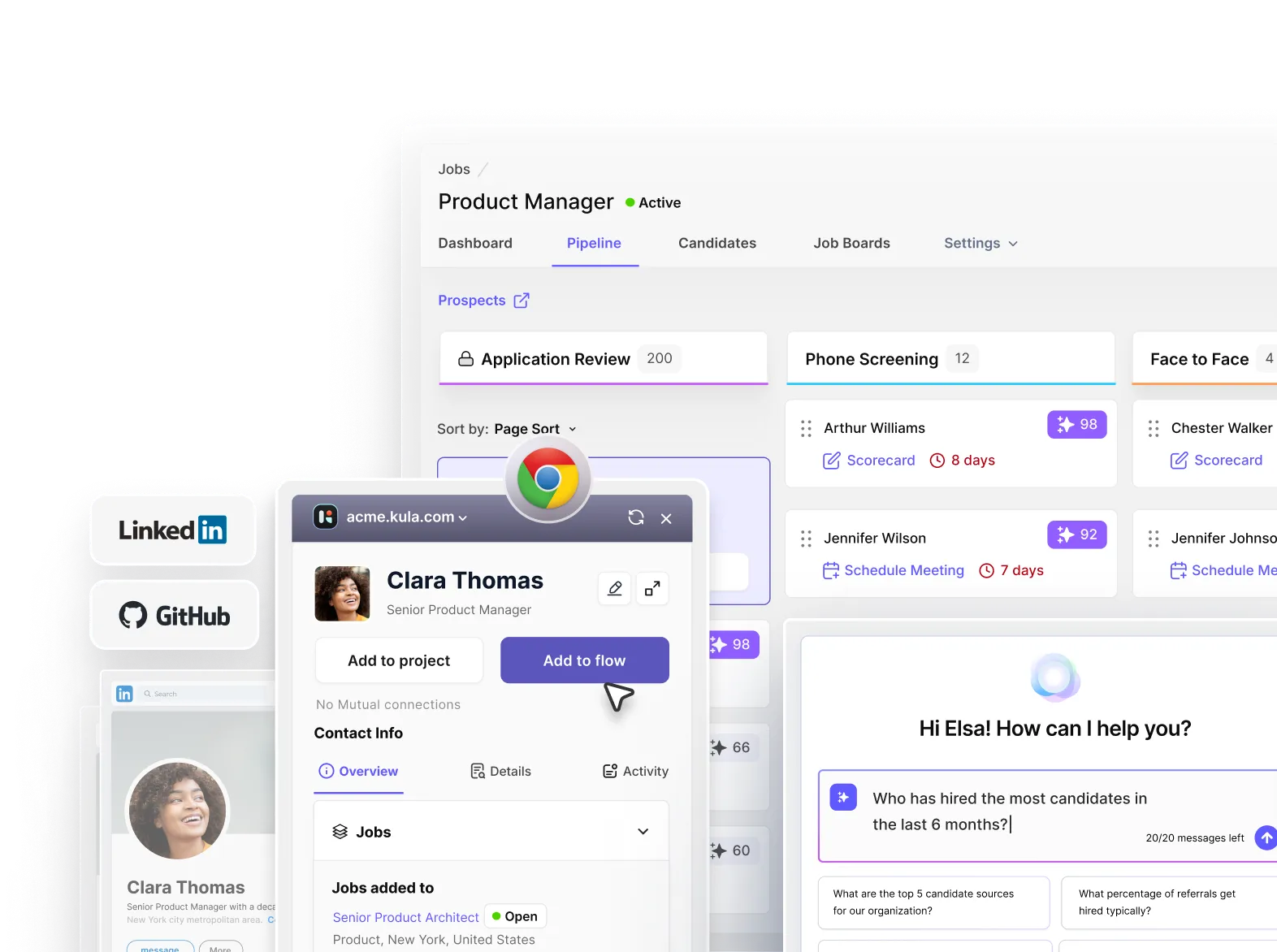
Kula’s AI notetaker is built into its ATS, so recruiters can record and transcribe live or virtual interviews without adding another interview-intelligence layer. It can also use the transcript to auto-fill interview scorecard criteria.
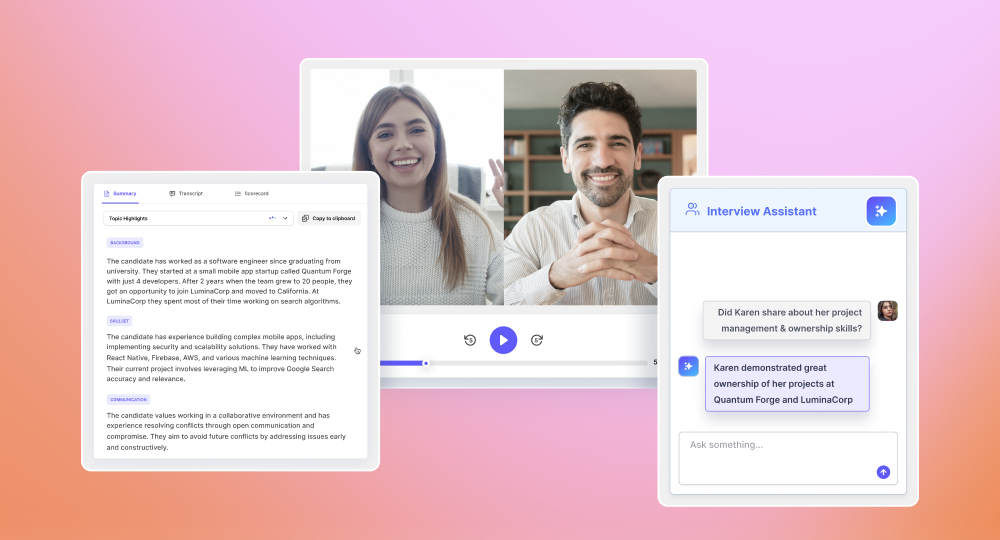
Plum reduced feedback turnaround from 1–2 days to just a few hours thanks to Kula’s AI notetaker for candidate interviews. Instead of recapping the entire conversation history with a candidate, Plum’s hiring team is now able to easily leave genuine feedback on candidates, without the stress of manual note taking or digging through transcripts.
Ashby’s AI notetaker takes a similar ATS-native approach. Its useful differentiator is how much candidate context recruiters can query. Instead of searching through separate transcripts, resumes, emails, and feedback, recruiters can ask questions across that information using natural language.
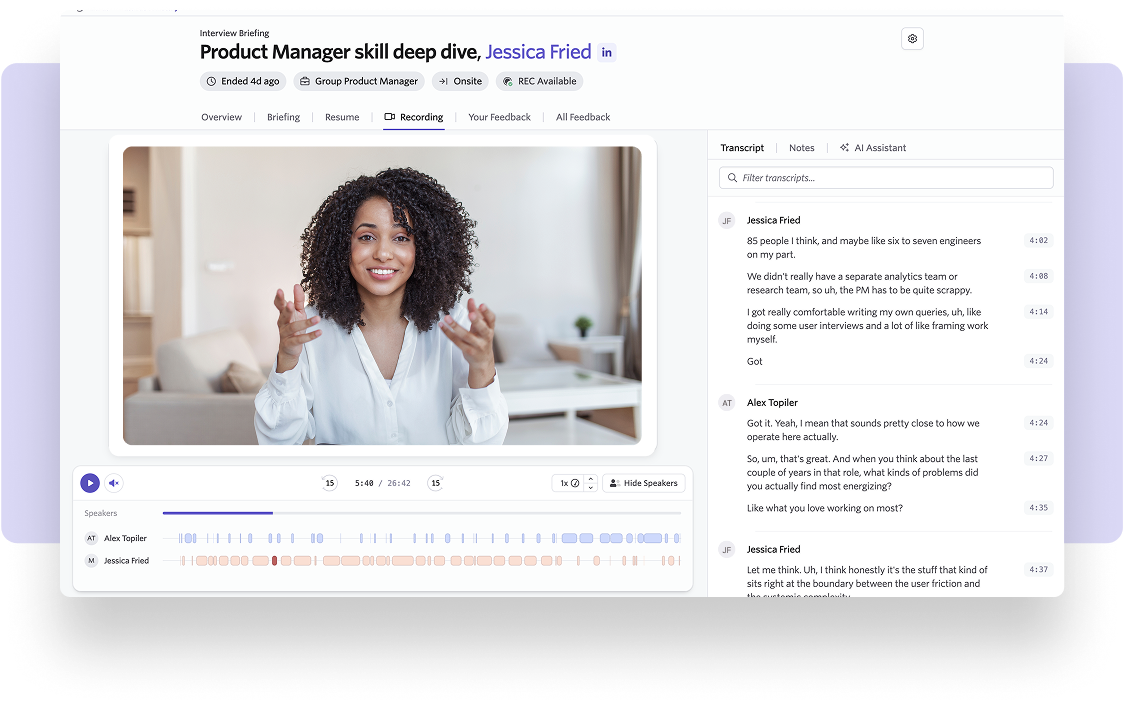
If you don't want to change your ATS, interviewing tools such as BrightHire and Metaview are worth looking at. BrightHire focuses heavily on interview intelligence and structured feedback, while Metaview focuses on turning interview conversations into notes and recruiting data that can flow back into your existing systems.
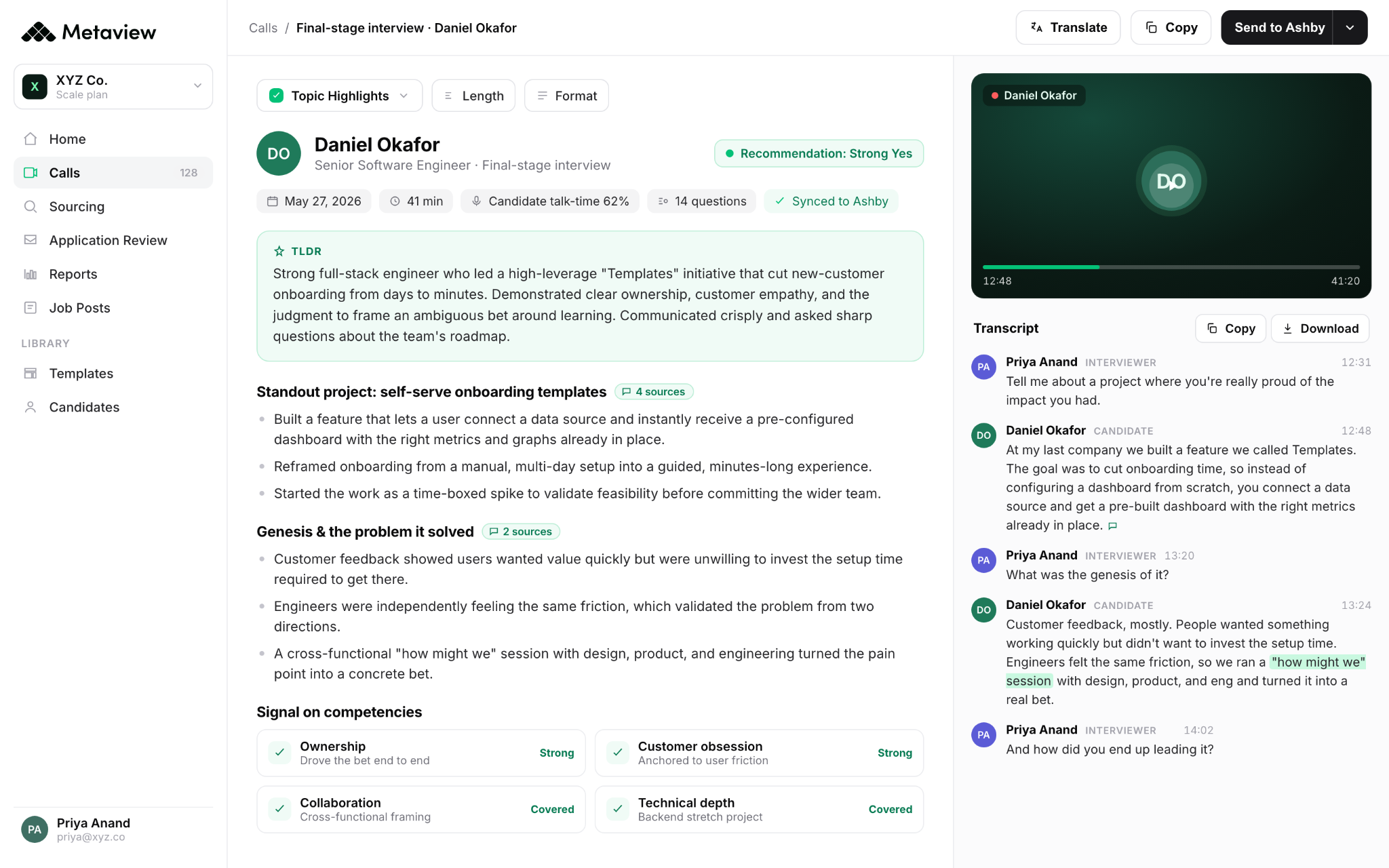
The deciding factor here is less about transcription quality and more about what happens after transcription. If your recruiters still have to copy information from an AI notetaker into the ATS and then complete the scorecard manually, you've only automated half the workflow.
If you need to screen candidates asynchronously
HireVue is the obvious platform to evaluate for large-scale structured video screening. Its on-demand interviews let candidates answer predefined questions without coordinating a live interview, and the platform also offers broader assessment capabilities.
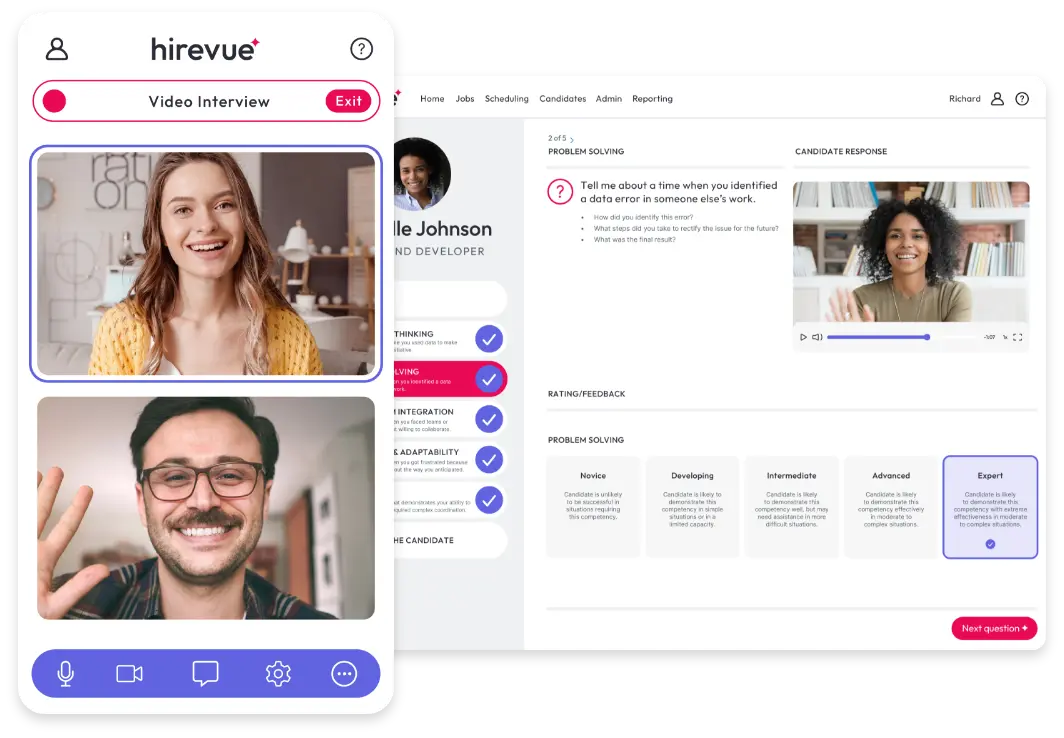
For teams that don't need that breadth, Willo and Hireflix offer a more focused asynchronous video workflow. Both are worth considering if your goal is to send candidates structured questions, let them record responses on their own time, and give recruiters one place to review them.
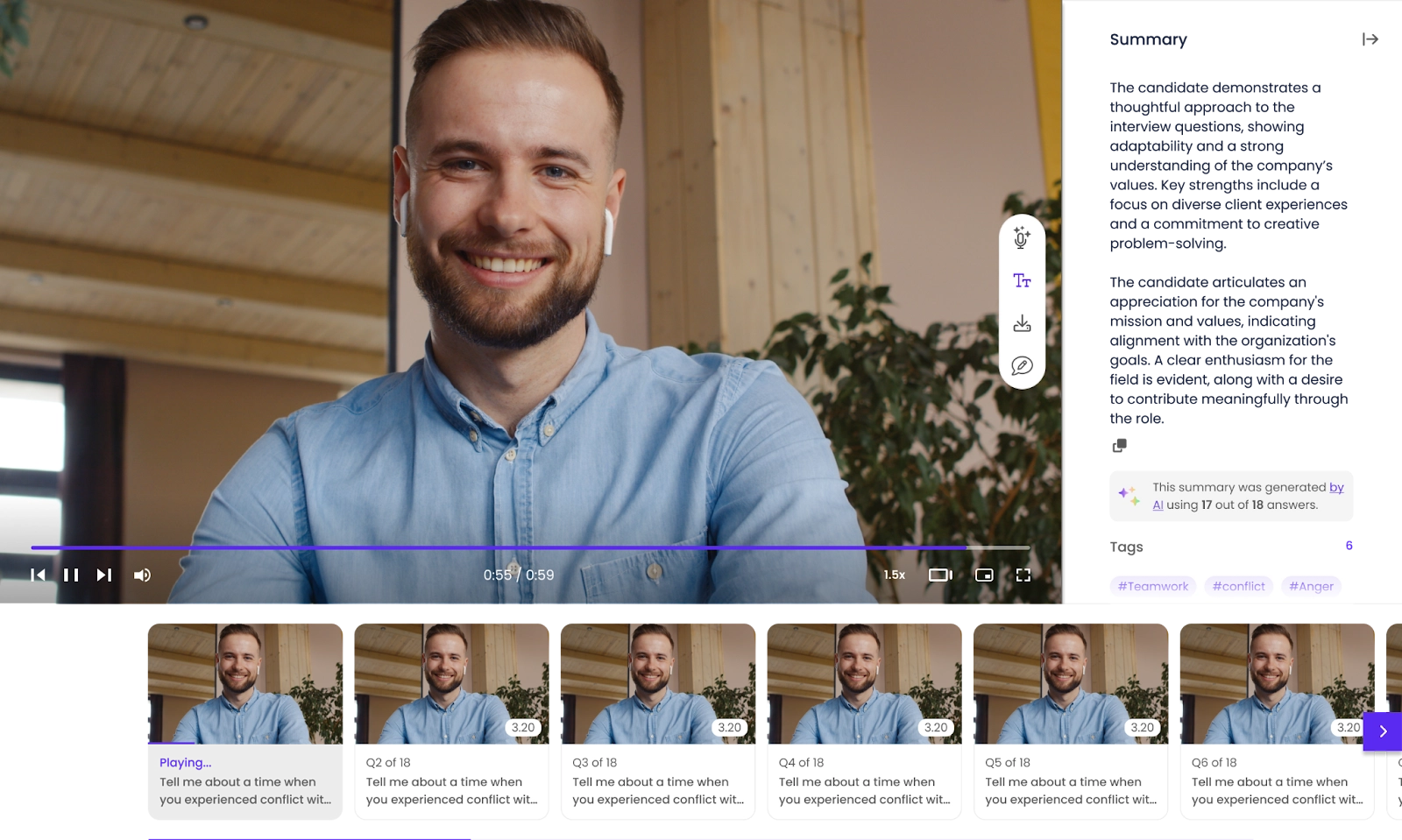
VidCruiter and Spark Hire are also established options if you want asynchronous video interviewing alongside a broader set of recruiting features.
When evaluating the best AI interview software, don’t ask "Which platform has the most features?"
Ask how much screening complexity you actually need. A 20-person recruiting team running occasional first-round screens doesn't necessarily need the same AI interview software as an enterprise hiring hundreds of candidates a month.
If scheduling is eating your team's time
This is one category where going native can make a lot of sense.
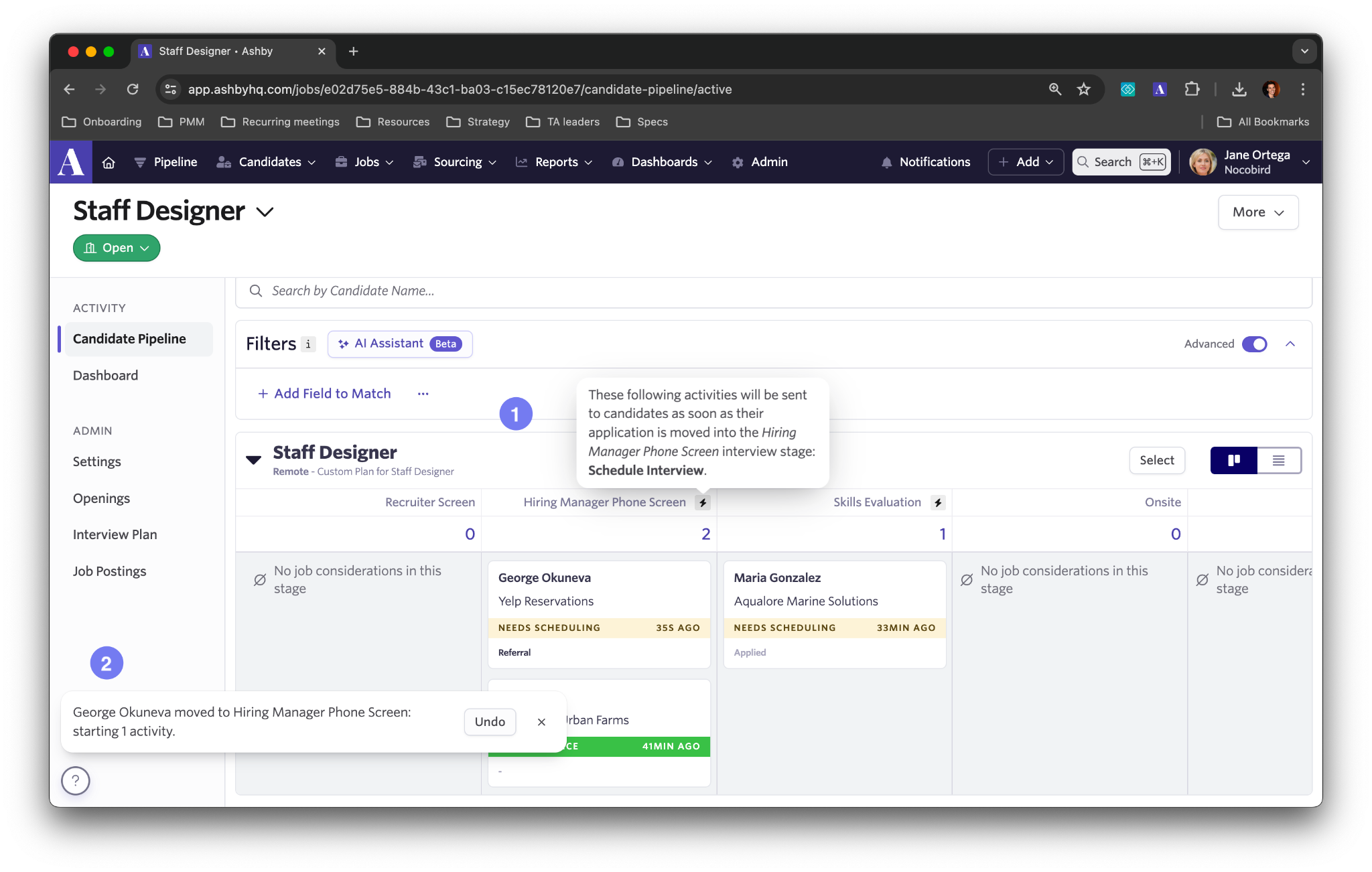
Ashby and Kula both build interview scheduling directly into their ATS workflows. Ashby's scheduling supports panel coordination, interviewer replacement, candidate availability, and calendar synchronization.
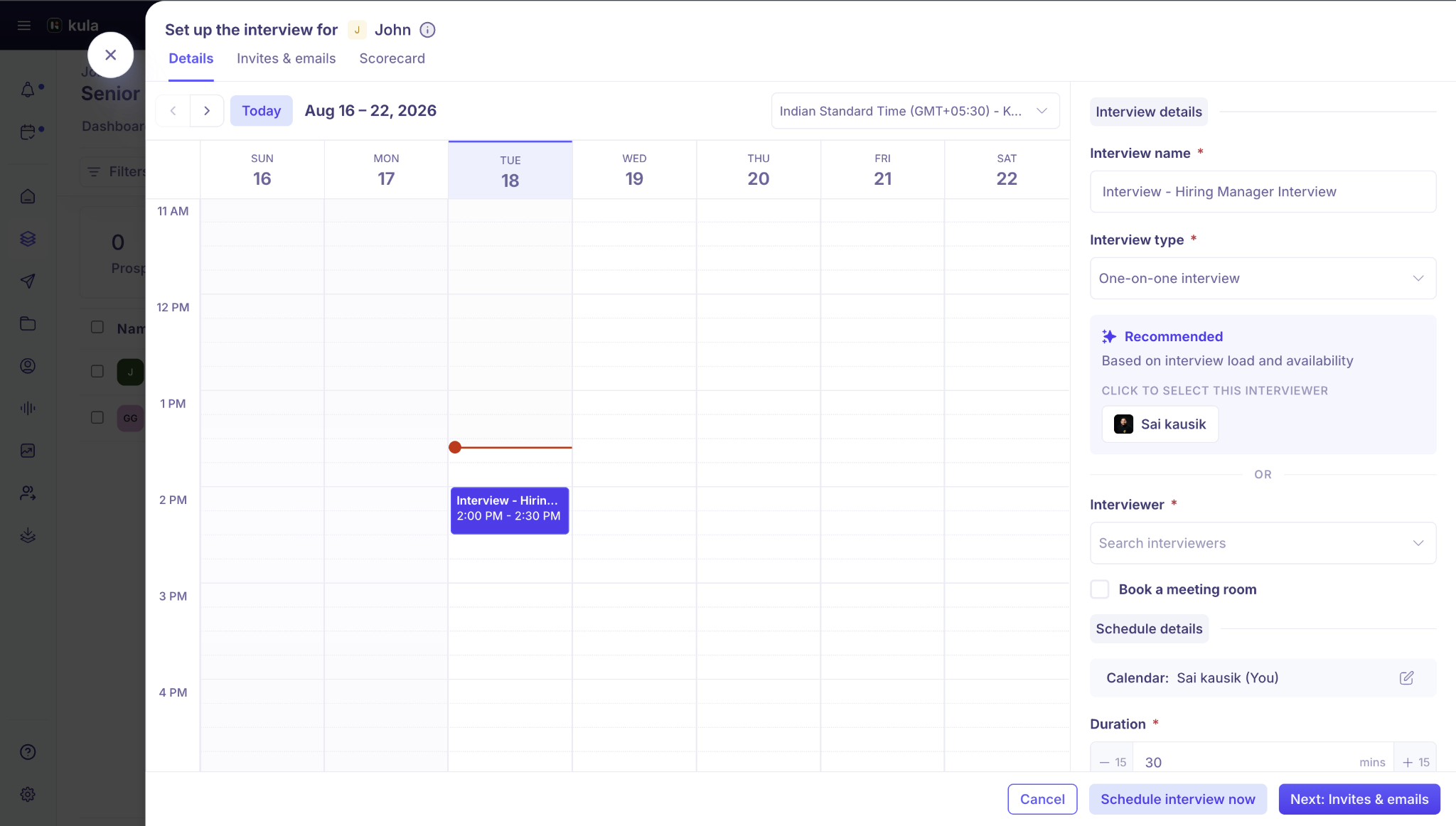
Kula's native scheduling includes panel scheduling across time zones, interviewer load balancing, and automated feedback nudges.
If you're not looking to change your ATS, GoodTime and ModernLoop are specialist options for more complicated scheduling workflows, particularly when you're coordinating panels and balancing interviewer capacity.
Calendly is also useful for simpler candidate self-scheduling. It becomes less useful when you need recruiting-specific logic around panels, interviewer availability, workload, and rescheduling.
Which AI interviewing tool should you choose?
Start with the problem you're trying to solve, then match the tool to it:\
- Want interview notes and scorecards inside your ATS? Look at Kula or Ashby. Both are native to their respective ATSs, so they make more sense if you're looking for a consolidated ATS with all the necessary features. If you're keeping your existing ATS and want a dedicated interview-intelligence layer, BrightHire or Metaview are more relevant options.
- Need structured video screening at high volume? HireVue is built for larger-scale asynchronous and structured interviewing. If you want something simpler and more focused on one-way video, consider Willo or Hireflix. VidCruiter and Spark Hire are worth comparing if you want video interviewing as part of a broader recruiting platform.
- Interview scheduling is the biggest headache? If you're already using Ashby or Kula, start with their native scheduling capabilities before adding another platform. For teams that need a dedicated scheduling layer, GoodTime and ModernLoop are better suited to complex panel scheduling and interviewer coordination. Calendly is fine for straightforward recruiter screens but isn't designed around complex recruiting workflows.
- Trying to reduce your recruiting tech stack? Prioritize an ATS-native AI interview tool where the capability is good enough for your use case. Keeping scheduling, interview data, transcripts, and scorecards connected can be more valuable than adding another specialist tool with a slightly longer feature list. Kula is a great choice if you want to reduce your reliance on third party tools as it’s an AI-native all in one recruiting platform.
The key is to compare tools within the same use case.
An AI notetaker shouldn't be judged against an asynchronous video platform, and a scheduling tool shouldn't be expected to solve candidate screening.
Once you've narrowed the category, test how well the tool fits your existing workflow, how much manual work remains, and whether recruiters can actually trust and explain the output.
How to adopt AI interview tools without losing the human touch
The goal of AI interviewing isn't to remove people from the hiring process. It's to remove the parts of recruiting that don't need a person in the first place.
Scheduling an interview, transcribing a conversation, or organizing feedback can give recruiters more time for actual candidate conversations. But having AI decide whether someone is a good fit is a very different proposition.
Here's how to keep the balance while aligning with AI recruiting regulations:
- Keep hiring decisions human. Use AI as decision support, not the final decision-maker. A recruiter or hiring manager should review the evidence before advancing or rejecting a candidate. For employers covered by the EU AI Act, AI systems used for recruitment and selection are classified as high-risk, with requirements around human oversight and other safeguards.
- Tell candidates when AI is involved. Don't make someone discover halfway through an interview that they're being recorded, transcribed, or evaluated by AI. Illinois' Artificial Intelligence Video Interview Act, for example, requires employers using AI analysis of video interviews to notify candidates, explain how the AI works in general terms, and obtain consent before the interview.
- Use AI to remove friction, not human interaction. An AI notetaker can let a recruiter focus on the candidate instead of typing. Automated scheduling can eliminate a chain of calendar emails. Those are useful applications because they give time back to recruiters without making candidates interact with a machine at every stage.
- Keep real people in the moments that matter. Candidates should still have opportunities to speak with recruiters and hiring managers, ask questions, discuss the role, and understand what happens next. The more consequential the decision, the harder it is to justify a completely automated experience.
- Give candidates a way out when the technology doesn't work. Accessibility needs to be part of the workflow, not a workaround after something goes wrong. NYC's rules for automated employment decision tools, for example, require candidate notices and instructions for requesting a reasonable accommodation.
- Measure the candidate experience alongside efficiency. Don't judge an AI interview tool only by minutes saved. Track interview completion and drop-off, candidate complaints, accommodation requests, correction rates for inaccurate transcripts or summaries, and how often recruiters override the AI's output.
The best AI interview workflow should feel less automated to the recruiter and less impersonal to the candidate. If AI saves your team time but leaves candidates feeling like they're being processed by a system, the workflow needs another look.
Are you ready to adopt AI interview tools?
Before adding another tool to your recruiting stack, ask three questions:
How much interview volume are you actually handling?
More than 50 phone screens a month can make asynchronous screening worth evaluating. More than 100 live interviews a month can justify AI notetaking.
If candidates regularly meet panels of five or more interviewers, AI scheduling can start paying off. Below those levels, the setup and change-management costs may outweigh the productivity gains.
Do you have the process to use what AI produces?
An AI notetaker gives you transcripts. AI screening gives you scored shortlists. AI scheduling gives you coordinated calendars. None of that matters if recruiters don't have a consistent workflow for reviewing and acting on the output.
Your priority should be a clear and organized process, before adding additional tools to your stack.
Can you handle the compliance work?
AI interviewing can introduce disclosure requirements, candidate rights, accessibility considerations, and obligations around automated decision-making and personal data. If legal and compliance teams aren't equipped to support the rollout, start with lower-risk applications such as notetaking rather than jumping straight into automated candidate evaluation.
If all three answers are yes, you have the foundations to evaluate AI interview tools seriously. If one isn't, fix that constraint before adding another layer of automation.
AI interview tools can take repetitive work off recruiters' plates without turning the entire hiring process into a conversation with a machine.
The key is using AI where it removes friction, while keeping human judgment, transparency, and candidate interaction where they matter most. Kula brings AI interviewing, notetaking, scheduling, and the rest of your recruiting workflow into one ATS, so your team can automate more without adding another disconnected tool to the stack.
Book a demo to see how Kula can fit into your hiring process.

The main ethical considerations are fairness, transparency, privacy, accessibility, and human oversight. Recruiters should avoid using AI to infer subjective traits such as personality, honesty, or “culture fit” from facial expressions, voice, or other unreliable signals. Candidates should know when AI is being used, what it evaluates, how their data is handled, and whether a human reviews the output. Employers should also provide reasonable accommodations and ensure that AI-generated recommendations do not become the sole basis for hiring decisions.
The right AI interview tool depends on the part of the hiring process you want to automate. Kula and Ashby are options for teams that want interview intelligence, AI-note taking and automated scheduling built into their ATS, while BrightHire and Metaview work as specialist interview-intelligence layers. For asynchronous video screening, recruiters can evaluate HireVue, Willo, Hireflix, VidCruiter, and Spark Hire.