




Finding a strong manager is one thing, but finding a VP or C-suite leader who is willing to leave their current role is a whole different challenge.
The usual sourcing playbook starts to break down at this level because:
- Broad searches produce plenty of names but few genuinely relevant executives
- Generic outreach gets ignored
- Most C-suite candidates aren't actively looking
With all these challenges, a weak approach can mean losing someone you may not get another chance to reach.
That is why executive talent sourcing requires a different approach. And we’ve covered exactly where to find senior and C-suite candidates, how to reach them, what makes executive outreach work, and how to build a repeatable executive search process.
Why executive sourcing is fundamentally different
A VP or C-suite search isn't just a harder version of a manager search. It is fundamentally different from your usual candidate sourcing strategies.
For starters, the candidate pool is much smaller. Relationships matter more. The stakes of a bad approach are higher. And the person you're trying to hire is usually evaluating the company just as closely as you're evaluating them.
Here are the biggest differences:
1. You're sourcing a network, not just a candidate pool
For a typical role, a recruiter can search by title, skills, location, company, and years of experience and build a long list fairly quickly.
Executive sourcing is less straightforward because the strongest candidates may not be actively looking, and the most useful leads often come from the people around them.
Who has worked with them before? Which executives know them? Which investors, board members, advisors, or former colleagues could make an introduction?
That changes the research process. Instead of stopping when you find a list of people with the right title, you keep following the network around the role.
For senior leadership sourcing, those connections can be just as valuable as the candidate database itself.
2. A generic message can hurt more than it helps
Senior executives are accustomed to being approached. That doesn't mean they're willing to read another generic pitch about an "exciting opportunity."
At this level, the message needs a reason to exist.
What did the candidate actually do that makes them relevant? What about the company or role connects to their experience? Why are you contacting them specifically?
3. Compensation gets more complicated
Executive compensation rarely stops at base salary.
Depending on the role, the package can involve variable compensation, equity, sign-on incentives, retention grants, and other components. The candidate may also be weighing what they're giving up by leaving their current company.
That means compensation needs to enter the conversation earlier in executive hiring. If the package is fundamentally misaligned, months of interviews won't fix it.
4. You're selling the opportunity while assessing the candidate
An executive search isn't a one-way evaluation.
A senior candidate is likely to ask about the CEO, board, business trajectory, team quality, strategic priorities, decision-making authority, and what success actually looks like in the role.
A conversation with the CEO isn't simply another interview stage. It's part of the candidate's decision-making process.
Every interaction either builds confidence in the opportunity or gives the candidate another reason to walk away.
5. The process can take longer, so every delay matters
Executive searches naturally have longer timelines. According to 2026 research by Talentfoot, executive hiring takes roughly six weeks across all roles, 60 to 90 days for senior leadership, and often 120+ days for executive and C-suite hiring.
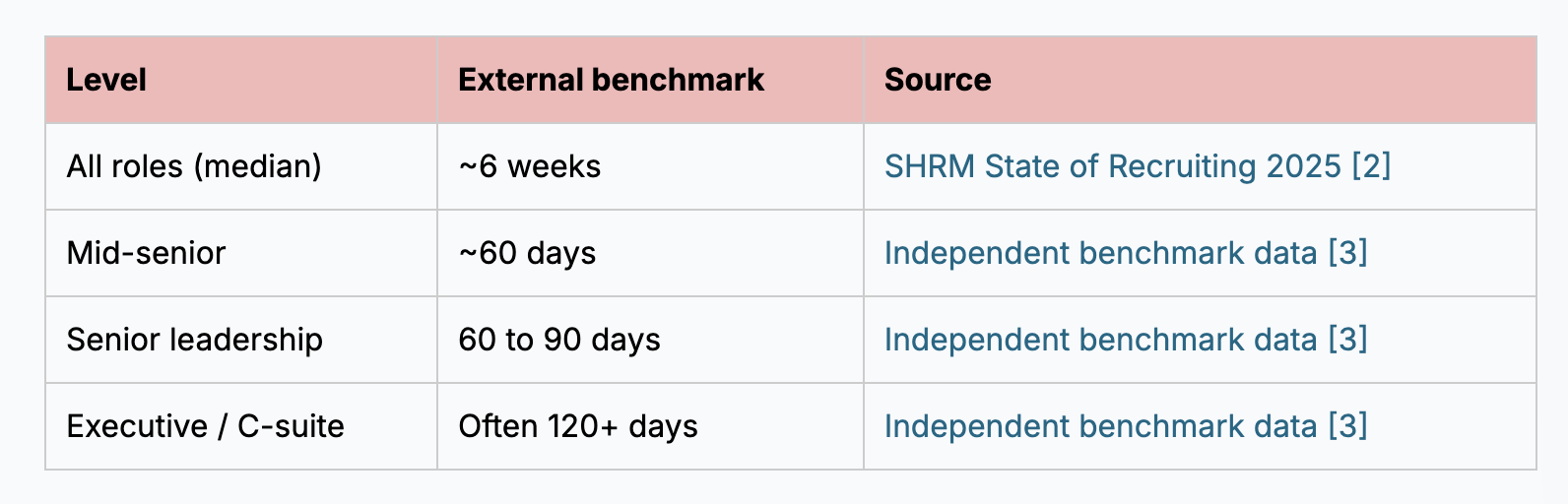
That longer timeline makes process discipline more important.
If a candidate waits weeks for feedback, gets rescheduled repeatedly, or can't get a straight answer about the role, the problem isn't simply that the search is taking a long time. The process itself starts sending a message about the company.
6. Executive search is competing with more than other employers
A strong executive candidate may already have relationships with recruiters, search firms, investors, founders, and other senior leaders.
You're therefore not competing for attention with job postings alone. You're competing with the candidate's existing network and the other opportunities reaching them.
That is why effective executive talent sourcing depends less on sending more messages and more on knowing who to approach, why you're approaching them, and who can credibly open the door.
This is the fundamental difference between executive sourcing and regular sourcing. Candidate sourcing is only the starting point. The real work is the research, relationship-building, and judgment that happen around it.
How C-suite candidates evaluate job opportunities
C-suite candidates don't evaluate an opportunity by asking, "Is this a good job?"
They're asking a much bigger question: Is this the right company, role, and moment in my career to make a move?
That means the pitch for an executive role has to go well beyond the job description. Here’s what executive talent actually wants to understand when recruiters reach out to them:
Who will I be working with?
Leadership philosophy and cultural fit matter because an executive's success depends heavily on the people around them. Candidates want to understand who they report to, how the leadership team makes decisions, and how the company handles disagreement and accountability.
What will I actually own?
Scope matters more than another title. A VP evaluating a move will want to know the size of the team, budget, reporting structure, board exposure, and decisions they will control. If the role looks like a lateral move with the same level of influence, there may be little reason to leave a company where they already have established credibility.
Where is the company going?
Senior leaders are taking on more than a new job. They are attaching their reputation to the business. Expect questions about the company's trajectory, financial position, growth plans, runway, and major upcoming milestones. The more senior the candidate, the less useful vague answers become.
Who will I lead?
Team caliber is another major part of the equation. Candidates want to know who they will inherit, who they will need to hire, and whether the existing team is capable of executing the company's plans.
How much can I change?
Autonomy is closely tied to scope. A senior title means little if every meaningful decision requires approval from someone else. Executives want clarity on where they have authority and where they don't.
What does the compensation package tell me?
Compensation isn't only about the final number. The balance between cash, equity, incentives, and other components can tell candidates a lot about the company's stage, priorities, and expectations.
What turns C-suite candidates off
The opposite is also true. Generic culture claims, buzzword-heavy job descriptions, copy-paste outreach, exaggerated promises, and a disorganized interview process make it harder to trust the opportunity.
"Great culture" doesn't tell an executive much. Neither does calling someone a "rockstar" or promising a vague "career-defining opportunity." Senior candidates want specifics they can evaluate.
And that leads to the most important part of executive search: trust.
Candidates are evaluating whether the company is being straight with them throughout the process. Be honest about the challenges in the business, weaknesses in the team, expectations for the role, and decisions the executive will actually control.
Assume they're doing their own research, too. A senior candidate can often ask people in their network about the CEO, company, leadership team, or role before accepting an offer.
That means, everything you tell them should hold up when they verify it independently.
For executive hiring, credibility isn't built through a polished pitch. It's built by giving candidates enough specific, honest information to decide whether the opportunity is worth the move.
How to write outreach that senior candidates respond to
Keep executive outreach short and specific
LinkedIn's analysis found that InMails under 400 characters had a response rate 22% above average, while messages over 1,200 characters had an 11% lower response rate. Yet only 10% of InMails were under 400 characters, while 46% exceeded 800 characters.
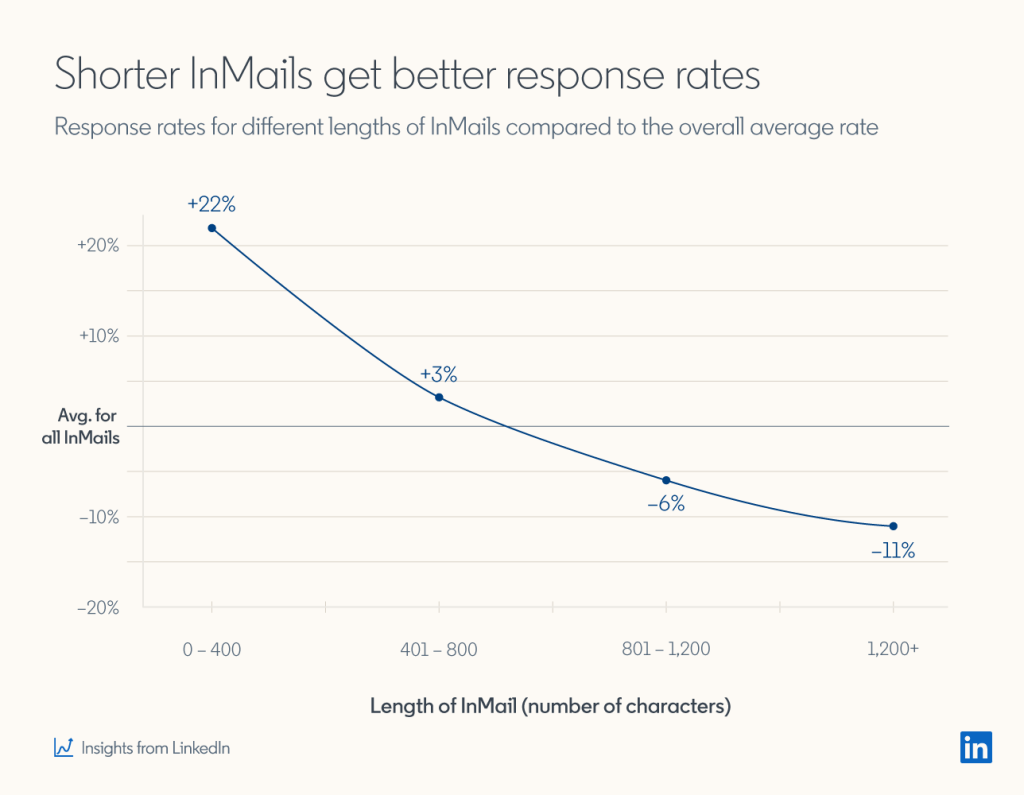
Your initial outreach message doesn’t have to explain the entire role, company, and compensation package in the opening note. Give the candidate enough context to understand why you're contacting them specifically and make it easy to continue the conversation.
For example:
Hi Sarah, your work scaling product at Acme caught my attention. I'm working on a VP Product search where that experience is particularly relevant. Open to a quick conversation?
The message is short, but it gives the candidate a reason for the outreach. It references something specific about their background, explains the opportunity at a high level, and ends with a clear ask.
Structure the first three touches around three things
Don't think of these as three increasingly persistent follow-ups. Think of them as three pieces of information you need to communicate.
Message 1: Show why you picked them.
Reference something specific about their work, not just their title or current company. It could be a product they launched, a business they helped scale, a conference talk, or a particularly relevant leadership experience.
The point isn't to make the message look personalized. It's to show that there is a genuine reason you're reaching out to them.
Message 2: Explain the opportunity plainly.
Once you've established relevance, give the candidate the information they need to decide whether a conversation is worth their time:
- What is the role?
- What stage is the company at?
- Who does the person report to?
- What makes the opportunity relevant to their background?
Skip language like "amazing opportunity" or "join our rocketship." Specific facts do more work than sales copy.
Message 3: Give compensation context.
Compensation should not become a late-stage surprise. Where possible, give candidates a clear range and explain the relevant components, such as base salary, equity, variable compensation, or total compensation.
The more senior the candidate, the more useful this clarity becomes. It allows both sides to establish whether there is a realistic fit before investing significant time in the process.
Use an exploratory ask for passive candidates
A passive executive candidate doesn't necessarily need to be convinced to leave their company. They first need a reason to have the conversation.
Instead of assuming they're looking, you can say:
I'm not sure you're considering a move, but your experience stood out for a VP Engineering search I'm working on. No pressure to explore it now. Would you be open to a 20-minute conversation?
This framing gives the candidate an easy way to explore the opportunity without committing to a job search.
Personalize the research, not just the template
LinkedIn reports that personalized InMails perform about 15% better than bulk sends.
But personalization shouldn't mean adding a first name or mentioning the candidate's company. For executive talent sourcing, the useful personalization is the detail that explains why their specific experience makes them relevant to this search.
Compare:
I was impressed by your extensive leadership experience at Acme.
with:
You took Acme's product organization from 12 to 40 people during its international expansion. I'm working on a VP Product role where that exact scaling experience is relevant.
The second message gives the candidate a reason to believe the outreach was written for them.
C-suite candidate outreach mistakes to avoid
Senior candidates have little reason to spend time decoding a recruiter message. Remove anything that makes the message harder to understand or easier to dismiss.
Avoid:
- Buzzwords such as "disruptive," "next-generation," and "hypergrowth"
- Generic templates with a few details swapped out
- Long explanations of the company before explaining the role
- Vague asks such as "Would love to connect"
- Aggressive follow-up sequences
- AI-generated copy that hasn't been properly edited
AI can help with candidate research and drafting, but the final message should sound like someone who actually understands why they're contacting this particular executive.
Don't overthink the timing
Timing can help, but it shouldn't become a substitute for good outreach.
LinkedIn's data shows that InMails sent Sunday through Thursday performed within about 1% of the overall average, while Friday and Saturday performed worse. Saturday messages received 8% fewer responses than average, while Friday messages received 4% fewer.
For executive search, prioritize relevance and personalization first. A perfectly timed message still won't work if the candidate has no reason to care about the opportunity.
Where to source the best executive candidates
The best executive candidates are rarely confined to one database. Executive talent sourcing works better when you combine searchable talent pools with the networks, communities, and professional signals that reveal who is actually influential in a particular market.
Start with LinkedIn, but search beyond titles
LinkedIn is still the obvious starting point. Its network now includes more than 1 billion professionals, and LinkedIn Recruiter provides 40+ filters for narrowing searches by titles, skills, companies, location, and other criteria.
But C-suite recruiting shouldn't stop at a title search.
Once you identify a few relevant executives, trace their professional networks. Look at previous employers, former colleagues, current and former leadership teams, board connections, and the people they interact with professionally. This can uncover candidates who have the right experience but don't appear in a straightforward Boolean search.
Turn referrals into a sourcing channel
For senior roles, warm introductions can give you something a cold message cannot: credibility before the first conversation.
Ask current executives, board members, investors, advisors, and trusted employees who they would recommend for the role.
Be specific about the profile you're looking for rather than asking, "Do you know any good candidates?"
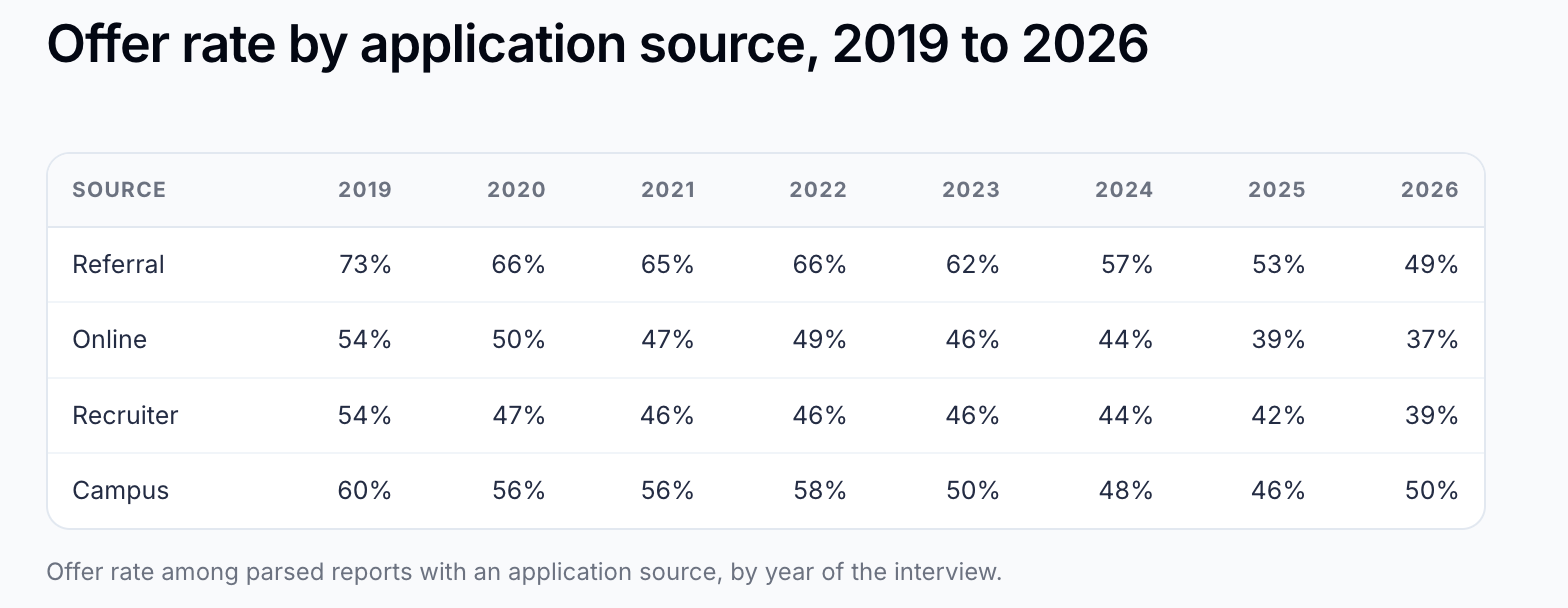
A 2026 analysis of 824,547 interview reports by Dataford found that candidates entering through referrals had a 49% offer rate, compared with 37% for online applications and 39% for recruiter outreach.
Sift through board, investor, and alumni networks
Board and investor relationships can be particularly useful for C-suite searches. Investors often have visibility into leadership teams across their portfolio companies, while board members and executives can introduce you to peers they've worked with directly.
Don't overlook alumni networks either. Former employees of your company, competitors, and relevant leadership programs already have some context about the work and may be easier to engage than completely cold prospects.
Go where executives demonstrate expertise
Industry associations, executive communities, conferences, and speaker directories can reveal candidates who are influential in their field.
Conference speaker lists are particularly useful for senior leadership sourcing because they give you a starting point based on demonstrated expertise rather than job title alone.
The same applies to authors of industry publications, podcast guests, and people consistently contributing to specialist communities—even LinkedIn posts.
For highly specialized searches, look beyond LinkedIn to professional associations, company leadership pages, board biographies, industry publications, and other public sources.
Don't make job boards the center of executive search
Job boards can still be useful for visibility, but they shouldn't be the foundation of an executive search. For senior and C-suite hiring, a sourcing strategy built around referrals, professional networks, direct research, and targeted outreach gives recruiters more ways to reach passive candidates who aren't actively applying.
What are the key differences between retained and contingent executive search models?
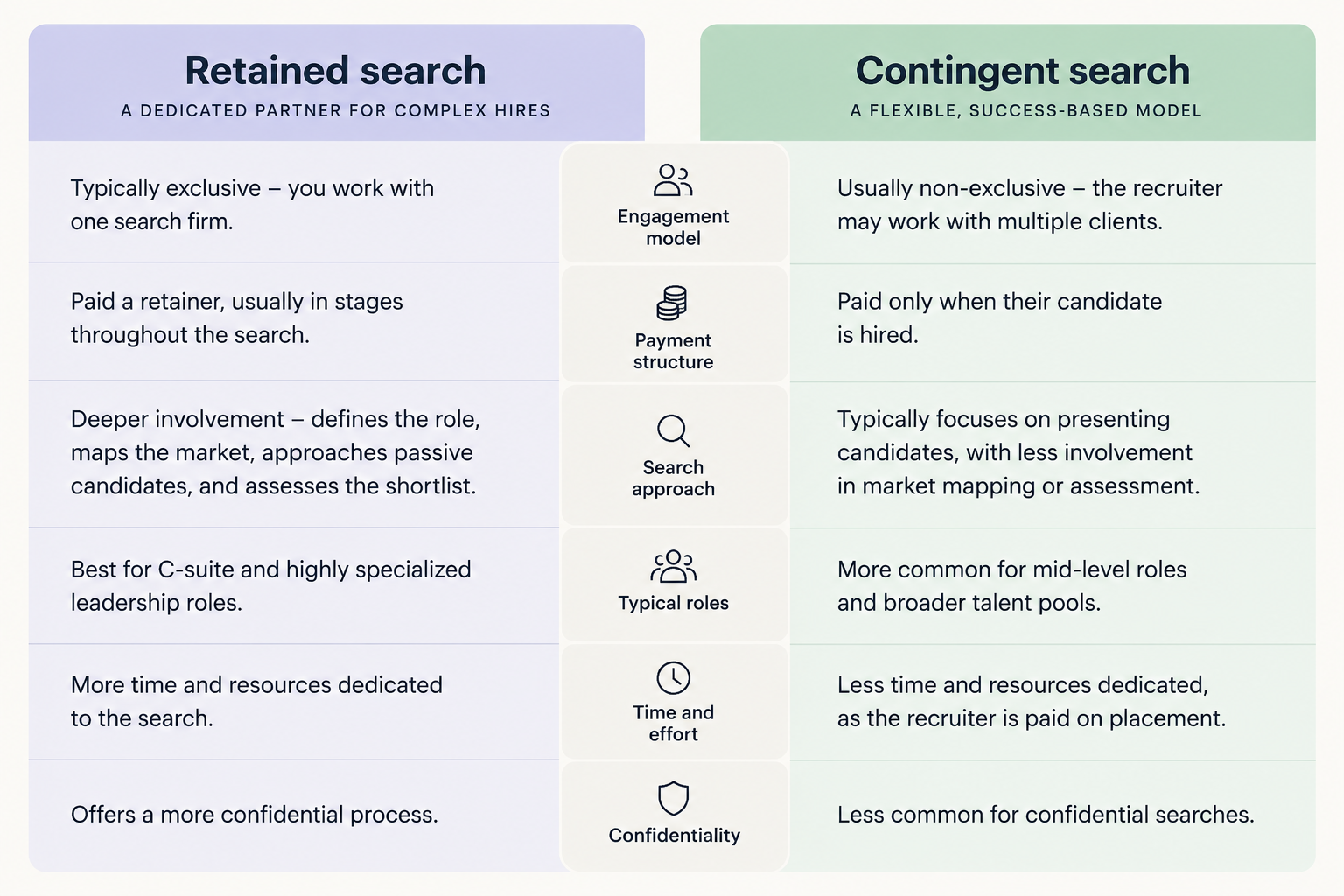
The main difference is how the search firm is engaged and paid, which affects how much time and attention it can dedicate to the search. Here’s how the two models work:
Retained search
With retained search, the company typically works exclusively with one firm and pays a fee in stages throughout the assignment. The firm takes a deeper role in defining the search, mapping the market, approaching passive candidates, assessing prospects, and managing the shortlist.
This model is commonly used for C-suite and highly specialized leadership roles, especially when confidentiality or access to hard-to-reach executives matters.
Contingent search
Contingent recruiters are generally paid only when their candidate is hired. They may work with multiple clients and tend to focus on candidates who are easier to identify and more likely to be actively considering a move.
This model is more common for mid-level and broader talent pools, where the search does not require the same level of market mapping or exclusivity.
Which model fits an executive search?
The choice comes down to the complexity of the role. Retained search can make sense for confidential, specialized, or high-stakes C-suite searches. Contingent search can work when the candidate pool is broader and the company wants a success-based engagement with less upfront commitment.
For repeatable VP and senior leadership searches, building in-house sourcing capability can also be an alternative to either model.
Best tools and platforms for executive talent sourcing
1. LinkedIn Recruiter
Best for: Core candidate discovery and outreach for most VP and C-suite searches.
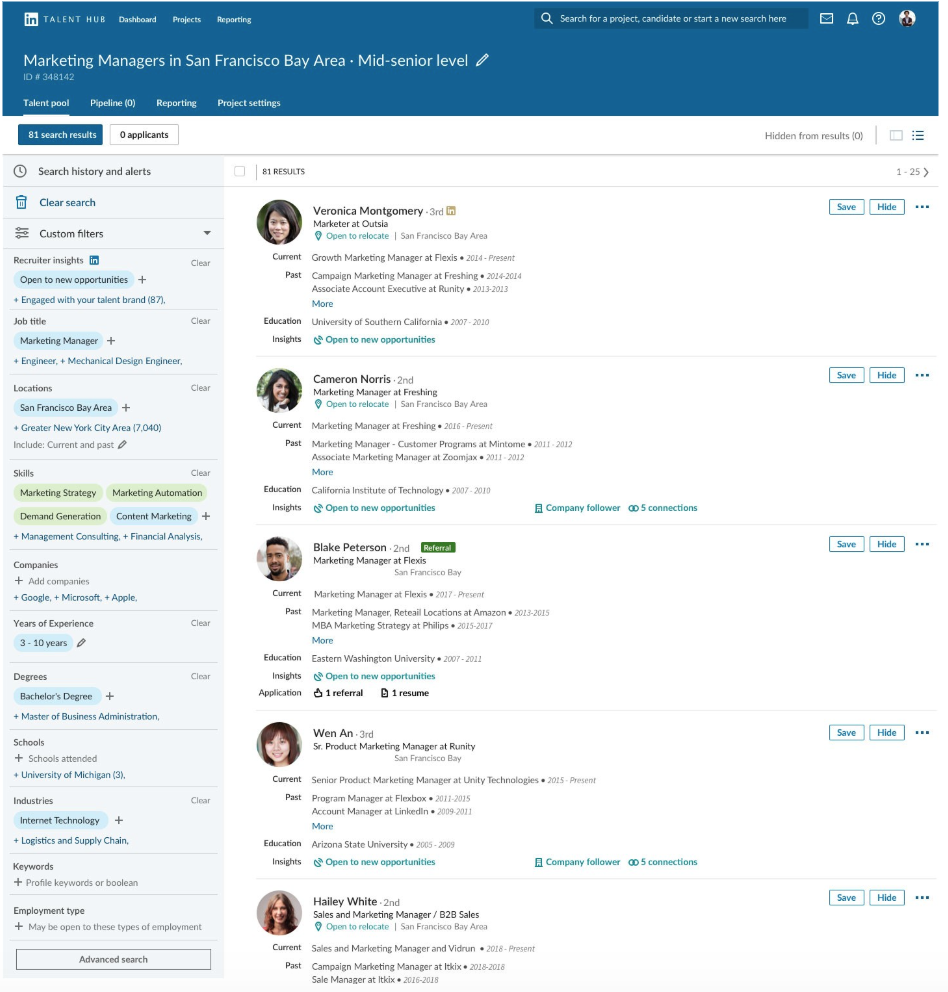
LinkedIn Recruiter is the core platform for most executive talent sourcing because it combines a large professional network with recruiting-specific search and engagement features.
Recruiter Corporate offers 40+ search filters, including seniority, function, company size, years of experience, and location. It also includes AI-Assisted Search and Hiring Assistant for natural-language candidate discovery.
For executive searches, its biggest advantage is the ability to move beyond exact title matching. Recruiters can search for executives based on their current and previous companies, seniority, function, skills, and other attributes, then use recommendations and their professional networks to expand the candidate pool.
Recruiter also supports projects, talent pools, InMail, and collaboration, making it useful for searches that stay open for weeks or months.
2. LinkedIn Sales Navigator
Best for: Account and executive research when you already use Sales Navigator, rather than as your primary recruiting database.
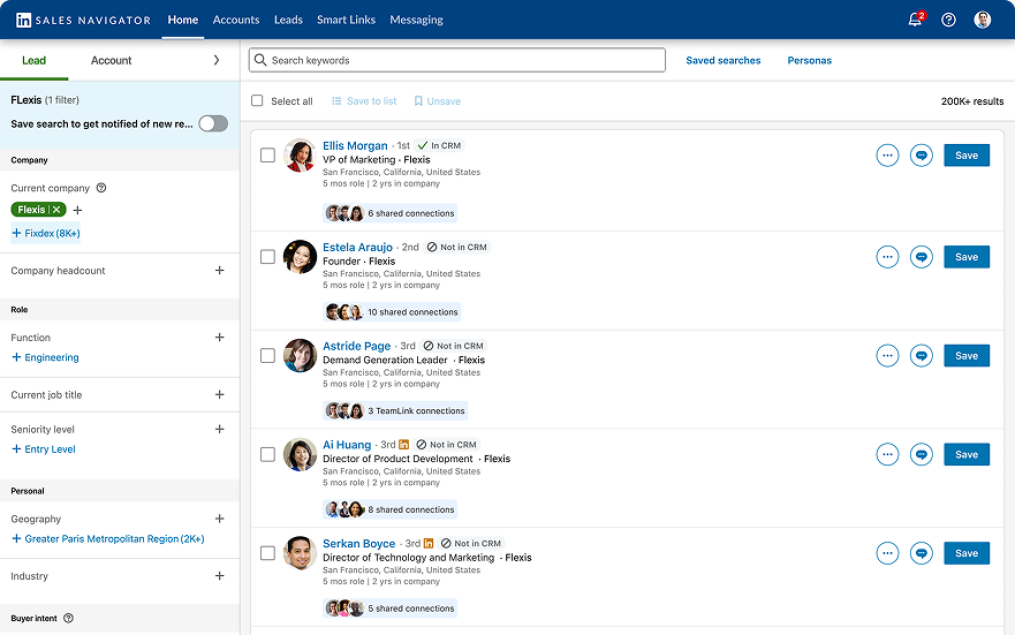
Sales Navigator can help with executive and company research, particularly when you need to map an organization or identify decision-makers and connections. But keep in mind, it is a sales product, not a recruiting platform.
That distinction matters. Recruiters get fewer recruiting-specific workflows than they would in LinkedIn Recruiter, so Sales Navigator is better treated as a supplementary research tool than a replacement for Recruiter in an executive sourcing workflow.
3. Kula
Best for: Recruiting teams that want executive sourcing, candidate evaluation, outreach, and the broader hiring workflow connected under one AI-native system.
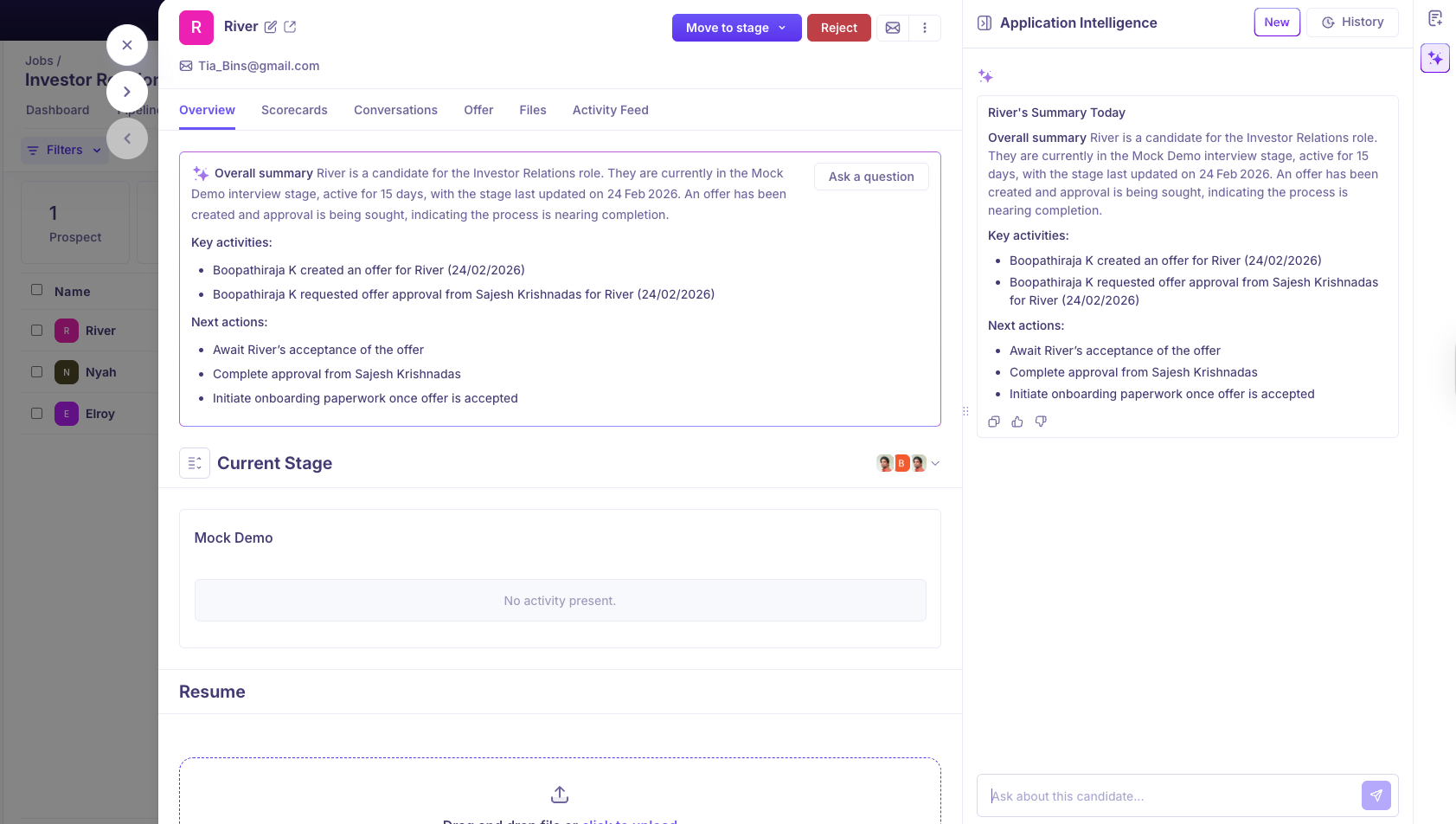
Kula is an AI-native, all-in-one applicant tracking system that connects sourcing, candidate evaluation, interviewing, ATS reporting and more in one platform. For executive hiring, this means recruiters can manage the entire hiring process from initial candidate discovery through evaluation and interviews without stitching together multiple recruiting tools.
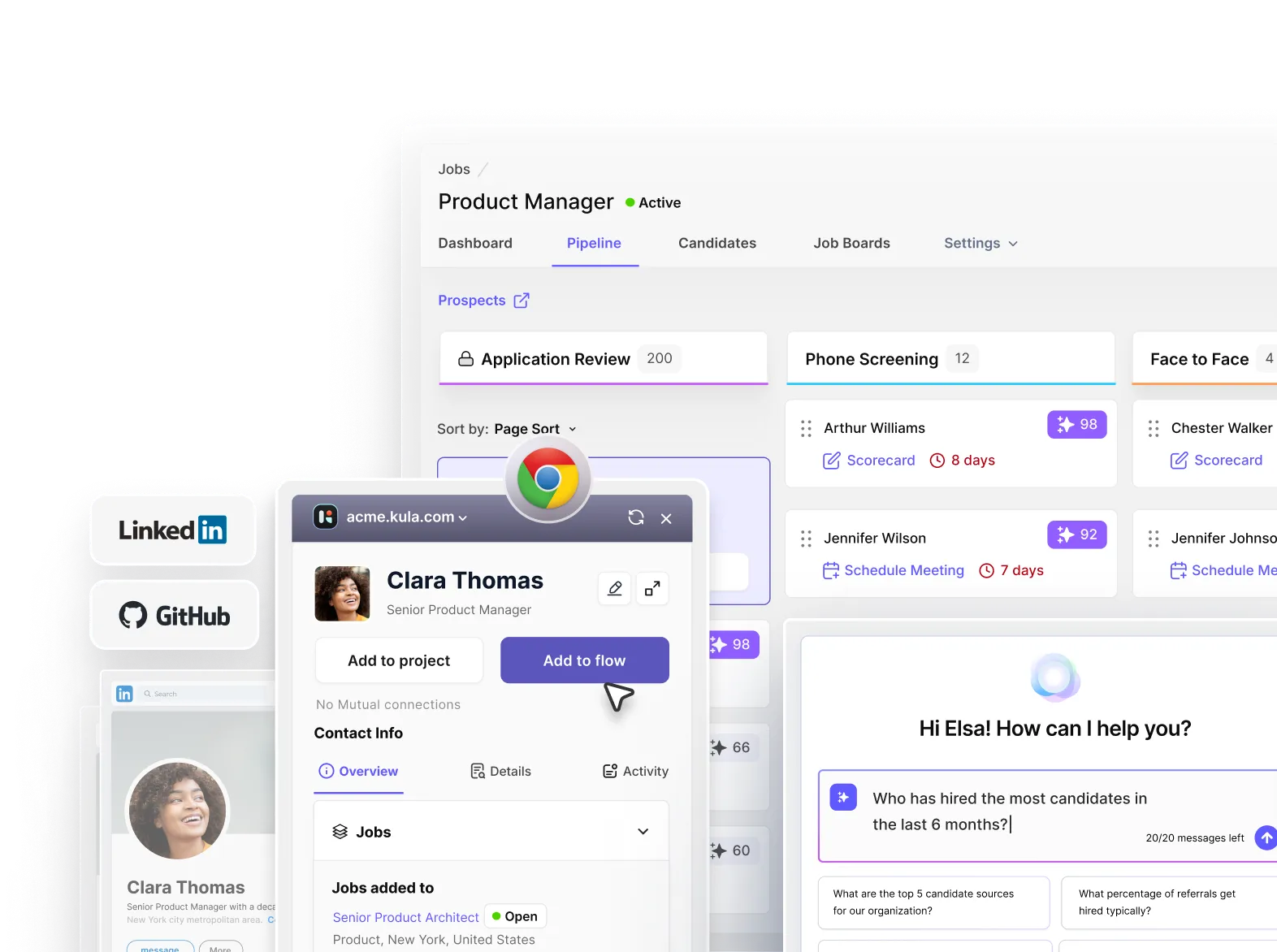
Kula’s sourcing and CRM capabilities help recruiters build and manage candidate pipelines, while its Chrome extension lets them capture candidates directly from LinkedIn and Github onto their ATS.
The multi-channel candidate outreach feature lets recruiters build outreach sequences across email, LinkedIn connection requests, and InMails from one workflow.
This is particularly useful for executive searches, where reaching a passive candidate may require multiple touchpoints rather than relying on a single InMail. Plus, all the actions in the sequence are automated and tracked so you can measure when your outreaches are seen and opened by candidates, and automatically have a follow up sent.
Once candidates enter the pipeline, Kula’s AI scoring can rank them against criteria such as skills, experience, and education, with explanations for each score.
There’s also an AI notetaker for interview transcripts, summaries, and scorecard updates, plus conversational analytics for querying recruiting data and pipeline performance.
4. Gem
Best for: Recruiting teams doing recurring executive searches and building a reusable candidate pipeline.
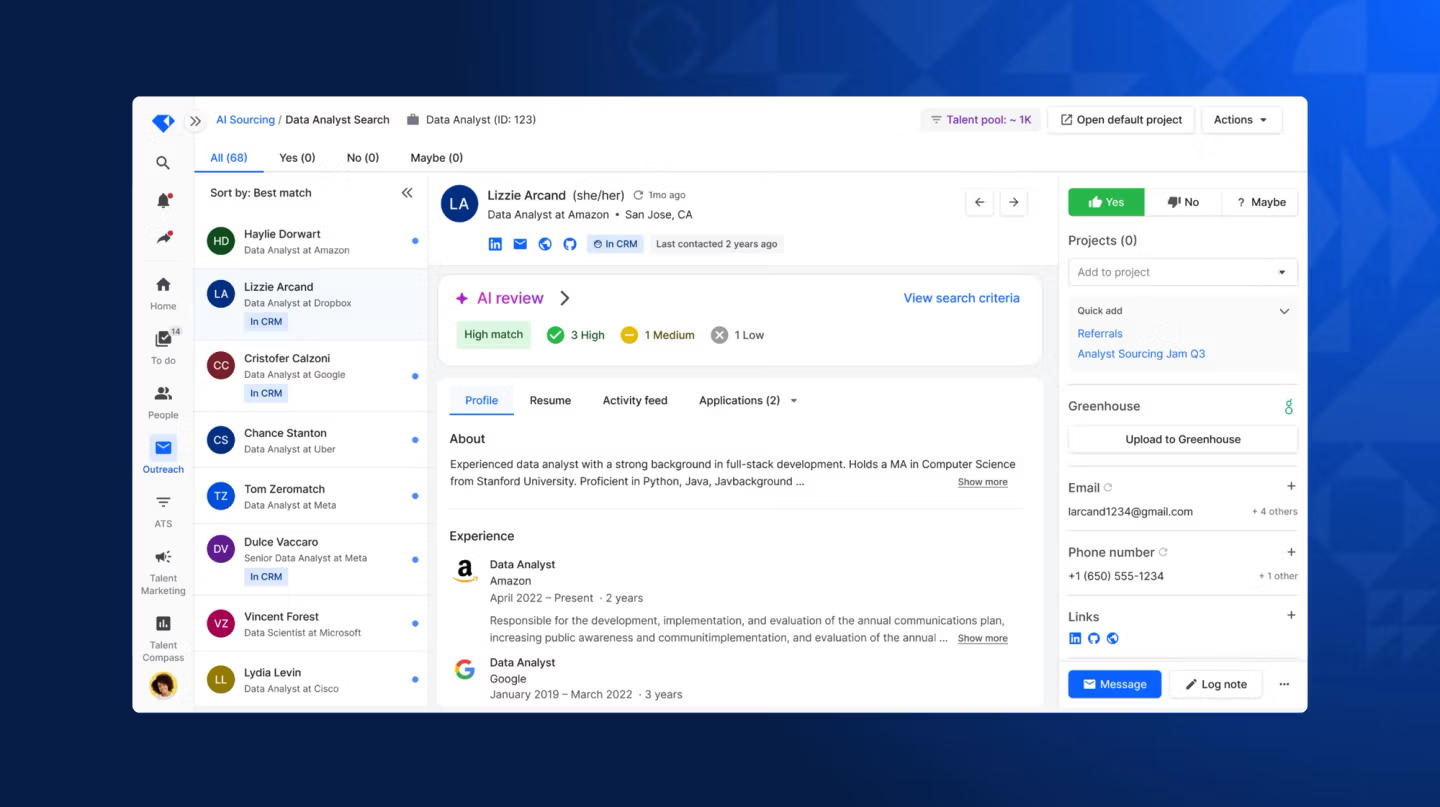
Gem is built around AI sourcing plus recruiting CRM functionality. Its AI sourcing agent searches 800M+ public profiles, while its rediscovery capabilities search candidates already stored in your ATS or CRM.
The rediscovery component is particularly relevant to executive recruiting. Instead of starting every search with a new LinkedIn query, recruiters can surface people who previously entered their pipeline and may now match a new leadership role.
Gem also combines sourcing with talent pools, sequencing, contact information, candidate matching, and engagement tracking, making it more suited to teams running multiple searches and maintaining longer-term candidate relationships.
5. Ashby
Best for: Teams already using Ashby that want sourcing and personalized outreach inside their ATS.
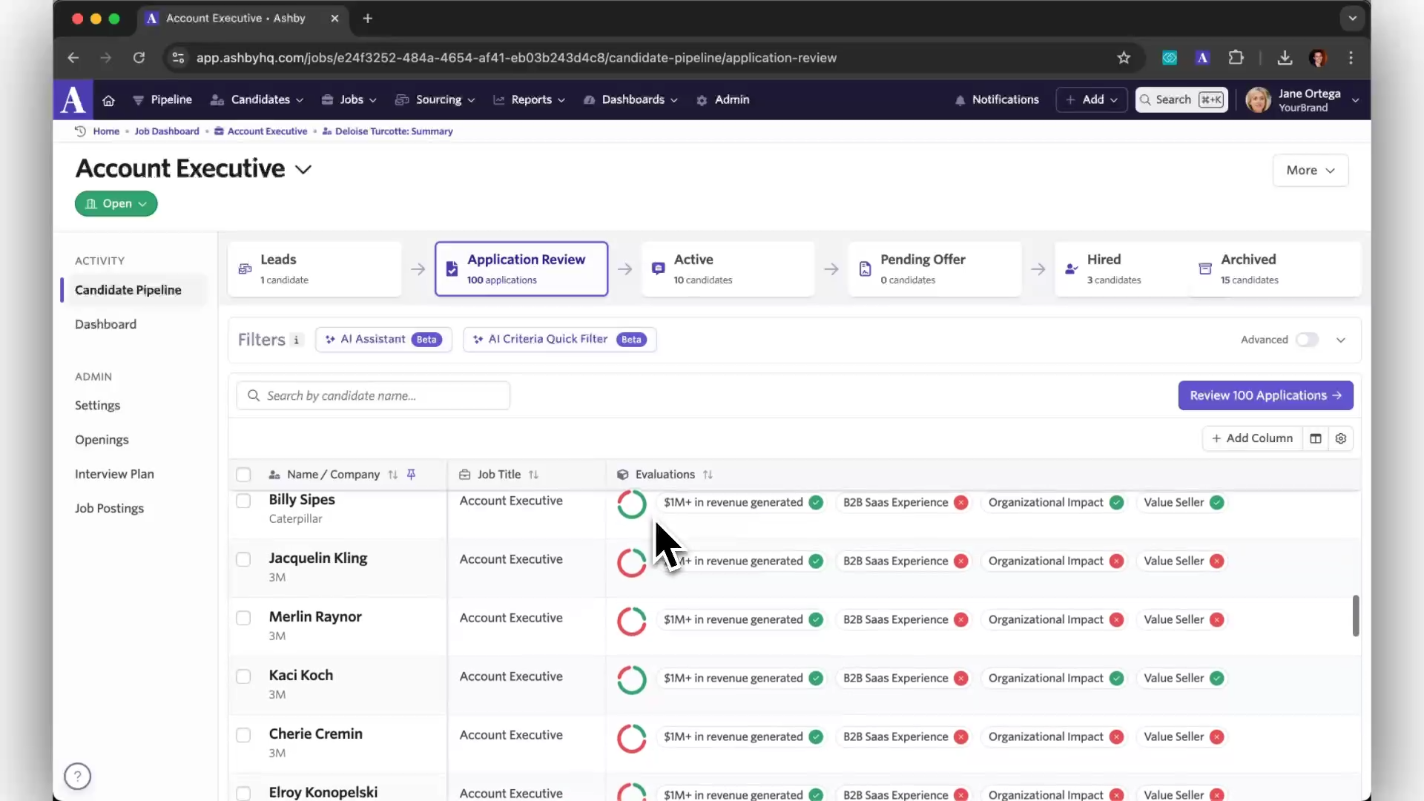
Ashby combines ATS functionality with sourcing and recruiting workflows. Its sourcing Chrome extension lets recruiters add candidates while researching them, while AI personalization tokens can generate candidate- and role-specific content within outreach sequences.
Its main advantage for executive recruiting is consolidation: teams can keep candidate records, sourcing activity, outreach, and ATS analytics within the same platform rather than maintaining separate systems.
6. BoardEx
Best for: Board searches, C-suite research, executive relationship mapping, and finding warm-introduction paths.
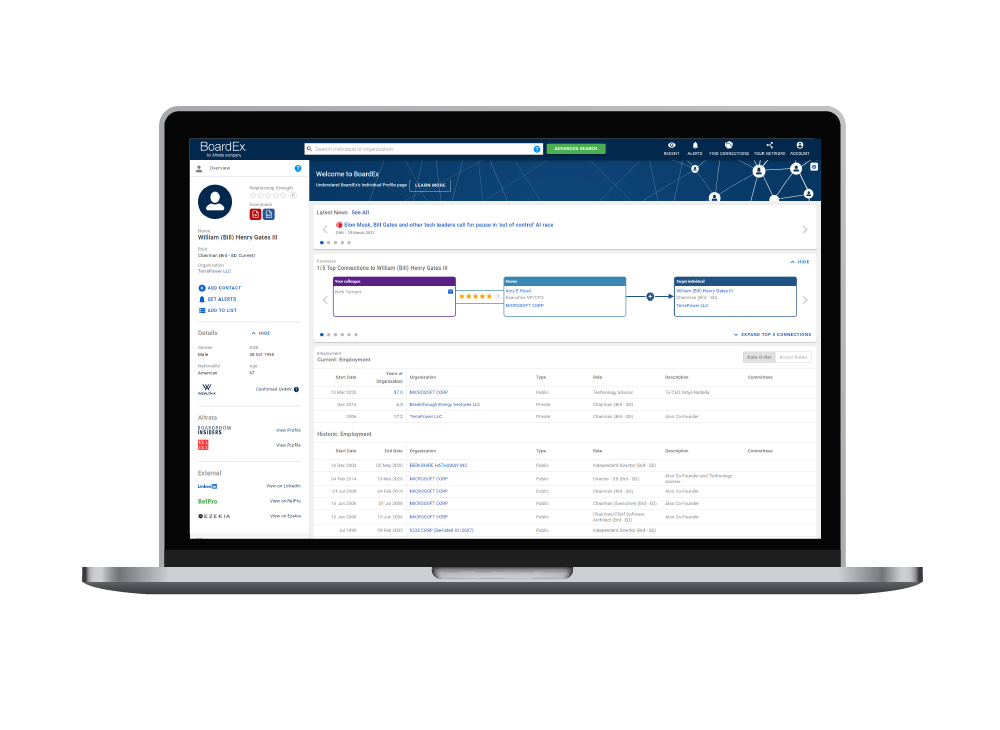
BoardEx is designed specifically around executive and board-level intelligence, making it useful for searches where professional relationships matter as much as someone's résumé.
Its database provides information on executives, companies, board positions, professional histories, and relationships between people. That makes it useful for identifying potential candidates and, importantly, figuring out who can introduce you to them.
For a C-suite search, that relationship mapping can be more useful than another generic candidate database.
7. Altrata
Best for: Executive research and preparation for targeted C-suite searches.
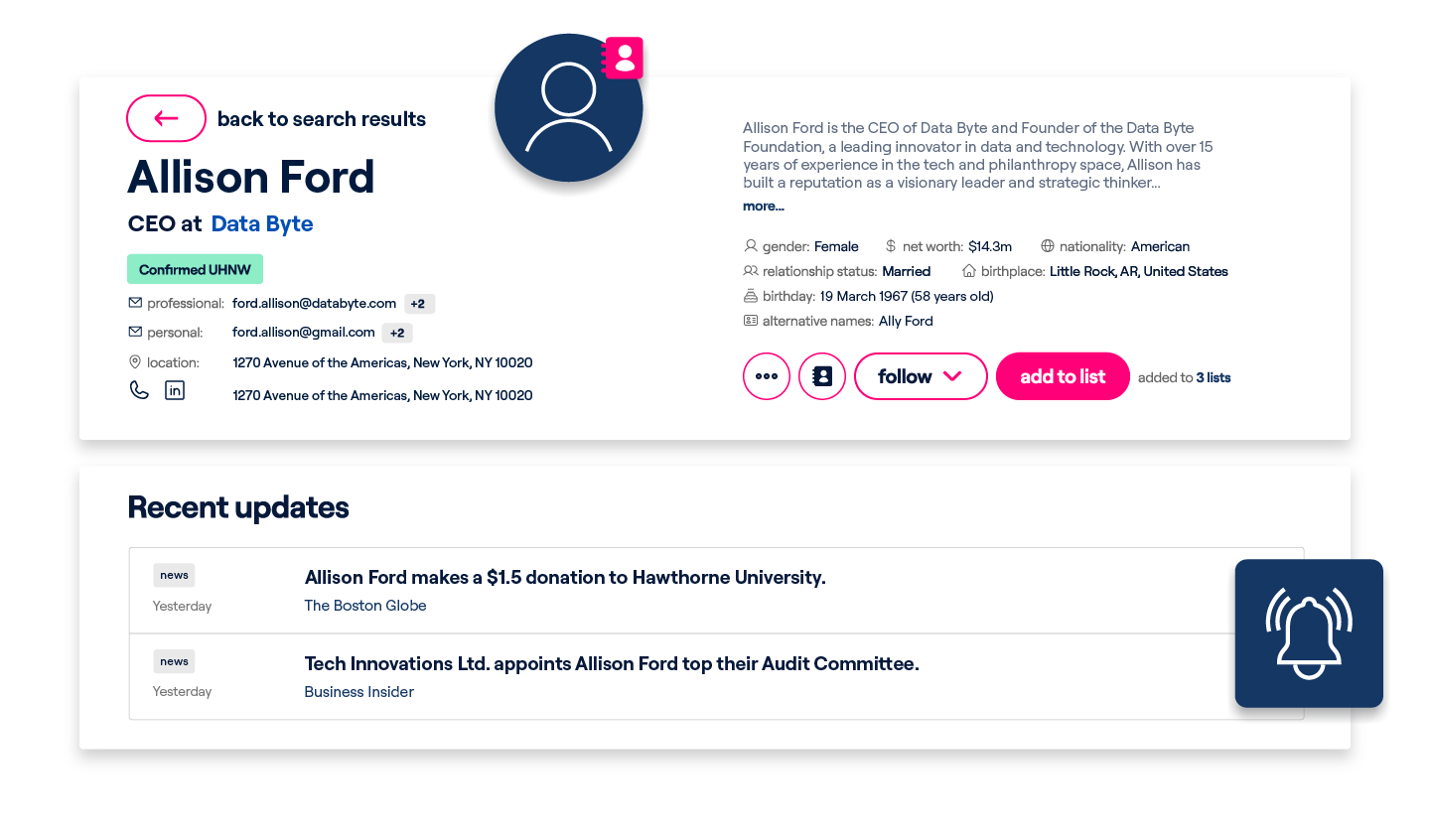
Altrata (previously known as Boardroom Insiders) is a platform that focuses on senior executives and provides information that can help recruiters research leadership backgrounds, priorities, and professional networks.
It's particularly relevant when the search requires deeper research into a small group of senior leaders rather than building a large candidate pool. It’s quite similar to BoardEx, but with more of a focus on talent acquisition, plus other functions.
How to choose the right executive sourcing tools
The right stack depends on what you need the tool to do at each stage of the search:
- For candidate discovery and direct outreach: LinkedIn Recruiter is the starting point for most VP and C-suite searches. Sales Navigator can supplement it when you need deeper company or decision-maker research.
- For sourcing plus the broader hiring workflow: Kula or Ashby make sense if you want sourcing, candidate management, outreach, and all hiring activity connected in one single tech stack instead of relying on multiple third party tools.
- For recurring searches and candidate rediscovery: Gem is useful when you're continuously building executive pipelines and want to revisit candidates already in your ATS or CRM.
- For relationship-led searches: BoardEx and Altrata are better suited to researching executive backgrounds, company connections, and potential warm-introduction paths. If you’re not looking to expand your entire tech stack and just want an additional platform for when executive search happens, these platforms are a perfect fit.
- For multi-channel outreach: Look for tools that let you manage several touchpoints rather than relying on one InMail. Kula, for example, supports outreach across email, LinkedIn connection requests, and InMails, with automated follow-ups and tracking. This Kula ATS feature is perfect if you rely on outbound recruiting for executive talent.
Remember that AI can make candidate discovery and research much faster, but that does not mean it should write the entire executive outreach process for you.
AI is useful for expanding searches, surfacing potential matches, summarizing profiles, and helping prioritize candidates. Ultimately, a recruiter still needs to decide why this person is worth contacting, what will actually interest them, and who should make the approach.
For executive hiring, AI should reduce the research workload, not remove the human judgment behind the relationship.
Is your executive search strategy working?
Executive sourcing is easy to mistake for a numbers game. A large candidate list or a high volume of outreach does not tell you whether the function is actually producing relationships and hires.
These three questions give you a better read on the health of your executive sourcing process:
1. What percentage of senior candidates respond when you approach them?
Your response rate is one of the clearest signals of whether your executive outreach is actually working. If fewer than 15% of senior candidates respond, look at the quality and relevance of your outreach before increasing the volume.
At this level, candidates are more selective about what earns their attention, so a low response rate can point to generic messaging, weak personalization, or an unclear reason for reaching out.
2. How many executives are already warm to your company?
Count the executives you have regular touchpoints with, including quarterly conversations and other ongoing relationship-building. If you have fewer than 20, your executive pipeline is thin.
Sourcing only when a role opens puts you back at the starting line every time. A warm pipeline gives you people to reconnect with when the right opportunity comes up.
3. Could you fill a VP-level role internally within 90 days?
If the answer is no, look at the process before adding another sourcing platform or defaulting to retained search. The goal is not to eliminate external search entirely, but to build enough internal capability to handle repeatable VP-level hiring without starting from scratch each time.
If these questions expose gaps, fix the underlying sourcing process before adding more tools or simply increasing outreach volume.

LinkedIn Recruiter is useful for broad executive candidate discovery and direct outreach, while Gem adds sourcing, CRM, sequencing, and candidate rediscovery for teams running recurring searches. For relationship-heavy C-suite searches, BoardEx and Altrata provide deeper executive and company intelligence.If you’re looking for an end-to-end complete recruiting tech stack dedicated to executive hiring, Kula, Gem, and Ashby are useful when you want sourcing connected to your ATS and broader recruiting workflow.
Start by looking beyond current job titles and identifying employees who are already taking on responsibilities beyond their role. Look at leadership scope, business impact, cross-functional influence, and the ability to operate at a broader strategic level. Internal mobility should also be part of your executive sourcing strategy, with potential successors identified before a leadership role opens rather than only when there is an immediate hiring need.
Look for advanced candidate search, executive research, CRM and talent-pool management, candidate rediscovery, multi-channel outreach, sequencing, relationship tracking, and integrations with your ATS. AI can also help expand searches, research candidates, and prioritize profiles, but executive outreach still benefits from human review and personalization.
Build a broader sourcing strategy rather than relying on the same executive networks and referrals for every search. Expand candidate research across different professional communities and backgrounds, write outreach around the opportunity rather than assumptions about the candidate, and use structured evaluation criteria to assess candidates consistently. Building relationships with diverse executive talent before a role opens can also create a stronger pipeline for future leadership searches.