



“AI recruiting agents” is the latest wave of AI-in-recruiting terminology. The problem is that the term can mean very different things depending on who's using it.
It might refer to a genuinely autonomous system that can source, screen, and coordinate candidate outreach with minimal recruiter input. It might be an existing sourcing or automation tool with a new label.
Or it might describe what a vendor plans to build in a future release.
That makes it harder to separate meaningful capabilities from marketing language.
The category is worth paying attention to, but before you invest in an AI recruiting agent, you need to understand what actually makes a tool an agent, how much autonomy it has, and what it can realistically handle. That's exactly what we’ve covered in this blog, plus the best AI recruiting agents you should check out.
What AI recruiting agents actually are and how they differ from automation
An AI recruiting agent is software that can autonomously find, screen, and manage candidates while keeping recruiters in the loop.
Unlike traditional recruiting automation, which follows predefined rules and workflows, an AI agent can work toward a goal, decide which actions to take, and adjust its approach based on the information it receives.
And the difference all comes down to autonomy.
Traditional recruiting automation is generally reactive:
A recruiter defines the workflow, sets the rules, and tells the system what to do. The software then carries out those instructions.
Agentic AI in recruiting is more proactive as it can reason through a task, plan the steps needed to complete it, and make decisions based on the context available to it.
Consider a recruiter hiring a software engineer.
With traditional automation, the recruiter might enter a Boolean search such as:
“software engineer AND Python AND 5 years experience”
The system searches for candidates who match those terms. That works when candidates describe their experience in the same language as the search query, but it can miss qualified people who use terms such as “backend engineer” or “Python developer” instead.
An AI recruiting agent can approach the same task differently. It can analyze the job description and intake notes to understand that the role requires API development and database management.
Instead of relying on one rigid search query, it can search multiple sources using related terms such as “software engineer,” “backend developer,” and “Python developer,” then evaluate candidates based on their broader experience.
The difference between the two is that traditional automation executes the search you define; whereas autonomous recruiting AI agents can determine how to approach the search based on the goal.
AI recruiting agents sit on an autonomy spectrum
Keep in mind that not every AI recruiting agent is fully autonomous.
Some are semi-autonomous, handling specific recruiting tasks under a recruiter's direction. Others can manage an entire workflow independently, with the recruiter stepping in only at important approval points.
So rather than asking whether a product is technically an “agent,” it is more useful to ask how much autonomy it actually has.
A product might autonomously source candidates but require recruiter approval before outreach. Another might source, screen, personalize outreach, and manage follow-ups with human approval only when a candidate reaches a defined stage.
What separates a real agent from an AI marketing label?
Three characteristics are especially useful when evaluating an AI recruiting agent:
- It works across multiple sources and channels without requiring the recruiter to specify every individual action.
- It adjusts its approach based on results, such as refining candidate criteria or changing its outreach strategy when the initial approach isn't working.
- It maintains context across tasks, so information gathered during sourcing can inform screening, outreach, and subsequent recruiting decisions.
If a product can only execute predefined actions after a recruiter tells it exactly what to do, it may still be a useful AI-powered automation tool. But calling it an autonomous recruiting AI agent would be misleading.
What AI recruiting agents can actually do today
The easiest way to understand AI recruiting agents is to look at the work they can handle today. Some capabilities are already practical, while others still need close recruiter oversight. Here’s where AI recruitment automation can help the most today:
1. Understand candidate experience beyond keywords
Traditional search treats a profile as a collection of terms. An AI recruiting agent can interpret those terms in actual context.
Let’s say you're hiring a machine learning engineer and your job description asks for experience with neural networks, model deployment, and Python. A keyword search might prioritize candidates who explicitly list those phrases.
On the other hand, an agent can look for related evidence across the candidate's experience:
- Deep learning projects
- Computer vision work
- Building recommendation systems
- Deploying models to production
- or conducting AI research.
It can also recognize that “managed an engineering team,” “led a team of 8,” and “oversaw engineering” describe similar work experience.
That matters because candidate profiles rarely mirror job descriptions.
People use different terminology, describe the same skill at different levels of detail, and often demonstrate a capability without naming it directly.
The agent's job is to connect those pieces.
2. Search your existing talent pool before starting from scratch
AI sourcing agents can search external talent pools, but one of their more useful applications is candidate rediscovery.
Think about the people already sitting in your applicant tracking system or recruiting CRM:
- A finalist who lost out to another candidate
- A strong applicant who wasn't right for the role at the time
- A referral who never entered the process
- A prospect who stopped responding
- Someone who was a close match for a similar role six months ago
A recruiter starting a new search may never remember those candidates, particularly in a database with tens of thousands of profiles.
An agent can compare the new role against that existing pool and bring relevant people back into consideration.
For example, if you open a new data engineering role, the agent could surface a candidate who reached the final interview stage for a data platform role last year but wasn't hired. Their previous interview feedback, skills, and interactions are already in your system. The recruiter doesn't have to rediscover the person manually.
This changes the sourcing question from “Where can I find more candidates?” to “Who do we already know that could fit this role?”
3. Run sourcing across multiple channels
An agent can also coordinate sourcing across different data sources instead of treating each channel as a separate search.
A recruiter might otherwise search LinkedIn, check their CRM, look through previous applicants, review referrals, and then repeat the process when the first batch isn't strong enough.
An agent can take the hiring goal and work across those sources, using the results from one search to inform the next.
The important distinction is that the recruiter doesn't have to prescribe every source or search string. They give the agent the hiring objective and constraints; the agent determines how to pursue it.
4. Personalize outreach based on actual candidate context
“Personalized outreach” is another area where the distinction between basic automation and an agent matters.
Adding someone's first name or current company to a template isn't meaningful personalization.
A stronger system can identify why a particular candidate might be relevant and use that context in the message.
If someone recently moved into a staff engineering role after leading a platform migration, for example, the outreach could reference that experience and connect it to the problem the new role is expected to solve.
The agent can then decide which candidates are worth contacting, generate the message, and manage follow-ups based on what happens next.
That creates a feedback loop: candidate context → outreach → response → next action
If a candidate responds positively, the agent can move them forward. If they don't respond, it can determine whether another follow-up makes sense rather than blindly sending the same sequence to everyone.
5. Turn a job description into screening logic
Recruiters often know what they want from a candidate without having formally written out every screening criterion.
An agent can take the job description, intake notes, and other role context and turn them into a structured evaluation framework.
For example, an intake conversation might reveal that a product manager needs experience launching B2B products, working closely with engineering, and operating in a company with a short sales cycle. Those requirements may be more useful for screening than simply matching “product manager” and “B2B” on a resume.
The agent can use those criteria to evaluate incoming applications and explain why a candidate appears to match or fall short.
That explanation is important as a score without the reasoning behind it doesn't give a recruiter much confidence in the result.
6. Coordinate complex interview schedules
Interview scheduling becomes particularly difficult when there are several interviewers, multiple rounds, different time zones, and limited availability.
An agent can handle the coordination rather than simply providing a calendar link.
For a five-interview loop, for example, it can consider the availability of each interviewer, candidate preferences, working hours, and the order of the interview stages. If one interviewer becomes unavailable, the system can find another workable combination instead of sending the recruiter back into a spreadsheet of calendars.
The value isn't that AI knows how calendars work. It's that the agent can solve a changing scheduling problem without requiring the recruiter to manually recalculate every option.
7. Turn interviews and feedback into usable hiring information
Interview intelligence can go beyond transcription.
An agent can extract relevant evidence from an interview, organize it against the job's evaluation criteria, and summarize what was actually discussed. It can also pull together feedback from multiple interviewers so the hiring team isn't trying to reconstruct the candidate's performance from disconnected scorecards and notes.
For example, if three interviewers independently mention that a candidate struggled to explain a system design decision, the agent can surface that pattern during the debrief. If one interviewer raises a concern that isn't supported by anything else in the interview feedback, the team can see that too.
That makes the agent useful after the interview, not just during it.
And that's an important distinction across all these capabilities: the strongest recruiting agents aren't simply doing individual tasks faster. They're using context from one step of the hiring process to inform what happens next.
The real test is whether that context produces better decisions without removing the recruiter from decisions that still require human judgment.
What AI recruiting agents cannot do
1. They can miss non-traditional talent
AI agents optimize for the criteria they're given. If those criteria heavily favor conventional qualifications, the agent can also favor conventional candidates.
Consider a self-taught developer with no computer science degree but five years of strong GitHub contributions. Or a career switcher whose previous experience gives them highly relevant skills for the role. A recruiter might recognize the connection after looking at the person's full career.
An agent may rank them lower if the screening criteria emphasize specific degrees, job titles, or years of experience.
There's a bigger risk here, too. If your hiring criteria are based on who has historically been hired, an agent can reproduce those patterns at scale.
2. They can't reliably measure human qualities
Some parts of hiring are difficult to reduce to structured criteria.
Can a candidate learn quickly? Will they respond well to feedback? How do they handle disagreement? Can they communicate clearly when a project goes off track?
A recruiter can form a judgment about these things through conversation, references, and repeated interactions. An agent can identify evidence related to them, but that isn't the same as actually measuring them.
That's why claims around AI evaluating “culture fit,” personality, emotional intelligence, or similar subjective traits deserve scrutiny. The safer use of an agent is to organize observable evidence and leave the judgment to people.
3. They can misread non-linear careers
A resume doesn't always explain why a career took a particular path.
A two-year employment gap might reflect caregiving. A senior leader might have left a stable role to build a startup that eventually failed. Someone might have taken a lower title because they wanted to work on a specific product or move into a new field.
A recruiter can ask about those decisions and understand the context. An agent working primarily from structured profile data may treat the same patterns as inconsistencies or risk factors.
That doesn't make the technology useless. It means recruiters need a way to review the underlying context instead of treating an agent's ranking as the final answer.
4. AI-generated communication can still feel like AI
Personalization doesn't automatically make outreach personal.
A message that mentions a candidate's company, title, and recent accomplishment can still sound generic if the connection to the role isn't meaningful. The same problem shows up in AI-generated job descriptions, where technically accurate copy can miss the details that make a particular opportunity compelling.
Candidate communication is also one area where efficiency can create a new problem: sending more mediocre messages doesn't improve the candidate experience.
5. Biometric analysis deserves serious skepticism
Some AI recruiting tools have attempted to infer things such as confidence, honesty, enthusiasm, or personality from facial expressions, voice, or other biometric signals.
Those claims are much harder to defend than using AI to organize information from a resume or interview transcript. Research and policy discussions have raised concerns about the scientific validity, reliability, and potential bias of these systems, including differences in how they perform across populations.
Recruiters should be particularly cautious about allowing an agent to make hiring recommendations based on facial or voice analysis.
6. Bias doesn't disappear because AI makes the decision
This may be the most important limitation.
An AI system can inherit patterns from the data used to build or evaluate it. If historical hiring decisions favored certain candidates, the system may learn those patterns without anyone explicitly telling it to discriminate.
For example, Amazon famously abandoned an experimental recruiting system after it reportedly learned to penalize resumes associated with women.
Other research has also raised concerns about automated hiring systems disadvantaged groups such as non-native English speakers.
The lesson isn't that AI recruiting is inherently biased. It's that automation can scale a bad hiring signal just as efficiently as a good one.
That makes independent testing, bias audits, appropriate data controls, and human review important parts of deploying AI recruiting agents.
Will AI replace recruiters or TA leaders?
Probably not. The evidence so far points to AI recruiting agents taking on more repetitive recruiting work while recruiters stay responsible for decisions that need human judgment.
Korn Ferry's 2026 TA Trends report found that:
- 84% of talent leaders plan to use AI in recruiting
- 52% plan to add autonomous AI agents to their teams in 2026
Korn Ferry frames this as people and AI working together rather than AI replacing recruiting teams.
Jeanne MacDonald, Korn Ferry's CEO of Recruitment Process Outsourcing, also stated:
“Talent acquisition is about people—and human intelligence will always be the differentiator.”
And more importantly, recruiters aren't fully convinced yet either. Our own research from our 2025 State of Recruiting report found that:
- 55% of TA leaders say AI-generated results aren't accurate enough
- 55% worry AI will remove too much of the human touch
- 34% are concerned about algorithmic bias
- 22% cite candidate privacy issues
- 18% say their teams aren't prepared to use AI because they lack training
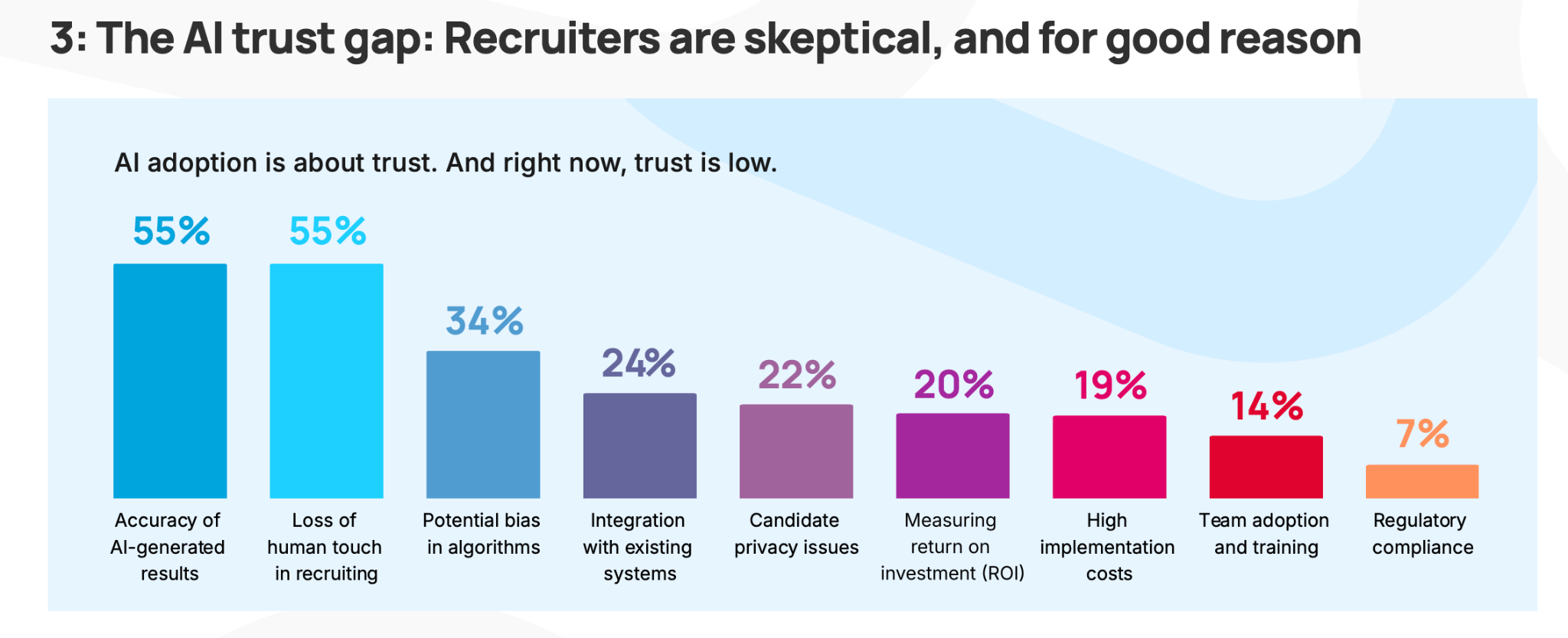
Those concerns make sense as an agent can rank candidates against defined criteria, but recruiting still involves things that are difficult to reduce to rules: understanding why someone wants to move, persuading a hesitant candidate, handling a difficult hiring manager, or recognizing when an unusual career path deserves a closer look.
At the same time, recruiters are handling more work. SHRM's 2026 Recruiting Executives Benchmarking data puts the median recruiter at 25 open requisitions, up from 20 from 2025
That limits the role of AI to administrative and bulk tasks such as:
- Sourcing and candidate rediscovery
- Application screening
- Outreach and follow-ups
- Interview scheduling
- Interview notes and feedback summaries
Recruiters can then spend more time on candidate relationships, hiring-manager alignment, nuanced evaluation, and closing offers.
TA leaders will have to make similar decisions at a broader level: where AI can work independently, where human approval is needed, and how the team checks that these systems are producing accurate and fair results.
So the question isn't really whether AI will replace recruiters. It's how much of the recruiting workflow recruiters will eventually manage through AI agents, and which decisions they will continue to own themselves.
Best AI recruiting agents and vendors worth evaluating
1. Kula
Best for: Teams that want AI capabilities across sourcing, interviews, and analytics within a consolidated ATS.
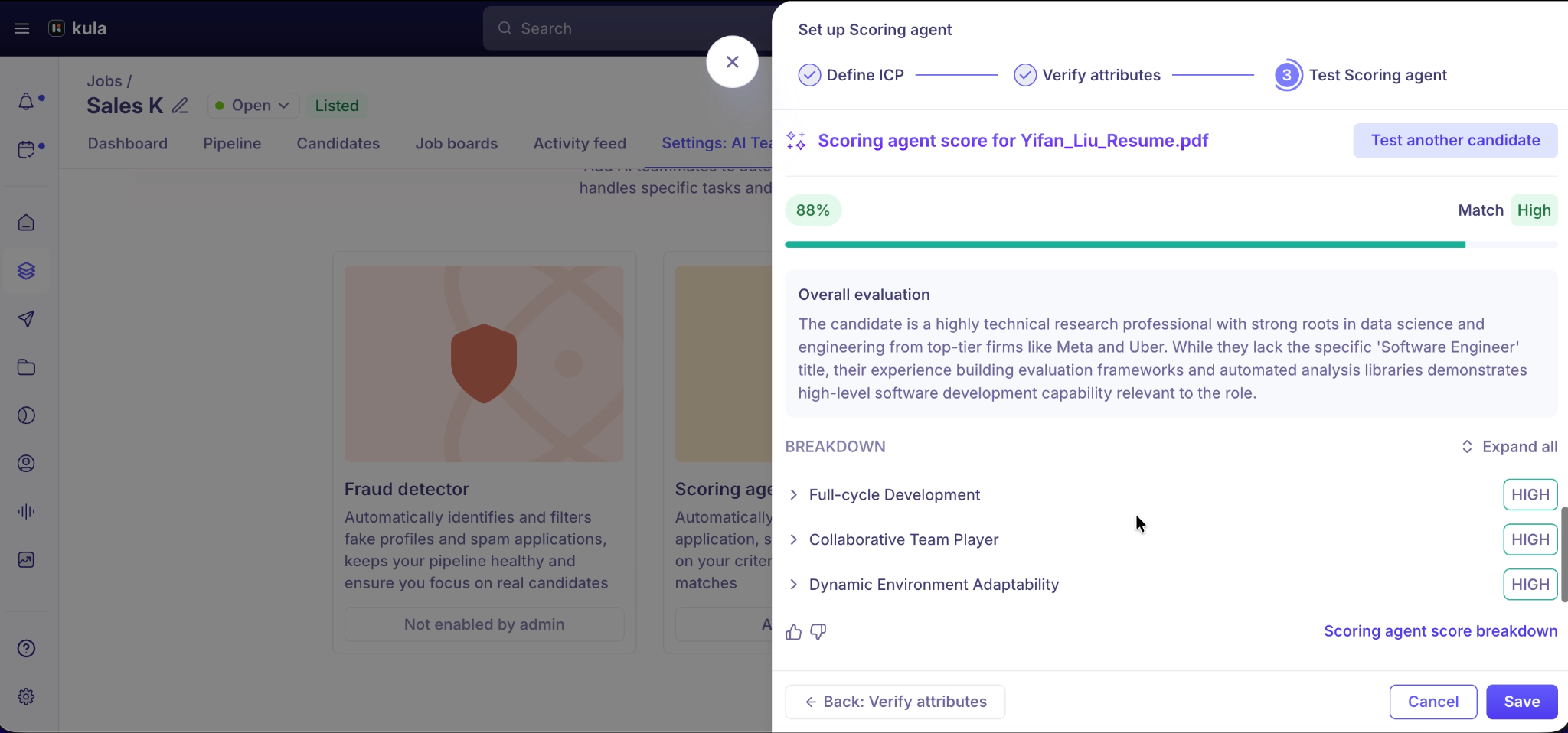
Kula takes an AI-native approach by building AI capabilities directly into its ATS rather than adding a separate agent layer on top.
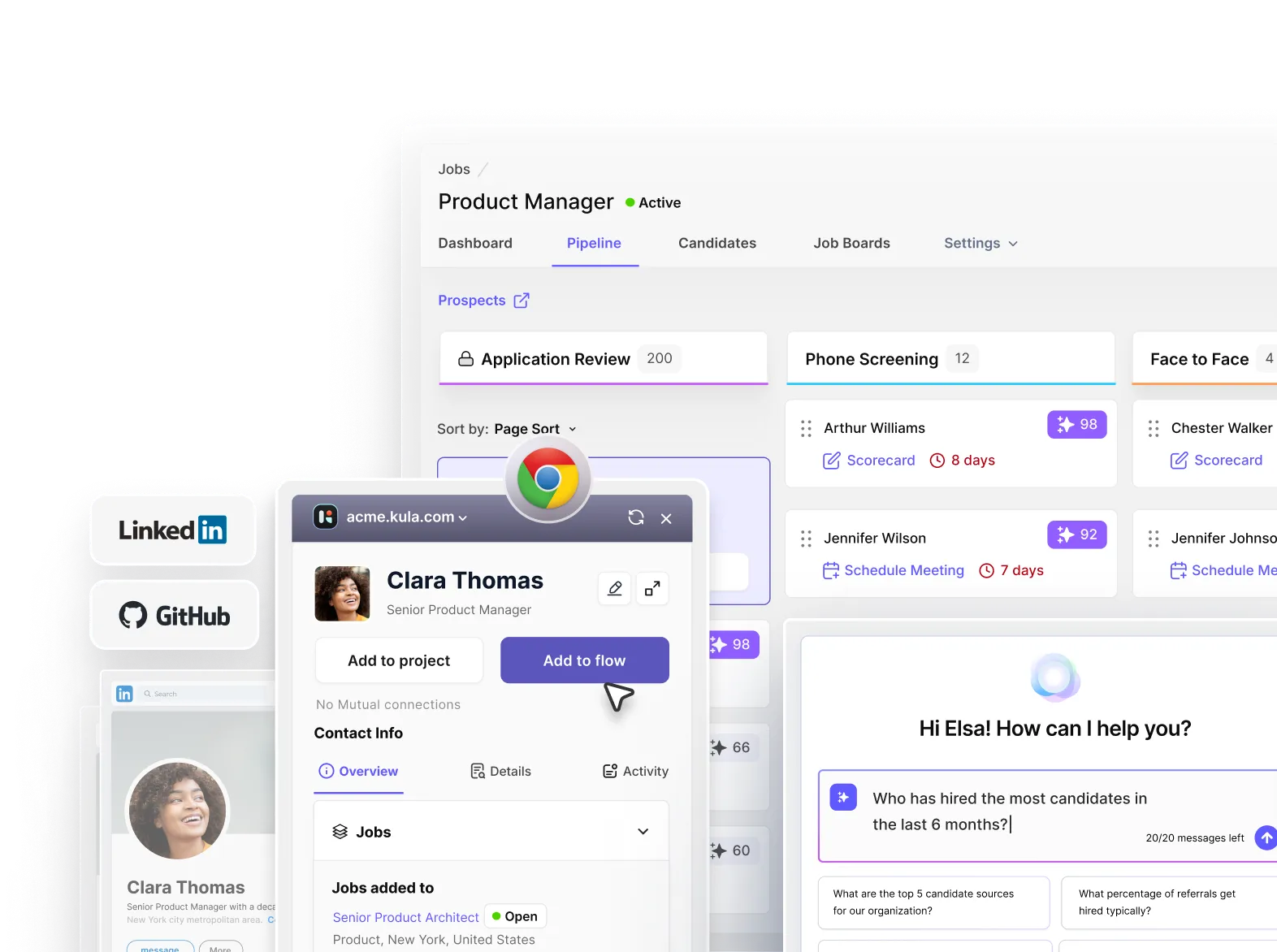
Its AI capabilities span several parts of the recruiting workflow. Recruiters can also capture candidates directly from LinkedIn and GitHub through a Chrome extension. The best way to speed up recruiting workflows is through its AI interview assistant transcribes and summarizes conversations and can auto-fill scorecard criteria in real time.
Kula also offers conversational AI analytics, where recruiters can ask questions about hiring data in natural language instead of manually building reports or switching to a separate analytics tool.
The platform also offers an intelligent AI candidate scoring system where hiring teams can assign custom criteria like skills, experience, and education, and the system will automatically rank and score candidates based on your requirements for a role. It’s a great way to incorporate AI candidate screening without losing the human touch.
2. Gem
Best for: Outbound recruiting heavy teams that want autonomous sourcing and rediscovery alongside inbound application review and fraud detection.
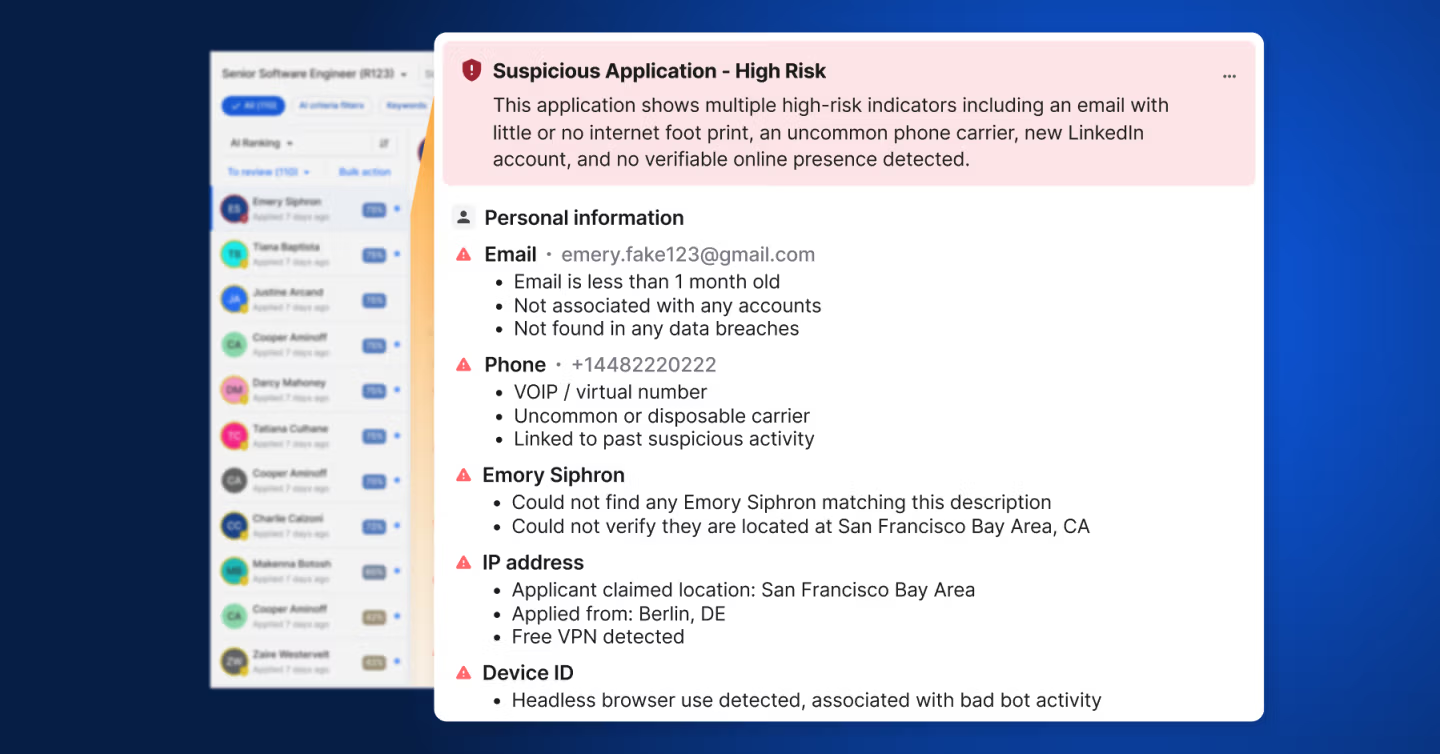
Gem has built a portfolio of four AI sourcing agents, screening, rediscovery, application review, and fraud detection.
Its AI sourcing agent can sift through more than 800 million profiles and can continuously surface relevant candidates, including people who have previously interacted with the company.
Their AI fraud detection agent is great for hiring teams who are heavy on background checks as it helps in identifying suspicious applications before recruiters spend time reviewing them.
It evaluates inbound applications across six signals. Keep in mind. Gem's fraud detection relies on its partnership with Tofu rather than in-house fraud modeling
3. Tezi's Max
Best for: Teams looking for a highly autonomous recruiting agent rather than a human-supervised sourcing assistant.
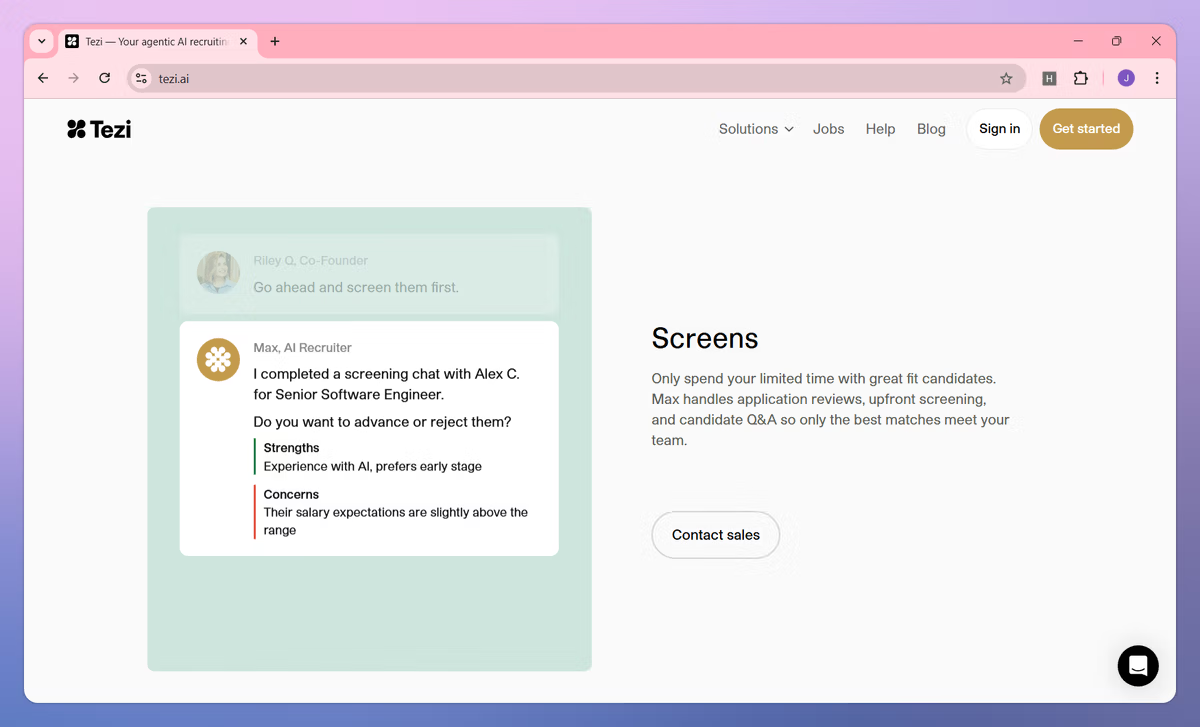
Tezi's Max is positioned as an autonomous AI recruiter that can manage the recruiting process from sourcing through scheduling.
It can search more than 750 million candidate profiles using natural-language search and deep calibration, screen inbound applications, rank candidates, and handle complex interview scheduling, including last-minute reschedules.
The product is designed to work with relatively little step-by-step direction. Recruiters set up a role and Max can continue running the workflow, checking in when human input is needed.
Tezi says Max is trained by hiring managers and recruiters rather than on customer data. The company also says Max has undergone third-party bias auditing and cannot independently make rejection decisions.
4. hireEZ's EZ Agent
Best for: Teams that want agentic recruiting capabilities without replacing their existing ATS.
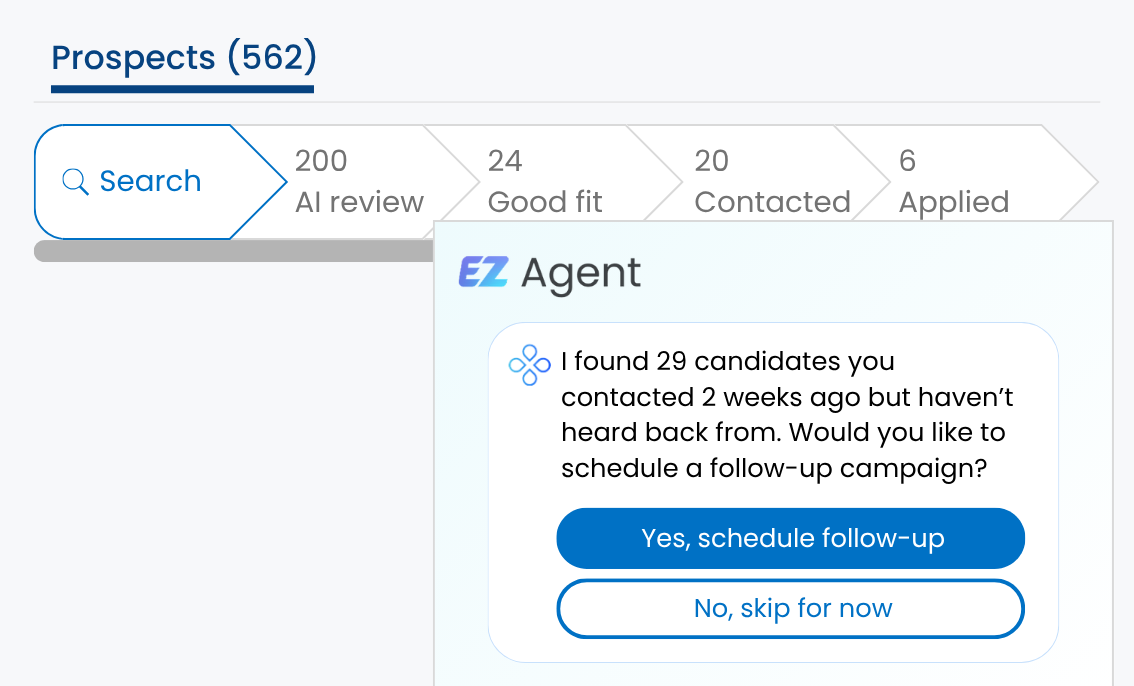
hireEZ's EZ Agent takes a semi-autonomous approach. It can automate sourcing, screening, outreach, scheduling, and analytics while keeping recruiters in control of strategic decisions and high-value candidate interactions.
The agent searches more than 45 external platforms alongside an organization's existing ATS. It evaluates candidates using context from their full profiles, then drafts and sequences outreach automatically.
Their EZ Agent is designed to sit on top of an existing recruiting stack, including systems such as Workday, iCIMS, Greenhouse, and SAP, rather than requiring an ATS migration.
5. Noon AI
Best for: Teams sourcing developer and technical talent across channels that traditional candidate databases may not cover well.
Noon AI is an AI talent sourcer that searches, evaluates, and cultivates candidate relationships across LinkedIn, GitHub, Reddit, and Slack.
Its approach differs from database-driven sourcing tools because its AI crawls the open web in real time rather than relying entirely on a pre-indexed candidate database. It also uses reinforcement learning from human feedback to adjust its search behavior based on recruiter decisions.
That makes it particularly interesting for technical recruiting, where relevant candidate signals may exist on GitHub, Reddit, or other communities rather than solely on LinkedIn.
The trade-off is that coverage can be harder to verify upfront for very niche roles.
6. Metaview's Sourcing Agent
Best for: Teams that want sourcing to be informed by actual interview conversations and hiring-team calibration, rather than relying only on job descriptions and search strings.
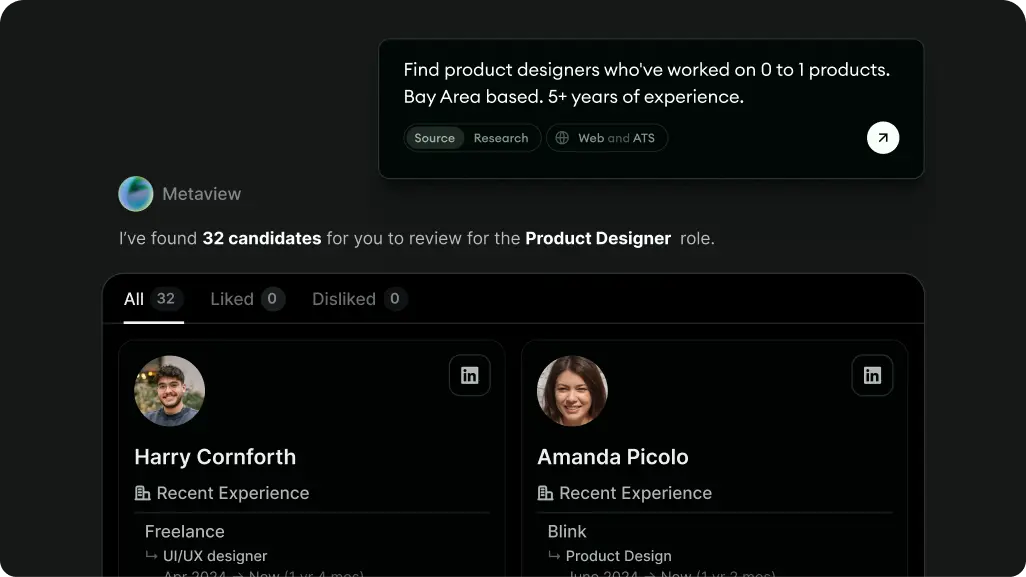
Metaview's Sourcing Agent stands out because of where its search context comes from.
If Metaview is present during a role intake call, it can use the conversation transcript to draft the initial search and generate candidates directly from the discussion. Recruiters can also open a completed interview and select “Find similar candidates” to source people with similar backgrounds and experience.
The sourcing agent is connected to Metaview's interview intelligence product, creating a loop between sourcing and interviewing. Once a sourced candidate reaches the interview stage, Metaview can map their answers to the hiring rubric and write the resulting scorecard back to the ATS.
That means interview data can feed back into sourcing instead of the two workflows operating independently.
7. Pin
Best for: Recruiting teams that want one consolidated tool for sourcing, outreach, and candidate management instead of stitching together several separate tools.
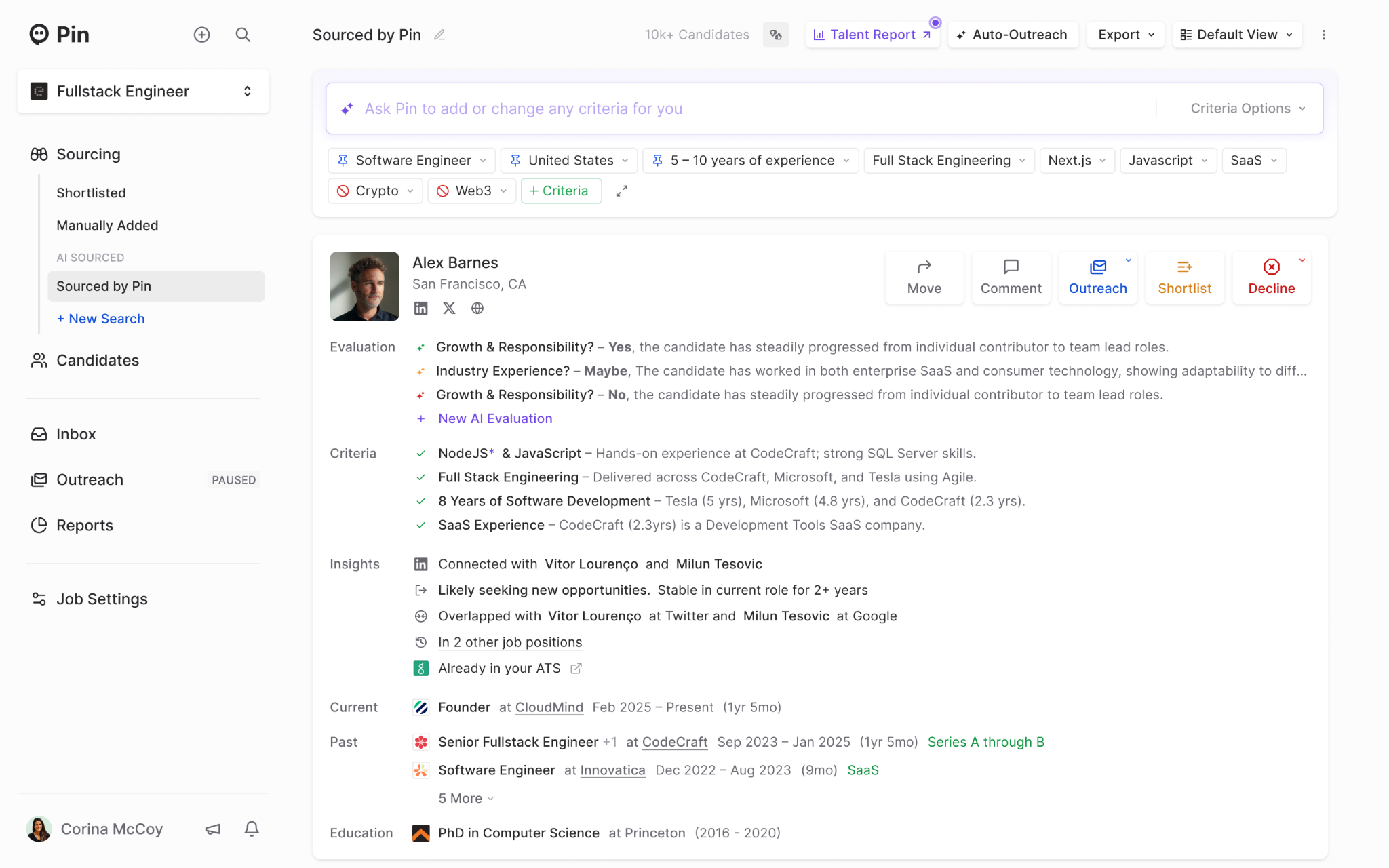
Pin is an AI recruiting agent that handles sourcing, candidate ranking, and outreach in one workflow. It searches for candidates across the web, evaluates them based on fit, and routes relevant profiles into multi-channel outreach across email, LinkedIn, and SMS.
Its outreach engine can adapt based on what's generating responses, changing the messaging and channel mix instead of simply running the same fixed sequence for every candidate. Pin also learns from recruiter feedback on candidate quality, using those signals to refine future searches and rankings.
Which AI recruiting agent is right for you?
The best option depends on where you want to introduce autonomy:
- Outbound-heavy recruiting: Gem, Tezi, or Noon AI
- Agentic capabilities within a consolidated ATS: Kula
- Agentic capabilities without replacing your existing ATS: hireEZ
- AI plus human recruiting support: Kula
- Sourcing driven by interview and intake conversations: Metaview
- End-to-end sourcing, outreach, and scheduling for lean teams: Kula and Gem
The important thing is to evaluate the actual workflow an agent can run, not just how many AI features appear on the vendor's feature page.
How to evaluate an AI recruiting agent
A polished demo can make almost any AI recruiting agent look impressive. The better test is to put it through the situations your recruiting team actually deals with.
Use these seven checks before you buy:
- Ask for a live demo using your data. Don't settle for a pre-recorded workflow. Give the vendor real candidate profiles and a real hiring requirement from your team. Watch how the agent searches, evaluates, and makes decisions. If a vendor won't demonstrate the product on your actual use case, take note.
- Demand explainable scoring. You should be able to see why a candidate was recommended: which skills, experience, or other criteria influenced the result. Black-box scores make it difficult for recruiters to trust, challenge, or audit an AI decision.
- Ask for bias audit documentation. Find out whether the system has undergone an independent bias audit and ask to see the documentation around AI recruiting regulations. For example, Gem partners with BABL and Kula partners with Warden AI. NYC Local Law 144 also requires annual bias audits for certain automated employment decision tools.
- Verify how PII is handled. Ask what personally identifiable information is removed before candidate data is processed. Names, addresses, graduation dates, and other demographic proxies shouldn't become hidden signals in an AI scoring system.
- Test how it handles potentially biased criteria. Give the agent criteria such as “cultural fit” or “demonstrates leadership skills” and see whether it flags the ambiguity or potential bias. A useful system should help recruiters identify problematic criteria rather than blindly execute them.
- Ask how candidate notification works. Depending on where you operate, candidates may need to be notified when automated tools are used in employment decisions. Ask whether the agent supports those notifications as part of the workflow.
- Test what happens when the agent is uncertain. This is one of the simplest ways to assess how much control you'll actually have. A good agent should know when it doesn't have enough information and escalate the decision to a recruiter. An agent that confidently guesses is a much bigger risk.
If a vendor can't give you clear answers to these questions, that's useful information in itself. An AI recruiting agent shouldn't just be able to make decisions autonomously. You should also be able to understand, audit, and override those decisions.
Are AI recruiting agents worth it?
AI recruiting agents can create real value, but they're not automatically worth the investment. Before buying one, ask yourself three questions.
1. Do you have enough volume for an agent to make a difference?
Agents are most useful when recruiters are handling 200+ applications per role, sourcing across multiple channels, or coordinating complex interview loops at scale. If your hiring volume is low, the setup and configuration work may cost more than the time you save.
2. Do you have the process to act on what the agent produces?
An agent can rank candidates, generate screening scores, and recommend outreach. But if recruiters don't consistently review those outputs and act on them, the technology won't change your hiring outcomes.
An end-to-end human process should come before the tool.
3. Can you invest the time to evaluate vendors properly?
Choosing the wrong agent can mean migration work, training costs, and frustrated hiring managers. A serious evaluation can take 2–4 weeks per vendor. If your team can't make that investment right now, waiting is better than rushing into the wrong system.
If you can answer yes to all three, an AI recruiting agent may be worth testing. If you can't, fix the underlying constraint first.
Bottom line: AI recruiting agents are useful, but autonomy isn't the goal
The most important takeaway from all of this is that AI recruiting agents aren't valuable simply because they can work autonomously.
They are most useful when:
- The workload is high enough to justify automation.
- The task is structured enough for an agent to handle reliably.
- The agent can explain its decisions, rather than giving recruiters unexplained scores.
- Human judgment stays in the loop where context and nuance matter.
- The recruiting team has the processes and training to use the technology properly.
And remember that AI is moving beyond simple automation.
Agentic AI in recruiting can now source across channels, rediscover candidates, screen applications, personalize outreach, coordinate interviews, and connect information across different stages of the hiring process.
But they can still miss non-traditional candidates, reproduce bias in hiring data, misread career context, and produce communication that feels automated.
So the right question isn't “Should we use an AI recruiting agent?”
It's “Which parts of our recruiting workflow are worth giving an agent control over?”
For teams looking to bring AI into those workflows without adding a separate layer of recruiting software, Kula combines sourcing, screening, conversational analytics, and AI interviewing capabilities audited for bias in its ATS.
Book a demo today and see it in action!

AI recruiting agents can take over repetitive parts of the hiring process, including candidate sourcing, application screening, outreach, interview scheduling, and feedback summarization. Unlike traditional automation, agents can use context to decide what to do next and adjust their actions based on results. Recruiters can then spend more time on candidate relationships, hiring-manager alignment, and decisions that require human judgment.
For recruitment agencies, AI recruiting agents can help recruiters manage larger candidate volumes without increasing the amount of manual work at the same rate. Agents can search multiple candidate sources, identify relevant profiles, personalize outreach, follow up with candidates, and coordinate interviews. This can be particularly useful for agencies handling multiple searches simultaneously, though recruiters still need to review AI-generated recommendations and candidate communications.
AI recruiting platforms can go beyond exact keyword and Boolean searches by analyzing skills and experience in context. An agent can identify related skills, search across multiple sources, and rediscover relevant candidates already in an ATS or CRM. Some platforms can also use recruiter feedback and interview information to refine future searches, helping teams find candidates who may not match the exact language of a job description.
The best option depends on what a startup needs from an AI recruiting agent. Tezi's Max and Pin are worth evaluating for teams looking for higher autonomy across sourcing, screening, outreach, and scheduling. Noon AI may be useful for technical sourcing across sources such as GitHub, Reddit, and Slack. Kula is worth considering for startups that want AI capabilities built into a broader ATS rather than adding a separate recruiting agent.
Start with a specific recruiting workflow rather than trying to automate everything at once. Test the tool using your own candidate data, verify how it handles PII and bias, and make sure its recommendations are explainable. Check that it integrates with your existing ATS and preserves the data and workflows your recruiting team already relies on. Most importantly, define where the AI can act independently and where a recruiter must review or approve its decisions.