




Offer acceptance rate measures the percentage of job offers candidates accept. Learn how to calculate it, benchmark your rate, understand declines, and improve acceptance.
You can spend weeks sourcing, screening, and interviewing a candidate, only to lose them when the offer arrives.
That makes the offer acceptance rate one of the most useful metrics at the bottom of your recruiting funnel. A decline does not just mean losing one candidate. It can mean reopening the search, repeating interviews, and pushing your hiring plan further out.
But what counts as a good offer acceptance rate?
There is no universal number. Your benchmark depends on factors such as industry, role, seniority, and company stage. A rate that looks healthy for one hiring team may point to a problem for another.
This guide breaks down the benchmarks, common reasons candidates decline offers, and practical ways to improve your rate.
What a good offer acceptance rate actually looks like
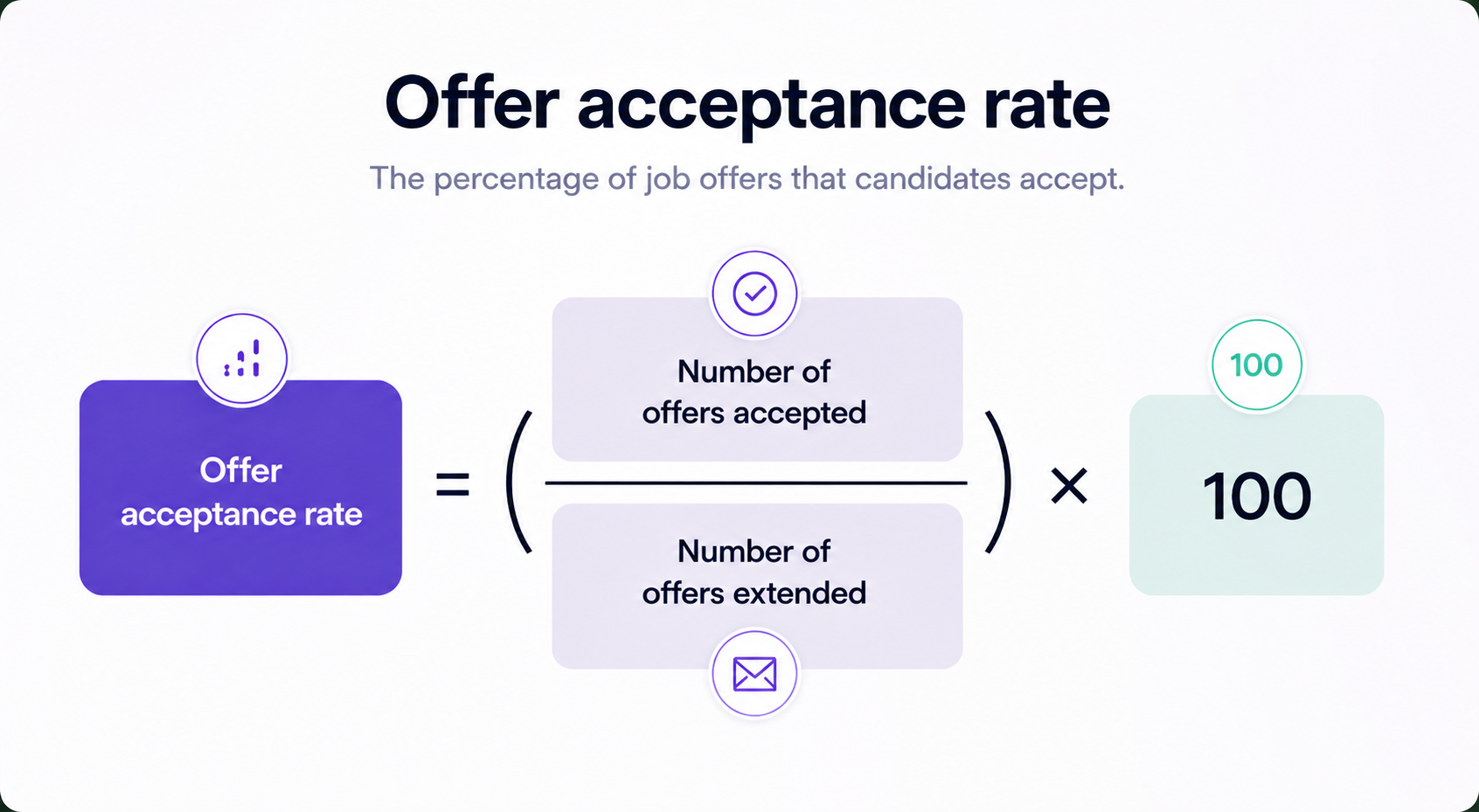
Start with the basic offer acceptance formula:
Offer acceptance rate = (number of offers accepted ÷ number of offers extended) × 100
For example, if you extend 100 offers and 82 candidates accept, your offer acceptance rate is 82%.
But keep in mind that offer acceptance rates can vary widely by industry. NACE’s benchmark data puts the college recruiting offer-to-acceptance rate at 69.3%.
For general hiring, industry offer acceptance benchmarks typically range from 77% to 92%, depending on the sector.
Manufacturing sits at the higher end, with acceptance rates above 90%. Tech and healthcare tend to be closer to 77%, where candidates may have more leverage and competing offers can make the final decision harder.
That gap matters when you benchmark your own team.
Comparing a 78% acceptance rate with a generic "good" benchmark could lead you to the wrong conclusion. The same number can mean very different things depending on who you are hiring and where you compete for talent.
But industry is only one part of the picture. The roles you hire for also shape your acceptance rate.
A team hiring mostly entry-level roles may naturally see a different rate than one hiring senior engineers, sales leaders, or executives. Senior candidates often have more options, more complex compensation packages, and more room to negotiate before deciding.
The same applies to company stage.
A startup may compete against larger employers on compensation but win candidates through other parts of the offer. An established company may have stronger brand recognition or more predictable compensation structures.
So instead of asking, "Is our offer acceptance rate good?" ask:
"Is our offer acceptance rate healthy for the roles, candidates, and market we're hiring in?"
That gives you a much more useful offer acceptance benchmark.
And don't stop at the company-wide number. Break acceptance rates down by role, department, seniority, and recruiter. An 85% overall rate can look healthy while one hard-to-fill role is sitting at 50%.
6 offer decline reasons and why your OAR is low
A candidate rarely declines an offer because of one isolated moment.
More often, the decision has been building throughout the hiring process.
A slow interview loop, unclear compensation, a weak connection with the team, and an uncertain career path can each create a little doubt. By the time the offer arrives, those doubts may be enough to push the candidate toward another option.
Here are 6 most common causes to look at when your acceptance rate starts falling:
1. Your hiring process takes too long
Speed matters. Every extra day between interviews, feedback, approvals, and the final offer gives candidates more time to interview elsewhere or lose interest in the role.
U.S. average time-to-hire has climbed 24% since 2021, from 33 days to 41 days. Top-tier candidates may also have 2–4 competing offers by the time they reach the final round.
That makes delays particularly costly at the end of the funnel. A candidate who was excited about your role three weeks ago may have a very different set of options by the time you make an offer.
There is friction earlier in the funnel, too. 46% of U.S. candidates abandon job applications when they have to manually re-enter resume information, and applications that take more than 15 minutes see a 73% abandonment rate.
These numbers point to the same problem: candidates have limited patience for unnecessary friction.
If your time-to-hire is consistently 45+ days, examine where the process is slowing down before assuming the offer itself is the problem.
2. Compensation does not match expectations
Compensation problems tend to appear in two ways.
The first happens when your offer is below what the candidate can get elsewhere.
The second occurs when there is a transparency problem. If compensation was vague throughout the process and the candidate only learns the actual range near the end, even a reasonable offer can feel disappointing.
43% of candidates cite compensation as the primary reason for declining an offer.
This is why it’s important to establish compensation alignment early. You don’t need to negotiate the final package during the first call, but you should know whether your expectations are broadly aligned before investing weeks in a candidate.
3. The candidate accepts a counter-offer
A candidate can be genuinely interested in your company and still decide to stay when their current employer makes a counter-offer.
Counter-offers account for approximately 25–30% of offer declines. You cannot prevent every one, but you can learn how likely a candidate is to accept one.
The best time to ask is before the offer.
During the final rounds, ask what would happen if their current employer offered them more money, a promotion, or another change they had been asking for. Their answer can tell you whether they are committed to leaving or whether a counter-offer could change their decision.
You can then address the underlying reason for their job search rather than finding out about it after the candidate has declined.
4. The candidate sees a cultural mismatch
Candidates are evaluating your company throughout the interview process. They are paying attention to how people communicate, how interviewers treat them, how decisions are made, and whether they can see themselves working with the team.
Cultural fit is a top-three reason candidates walk away from offers. In many cases, the problem only becomes obvious because the interview process gave them a view of the company that the job description and recruiter conversations did not.
This is why candidates should meet the people they will actually work with. When the process only involves a recruiter and hiring manager, important mismatches can remain hidden until the offer stage.
5. The career path is unclear
A strong candidate is not only evaluating the job you are offering. They are evaluating where that job could take them.
If you cannot explain what they will own, how their responsibilities could grow, or what success looks like over time, another company with a clearer path can become more attractive.
This matters particularly for senior individual contributors who may be comparing multiple offers. They have more reason to think beyond the immediate role and ask whether the opportunity will continue to make sense for their career.
You don’t need to promise a promotion by a specific date, but at least provide candidates a realistic picture of how the role can develop and what opportunities exist if they perform well.
6. The candidate experience has already taken a hit
A competitive offer cannot always undo a frustrating candidate screening or interview experience.
Candidates notice when interviews are repeatedly rescheduled, interviewers arrive unprepared, feedback takes too long, or nobody tells them what happens next.
Research from Robert Half shows that 62% of candidates lose interest if they do not hear back within two weeks.
Each issue might seem minor on its own. Together, they can change how a candidate views the company.
The effect can be especially damaging because candidates often use the hiring process as a preview of what working with your company will be like. If communication is slow before they join, they may reasonably wonder whether it will be slow after they join.
A candidate might wait six weeks for an offer, receive less compensation than expected, and still be unsure about their career path. Any one of those issues might be manageable. Together, they can make another offer much easier to choose.
That is why looking only at the reason marked "compensation" in your offer-decline report is not enough.
Look at the full candidate journey:
- How long did the process take?
- What compensation did they expect?
- Did they receive another offer?
- What did they learn during the interviews?
- Did they raise concerns about the role or career path?
The answers to these questions will most probably tell you much more than just a simple recruiting KPI or metric.
10 ways to improve your offer acceptance rate
1. Pre-close the candidate before extending the offer
Don’t wait until the offer is ready to find out whether the candidate actually wants the job. Before sending the formal offer, have a 30-minute conversation that covers:
- What are you making today, including base and variable compensation?
- What is the minimum you would need to say yes?
- What other opportunities are you considering, and where are you in those processes?
- What would make you decline this role if we offered it?
The goal isn’t to pressure the candidate into committing, but to surface objections while you still have time to address them.
Make this a formal step in your offer process rather than relying on individual recruiters to remember to do it.
2. Move fast once the hiring decision is made
The offer stage is not the time for internal delays.
Once the panel has made its decision, aim to get the offer to the candidate within 24–48 hours. A candidate can spend that time speaking with another company, negotiating another offer, or simply reconsidering whether they want to make a move.
For standard roles, pre-approved compensation ranges and faster approval workflows can remove much of this delay.
3. Extend the offer verbally before sending it in writing
A written offer can feel transactional. A conversation gives the recruiter a chance to explain the opportunity, walk through the terms, and hear the candidate's reaction.
Call the candidate first. Explain the offer, answer questions, and understand what is giving them pause.
If the conversation goes well, the written offer becomes confirmation of what you already discussed rather than the first time the candidate sees the terms.
4. Make compensation competitive and transparent
Compensation should not be a surprise at the end of the hiring process.
Discuss the expected range early. Be clear about base salary, variable compensation, equity, bonuses, and other meaningful components of the package.
Since so many candidates cite compensation as the primary reason for declining an offer, this is a crucial step.
Of course, you may not be able to match every competing offer, but you can make sure candidates understand what you can offer before both sides have invested too much time.
5. Reduce time-to-hire
If your process is slow, improving the offer itself may not solve the problem.
Map the time between each stage and look for avoidable gaps, like:
- How long does interview feedback take?
- How long does it take to approve compensation?
- How long does the recruiter wait before contacting the candidate?
- Does candidate evaluation take too long to complete?
A shorter process keeps candidates engaged and reduces the amount of time they have to pursue other options.
Fix those delays before assuming you need a more persuasive offer.
6. Get executives involved for senior hires
Senior candidates often need more than a standard recruiting process.
For important leadership or senior roles, consider having the CEO or hiring executive personally connect with the candidate during the final rounds or at the offer stage.
The conversation does not need to be a sales pitch. A direct discussion about the company's direction, the role's importance, and what the candidate would own can give them context that a standard offer letter cannot.
7. Talk about career growth before the offer
Do not introduce career progression for the first time when you are trying to close the candidate.
During the interview process, talk about where the role could lead over the next 18–24 months. Explain how responsibilities can grow, what skills the person could develop, and what promotion could look like.
Be realistic. Candidates do not need a guaranteed promotion date. They need enough information to judge whether the opportunity fits their longer-term goals.
8. Personalize the offer experience
The final stage should feel like a continuation of the relationship you've built with the candidate, not an automated transaction.
Small details can make the offer feel more personal:
- A custom message explaining why you want the candidate
- A video message from the hiring manager or future teammates
- Specific references to conversations from the interview process
- A clear explanation of why the role is a strong fit
The objective is to make the candidate feel that the company chose them specifically, not just that they cleared a hiring process.
9. Prepare for the counter-offer conversation
When a candidate tells you their current employer has made a counter-offer, do not turn the conversation into a salary competition.
Go back to the reasons they wanted to leave in the first place. Was it career growth? Their manager? The type of work? Learning opportunities? Company direction?
A stronger conversation connects the new role to those motivations. If compensation was the only reason they were considering a move, the counter-offer may be difficult to overcome. If they wanted a broader change, you have more to discuss.
10. Measure what happens after every decline
A declined offer should give you information you can use.
Track acceptance rate by role, recruiter, hiring manager, and department. Record the reason for each decline in a structured way rather than relying on free-text notes.
Then look for patterns.
If candidates repeatedly decline one role because of compensation, you have a different problem than if they decline after a long process or after meeting the hiring team.
The goal is not simply to get the acceptance rate higher. It is to understand what is causing candidates to say no, then fix the part of the process that is creating those decisions.
How to build an offer process that gets candidates to yes
A good offer process does more than deliver paperwork. It keeps the candidate engaged from the moment the hiring decision is made through their first day.
A simple seven-step workflow can make that process more consistent.
Step 1: Have a pre-close conversation
After the final interview but before preparing the formal offer, schedule a 30-minute conversation with the candidate.
Confirm their compensation expectations, whether they are considering other opportunities, their potential start date, and anything that could prevent them from accepting.
This is your opportunity to surface objections while you can still address them. If the candidate has concerns about compensation, scope, timing, or another offer, you want to know before the offer is finalized.
Step 2: Complete internal approval quickly
Once the candidate is ready to move forward, the hiring manager and TA lead should confirm the offer, get compensation approved, and prepare the offer letter.
For a standard role, aim to complete this within 24 hours of the final interview. Internal approval should not become the reason a strong candidate waits several days for an answer.
Step 3: Make the verbal offer
The recruiter should call the candidate before sending the written offer.
Walk through the compensation package, role, start date, and other important terms. Give the candidate space to react and ask questions.
The conversation also gives you one last opportunity to identify hesitation. If they are excited, confirm their verbal acceptance before moving to the paperwork.
Step 4: Send the written offer
Once the candidate has verbally accepted, send the formal offer within 24 hours.
The document should clearly spell out the details they need to make their decision: base salary, variable compensation, equity, benefits, start date, and reporting structure.
Make it easy to review and sign electronically. There should be no major surprises between the verbal conversation and the written document.
Step 5: Keep engaging after acceptance
The period between signing and starting is when candidates can receive counter-offers, reconsider their decision, or continue conversations with other companies. Going quiet after the candidate signs creates unnecessary risk.
Schedule regular touchpoints instead. Introduce them to future teammates, share useful context about the team, or arrange a conversation with the hiring manager or CEO when appropriate.
Step 6: Give them an onboarding preview
Don't make the candidate wait until their first day to find out what joining the company will actually look like.
Send an onboarding preview that covers what their first week will involve, who they will meet, what they will work on, and anything they can do to prepare.
It reinforces the decision they've made and turns an abstract future job into something they can start picturing themselves doing.
Step 7: Confirm the start date
About a week before the start date, check in and confirm that everything is still on track.
This is a useful final checkpoint for identifying hesitation or changes in circumstances. If something has shifted, finding out before the start date gives your team time to respond rather than discovering a problem on the candidate's first Monday.
Remember, treating the final offer as a paperwork step leaves too much to chance.
The strongest process is continuous:
- Pre-close the candidate
- Approve quickly
- Make the offer personally
- Remove surprises
- and keep the relationship warm until the start date
Build a tech stack that strengthens your offer process
The right recruiting tools can remove administrative bottlenecks, make candidate communication more consistent, and give recruiting teams enough data to see where offers are being lost.
The best setup usually has three layers: an applicant tracking system to manage the workflow, additional tools for specific offer-stage tasks, and analytics to identify patterns.
1. Start with your ATS
Your ATS or CRM should be the system of record for the offer, rather than making recruiters piece together the process across spreadsheets, email, and separate signing tools.
Kula supports this workflow with customizable offer templates, candidate-facing messaging, and DocuSign and PandoDoc integrations for digital signatures. Recruiters can personalize the communication around an offer while keeping the offer itself, its status, and related recruiting data in the same workflow.
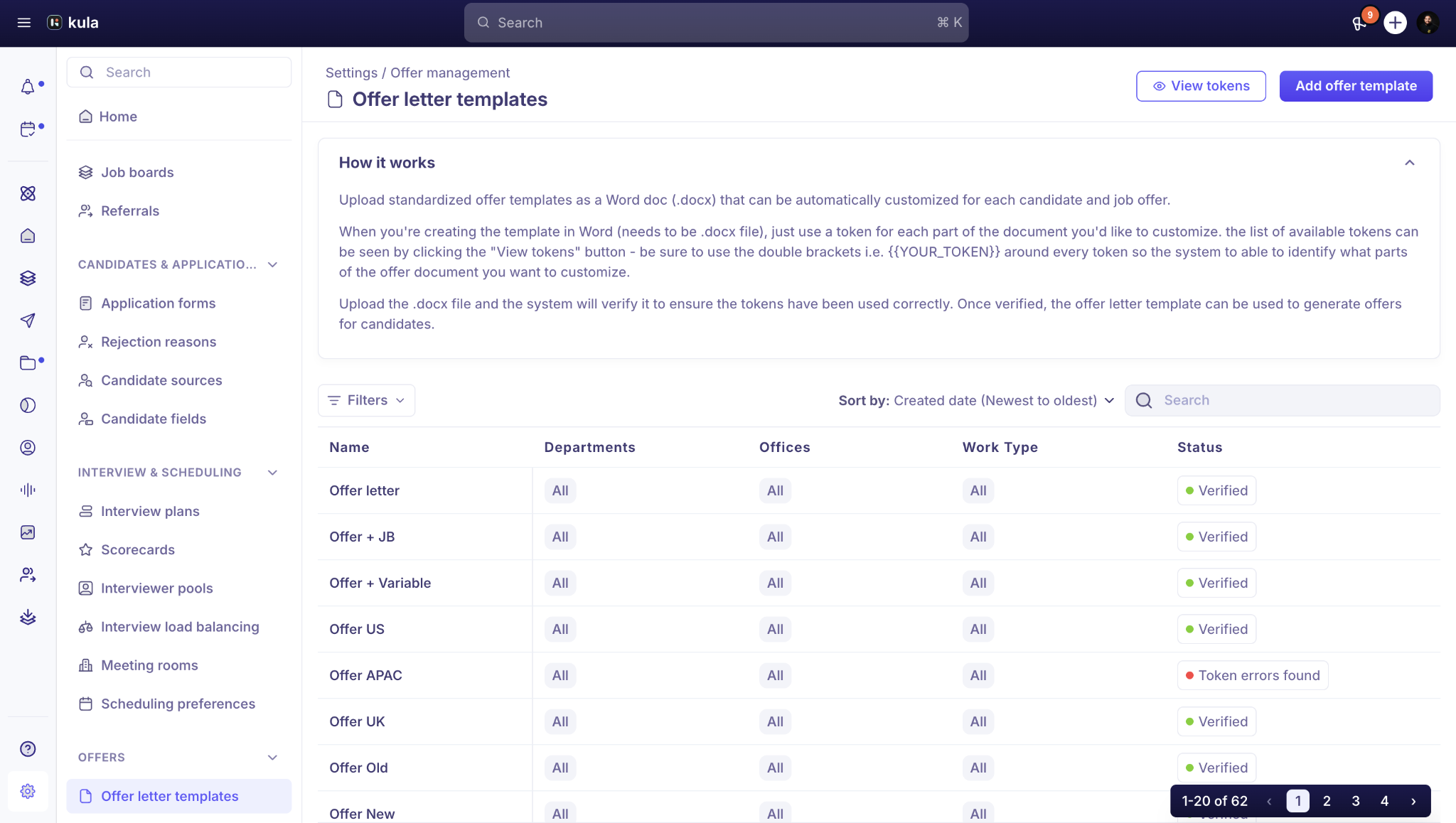
Its offer analytics can also help teams examine metrics such as offer trends and time to offer across different parts of the hiring process.
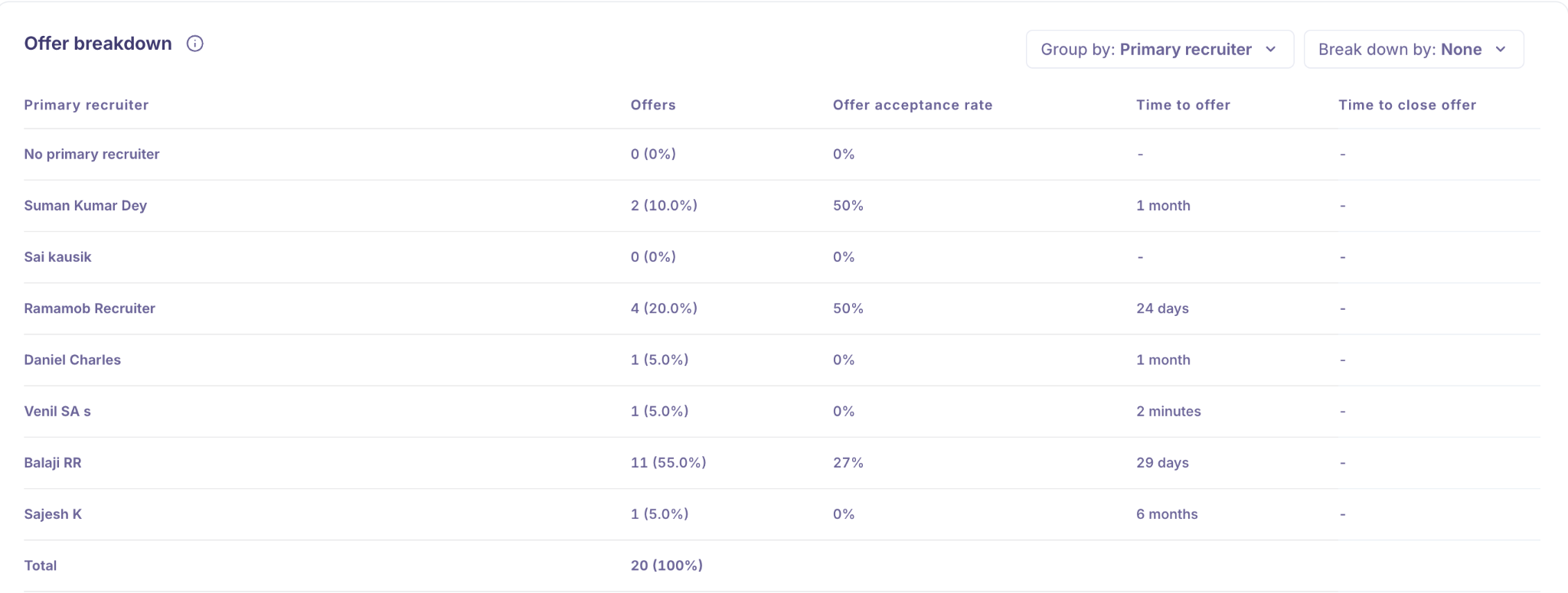
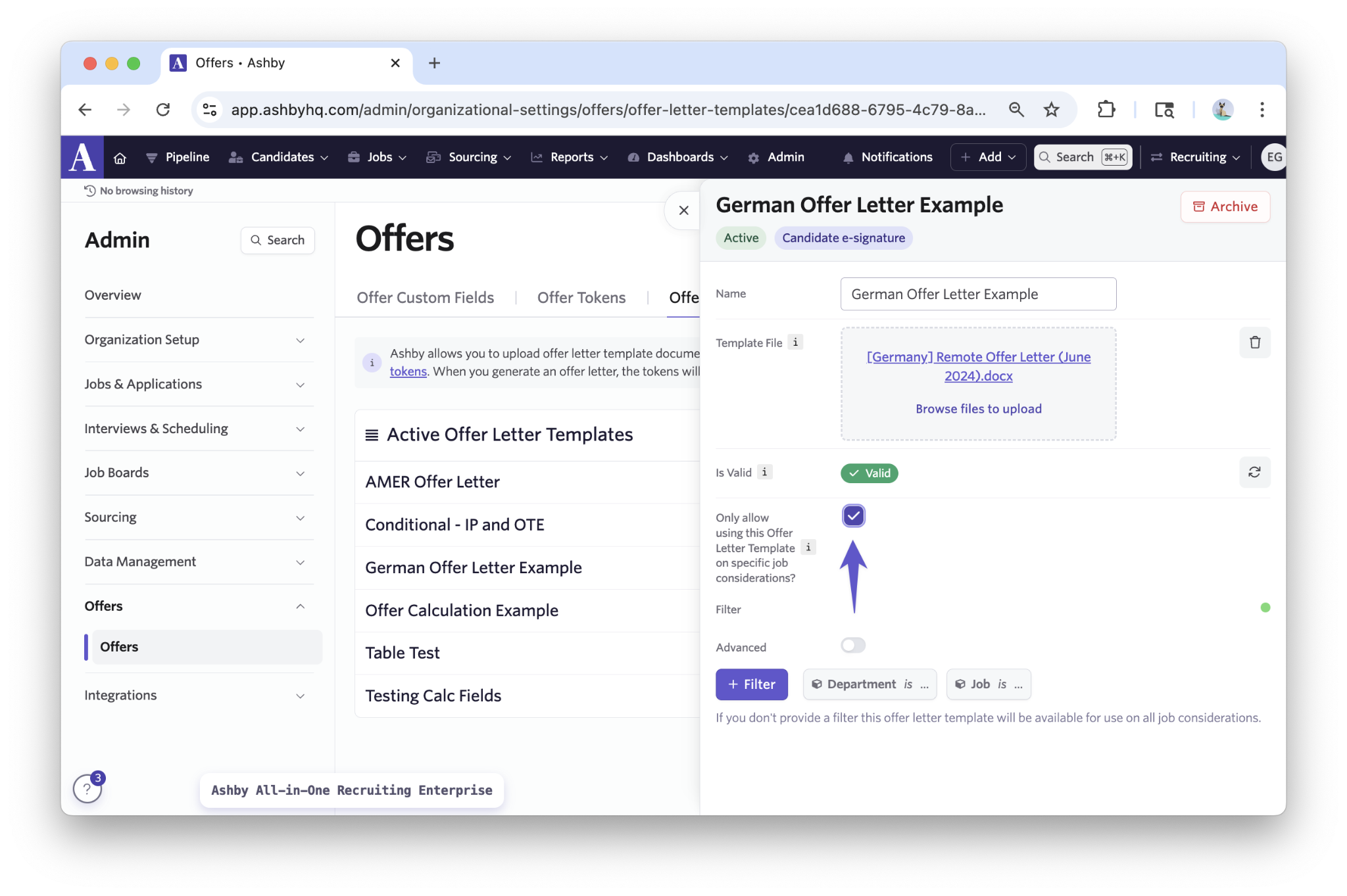
Ashby is also particularly strong for teams that want to analyze offer performance alongside their broader recruiting data. Its analytics can surface offer acceptance and outcomes, while configurable approval workflows help teams standardize how offers move from hiring decision to candidate.
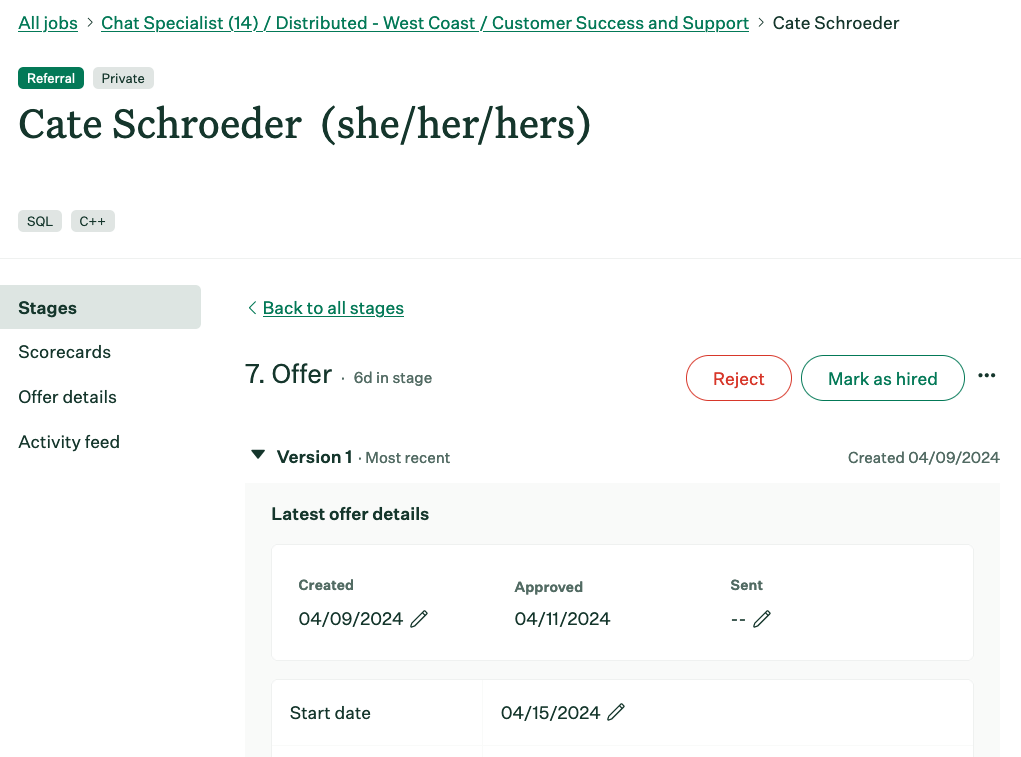
Greenhouse takes a more structured approach to offer management, with configurable approval workflows, offer templates, and e-signature integrations. It is useful for organizations where compensation and offer approvals need clear controls before anything reaches a candidate.
Lever, Workable, and iCIMS also cover core offer workflows, including offer creation and digital acceptance, although their approaches and depth of customization, approvals, and reporting differ.
2. Add specialized tools where they solve a real gap
Some parts of the offer experience may benefit from dedicated tools:
- E-signature: Tools like DocuSign and PandaDoc can handle digital signing, templates, and automated workflows when your ATS does not provide the experience you need.
- Compensation benchmarking: Radford, Payscale, and Levels.fyi can give recruiters and compensation teams market data to inform offer ranges and reduce avoidable compensation mismatches.
- Personalized video: Loom can help hiring managers send a short personal message alongside an offer, particularly for senior or high-priority hires.
Remember, you don’t need every tool on this list. The goal is to close specific gaps in your process, not add another layer of software.
3. Use analytics to find where the process is breaking
The most valuable tooling does not just tell you whether an offer was accepted. It helps you identify patterns behind acceptance and decline.
Track acceptance rates alongside factors such as role, seniority, recruiter, hiring manager, department, compensation, and time to offer. If one team consistently loses candidates after long approval cycles while another does not, you have found a process problem worth investigating.
That is ultimately what good tooling should do: make the offer process faster, more personal, and more measurable.
It cannot replace a strong pre-close, competitive offer, or good candidate experience. It simply makes it easier to execute all three consistently.
Three questions to diagnose your offer acceptance problem
Before changing your compensation strategy or buying another recruiting tool, answer these three questions.
1. Do you track acceptance rate beyond the company-wide number?
Break it down by role type, department, and recruiter. A healthy overall rate can hide a serious problem in one team or role. If engineering is accepting 50% of offers while the company average is 85%, the average is not telling you what you need to fix.
2. Do you pre-close candidates before extending formal offers?
If you only find out what a candidate needs when they see the offer, you are learning too late. A pre-close conversation gives you a chance to surface compensation expectations, competing offers, start-date concerns, and other potential objections while there is still time to address them.
3. Can you explain why your last five offers were declined?
Not just "the candidate chose another company." You should know whether the underlying reason was compensation, a counter-offer, a slow process, career concerns, or something else. If you cannot identify the pattern, you cannot reliably fix it.
If any answer is no, start there. Better offer acceptance usually comes from better diagnosis, not simply making more offers or adding more software.
A candidate saying no at the offer stage is often telling you something about the process that came before it.
Benchmark the right number. Find the friction. Fix it before the next offer.
And if your recruiting stack makes that harder than it should be, Kula brings offer workflows, candidate communication, and recruiting analytics together so your team can move faster without losing the personal touch.

There is no single tech-industry acceptance rate that applies to every company or role. Industry benchmarks for general hiring typically fall around 77% to 92%, while tech tends to sit closer to the lower end of that range. The right benchmark also depends on factors such as role, seniority, location, and company stage, so your own historical acceptance rate is an important comparison point.
Startups can improve offer acceptance rates by addressing the areas where they are most likely to lose candidates: compensation expectations, speed, career growth, and uncertainty about the company. Discuss compensation early, move quickly once a hiring decision is made, pre-close candidates before extending the offer, and clearly explain what the candidate will own and how the role can develop. Strong communication can also help startups compete when they cannot match larger companies on compensation.
The most effective practices include pre-closing candidates before making the offer, moving quickly after the hiring decision, discussing compensation transparently, making the offer verbally before sending it in writing, and maintaining engagement after acceptance. It also helps to understand competing offers, prepare for counter-offers, personalize the offer experience, and track decline reasons so you can identify recurring problems.
Offer acceptance rate is calculated by dividing the number of offers accepted by the number of offers extended, then multiplying the result by 100. Offer acceptance rate = (Offers accepted ÷ Offers extended) × 100 For example, if you extend 50 offers and 40 candidates accept, your offer acceptance rate is 80%.
Offer rate and offer acceptance rate measure two different parts of the recruiting funnel. Offer rate measures how many candidates receive an offer relative to the number who reached a particular stage, while offer acceptance rate measures how many of the offers you extended were accepted. For example, if 100 candidates reach the final stage and you extend offers to 40 of them, your offer rate is 40%. If 32 of those 40 candidates accept, your offer acceptance rate is 80%. For recruiting teams, offer acceptance rate is usually the more useful metric for understanding how effectively offers convert into hires.