


Time-to-hire is one of the most closely watched recruiting metrics and one of the hardest to move.
Elite teams close roles in 34 days on average. Ordinary teams take 91 days, which is nearly three times longer. The gap is not talent or budget, it is workflow efficiency.
And in 2026, the single biggest lever for closing that gap is AI applied to the specific workflows that consume recruiter time.
This article covers what the data actually shows about AI reducing time-to-hire. The goal is to show where the time savings actually come from so teams can invest in the right places.
The time-to-hire benchmark that most companies do not know
The elite versus ordinary gap
High-performing recruiting teams fill open positions in an average of 34 days. Ordinary teams take up to 91 days. That is not a marginal difference. It is a 2.7x gap in the same market with roughly the same candidate pool. Something structural separates the top and bottom of this distribution.
The candidate velocity problem
The gap matters because candidates are highly time-sensitive. 62% of job seekers lose interest in a role if they do not hear back within two weeks. 70% drop off if they do not hear back within one week. The SHRM Talent Pulse Q1 2025 report shows 72% of candidates drop off mid-process due to lack of timely communication. Slow hiring processes lose candidates before they can be hired.
The vacancy cost
Every day an empty desk sits open costs an organization over $4,700 and 44 days of lost productivity. Multiply that across an open req count and the cost of slow hiring becomes tangible.
The talent window
The highest-performing candidates are typically off the market in 10 days. The average hiring process takes 23.8 days according to Glassdoor and 44 days overall according to broader benchmarks. If your process is not compressed enough to compete inside the 10-day window, you are systematically losing the top of the market.
Where the time actually goes
Recruiters spend one-third of their workweek, about 13 hours, sourcing candidates for a single role. Interview counts per hire have increased 33% since 2021. Technical roles now average 35-36 interviews and 26 interviewer hours per hire. The workflow has gotten heavier while the tolerance for slow hiring has decreased. AI is how the two forces are reconciled.
Screening: the bottleneck where AI produces the largest time savings
Traditional recruiters spend an average of 23 hours per position reviewing resumes, and only 5-10% of inbound applicants meet basic qualifications. The math is brutal, as most of the recruiter's screening time is spent rejecting people who never should have advanced.
AI screening tools can help with this problem. It reduces time-to-hire by up to 75%. Recruiters save an average of 23 hours per hire on screening alone. That is not a minor productivity gain. That is a full recruiter workweek returned for every hire.
AI screening compresses the top of the funnel from days to minutes. Recruiters review pre-ranked shortlists instead of raw application volumes. Hiring managers review 30 profiles instead of 300. The workflow becomes cognitively manageable, which is what makes the speed sustainable.
The screening bottleneck is where AI produces the highest ROI per dollar spent. Start here.
For example, Plum (health benefits platform) reduced manual resume screening from 2-3 hours per 100 applications to minutes after implementing Kula's AI-native ATS. The company completed 10 hires using the platform in its first 30 days.
As Head of Talent Acquisition Geetanjali Kumar puts it:
"We were spending so much recruiter time on screening, chasing feedback, and manually tweaking reports. We needed something AI-first to cut down this busywork."
Sourcing: where AI compounds into rediscovery advantages
Sourcing is where AI produces the most durable competitive advantage. The database compounds. The targeting improves. The response rates increase. Teams that invest here early build advantages that persist.
Recruiters spend about a third of their workweek, approximately 13 hours, sourcing candidates for a single role. Sourced candidates are 8x more likely to be hired than inbound applicants. The math heavily favors outbound, but the manual cost of it constrains most teams.
With AI sourcing agents, recruiters can automatically search across 800M+ profiles 24/7, source 5x faster than manual search, and locate passive talent up to 60% more accurately than keyword Boolean searches.
For example, Praxent switched to Kula's AI sourcing, which made their sourcing 50% faster, and they were able to close roles 5x faster than before. As Corporate Recruiter Lauren Moye says: "Kula has made our sourcing 50% faster, and we have closed roles 5x faster than before."
The rediscovery multiplier.
The most underused sourcing capability is rediscovery, surfacing past applicants who almost got hired.
Research shows that sourced hires rediscovered from existing CRM/ATS databases have surged from 29.1% in 2021 to 44% in 2024. Rediscovery is now the highest-leverage sourcing activity available.
For example, Scale AI filled 12+ engineering roles in 3 weeks, with 70% of hires being past silver medalist candidates discovered through AI-powered talent rediscovery.
The outreach personalization multiplier
Cold outreach using AI personalization tokens drives 30-40% higher response rates and achieves ~46% lift in campaign reply rates (35.3% vs. 24.1%). This compounds the sourcing efficiency because the same candidate volume produces more conversations.
Scheduling: the least glamorous but most consistent time saver
Manual scheduling eats 4-6 hours per week per recruiter on average. In extreme cases it climbs to 16 hours. 67% of recruiters say scheduling a single interview takes 30 minutes to 2 hours. Every one of those hours is administrative work that produces no candidate signal.
Automated calendar sync and self-scheduling links cut scheduling admin from 4-6 hours per week to 30-60 minutes, an 80% reduction. AI scheduling can coordinate panel loops in 2 minutes instead of 30. Candidate time-to-first-interview decreases by 52%. Overall time-to-hire drops 25% from scheduling improvements alone.
For example, Workiva experienced a 90% reduction in time spent on scheduling. Annual coordinator screen scheduling went from 250 hours to 30 hours. Bulk campus recruiting scheduling — managing 160 interviews — went from 20 hours per season to 1.3 hours. Manager of Talent Operations Melissa Farmer: "We see such an awesome win with screening and scheduling because Gem and Workday communicate."
Feedback and notetaking: the compound savings that reshape debriefs
Interview feedback is chronically late. At Plum, feedback delays of 1-2 days between interview rounds were standard before automation. Recruiters spend hours per week chasing scorecards. When feedback is finally submitted, quality is often thin because interviewers wrote from memory hours after the interview.
AI notetakers record, transcribe, and auto-fill scorecards, helping interviewers focus on the conversation rather than note-taking. Scorecard completion drops from 15-20 minutes to 5 minutes. The debrief becomes faster because everyone has a shared transcript.
Here are some of the examples:
- RemotelyHR, a California-based outsourcing firm, was able to cut hiring timelines by about 50% overall, with 66% faster time-to-hire on some roles. Filled a loan coordinator role in under a week. As Recruiter Lina Baron says: "I typed the information I needed into Kula's AI Notetaker, and it pulled the info instantly. I can just copy-paste and send my notes without worrying they're not detailed enough."
- Plum, a fast-growing modern health benefits platform, with Kula's AI Notetaker was able to cut interview feedback turnaround from 1-2 days to hours. Geetanjali Kumar, Head of Talent Acquisition, says, "The AI Notetaker cuts down on that cognitive effort a lot. It has helped us with our hiring and the pace at which we hire."
- DeepScribe cut recruiting costs by 30% after switching from Greenhouse to Kula. One of their primary bottlenecks was that scorecards were often incomplete or delayed due to busy schedules. With Kula AI Notetaker, recruiters were able to auto-fill scorecards with interview insights. HR Business Partner Samantha Stambaugh puts it: “Interviewers don’t always have time to take notes. Kula helps capture feedback effortlessly with auto-filled scorecards.”
The full-stack outcome: what happens when AI reshapes the entire workflow
No single AI capability produced the outcome. The combination do. Screening AI compressed the top of the funnel, sourcing AI increased the quality of who entered it, and scheduling AI eliminated the coordination overhead.
Feedback automation made debriefs faster and higher-quality. Each intervention was modest on its own. Together they reshaped the entire workflow.
The compounded case study: Dave, a lean TA team, achieved an 80% increase in recruiter productivity over 18 months. Recruiter screens reduced by 40%. Time-to-fill held steady at 60 days despite the productivity increase. Hiring manager interview time cut by 45%. Total interview hours per hire reduced by 32%. Offer acceptance rate boosted from 69% to 85%.
The most underrated outcome is offer acceptance rate. When the hiring process is compressed and coordinated, candidates feel respected. When it drags, they feel deprioritized. The Ashby customer's move from 69% to 85% offer acceptance is not just a candidate experience win. It is a hiring capacity multiplier, every 1% increase in offer acceptance rate reduces the number of offers needed to hit the same headcount plan.
The Praxent case: Roles closed 5x faster. Sourcing became 50% faster. Recruiter Lauren Moye described it directly: the combination of native AI capabilities across sourcing, screening, and scheduling produced compound outcomes that no individual improvement could have delivered.
The takeaway: AI reduces time-to-hire not through any single intervention but through the combined effect of AI applied across every workflow bottleneck.
How to evaluate whether AI will produce these outcomes for your team
Question 1: What is your current time-to-hire, and where is the time actually going? Break down the days by stage: Sourcing time, screening time, scheduling time, feedback time, and interview scheduling gaps. The stage that consumes the most time is where AI will produce the largest ROI.
Question 2: What is your application volume and screening burden? If you review more than 100 applications per role, AI screening produces high-confidence ROI. If your volume is lower, other interventions produce better returns.
Question 3: What is your hiring team's tolerance for tool consolidation? The compound outcomes come from AI applied across multiple workflows. If your team is running an ATS plus three point solutions, consolidation is a prerequisite to compound gains.
Question 4: What is your baseline for measurement? Before implementing AI, capture current-state metrics — time-to-hire, screening time, sourcing volume, feedback turnaround, offer acceptance. Without a baseline, the after-numbers cannot be defended.
Question 5: Can your leadership see the ROI within 90 days? Most of the case studies above showed measurable outcomes within 30-90 days. If your evaluation cycle takes longer than that, the timing may not be right.
The three tools worth mentioning and why the choice matters less than most teams think
1. Gem
Gem is an AI-first recruiting platform that offers AI agents, which are specialized AI-powered assistants that perform specific recruiting tasks with less manual intervention. Gem ATS offers A strong outreach and sourcing layer.
Gem currently highlights three agents:
- AI Sourcing Agent: Searches 800M+ profiles, surfaces relevant past candidates, and finds candidates with verified contact information.
- AI Application Review Agent: Reviews and ranks applicants 5× faster, while explaining why each candidate fits the role.
- AI Fraud Detection Agent: Identifies potentially fraudulent candidates before recruiters spend time evaluating them or before they become a security risk.
Gem also supports structured interviews with competency-based scorecards, interview feedback summaries, and automated reminders.
The platform also produced the strongest outcomes in outbound-heavy motions such as Faire, Cockroach Labs, Scale AI, Mission Cloud, Workiva, and Tropic.
2. Ashby
Ashby is an all-in-one platform which isbest suited for tech-savvy teams, as the platform offers advanced AI capabilities and deep customization.
Ashby AI is an assistive AI layer built into the recruiting workflow, helping teams review applications, source and rediscover candidates, personalize outreach, schedule interviews, summarize feedback, and analyze recruiting data.
Ashby produced the strongest outcomes in analytically sophisticated teams — FullStory, Monte Carlo, January, Infinite Lambda, Avid4 Adventure, Flock Safety.
3. Kula
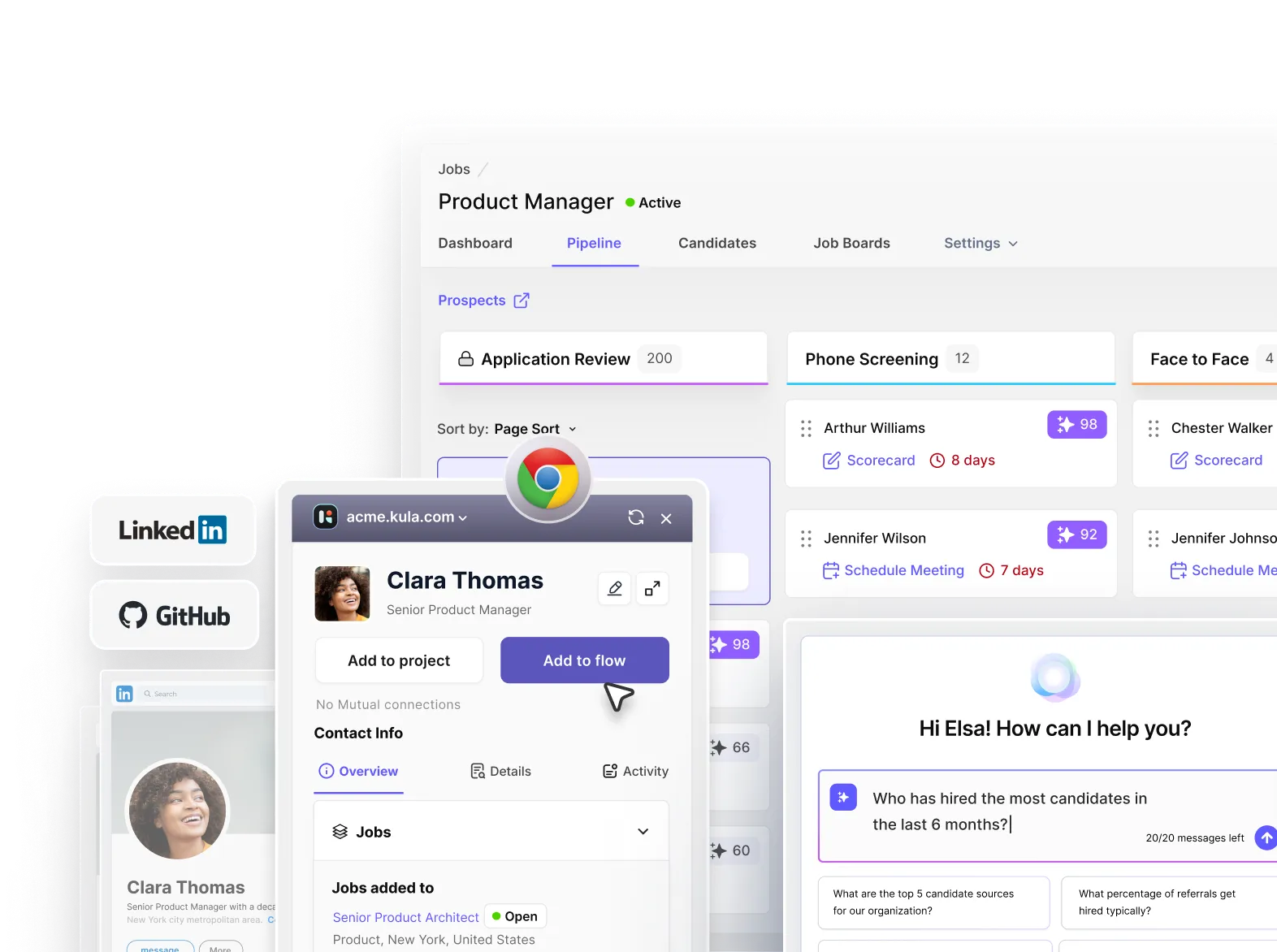
Kula is an all-in-one AI-native ATS that connects sourcing, screening, scheduling, interviews, and analytics in one workflow.
Its AI capabilities automate tasks such as candidate scoring and resume review, personalized outreach, scheduling, interview note-taking, scorecard completion, and conversational analytics.
Kula produced the strongest outcomes in mid-market teams consolidating stacks such as Plum, RemotelyHR, Praxent, and DeepScribe.
The honest observation:
The tool choice matters less than the discipline. Every one of these platforms produced measurable time-to-hire improvements for teams that implemented them seriously.
The teams that failed to see gains almost universally underinvested in configuration, training, or process change.
Pick a platform that fits your stage and workflow, then commit to the implementation.
For mid-market teams looking to reduce hiring delays and manual work, Kula has helped Plum cut feedback turnaround from 1–2 days to hours, Praxent close roles 5x faster with 50% faster sourcing, DeepScribe cut recruiting costs by 30%, and RemotelyHR reduce time-to-hire by 66% on some roles.
Want to see how Kula can help your team hire faster? Book a demo and see it in action.