


The hiring manager is the single most important stakeholder in the hiring process and the single most difficult to work with.
They are overloaded. They do not enter feedback in the ATS. They cancel debriefs. They ghost candidates for weeks. And when they finally show up, they reject qualified people based on vibes and gut instinct.
The recruiter spends hours per week chasing feedback, mediating disagreements, and covering for the manager's absence. This is not a personality problem or a training problem alone. It is a structural problem that software can help solve, but only when the software is paired with process.
This article covers what hiring manager software actually does, how to structure the hiring manager relationship for consistent decisions, and which tools produce measurable improvements in feedback quality, calibration, and time-to-hire.
Why the hiring manager relationship is the most consistent failure point in recruiting
1. The engagement problem
Hiring managers do not treat the ATS as their tool. They treat it as the recruiter's tool that they occasionally have to visit.
Recruiters often find that hiring managers “care less and less” after the initial stages, gradually disengaging from the ATS and relying on recruiters to keep the process moving.
Once the manager disengages, the recruiter is running the process alone.
2. The time problem
Hiring managers and interviewers have real day jobs, and hiring is often an additional responsibility layered on top of them.
Interview panels compete for attention with product launches, board meetings, customer escalations, and urgent headcount issues.
That can mean delayed feedback, rushed interviews, inconsistent evaluations, and lower engagement throughout the process.
3. The subjectivity problem
Without structure, hiring managers evaluate candidates on vibes.
For example, engineering leads defend unstructured coding tests because "the surprise element will prove who's a good developer or not." Managers reject candidates because their "vibe was off" or "we didn't see enough of your personality.”
Such rejections don't even reflect what actually happened in the interview.
4. The feedback delay problem
Feedback that should arrive in 24 hours arrives in three days, if it arrives at all.
The problem is rarely the absence of a feedback mechanism; it is that interviewers have competing priorities and little incentive to treat feedback as urgent once the interview is over.
The result is a cycle of manual follow-up. Recruiters spend hours each week nudging interviewers, chasing missing evaluations, updating candidate statuses, and manually keeping reports current.
At Plum, feedback delays of 1-2 days between interview rounds were standard before automation.
5. The calibration problem
Different hiring managers can apply very different standards to the same role, even when they are evaluating candidates against the same job description.
You can ask the hiring manager to have 2-3 of your best current engineers take the same test, anonymously. When they see the score spread from people already succeeding in the role, ‘these candidates don't measure up’ gets harder to sustain.”
The exercise gives hiring teams a real internal benchmark rather than relying on subjective assumptions about what a “strong” candidate should look like.
6. The candidate impact
All of these problems compound into candidate experience damage.
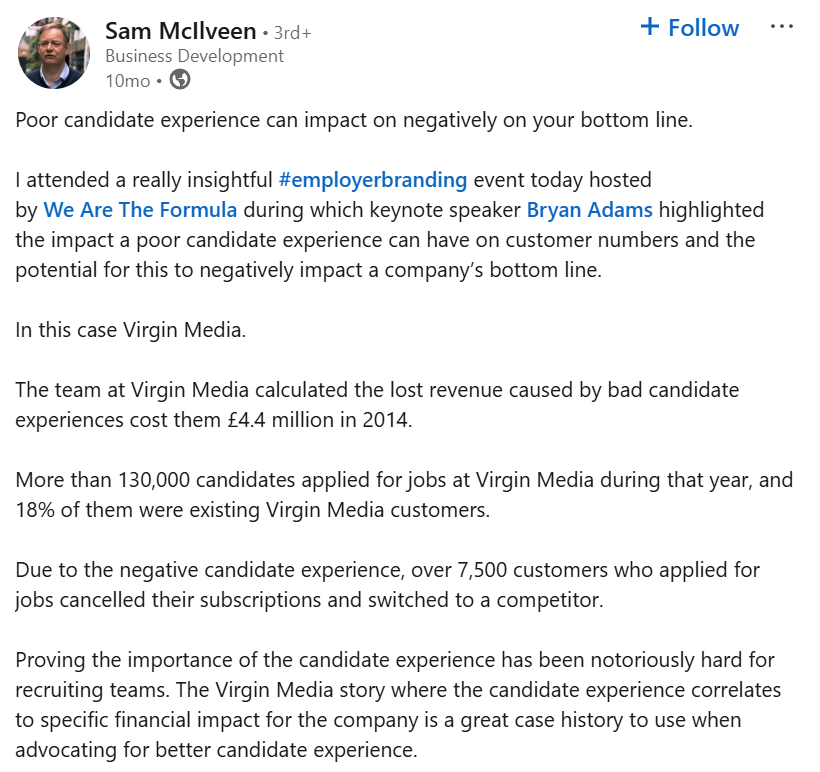
62% of candidates lose interest if they do not hear back within two weeks. The Virgin Media case documented £4.4M in lost revenue from poor candidate experience.
Hiring manager problems become business problems eventually.
What hiring manager software actually does
Core capabilities
1. Hiring manager access to the ATS
Hiring managers can view candidates, review resumes, submit feedback, and manage their pipeline without needing the recruiter as an intermediary. Modern ATSs support this natively. Legacy ATSs require workarounds or extra licensing.
2. Scorecards and structured feedback
Your hiring software must support custom scorecards by role with anchored rating scales. It must require scorecard completion before candidate advancement. Feedback blinding is another important feature for interviewers to submit their evaluations before seeing peer scores. This mechanism drives calibration.
3. Interview scheduling and self-serve
Hiring managers should be able to view their calendar, block interview slots, and let candidates self-schedule within their availability windows. This removes the coordinator middleware that slows most processes.
4. Real-time analytics and pipeline visibility
Live dashboards must show pipeline status, funnel drop-offs, and time-in-stage metrics. It helps hiring managers to see their own hiring health without asking the recruiter for a report.
5. Notification and escalation systems
Your hiring software must send automated reminders for interviews, feedback deadlines, and pending actions. This multi-tier escalation is for hiring managers and stakeholders involved to not miss deadlines.
6. Mobile interfaces
Hiring managers do not sit at desks all day. They need mobile access to review candidates between meetings, submit feedback from the car, and approve offers from anywhere. The hiring software must offer a user-friendly mobile interface for ease of access.
AI-augmented features.
7. AI notetakers
Your hiring software must auto-transcribe interviews so hiring managers can focus on the conversation instead of note-taking. It should also offer auto-fill scorecard fields based on the transcript. Modern ATS such as Kula, Ashby, BrightHire, and Metaview all offer this.
8. AI decision support
Features such as application AI scoring and AI ranking based on defined criteria simplify the initial screening process. It provides explainable outputs so hiring managers can see why a candidate was scored a particular way.
9. AI screening summaries
Consolidated candidate summaries from resumes, applications, and interview transcripts helps cut down the hiring manager's review time significantly.
10. Anti-cheating and verification
Hiring platforms now also offer AI detection for candidate-side AI use during interviews. They offer features such as face verification, voice analysis, and response pattern detection. The category is contested and evolving.
11. Integration with the broader stack
Your hiring software should offer one-click integrations with calendar platforms like Google Calendar and Outlook, Slack notifications for feedback deadlines, email templates for candidate communication, and ATS integration for a complete view of the hiring pipeline.
The five specific problems hiring manager software should solve
Problem 1: Late and low-quality feedback
The most common problem is hiring managers delaying feedback submission and coming up with the most generic candidate reviews, such as "great candidate" or "not the right fit."
Modern hiring software helps with an escalation cadence that actually works.
For example, it sends automated feedback and brief reminders within 24 hours of the interview, auto-nudges stakeholders after one day, and escalates to the recruiting team after 48 hours.
Modern software also requires scorecard completion before a candidate advances and uses feedback blinding, so hiring managers submit their assessments independently before seeing their peers’ scores.
Plum, a modern health benefits platform, reduced feedback turnaround from 1-2 days to hours with automation.
DapperLabs' Head of Talent Acquisition, Anil Puli, also mentions:
"Kula's AI Notetaker automatically transcribes and shares interview highlights with hiring managers, which keeps everyone in the loop without disrupting their day."
Problem 2: Poor calibration across interviewers
Different interviewers evaluate the same candidate differently, which produces wildly different assessments.
Teams should run the calibration test from the research; for example, you can let your current engineers take the same coding challenge anonymously and then show the score distribution. This dismantles the "these candidates aren't senior enough" pattern.
Hiring software helps reinforce this consistency through standardized scorecards, anchored rating scales, structured debrief sequences, and AI notetakers that create a consistent record of each interview
DeepScribe's Samantha Stambaugh used Kula's AI Notetaker to "gain insights into how hiring managers and interviewers conduct interviews" and standardize evaluation. They were able to cut hiring costs by 30% with an AI-native ATS.
Problem 3: Scheduling friction that adds days to time-to-hire
Hiring manager calendar scheduling consumes hours per week. Coordinators spend more time managing calendars than evaluating candidates.
The solution is hiring manager calendar integration where candidates self-schedule within manager availability windows.
This integration also allows for panel scheduling that auto-substitutes when a member declines.
Problem 4: Hiring managers making subjective decisions without accountability
Hiring managers often make vibe-based rejections, or personality-based rejections with no structured evidence for why candidates were rejected.
This creates confusion during debriefs and makes it difficult to distinguish genuine concerns about a candidate’s capabilities from subjective impressions.
Your selected hiring software must support structured scorecards for objective evaluations. It should also offer pass-through rate analytics that reveal which stage produces disproportionate drop-off, as well as manager-specific rejection rate reports that create accountability.
Problem 5: Candidate quality perception disagreements
Recruiter and hiring manager disagree on candidate quality.
A recruiter may see a candidate as a strong match based on their experience and skills, while the hiring manager may reject them because they do not meet specific expectations that were never clearly defined upfront.
When this happens repeatedly, recruiters end up spending time sourcing and presenting candidates who are unlikely to meet the manager’s bar.
The software solution is to capture structured intake meetings in the ATS, align candidate scoring with the agreed-upon criteria, and provide AI screening summaries that clearly show why each candidate matches or falls short of the requirements.
The candidate-side AI problem hiring managers now have to navigate
Candidates are aggressively using AI during interviews, and hiring managers cannot solve this alone.
It requires process changes such as structured evaluation, live assessments, and verified interviews. The tools can help, but process discipline is what ultimately makes the difference.
Some platforms now offer AI-based candidate verification such as voice analysis, response pattern detection, and real-time cheating detection.
Some common signs include:
- Polished STAR-format answers with zero hesitation
- Delayed responses that suggest reading from a second screen
- Eye contact drift during technical questions
- Answers that are word-perfect but lack specific personal detail
- Answers that dodge follow-up probes
The response tactics
The research points to several practical interventions:
- Ask candidates to remove headphones during interviews to reduce the possibility of receiving external prompts.
- Move beyond predictable behavioral questions that AI can answer easily. Use unscripted follow-ups such as, “Walk me through specifically what happened between Tuesday and Thursday.”
- Use live technical assessments instead of relying solely on take-home assignments.
- Probe for personalized detail. If a candidate can only provide generic answers and cannot explain their specific role, decisions, or experiences, that should be reflected in the evaluation: “If it’s all basic, go-nowhere responses without any personalized detail, we failed them.”
Top three hiring manager softwares worth evaluating in 2026
1. Kula
Kula is an all-in-one AI-native ATS that comes with inclusive pricing and an intuitive interface.
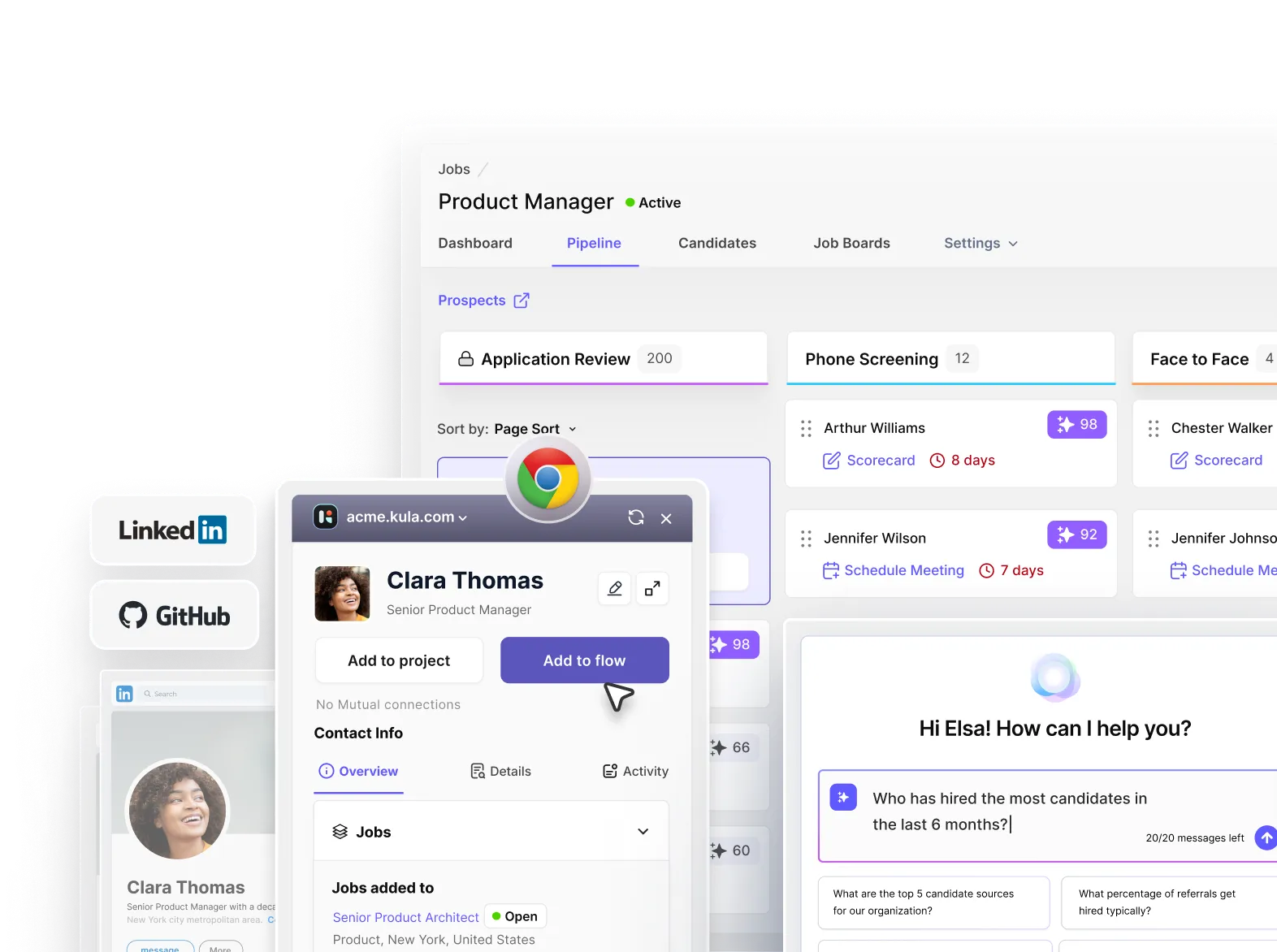
Kula offers features such as native scorecards with automated escalation, an AI Notetaker that transcribes interviews and auto-fills scorecards, and native scheduling with calendar integration.
Kula supports multi-tier feedback escalation matching the 24-hour and 48-hour cadence, and provides real-time dashboards showing pipeline health.
Kula also offers a mobile-first interview experience for its users.
Real customer outcomes:
- Praxent: 5x faster role closure and 50% faster sourcing
- DapperLabs: Anil Puli praised Kula's simplicity and AI-first architecture
- RemotelyHR: 50% time-to-hire cut
- Instawork: 40-60 minutes saved per scheduling event
Best fit: Mid-market teams that want consolidation of ATS and hiring manager engagement in one platform.
2. Ashby
Ashby offers a full suite that combines ATS and CRM functionality in a single platform. It is a technically mature platform with deep customization capabilities, which can also result in a steeper learning curve for users.
Ashby offers native scorecards with strong analytics, AI Notetaker for interview transcription, deep BI-level reporting for hiring manager accountability, and fast, intuitive interview scheduling.
Real customer outcomes:
- Vercel: hiring manager scorecard writing from 45 minutes to 5 minutes
- FullStory: 20+ hours saved weekly
- Coder: 10+ hours saved weekly
Best fit: Analytically sophisticated teams with dedicated TA ops capacity.
3. Gem
Gem is an intuitive modern platform with sourcing being one of its biggest strengths. The platform searches 800M+ profiles and imports candidates from LinkedIn, GitHub, and 20+ sourcing platforms via its browser extension.
Gem also supports automated interview scheduling, a centralized ATS workflow, and AI-powered application review that explains why candidates fit.
Real customer outcomes:
- Tropic: 66% tech spend reduction
- Workiva: 10 hours weekly per recruiter saved
Best fit: Teams migrating from legacy platforms.
The three questions that reveal whether your hiring manager relationships are working
Question 1: Can you tell tomorrow which hiring manager has the highest and lowest pass-through rates at their interview stage? If not, you are not tracking manager-level metrics that create accountability. This is the highest-leverage change available.
Question 2: Do your hiring managers submit interview feedback within 24 hours without being nudged? If they need nudging, the process is broken. Automated escalation systems fix this. Manual chasing does not scale.
Question 3: When a candidate is rejected by a hiring manager, can you produce written evidence of the specific criteria they failed to meet? If not, the rejection is subjective and cannot be defended in a compliance audit. Structured scorecards can fix this.
If you answered “no” to any of these questions, Kula can help with automated feedback reminders, AI interview notes, and mobile access for hiring managers. Customers have also seen faster role closures and less time spent on scheduling.
Want to make hiring manager follow-ups easier? Book a demo with Kula.