

Hiring decisions at most companies are often the result of the loudest interviewer, the most senior hiring manager, the most recent gut feeling, or the candidate who "just felt right."
Everyone participates in this process. Everyone knows it produces mixed results. And almost no one has a framework strong enough to override it consistently.
In 2026, the pressure to fix this is growing because of rising AI involvement. AI-generated resumes have made screening less reliable. Candidates are using AI live in interviews. AI-scoring tools are being adopted rapidly, sometimes producing catastrophic errors.
This article covers what candidate evaluation actually is when it is done well: the frameworks, the calibration tactics, the AI arms race, and the operational disciplines that separate teams making defensible hiring decisions from teams operating on vibes.
What "candidate evaluation" actually is, and what it is not
Candidate evaluation is the process of collecting, structuring, and comparing evidence about candidates against defined criteria to make defensible hiring decisions.
The three components that matter most in candidate evaluation include collecting evidence (interviews, assessments, work samples, references), structuring it (scorecards, rubrics, competency frameworks), and comparing candidates against each other and against the role requirements to reach a decision.
What it is not
❌It is not just interviewing. Interviewing is a data collection method. Evaluation is what happens with the data.
❌It is not just scoring. Scoring is a structural discipline. Evaluation is the broader system of turning candidate signals into decisions.
❌It is not the responsibility of the recruiter alone. Recruiters facilitate evaluation. Hiring managers, interviewers, and sometimes leadership all participate in final decisions.
❌Complete candidate evaluation cannot be executed by AI alone. AI can support specific parts of evaluation (screening, scoring, transcription), but it cannot make the final call and should not.
For example, AI can screen resumes, score candidates against defined criteria, and summarize interviews. But humans still need to assess context, motivation, communication, and fit before making the final decision.
The three dimensions of a good candidate evaluation process
1. Consistent
The same candidate should receive similar evaluations from different interviewers using the same rubric. When two interviewers reach opposite conclusions on the same candidate, the process is not working. The goal should be to make the interview structured, with consistent questions, evaluation criteria, and scoring methods across candidates.
2. Defensible
The decision should be explained with specific evidence rather than vibes or gut feel. For this, feedback should be collected independently from each interviewer, tied to predefined criteria, and supported by specific evidence before the group debrief begins. This matters for compliance, for internal calibration, and for candidate experience.
3. Predictive
The criteria used to evaluate candidates should have a meaningful relationship with how they perform after joining. Elite teams don't just track whether a candidate was hired; they look at whether the signals used in evaluation correlate with quality-of-hire outcomes over time. Otherwise, a faster or more consistent hiring process can still produce mediocre hires.
The core failure mode
Most teams have some evaluation infrastructure, such as scorecards, rubrics, and structured interviews, but do not enforce it consistently. The result is unnecessary drama. The scorecard exists, but nobody fills it out completely. The rubric exists, but interviewers score based on gut and back-fill the rubric. This is worse than no structure at all because it produces the appearance of rigor without the reality.
The three archetypes of candidate evaluation
Archetype 1: Culture fit + rigor (Anaconda's approach)
Anaconda's approach uses a framework focused on "cultural fit and skill assessment," which is hiring for character while training for skill. The evaluation weight is heavier on values alignment and learning ability than on immediate technical capability.
When it works: Senior individual contributor roles where culture and adaptability matter more than credential-matching.
When it fails: When "culture fit" becomes code for hiring people who look and think like existing team members. One of the biggest bias traps in candidate evaluation. It can also lead to less diverse hiring and cause compliance issues.
The fix: Replace "culture fit" with "culture add." What is missing from the current team that this candidate brings? Turns the criterion from exclusionary to inclusive.
Archetype 2: Archetype-based (Ramp's approach)
Ramp’s hiring approach includes building their evaluation around the concept of the "engineering archetype." Beyond credentials, they identify specific personality traits and technical approaches that separate top performers.
As David Kwon Yi, Senior Technical Recruiting Manager at Ramp, puts it: "We hire based on archetype, meaning beyond pedigree we look at personalities and see what sets an engineer apart from the ten thousand others that apply."
When it works: High-volume technical hiring where differentiation from a large candidate pool is the primary challenge.
When it fails: When the archetype becomes prescriptive rather than descriptive. If the archetype is "kind of like the founding team," you have built a hiring machine that reproduces the founding team indefinitely.
The fix: Define archetypes around observable behaviors and job-relevant outcomes, not personality types or similarities to existing employees.
Archetype 3: Predictive validity (research-based approach).
It is the most academically defensible framework. Instead of defining the ideal candidate based on traits, credentials, or similarities to existing employees, this approach starts with a different question: which evaluation methods actually predict on-the-job performance? This approach focuses on the selection methods with the strongest predictive validity for on-the-job performance.
For example, the Schmidt and Hunter meta-analysis suggests that cognitive ability tests had substantially higher predictive validity than unstructured interviews. Structured interviews outperform unstructured ones, while work samples and job knowledge tests outperform reference checks.
When it works: It works for teams that can commit to the operational discipline required to run structured interviews and work sample assessments consistently.
When it fails: When the process becomes so heavy that it damages candidate experience or produces false rejection of qualified candidates who did not perform well on the specific assessment.
The fix: Use predictive methods as evidence, not as an automatic decision rule. Combine structured assessments with multiple job-relevant signals, and regularly validate whether those signals actually correlate with post-hire performance.
Which archetype fits your company?
Startups typically lean toward Archetype 1 because pedigree matters less at their stage. Mid-market technical companies often adopt Archetype 2 because differentiation from volume matters. Enterprise and regulated industries typically adopt Archetype 3 because defensibility matters most.
The best teams borrow elements from all three. The point is not to pick one. It is to choose deliberately rather than defaulting to whatever the last hire did.
The calibration tactics that actually change evaluation quality
Tactic 1: Score your current team on the rubric first
Before deploying a new rubric on candidates, run it on your current team. Ask the hiring manager to have 2-3 of your best current engineers take the same test, anonymously. If people already succeeding in the role score poorly, that's a signal to question the rubric, not automatically reject candidates who do.
Why it works: Exposes the gap between the stated hiring bar and the actual bar current employees would clear. Almost always reveals that current employees would fail their own rubric. Forces recalibration.
Tactic 2: Force written feedback before verbal debrief
Every interviewer should have detailed notes in writing on how their interview went, along with a yes or no hire rating. It's extremely important to have this information submitted in writing before the debrief.
Why it works: Eliminates conformity bias. Junior interviewers cannot align with senior interviewers if they cannot see senior interviewer scores. Written commitment forces evidence-based reasoning.
Tactic 3: Junior interviewers speak first in debriefs
Once written scores are submitted, debriefs must proceed with junior interviewers presenting first. It is because some junior team members may feel uncomfortable disagreeing or giving a totally different evaluation than a senior.
Why it works: Creates space for dissenting views to be heard before dominant voices set the tone.
Tactic 4: Track pass-through rates by interviewer
Some interviewers pass 40% of candidates. Others pass 5%. Neither is inherently right or wrong, but the variance reveals calibration gaps.
Look beyond the pass rate itself: compare the types of candidates each interviewer is passing or rejecting and whether those decisions hold up in later interview stages.
If one interviewer consistently rejects candidates who other calibrated interviewers advance, review the evidence behind those decisions and recalibrate the rubric together.
Why it works: Makes calibration disagreements visible with data instead of debating them abstractly.
Tactic 5: Kill the "vibe rejection”
Explicitly forbid feedback like "vibe was off" or "didn't see enough personality" or "not a culture fit." Such feedback directly reflects the lack of objective evaluation.
Interviewers should describe in feedback what the candidate actually said or did, what competency that evidence relates to, and how it compares with the defined bar.
If an interviewer can't point to observable evidence, the feedback shouldn't influence the hiring decision.
Why it works: Forces interviewers to move from reaction to evidence, leading to more consistent, job-relevant evaluations
Tactic 6: Use skill-adjacent hiring for growth roles
For roles that require potential over pedigree, adopt Nolan Church's approach.
Nolan Church has argued for looking beyond direct experience and considering a candidate's trajectory and potential to grow into a role.
Why it works: Expands the qualified candidate pool significantly. Someone with strong analytical skills from marketing analytics can succeed in product analytics with the right ramp. Rigid skill-matching misses these candidates.
Tactic 7: Debrief cancellation when trending negative
Cancel debriefs when the pattern is clear. For example, if three interviewers independently flag the same job-relevant concern, don't spend another 30 minutes debating whether the candidate should move forward. Document the evidence, close the loop, and move on.
Why it works: Respects the panel's time and reduces the cost of a no-hire decision.
The AI arms race in candidate evaluation right now
The candidate side
Candidates are using AI to submit AI-generated resumes at scale with wrong experience, qualifications, and skills. That can flood the top of the funnel with candidates who look qualified on paper but fail basic screening once their actual experience is tested.
Candidates are also using AI during interviews, including live LLM tools on second screens. Some classic signals of such cheating include polished STAR-format answers, delayed responses, eye contact drift, and answers that dodge follow-up probes, but none is proof of AI assistance on its own.
The stronger test is whether the candidate can explain, adapt, and reason through follow-up questions without relying on a prepared answer.
The evaluator side
AI decision support is also emerging. Auto-generated candidate summaries. Rank-ordered shortlists. Explainable scoring outputs. When done well, these produce meaningful time savings and better decisions.
AI-scoring tools are being adopted rapidly. Sometimes they work. Sometimes they fail catastrophically. The risk depends on what the AI is actually doing.
A tool that summarizes evidence against a defined rubric is fundamentally different from a black-box system that ranks candidates or makes recommendations without showing how it reached them. The latter creates both quality and compliance risk.
AI notetakers are becoming standard in structured interview workflows. Modern ATS and interview intelligence tools offer capabilities such as Kula's AI Notetaker, Ashby's AI Notetaker, BrightHire, and Metaview. These reduce cognitive load and produce searchable transcripts.
Auto-generated candidate summaries, rank-ordered shortlists, and explainable scoring outputs are increasingly being used to help recruiters process large candidate pools. This is where the quality bar gets higher. AI should make the evidence easier to evaluate, not replace the evaluation itself.
The evaluation implications
- Resume screening reliability is falling. Move to skill-based and work-sample evaluation earlier in the funnel.
- Interview verification is becoming necessary. Live technical assessments over take-homes. Unscripted probing questions. Live coding sessions over async coding challenges.
- AI-scoring must be explainable. Any AI scoring tool used should show its reasoning, not just its score. Black-box scoring is a legal and quality risk.
- AI bias audits are mandatory. Any AI scoring tool needs third-party bias validation before deployment. NYC Local Law 144 requires annual bias audits.
- The compliance overlay. EU AI Act classifies hiring AI as high-risk. Illinois AI Video Interview Act requires disclosure. Multiple state laws are following.
The philosophical position
AI in candidate evaluation should be an augmentation, not a replacement. The recruiter and hiring manager should still make the decision. AI helps them make it with better information and less administrative overhead.
How to compare candidates without making the wrong comparison
1. The comparison trap
When you have three candidates in your final round, the temptation is to compare them against each other. Which one interviewed the best? Which one seemed most confident? Which one felt right? This produces relative rankings that do not tell you whether any of them is actually qualified.
What to do: Compare each candidate against the rubric first, then against each other. Are any of them meeting the "yes hire" bar independently? If yes, then compare. If no, you have no qualified candidates in your final round and should keep sourcing.
2. The stack-ranking bias
When you stack-rank three candidates, you produce a first, second, and third. But the first-ranked candidate may still not meet the bar. This is how hiring managers end up hiring the "best of the ones we saw" and reproducing hiring mistakes.
What to do: Create specific criteria to compare on. For example, not overall impressions, but score candidates on specific dimensions such as technical depth, problem-solving, communication, ownership, and growth potential. Each dimension gets its own rating. This produces a nuanced comparison where different candidates may excel in different dimensions.
3. The role-specific weighting
Some roles weight communication over technical depth. Others weight problem-solving over ownership. The weighting should be set before candidates are evaluated, not after. This eliminates post-hoc rationalization of the hiring decision.
What to do: Define and agree on the weighting for each competency before interviews begin, and apply the same weighting consistently to every candidate.
4. The reference calibration
When you have a shortlist, consider back-referencing your top current employees against the same rubric. Would the strongest current employee in this role clear the same bar you are applying to candidates? If not, you are applying an unrealistic standard.
What to do: Score a few high-performing current employees against the same rubric and adjust the hiring bar if strong performers consistently fall below it.
5. The "would we hire this person again" question
For finalist candidates, imagine they are on the team six months from now. Would you still be excited to have them? This filters out candidates whose enthusiasm carried them through interviews but who lack the durability you need.
What to do: Ask whether you would confidently hire the candidate again based on the evidence collected, rather than letting interview enthusiasm or charisma influence the final decision.
6. The final decision protocol
Showcase written decisions with specific evidence. The final decision should clearly connect the candidate's evidence to the predefined evaluation criteria and explain why that evidence meets or falls short of the hiring bar.
What to do: For example, instead of "we picked candidate B,” write "We picked candidate B because they scored 4/5 on system design where the role requires it, demonstrated ownership on the debugging exercise, and showed stronger communication with stakeholders in the panel.
The vendors that support candidate evaluation infrastructure
Top 13 Candidate Evaluation Platforms for 2026
Scorecard and evaluation platforms
1. Kula
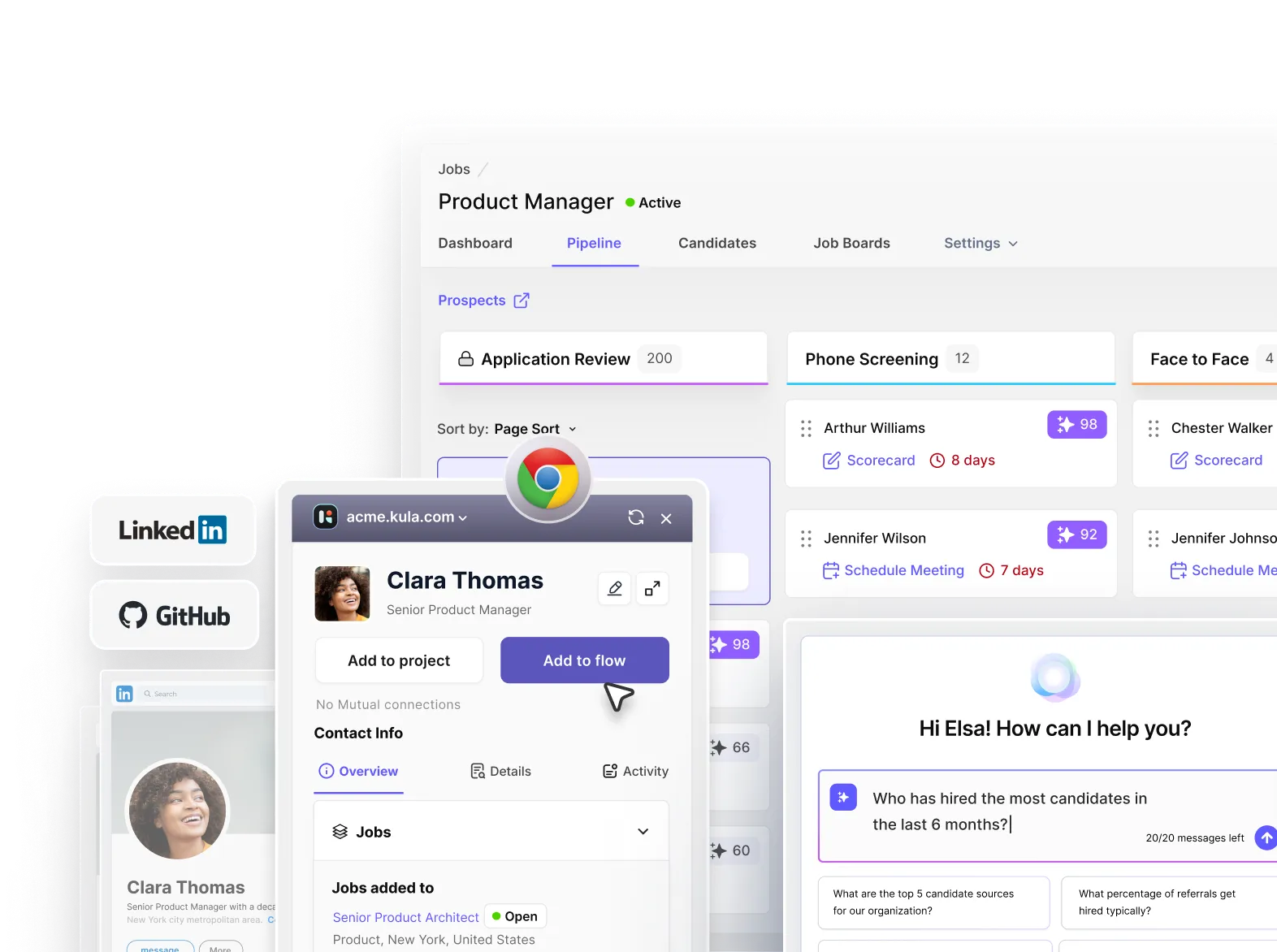
Kula's customizable interviews let teams build structured scorecards around the competencies that matter for each role. Its AI Notetaker can transcribe interviews, summarize key points, and auto-fill scorecards, helping interviewers submit faster, more evidence-based feedback.
2. Ashby
Ashby lets teams create structured interview plans and custom feedback forms for each role. Feedback blinding keeps evaluations independent, while AI-generated feedback summaries highlight strengths and concerns for more objective feedback.
3. Greenhouse
Greenhouse helps teams build structured interview plans, candidate scorecards, and predefined role criteria to keep evaluations consistent. Its AI can generate scorecard attributes, summarize interview feedback, and surface disagreements while anonymizing assessments.
4. Lever
Lever combines interview transcripts and AI summaries with scorecard support. Its Interview Intelligence can surface key signals and generate scorecards from interview conversations, while explainable AI keeps the reasoning behind recommendations visible to recruiters.
AI notetakers and interview intelligence platform
5. BrightHire
BrightHire automatically captures interview notes and summarizes them around the competencies you’re evaluating. It can also auto-fill ATS scorecards, so interviewers spend less time writing feedback and more time evaluating candidates.
6. Metaview
Metaview also automatically captures and structures interview notes. It supports custom templates and generates concise candidate summaries for faster feedback and debriefs.
Technical assessment platforms.
7. HackerRank
HackerRank offers take-home technical assessments with a large library of role-specific challenges, plus secure environments and proctoring to protect assessment integrity. It uses proctoring and plagiarism detection to flag any suspicious activity.
8. CodeSignal
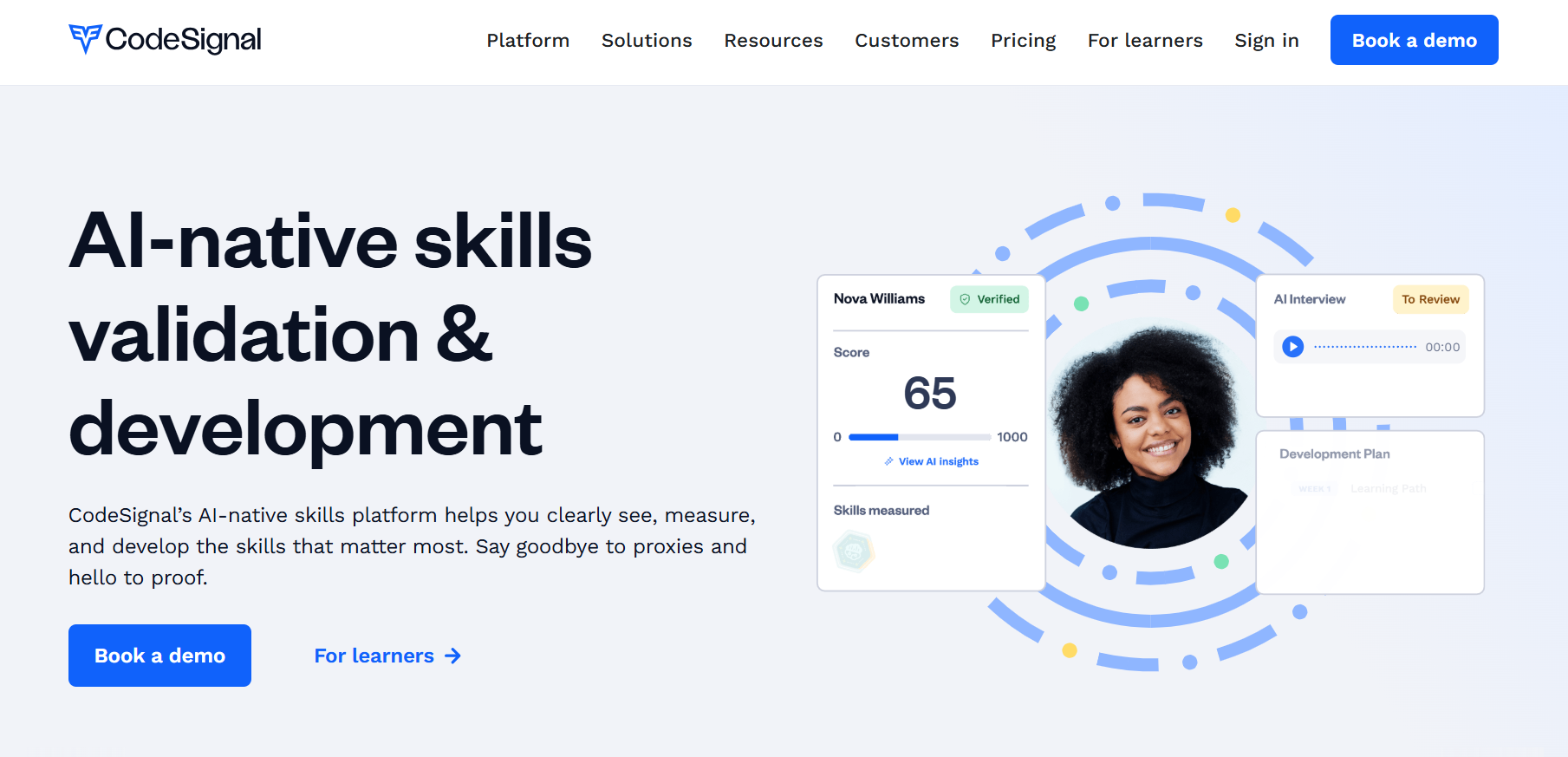
CodeSignal uses skills assessments and job simulations to evaluate technical ability through realistic, job-relevant tasks. The platform also offers Cheating & Fraud controls that detect suspicious candidate behavior.
9. Codility
Codility uses real-world technical assessments and live coding interviews to evaluate how engineers actually solve problems. It provides objective scores, detailed performance breakdowns, structured evaluation frameworks, and integrity checks to make technical assessments more consistent and defensible.
10. TestGorilla
TestGorilla lets teams build role-specific assessments using technical and other skills tests, custom questions, and AI interviews. Its Trust Layer monitors candidate behavior and provides identity and trust signals to flag suspicious activity.
11. iMocha
iMocha offers 10,000+ skills assessments and 5,000+ coding problems across technical, functional, cognitive, and soft skills, with AI-driven scoring for faster, objective evaluation. Its Smart Proctoring Suite uses AI to monitor webcam, screen activity, tab switching, impersonation, and copy-paste actions, flagging suspicious behavior with timestamped violation logs round than candidate A."
AI candidate ranking and screening
12. Gem's AI Application Review Agent

Gem’s AI Application Review scores and ranks candidates against your hiring criteria, surfaces the strongest fits first, and explains why each candidate matches. Recruiters can then filter, review AI summaries, and make the final hiring decision themselves.
13. HireVue Structured Interview
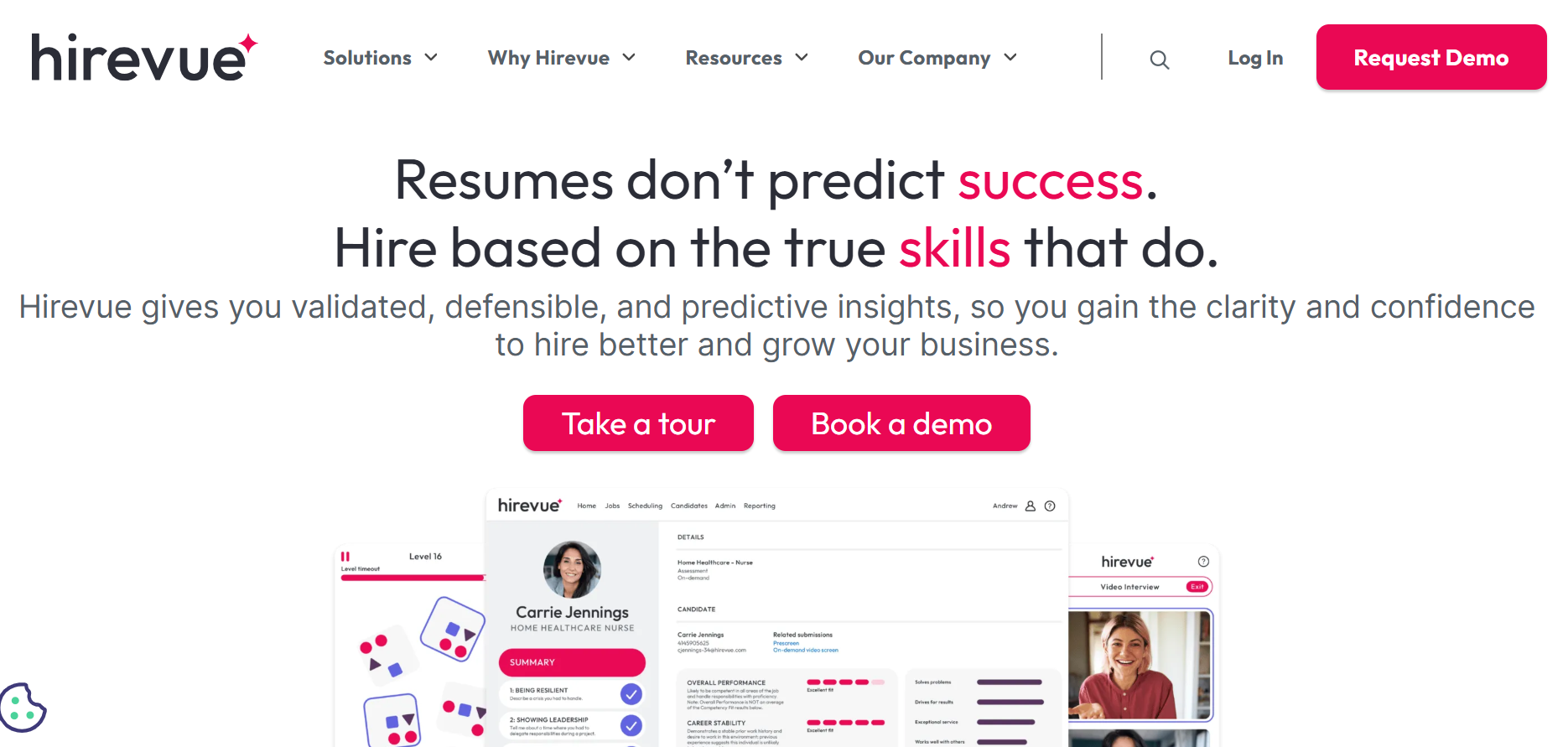
HireVue helps recruiters evaluate candidates based on job-relevant skills, not just resumes. HireVue also supports structured async video interviews with AI scoring. Its Virtual Job Tryouts and AI-powered assessments test the skills needed for specific roles, giving recruiters more evidence-based insights.
How to choose?
For teams already on a modern ATS, use native evaluation capabilities before adding specialized tools. For teams on legacy ATSs, specialized tools are the right answer if you cannot switch.
The three questions that determine whether your evaluation actually works
Question 1: Can two interviewers who evaluated the same candidate independently produce similar scores using your rubric? If they routinely produce very different scores, the rubric is not specific enough. Use anchored scales with behavior descriptions to fix this.
Question 2: Do your hiring managers write evidence-based feedback that describes candidate behavior rather than interviewer reaction? If most feedback contains "vibe," "personality," or "fit" without specific behavioral evidence, the process is not producing defensible decisions. Fix this with feedback templates and manager training.
Question 3: Can you predict on-the-job performance from your evaluation scores? If your best-scored candidates do not become your best performers, your evaluation criteria are not predictive of success. Track quality-of-hire against evaluation scores. Iterate the rubric based on real outcomes.
If any of these three answers is no, the evaluation function has structural gaps worth addressing before adding tools or changing platforms.
If these gaps are coming from inconsistent feedback, incomplete scorecards, or too much manual evaluation work, Kula helps teams address them with scorecard automation, AI Notetaker, and explainable AI scoring, reducing administrative work while keeping hiring decisions grounded in evidence.
Want to see how it works? Book a demo.