

Interview feedback is one of the most important documents in the hiring process and also one of the most poorly executed.
Most feedback arrives late or is written in three lines. It references "vibe" or "personality," instead of evidence, which leads to hiring decisions that no one can defend six months later when the hire underperforms.
Hiring managers are often blamed for poor feedback. In reality, the problem isn't a lack of effort. It's a process that asks interviewers to recall hour-long conversations from memory while juggling competing priorities, using tools designed for compliance rather than evaluation.
Poor interview feedback doesn't just affect hiring teams. The candidate pays the price too, often experiencing weeks of silence followed by an impersonal rejection they cannot learn from.
This article covers what good interview feedback looks like, how to write it in a way hiring managers will actually use, how to get feedback submitted on time, and how modern AI tools are changing what feedback quality means in 2026.
Why interview feedback quality is broken across most companies
Failure 1: Interviewers are cognitively overloaded during interviews.
The mental load of running a live interview, asking questions, listening carefully, evaluating in real time, and taking notes simultaneously is more than what most interviewers can handle.
This overload of tasks leads to missed details about candidates that eventually lead to extra time spent refining notes.
The output is compromised, which leads to broken or incomplete feedback.
Failure 2: ATS note fields are technically constrained
For technically advanced teams that already use AI for interview management, some users still face issues as many ATSs provide basic note boxes instead of robust scorecards, competency-based rubrics, and evidence-based feedback forms.
Some users report that note fields are too small, don't support basic formatting such as bullet points, and offer little customization. Others prefer seeing interview notes, scorecards, and feedback on a single page but instead have to switch between multiple tabs.
Such capabilities constrain the feedback before the interviewer even starts writing.
Failure 3: Scoring scales lack nuance
Most ATSs default to 5-level general rating scales, which sound structured but often are not enough. Rating scales only work when behavioral anchors are attached to each score, and interviewers must be trained to apply them consistently.
One recruiter describes the limitation directly: "We might have 30 candidates doing a take-home exercise, and we are trying to narrow down to 6 candidates. Having only strong yes, yes, no, strong no is not sufficient and doesn't allow you to compare candidates to each other."
Without sufficient context, interview debriefs often become confusing and lead to conflicting opinions among stakeholders.
Failure 4: Feedback arrives late or not at all
The "chasing" problem is universal. Recruiters spend hours nudging interviewers to submit scorecards.
As feedback gets delayed, interviewers rely more on memory than on what actually happened during the conversation.
Hiring decisions are pushed back because debriefs cannot proceed until everyone submits their feedback. Over time, this creates bottlenecks and increases the risk of losing top talent.
Instead of focusing on sourcing and engaging candidates, recruiters end up acting as project managers, repeatedly following up to collect overdue interview evaluations.
At Plum, feedback delays of 1 to 2 days between interview rounds were standard before implementing automation.
Failure 5: Feedback content is subjective and often bias-driven
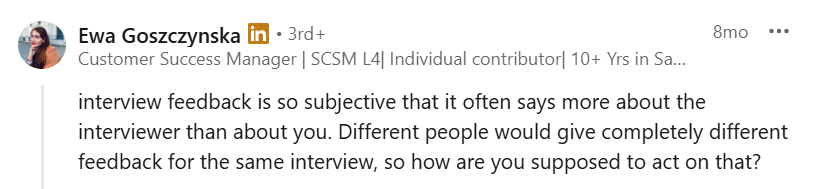
Vibe. Personality. Fit. Culture. The most common feedback dimensions are also the most unmeasurable.
Without predefined competencies and behavioral anchors, interviewers often rely on vague impressions instead of evidence from the interview. As a result, candidates receive feedback that is difficult to interpret, challenge, or improve on.
When feedback is subjective, hiring decisions become difficult to justify, interviewers cannot calibrate their evaluations, and recruiters have little evidence to defend or explain a rejection.
What good interview feedback actually looks like
1. It maps to defined evaluation criteria
Good interview evaluation criteria assess candidates on four to six specific competencies for the role and provide scores with behaviour anchors attached.
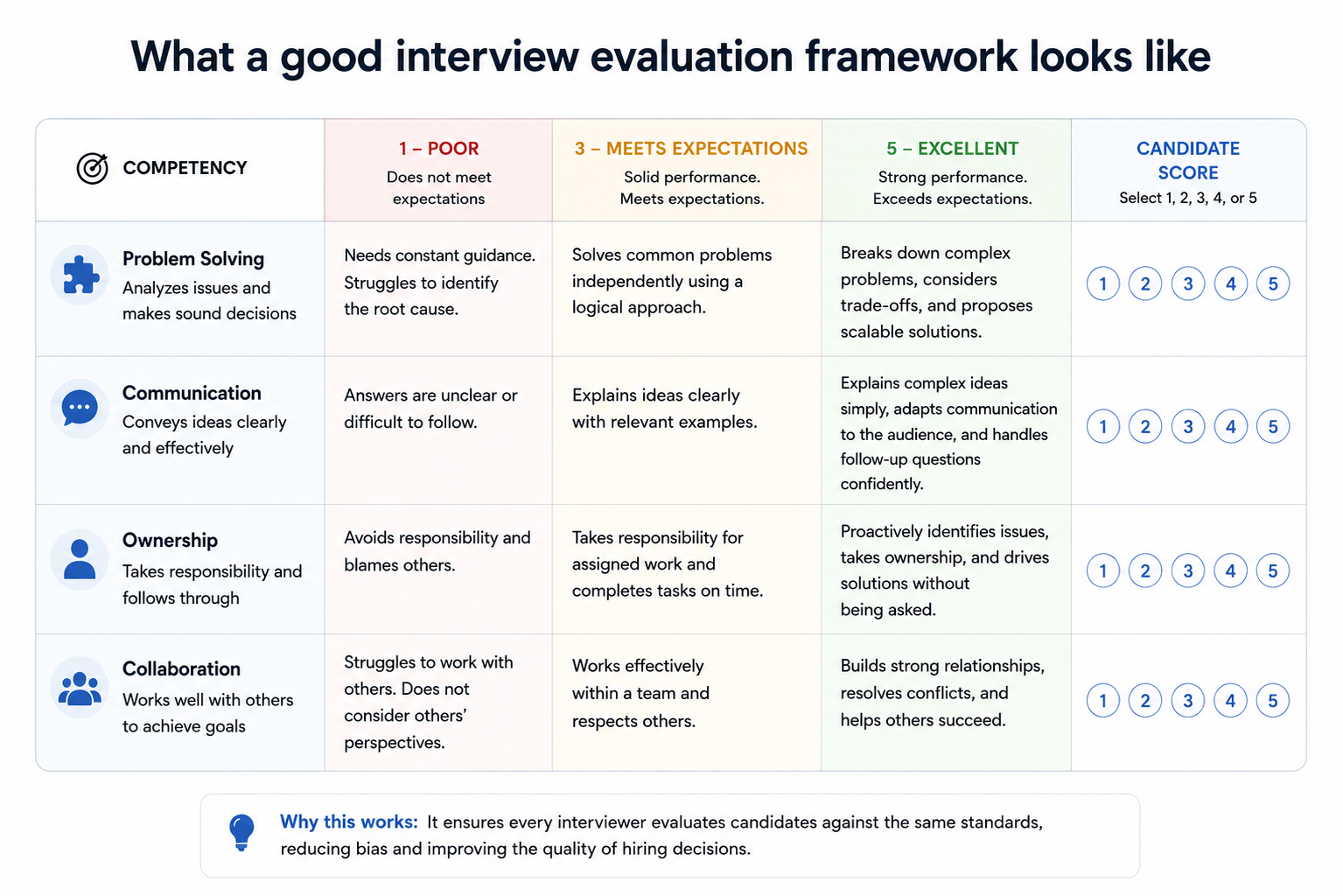
Behavioral anchors define what poor, average, and excellent performance looks like for each competency, so interviewers can score more objectively.
Scoring based on behavioral anchors also helps interviewers to write more detailed feedback. Because each score is tied to specific behaviors, interviewers have a clear framework for explaining why they assigned a particular rating.
For example, instead of "great candidate overall," feedback becomes "strong on system design (rating: 4/5), demonstrated ability to trade off consistency and availability with clear examples from previous work."
2. It uses concrete examples, not impressions
Good feedback is specific, accurate, and describes what the candidate actually said or did.
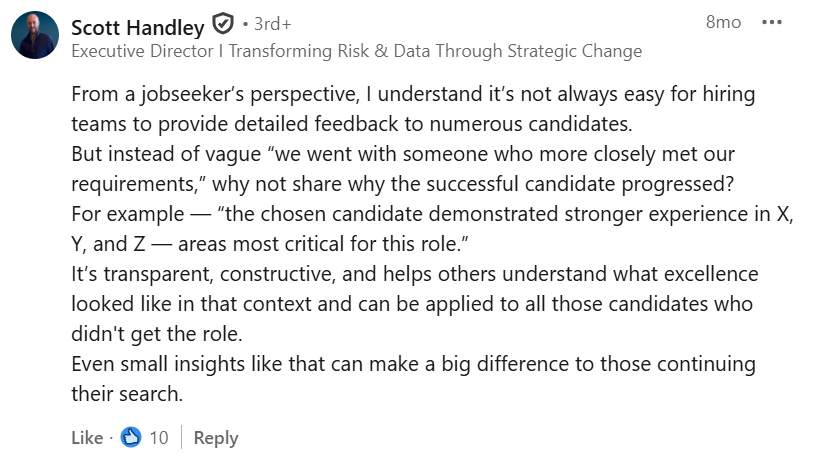
A good practice is to support interview feedback with concrete examples, as they make feedback verifiable. They show why a candidate received a particular rating, helping hiring managers trust the evaluation and compare candidates more objectively.
For example, "great communication" is vague feedback, but "explained the microservices decision at Company X clearly, using non-technical language when I asked about the business impact" is what leaves an impact on the candidate.
Use AI note-taking or automated transcript features in your ATS, which makes it easier for interviewers to write evidence-based feedback.
3. It uses the S.T.A.R. format for behavioral evaluations
S.T.A.R (Situation, Task, Action, Result) is not just a candidate framework. It is a feedback framework too.
It helps capture the context behind a candidate's behavior instead of reducing it to a label.
For instance, instead of mentioning "they showed leadership," write:
"When facing a mid-project team member departure (situation), they had to re-scope the sprint (task), redistributed work based on strengths (action), and shipped on time with one week of buffer (result)."
This gives hiring managers the evidence behind the rating, making it easier to compare candidates and justify hiring decisions.
4. It includes a clear recommendation with reasoning
Good interview feedback doesn't stop at observations. It connects those observations to a hiring recommendation and explains why the candidate should or shouldn't move forward.
Instead of writing simply "Hire" or "No Hire," write:
"Strong hire because they showed exceptional technical judgment on the system design question and clear ownership on the debugging exercise. My concern is limited to whether they will manage stakeholder communication at scale, which we should probe in the next round."
Avoid recommendations based on subjective impressions:
- "Their vibe was off"
- "I didn't see enough personality"
- "Just not a culture fit"
- "Something felt off"
- "They seemed nervous"
- "Not what we're looking for"
These statements do not describe candidate behavior. They describe interviewer reaction. They provide no evidence, no learning, and no defense against bias claims.
Instead, tie your recommendation to observable behavior:
- "They weren't able to prove that they had led a project of this scope"
- "Their work on X really stood out because they explained tradeoffs clearly"
- "I'm not confident they can manage a distributed team based on how they described their previous team structure"
- "They demonstrated the technical skills required, but I have concerns about their ability to communicate with non-technical stakeholders based on the two examples they shared"
The pattern is simple: describe what happened, explain what it means for the role, and end with a clear recommendation.
How to get feedback submitted on time
1. The two-day rule
Feedback should be submitted within 24 hours of the interview. Any longer and interviewer recall drops significantly, and the debrief cannot happen without further delay. Fresh feedback leads to better hiring decisions.
2. The escalation system
When feedback is not submitted, the ATS should escalate automatically. Waiting for recruiters to manually chase interviewers slows hiring and creates inconsistent follow-ups.
For example, Kula uses a three-tier system that maps to how this should work: send an automated debrief request within 24 hours of the interview, auto-nudge stakeholders if no response after one day, and escalate to the recruiting team if feedback is still not received after 48 hours.
This creates accountability without relying on recruiters to repeatedly follow up, ensuring interview feedback is collected on time, and hiring decisions keep moving.
3. The debrief scheduling rule
Debriefs should be scheduled at least a few hours after the last interview wraps up, with mandatory feedback submission at least one hour before the debrief.
This gives every interviewer time to review the panel's feedback before the discussion begins. Instead of spending the meeting sharing observations for the first time, the team can focus on resolving disagreements, calibrating evaluations, and making a hiring decision.
Also, debriefs that start without pre-read feedback tend to be dominated by the loudest voices. So, this practice becomes important for preserving independent candidate evaluations.
4. The visibility norm
Recruiters need visibility into which scorecards are outstanding and which interviewers are chronically late.
When interviewers know their submission habits are tracked, they're far more likely to complete scorecards on time.
Some teams have gamified this.
For example, at AMO Tech, stakeholders turned scorecard submissions into a friendly office competition. The stakeholders involved in hiring have a fun competition going around for who is fastest at submitting their scorecards or who has spent the most time on interviewing. This information gets shared internally through a Top Interviewers Report.
A leaderboard sounds silly, but it changes behavior.
5. The cancellation rule
If feedback is trending negative and the decision is clearly no-hire, cancel the debrief.
It's okay to cancel the debrief and save everyone 30 minutes since it's clear this person won't move to the offer stage.
Debriefs should exist to resolve real disagreement, not to formalize consensus.
6. The technical enablement
Feedback reminder and submission workflows shouldn't depend on recruiters remembering every follow-up or maintaining manual trackers.
The ATS should automate reminders, escalations, debrief scheduling, scorecard visibility, and reporting so the hiring process runs consistently.
Most modern ATSs support all of this. Legacy ATSs generally do not.
If your current system requires recruiters to chase interviewers, schedule debriefs manually, or track outstanding scorecards, that is a sign that the tooling has not kept up.
The feedback blinding principle: Why it matters more than most teams realize
1. The feedback blinding
When interviewers see each other's scores before submitting their own scores, conformity bias takes over. Junior interviewers try to align with senior interviewers. Later interviewers want to align with earlier ones. The panel converges before the debrief starts.
Make sure no interviewer sees another interviewer's evaluation until their own is submitted.
Many ATSs, such as Kula, Workable, Ashby, Greenhouse, and Lever, offer native capabilities that automatically hide feedback and scorecards from other interviewers.
2. The written-first rule
Beyond blinding the scores, blind the discussions as well.
Every interviewer should have detailed notes in writing on how their interview went, along with a yes or no hire rating. It's extremely important that this information is submitted before the debrief and that interviewers do not discuss the candidate beforehand.
Talking to one another before submitting written feedback will lead to interviewers biasing each other on the panel.
3. The debrief order rule
Once feedback is submitted, the debrief order also matters.
For example, if someone hasn't submitted written feedback, have them go first. They're the most susceptible to bias.
Then go in order of seniority: junior first, leadership last. Save leadership for last, as they're the most likely to bias the group if they go first.
The AI notetaker era: How modern tools change interview feedback
What AI notetakers actually do:
Record the interview conversation, transcribe it automatically, generate a structured summary, and pre-populate scorecard fields. This shifts the interviewer's job from "take notes and evaluate" to "evaluate." That is a meaningful cognitive reduction.
The Plum case study:
Geetanjali at Plum described this shift directly: "Feedback turnaround time is down to hours thanks to Kula’s AI Notetaker and streamlined workflows. Our managers love that they can focus on the conversation without worrying about taking notes. It cuts down the cognitive effort and eliminates the need for debriefs in some cases because everyone's already aligned from the notes and transcripts."
The DeepScribe case:
Samantha Stambaugh at DeepScribe also used Kula's AI Notetaker to "gain insights into how hiring managers and interviewers conduct interviews" and debrief interviews asynchronously to "make hiring more objective." For them, the AI transcript becomes a coaching tool, not just a note.
The candidate-side backlash:
As AI notetakers have entered interviews, some candidates have also begun using AI assistants during interviews. As a result, interviewers are paying closer attention to signs that may indicate external assistance, such as responses that feel unusually polished or scripted, or slight delays followed by breaks in eye contact that suggest the candidate may be looking at another screen.
Because these signals aren't conclusive on their own, many hiring teams are changing the interview format instead of relying on suspicion.
Some engineering leaders now ask candidates to remove headphones during virtual interviews or shift toward deeper follow-up questions and technical discussions that require candidates to reason in real time rather than recite prepared answers.
What good AI notetaker adoption looks like
- Notify candidates that the interview is being recorded.
- Use the transcript for hiring manager coaching, not just candidate evaluation.
- Do not let the AI summary replace the interviewer's judgment. The AI reduces the administrative load. It does not replace the human decision.
The business impact of feedback quality in 2026
1. The candidate drop-off wall
Strong candidates are often interviewing with multiple companies, and long gaps without updates create uncertainty and increase the likelihood that they'll accept another offer or withdraw from your process altogether.
77% of candidates lose interest if they do not receive feedback within two weeks of an interview.
Delayed feedback is not a candidate experience problem. It is a pipeline problem.
2. The employer brand cost
Candidates share bad experiences publicly. 25% of unhappy candidates post about their experience on Glassdoor, LinkedIn, or similar platforms.
The Virgin Media case study documents the extreme end: £4.4 million in lost annual revenue because 18% of rejected candidates were Virgin customers, and 6% of them actually switched providers because of negative hiring experiences.
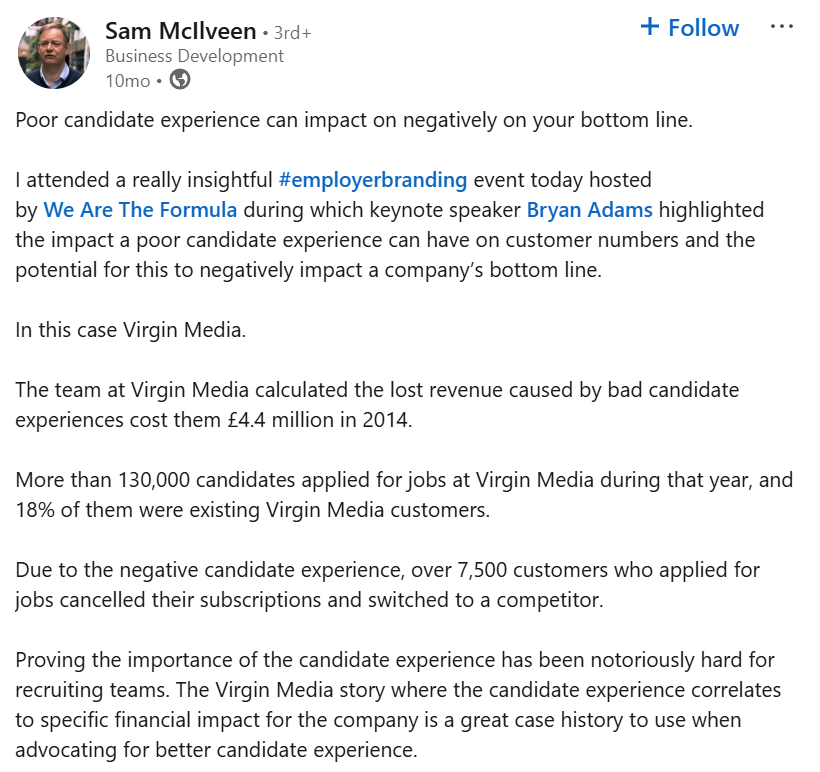
3. The acceptance rate lift.
Timely feedback is a conversion tool. Candidates who receive timely feedback after interviews are more likely to accept job offers.
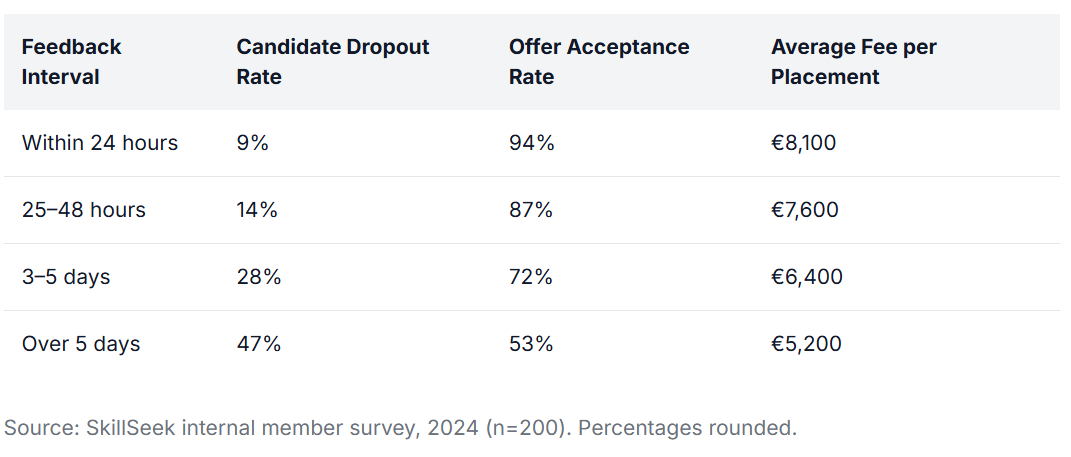
Quick communication signals that your company is organized, respectful of candidates' time, and genuinely interested in hiring them. It affects close rates directly.
The three questions that determine whether your feedback process actually works
Question 1: How long does feedback typically take to arrive after an interview? If the answer is more than 24 hours, you have an operational problem. The fix is escalation automation, not more chasing.
Question 2: Can you tell what happened in an interview by reading the feedback alone? If not, the feedback lacks specificity. Fix this with S.T.A.R.-format guidance and rubric integration.
Question 3: Do interviewers submit written feedback before the debrief and before seeing peer evaluations? If not, conformity bias is contaminating every panel decision. Feedback blinding is the fix.
If any of these three answers is no, the process has structural gaps worth fixing before adding tools or rewriting templates.
If you answered "yes" to all three and are looking for a platform that supports these best practices, Kula brings them together in a single hiring platform.
It combines AI interview transcription, automatic scorecard population, feedback blinding, and multi-tier escalation workflows to help teams collect timely, independent, and evidence-based interview feedback.
Book a demo to see how Kula helps hiring teams capture timely, unbiased, and actionable interview feedback at scale.