


Interview quality is one of the most consequential and least controlled parts of most hiring processes.
Every recruiter has seen a strong candidate rejected because their "vibe was off." Every TA leader has watched interviewers apply different standards to the same candidate. And every experienced recruiter has questioned a hiring manager who mistook an adversarial interview for a rigorous one.
Structured interviews are the fix. The evidence has been consistent for decades: structured interviews lead to more reliable and objective hiring decisions.
The reason most companies do not have structured interviews is not that they do not know what they are. It is because implementing them requires navigating hiring manager resistance, political friction, and the belief that hiring is a subjective art.
This article covers what structured interviews actually are, why they produce better hires, and most importantly, how to introduce structure into a process where hiring managers do not want it.
What structured interviews actually are
The four components of a structured interview:
1. Standardized questions in the set order
Every candidate for the same role is asked the same core questions in the same order by the same interviewers and graded against a pre-determined scoring system. Follow-up questions can vary based on responses, but the base set is fixed.
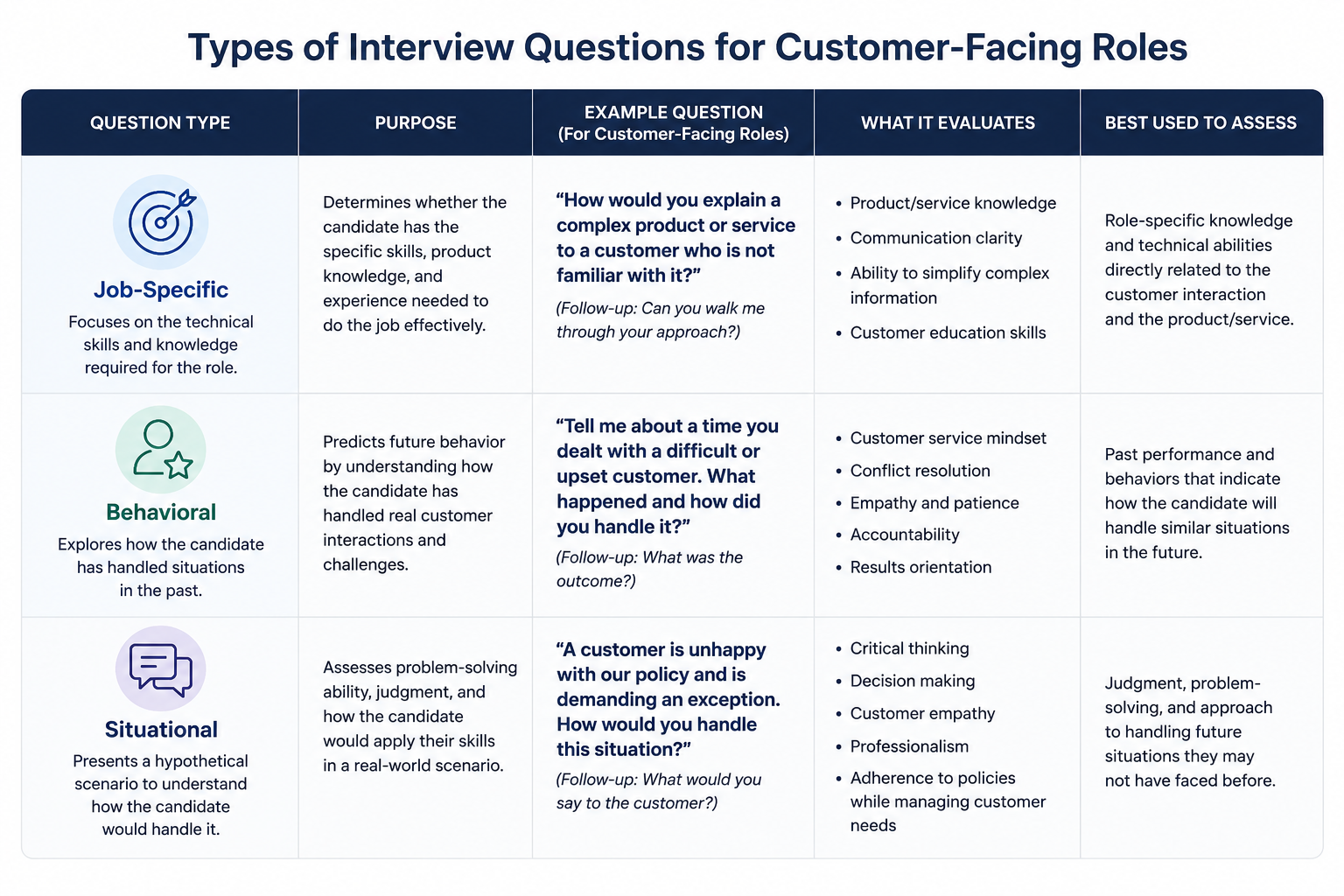
The interview typically combines job-specific, behavioral, and situational questions.
The goal is to assess candidates uniformly against relevant competencies and skills to make more objective hiring decisions.
A former Uber recruiter shares how, during the hiring process, one senior leadership candidate looked like the perfect hire on paper and made a great first impression.
But structured interviews told a different story. Because every interviewer assessed the same competencies using a scorecard, the team spotted consistent red flags, including contradictory answers, blame shifting, and vague explanations of past achievements.
Without a structured evaluation process, those patterns could have been dismissed, and a bad hire would have been made.
2. Predefined rubrics
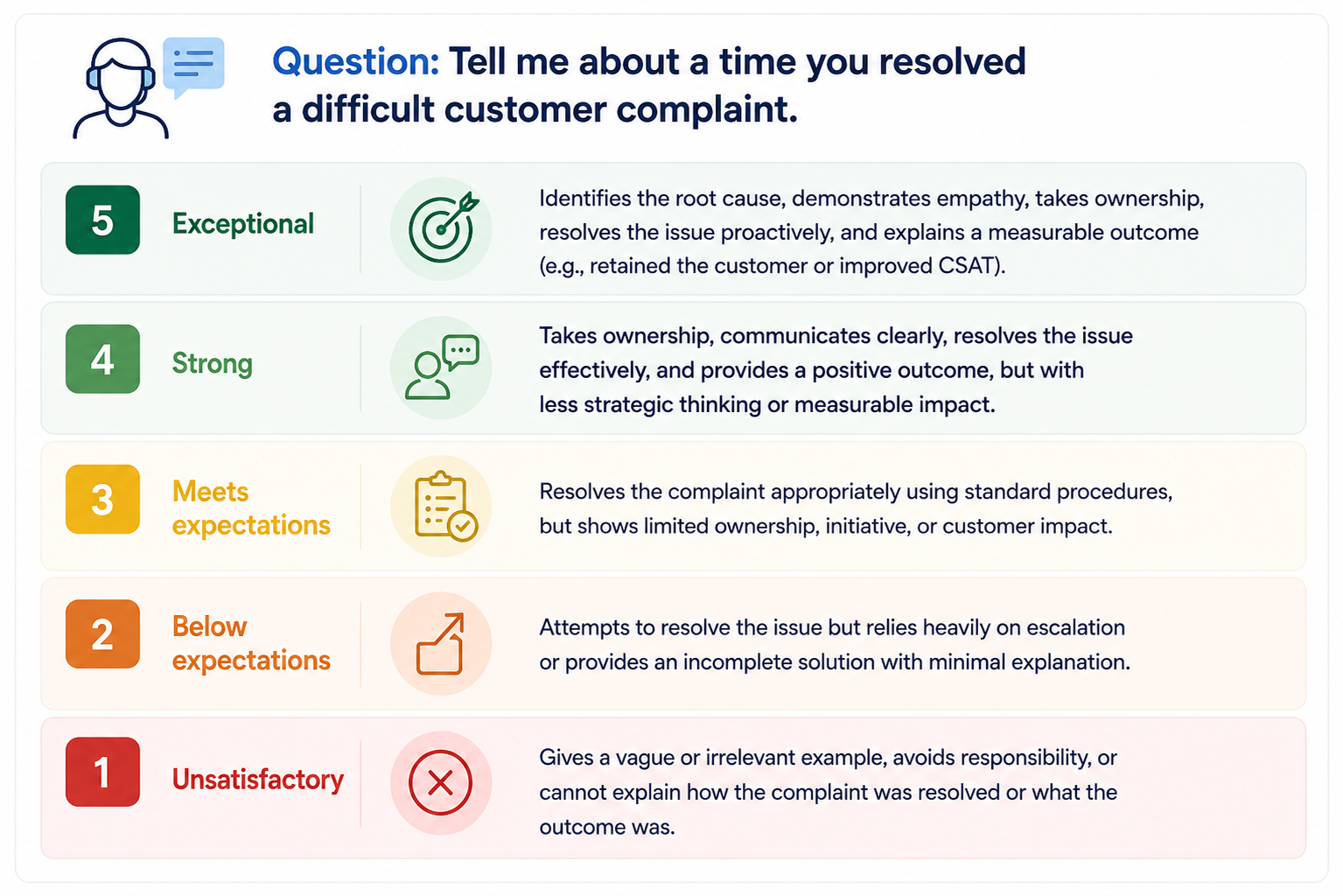
There are four to six core competencies on which each candidate is judged, and the team uses anchored scales from 1 to 5 with specific behavior descriptions attached to each level for each question to eliminate "gut-feeling" biases.
So the power of scoring comes from the behavioral anchors you tie to each score; otherwise, a 3 would be subjective and mean completely different things for each interviewer.
For example, for a customer-facing role:
Also, the hiring team should define must-have vs. nice-to-have skills for each role before interviews begin to assign the right scoring weights to competencies.
For example, a Customer Success Manager interview might give 3× weight to communication and customer empathy, while a Software Engineer interview might prioritize technical expertise and problem-solving.
3. Independent scoring
Each interviewer must document evidence-based feedback for every interview question and assign ratings using the predefined rubric. All this should happen independently before discussing with the panel.
Panel members must not discuss the candidate or compare notes until everyone has submitted their scores.
This is to prevent stronger personalities or senior interviewers from influencing others' evaluations and ensures each assessment is based on the interviewer's independent judgment.
4. Written feedback before debrief
After completing their interviews, each interviewer should independently submit their scores, written feedback, and an overall recommendation (e.g., hire, lean hire, lean no hire, or no hire).
Only after everyone has submitted their evaluation should the interview panel discuss the candidate.
This preserves each interviewer's independent assessment, prevents groupthink from influencing scores, and creates a documented record of the rationale behind every hiring decision.
Former Amazon leader Susan Rouser explains that most interview debriefs eventually turn into a debate of opinions. Amazon tackled this differently.
Every interviewer evaluated one predefined leadership principle using behavioral evidence, while an independent Bar Raiser ensured the hiring bar stayed consistent.
Instead of everyone giving a gut-feel verdict, interviewers were expected to justify their recommendation with evidence, making hiring decisions far more consistent.
What structured interviews are not.
❌They are not scripted or robotic. Interviewers can still probe, follow up, and adapt to the candidate. The structure is in the evaluation, not in the conversation. The rule of thumb is to wait and assign a score to each answer before improvising or following up.
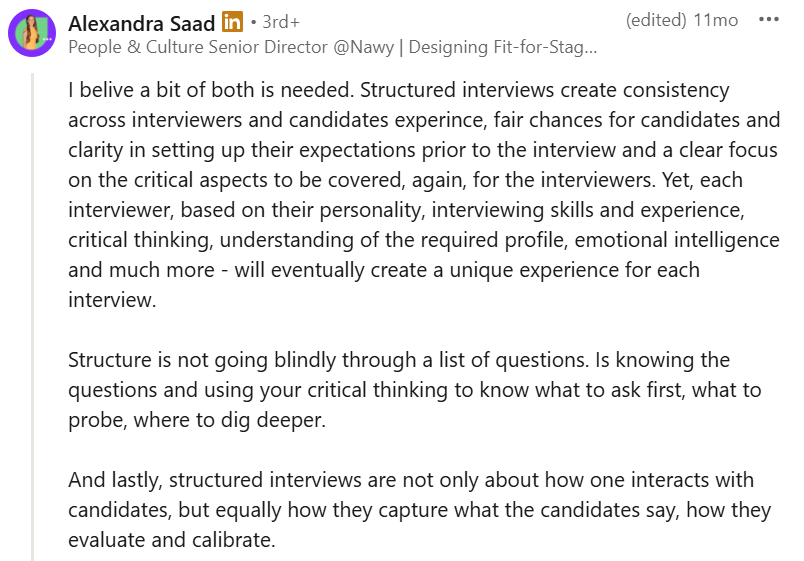
❌They are not the same as behavioral interviews. Behavioral interviews focus on past experience. Structured interviews focus on consistent evaluation with the same set of questions asked in the same order. Structured interviews include not just behavioral but situational, technical, or job knowledge questions. The two are complementary, not identical.
❌Structured interviews are not enterprise-only. The mechanics work at any scale. The barrier is political will, not tooling complexity.
Why the definition matters: Most companies claim they run structured interviews when they actually run interviews with a shared question list and free-form evaluation. That is an unstructured evaluation with a structured question intro. It captures none of the benefit.
What unstructured interviews actually cost you
The prediction problem
Unstructured interviews have among the lowest predictive validity of any selection method used at scale.
In an unstructured interview, the conversation flows naturally, which leads to different candidates answering different questions. This negatively impacts validity because candidates are no longer evaluated against the same criteria.
Schmidt & Hunter's meta-analyses give unstructured interviews a predictive validity of around 0.38 and structured interviews a score of around 0.51 for job performance. There is a 30% difference.
In other words, structured interviews are about 30% better at predicting future job performance, helping companies make more accurate hiring decisions and avoid costly mis-hires.
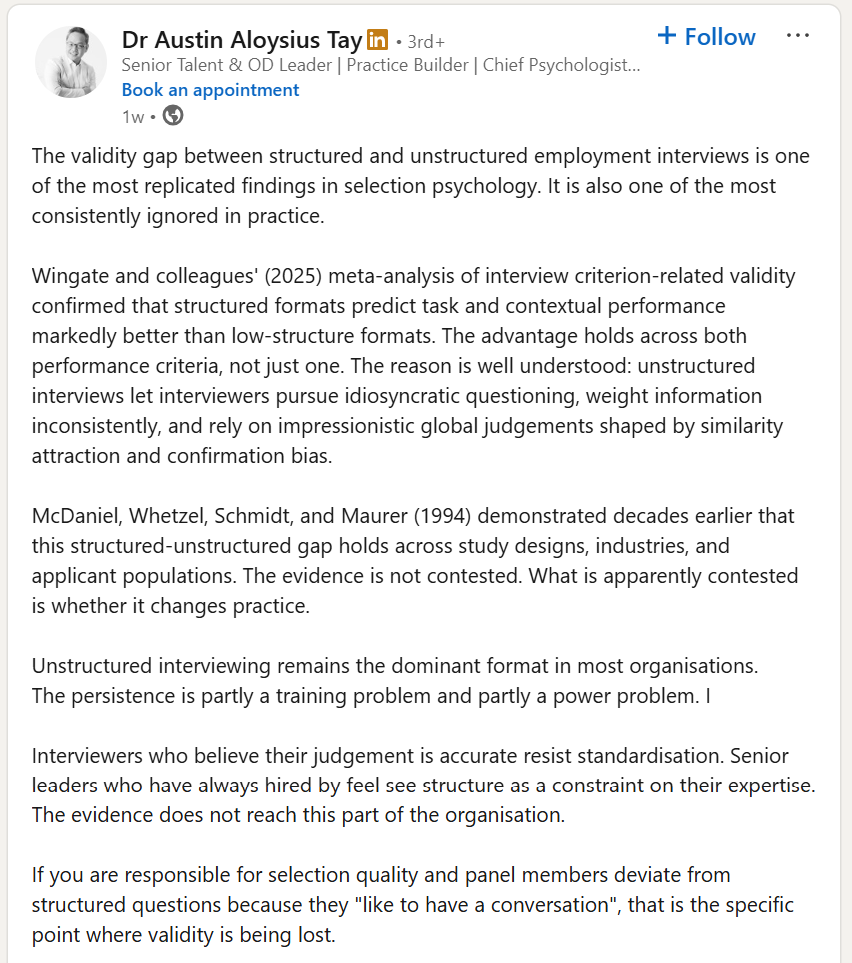
And still, around 44% of organisations still use unstructured interviews.
2. The calibration problem
When teams do not enforce structure, evaluation quality varies wildly across interviewers.
Without standardized questions, scoring rubrics, and interviewer training, each interviewer develops their own definition of what "good" looks like. One interviewer may reward confidence, another may prioritize technical depth, while a third values communication.
Although this issue is especially visible in technical hiring, it exists across every function. Different interviewers applying different standards often reach completely different conclusions about the same candidate.
3. The bias problem
Unstructured evaluation is a bias multiplier. There are no predefined scoring criteria or behavioral anchors, so interviewers rely on their own interpretation of what a "good" answer looks like.
The result is inconsistent evaluations, where the same response can receive completely different scores.
Candidates may be rejected because they "didn't seem confident enough," "weren't a culture fit," or "didn't show enough personality," feedback that reflects subjective impressions rather than job-related competencies.
4. The data pollution problem
Poor interview processes don't just affect individual hiring decisions, they undermine recruiting analytics.
Without standardized interview questions, scoring criteria, and documented evaluations, hiring teams cannot reliably compare candidates or identify where their process succeeds or fails.
As researchers note:
"If a recruiting team does not carefully plan how to structure job interviews enterprise-wide, it can be much harder to sift good data from bad."
Metrics such as pass-through rates, interviewer performance, time-in-stage, and quality of hire become unreliable because the underlying evaluations are inconsistent.
5. The business cost
The consequences of unstructured interviews and unfair scoring extend far beyond recruiting:
- 58% of job seekers have actively declined a job offer due to poor candidate experience.
- 72% of candidates consider the interview experience when deciding whether to accept a job offer.
- 56% cite scheduling delays and interview inconsistency as their biggest frustration.
- Companies with structured, positive candidate experiences see 70% improvement in hire quality.
Each empty desk costs $4,700 and 44 days of lost productivity per SHRM. Every candidate lost to a bad process is a real cost, not a soft one.
The math is not close. Structured interviews produce better hires. Unstructured interviews produce worse hires and better excuses.
The four hiring manager patterns that break structure
Pattern 1: The "surprise element" defender
A tech startup hired seniors and tech leads through a coding test where candidates were required to recite lines of code for the hiring manager to type.
The real problem with this assessment was the lack of objective evaluation. There was no scorecard or predefined checklist. Decisions were based on subjective comments like "they needed too much prompting" or "I don't think they're a senior."
When recruiters challenged the format, the managers defended it as revealing character: "the surprise element will prove who's a good developer or not."
When candidates performed well, managers still found reasons to reject them. One candidate who aced the interviews was suspected of using AI simply because he looked away while thinking.
This pattern shows up whenever hiring managers confuse rigor with adversarial design. The fix requires structural intervention, not persuasion.
How structured interviews fix it: Questions may still be challenging, but every candidate is assessed against predefined competencies and scoring criteria instead of the interviewer's intuition.
Pattern 2: The over-engineered process
A client implemented "a three-step interview process with an exam, a technical assessment, and then a week-long working interview."
The process became so demanding that candidates didn’t even bother to participate in the interview. Eventually, the recruiting agency stopped doing business with this client because its reputation had become toxic.
The problem was the assumption that a longer process automatically produces better hiring outcomes.
Long processes are no more rigorous than structured ones. They are simply longer. The pattern is confusing effort with insight.
How structured interviews fix it: Rather than adding more interviews, improve the quality by evaluating candidates against relevant competencies using a structured scoring rubric.
Pattern 3: The vibe rejector
Vibe-based rejection is the most common pattern. Candidates get rejected with feedback like "their vibe was off" or "we didn't see enough personality."
For instance, one candidate summarized the frustration:
"When I was interviewing recently, I was given feedback that the hiring manager didn't see enough of my personality. I'm not sure what that even means."
Another described the current state: "Honestly, hiring has become so inconsistent. Half the time, rejection feedback doesn't even reflect what actually happened in the interview."
Vibe-based rejection is an unstructured evaluation dressed up as intuition. It correlates strongly with unconscious bias.
How structured interviews fix it: Every hiring decision must be supported by evidence linked to predefined competencies rather than subjective impressions.
Pattern 4: The AI cheating suspicion
As AI-assisted interviewing becomes more common, another pattern has emerged.
Instead of evaluating answers, some interviewers spend the interview trying to determine whether the candidate is secretly using AI.
They look for:
- eye movements,
- unnatural pauses,
- overly polished STAR responses,
- Or candidates looking away while thinking.
AI-assisted cheating is a legitimate concern.
But when detecting AI becomes the primary objective, interviewers stop evaluating the skills the role actually requires.
How structured interviews fix it: Standardized questions, evidence-based scoring, and competency-focused evaluation reduce the need to rely on suspicion when making hiring decisions.
How to design a structured interview process
Step 1: Define the role-specific competencies
Before writing any questions, define the four to six competencies that matter for the role. For an engineering role: technical depth, system design, collaboration, communication, and ownership. For a sales role: prospecting rigor, discovery skill, negotiation, and resilience.
Make the list short enough that every interviewer can meaningfully assess and agree on it.
Step 2: Write questions that map to competencies
Each interview round should assess two to three competencies. Each competency should be evaluated in at least two rounds, so no single interviewer's assessment dominates.
Questions should be job-specific, behavioral, and situational. They should be specific and answerable. For example, it should not be "tell me about a time you led" but "walk me through the last time you had to make a technical trade-off that a stakeholder disagreed with, and what happened."
Step 3: Build the rubric before the first interview
Before interviewing candidates, define how every answer will be evaluated. Each interview question should have a behaviorally anchored rating scale (1–5) that clearly describes what performance looks like at each score, not just a number.
For example, instead of simply giving a candidate 3 out of 5, define what a 3 means, such as: "The candidate demonstrated a solid understanding of the concept but struggled to apply it to a new or unfamiliar scenario." Likewise, specify what qualifies as a 1 (poor), 2 (below expectations), 4 (above expectations), and 5 (excellent).
This ensures interviewers score candidates based on predefined, job-related criteria rather than intuition or first impressions.
Step 4: Train interviewers on the rubric, not the questions
Most interview training focuses on questions to ask. Questions are already fixed, and so is the order.
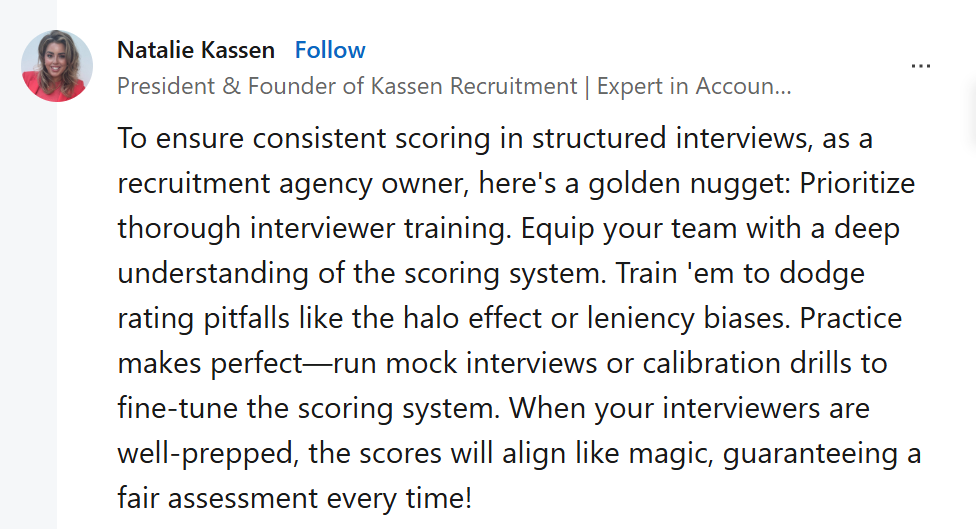
Structured interview training must explicitly focus on how to score. Include calibration exercises, have interviewers score sample answers, and discuss disagreements. This is where consistency actually gets built.
Step 5: Enforce independent scoring
Interviewers must submit written scores and notes before any panel discussion. No exceptions. The rule of thumb: Don't allow interviewers to see their peers' evaluations before they've submitted their own to minimize conformity bias.
Modern ATSs support this natively; they hide reviewer evaluations from other reviewers until they submit their own.
Step 6: Run structured debriefs
Hold the debrief session within 48 hours while the interview is still fresh in everyone's mind.
Always try to benchmark the candidate against the hiring plan and interview rubric, and not against each other.
Comparing candidates side by side is okay when you're small, but be careful about making this the norm, as it may shift the focus from "Did this candidate meet our hiring bar?" to "Who do we like more?"
That's when unconscious bias is more likely to influence decisions.
Step 7: Iterate the rubric based on hires
Track which rubric scores correlate with successful hires and which do not. Refine the rubric based on real outcomes. This is where structured interviews compound, and the rubric gets more predictive over time as the team learns which signals matter.
The mechanics are not complicated. The challenge is enforcing them consistently against organizational drift.
The five tactics for introducing structure when hiring managers resist
Tactic 1: Show hiring managers their own baseline
When a hiring manager insists, "these candidates don't measure up," show them the data instead of challenging their judgment.
Ask two to three of their best current engineers to take the same test, anonymously. When they see the score spread among people who are already succeeding in the role, 'these candidates don't measure up” becomes much harder to defend.
This tactic works because it doesn’t challenge the manager's authority. Instead, it provides evidence that their hiring standard would reject people they already consider successful, creating evidence that's difficult to ignore.
Tactic 2: Reframe as false negative rate
Do not argue that the manager's test is bad. Instead, shift the conversation to the candidates the company may be losing.
Ask:
How many qualified candidates are we incorrectly rejecting?
As one recruiter put it:
"You're not arguing the test is wrong. You're asking: how many solid engineers are we incorrectly rejecting? One bad hire is expensive. Eliminating 10 qualified people silently is expensive differently."
This shifts the frame from "you are wrong" to "we are losing pipeline value." Hiring managers are often more receptive to improving pipeline quality than defending their interview design.
Tactic 3: Propose a rubric pilot, not a process change
Large process changes usually trigger resistance.
Instead of asking hiring managers to redesign the interview, ask them to use a structured scorecard for the next 10 interviews while keeping everything else the same.
The goal isn't to replace the interview overnight. It's to collect evidence.
Once interviewers begin scoring against predefined criteria, inconsistencies in their evaluations often become obvious. The data frequently convinces hiring managers to improve the process voluntarily.
Tactic 4: Replace the format instead of arguing about the criteria
Rather than debating whether dictation coding or whiteboard interviews are effective, propose alternative formats that assess the same competencies more consistently.
For example:
- Pair programming often produces a better signal than dictation coding.
- Realistic take-home projects can assess engineering ability more effectively than whiteboard puzzles.
- Standardized scenarios reduce both interviewer preparation time and variation in candidate experience.
One engineering team standardized on a single 4–6 hour take-home exercise, provided pre-configured loaner laptops, and assigned consistent interviewer roles (buddy for questions, code reviewers, and a wrap-up interviewer).
Their conclusion:
"Standardizing on one question decreases prep time, increases our calibration, and reduces variance in candidate experience.”
Tactic 5: Use unscripted probing to counter AI-scripted answers
AI-assisted interviewing is a real concern, but trying to detect AI through eye movements, pauses, or polished delivery often creates false positives.
Use unscripted follow-up questions such as:
- “What would you do differently if you could redo that situation again?”
- Walk me through specifically what happened between Tuesday and Thursday that week.”
Real memories are messy. AI-generated answers are polished. The tell is in the details, not the delivery.
The three questions that determine whether your process is actually structured
Question 1: Can two different interviewers score the same candidate response and reach the same conclusion? If not, your rubric is not specific enough. Anchored scales with behavior descriptions fix this.
Question 2: Do interviewers submit written scores before the debrief? If not, conformity bias is influencing every debrief. Independent scoring is the single most important structural discipline.
Question 3: Can you show that specific rubric dimensions predict successful hires? If not, you have structure but no compounding value. The point of structured interviews is not just fairness in the moment, but the ability to learn which signals matter over time.
If any of these three answers is no, the process has structural gaps worth fixing.
How your ATS supports structured interviews
What to look for in your ATS:
Scorecard templates by role: The ability to build role-specific scorecards with custom dimensions and anchored scales, not just the default 1-to-5 that ships with most tools.
Evaluation hiding: The feature that prevents interviewers from seeing peer scores until they submit their own. Workable and Ashby both support this natively. Legacy ATSs generally do not.
Required scorecard completion before advancement: The system should prevent moving a candidate forward without a completed scorecard from every required interviewer. This is the mechanism that enforces discipline over time.
Structured debrief workflows: Some platforms support debrief templates that summarize all interviewer feedback in a format that supports rubric-based decisions.
Historical scoring analytics: The ability to see which rubric dimensions correlate with successful hires. This is what turns structured interviews into a compounding advantage.
Most modern ATSs support structured interviews at the feature level. The real difference is how consistently those features are enforced.
For example, Kula supports role-specific scorecard templates, feedback blinding, and required scorecard completion before candidates advance, helping teams apply the same evaluation process across every interview.
Kula also offers interview intelligence features such as AI-generated interview summaries and transcripts, automated interview scheduling, and notifications that remind interviewers to submit feedback on time.
If you're looking for an ATS that helps enforce structured interviews, not just support them, book a demo with Kula and see how it works.