


Most teams have a scorecard somewhere, usually in a Google Doc, sometimes in the ATS, but rarely used consistently. The gap between having a scorecard and running a structured hiring process is where hiring quality gets lost.
This article covers what a functional scorecard actually looks like, the rating scales that produce calibrated evaluations, the templates that work for different role types, and how to enforce completion so the scorecard is not just theater.
The goal is not to hand you 20 templates you will never use. The goal is to give you one strong template, the framework to adapt it, and the operational discipline to run it.
What an interview scorecard actually is (and what makes it fail)
An interview scorecard is a structured evaluation document that captures interviewer assessments of a candidate against pre-defined competencies, such as qualifications, interpersonal and technical skills, or values.
When done well, it produces calibrated comparisons across candidates. It converts subjective interview impressions into structured evidence that supports defensible hiring decisions.
The three purposes of a scorecard:
Purpose 1: Standardize evaluation: Every candidate for the same role is evaluated with the same set of questions and the same scoring system. This is the foundation of fair, comparable hiring.
Purpose 2: Force evidence-based feedback: Interviewers must translate impressions into specific ratings and behavioral observations. This eliminates vibe-based rejections.
Purpose 3: Compress debriefs and improve decisions: Structured pre-submitted scorecards make panel debriefs faster and reduce conformity bias. This is because each score is backed by specific behavioral observations rather than general impressions.
What makes scorecards fail in practice:
Failure 1: Ratings without behavioral evidence
Simply rating the candidate 1 to 5 for each attribute means nothing, as it can still produce subjective results. Tie each score to specific behavioral attributes and communicate them clearly across the hiring team to produce objective judgment.
Failure 2: No required completion
Scorecards submitted after the debrief are useless. They become documentation of decisions already made rather than input to decisions. Make sure to push interviewers to submit scorecards before debrief.
Failure 3: Culture fit as a scorecard dimension
Sometimes culture fit becomes a proxy for personal biases, causing recruiters to reject candidates from different backgrounds. Instead, assess candidates against structured values-based criteria or evaluate culture add.
Failure 4: No feedback blinding
When interviewers can see each other's scores before submitting their own, conformity bias seeps in. Junior interviewers automatically try to align with senior interviewers. Hide scorecards until debrief and let juniors speak first in debrief sessions.
Failure 5: No calibration process
Scorecards used without periodic calibration drift over time. Different interviewers start applying different mental standards to the same rubric, so a “4” from one interviewer may look like a “3” to another. Regular calibration sessions help interviewers review sample responses and compare how they applied the scoring criteria.
The rating scale is everything: pick the right one for your context
1. Behaviorally Anchored Rating Scales (BARS)
BARS combines quantitative ratings with specific behavioral descriptors to avoid bias.
For example, instead of rating "3 out of 5” based on your subjective judgment, you only score "3 out of 5” with a specific description attached, such as: "The candidate explained the concept clearly but could not adapt when the interviewer asked a follow-up question in different terms."
Every rating point on the scale has a behavior description attached.
When to use: For a structured hiring process at scale, this is the most defensible approach.
2. Google's 1-5 Rubric
Google evaluates candidates on Cognitive Ability, Leadership, Job-Relatedness, and Culture Fit. Each dimension uses a 1-5 scale with clear descriptions:
- 1 (Very Poor): Failed to meet expectations, poor performance
- 2 (Poor): Below expectations, some concerns
- 3 (Neutral): Meets expectations, average performance
- 4 (Good): Exceeds expectations, strong performance
- 5 (Excellent): Far exceeds expectations, exceptional performance
When everyone uses the same scale and understands what each score represents, hiring teams can identify where interviewers agree or disagree and make a more evidence-based hiring decision.
When to use: For teams that want a proven, general-purpose scale. Teams can adapt the dimensions to fit your role types.
3. Amazon's Leadership Principles Framework
Amazon evaluates candidates against their 16 Leadership Principles. Each principle has behavioral indicators, and interviewers assess candidates against 2-4 principles per interview round, then aggregate across the panel.
When to use: Values-driven organizations that have clearly articulated leadership principles.
4. Overall Strong Hire / Hire / No Hire / Strong No Hire
This is the simplest scale that still produces signal. It is used at Vercel, HackerOne, and others.
The simplicity matters because interviewers spend less time debating what separates a 3 from a 4 or trying to justify an arbitrary numerical score. Instead, they make a clear judgment against the hiring bar and support it with evidence from the scorecard.
When to use: For teams that want speed and commitment. Especially good for senior hires.
What to avoid:
- Rating scales with more than 7 points can create false precision. The more levels you add, the harder it becomes for interviewers to distinguish between adjacent ratings consistently.
- Numeric scales without behavioral anchors invite inconsistency. Two interviewers can interpret the same “4 out of 5” very differently. Define what each rating looks like in observable terms so scores are tied to evidence rather than personal judgment.
- Even-numbered scales remove the neutral midpoint. This forces interviewers to lean positive or negative rather than defaulting to the middle.
A working interview scorecard template for 2026
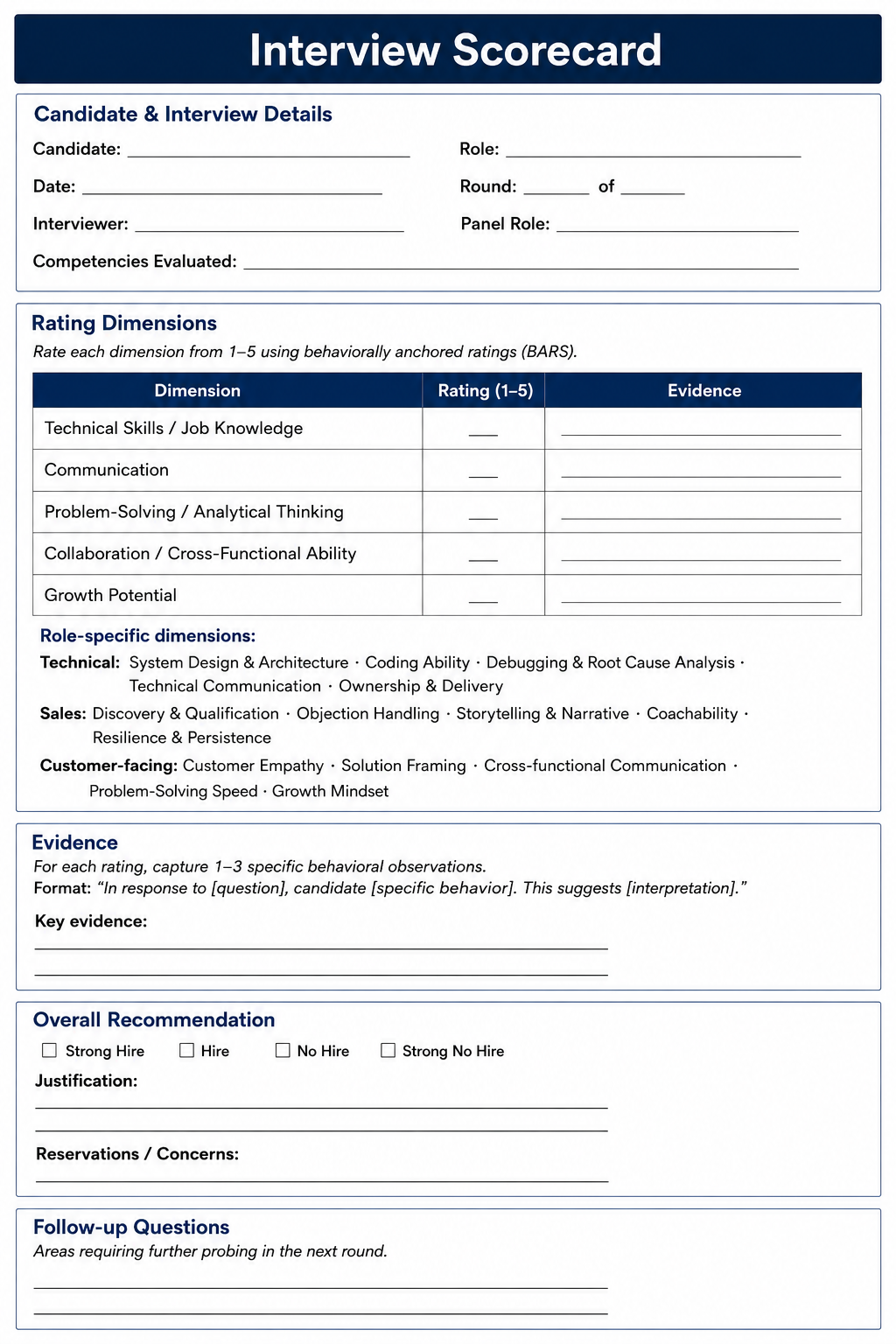
Download the resource here: Interview Scorecard Template
How to adapt for your role.
- Replace competencies with the 4-6 that matter most for the specific role. Do not use more than 6. More dimensions produce interviewer fatigue and reduce completion quality.
- Weight competencies for the role. Some may be must-haves. Others may be nice-to-haves. Make weighting explicit before interviews start.
- Add a role-specific values assessment section for organizations that hire against clearly articulated values (Amazon Leadership Principles, similar frameworks).
- For engineering roles specifically, HackerRank recommends including candidate GPA, project experience, and hobbies as separate context sections. Do this deliberately if it fits your culture.
How to design a scorecard that actually gets completed
Rule 1: One scorecard per interview round: Interviewers get one separate scorecard per interview and not a shared document for all rounds. Each interviewer must submit scores and feedback independently to maintain objectivity.
Rule 2: Required completion before advancing candidates: The ATS should block candidate advancement without completed scorecards. This is the mechanism that produces discipline over time. Kula, Ashby, Workable, and others support this natively. Legacy ATSs typically do not.
Rule 3: Feedback blinding by default: Interviewers cannot see peer scores before submitting their own. This is to avoid influencing the scores of any other recruiters. Choose an ATS that offers such a feature.
Rule 4: Time limits should be 5 to 15 minutes per scorecard: The longer your scorecard takes to complete, the less likely interviewers are to complete it consistently. Keep it short enough to fit naturally into the interview workflow.
Rule 5: Async completion within 24 hours: Your ATS should send automated reminders 24 and 48 hours after the interview. If no response after one day, it should auto-nudge stakeholders to submit comments. The system should also escalate an alert to the recruiting team if feedback is still not received after 48 hours.
Rule 6: Mobile-friendly: Hiring managers do not sit at desks all day, so scorecards should be mobile-optimized. Teams can also gamify scorecard completion to encourage instant participation.
Rule 7: Pre-populated with candidate context: The scorecard should pull in candidate resume, application data, and previous round notes automatically. Interviewers should not be typing candidate names into forms, as that friction produces incomplete submissions.
Rule 8: Anonymous option for specific stages: For initial screening stages where bias reduction is highest-leverage, scorecards must be completed against anonymized candidate profiles. Names, photos, and demographic proxies are removed from the application, and recruiters evaluate based on skills and qualifications.
How to Run a Structured Interview Debrief
Rule 1: Written first, verbal second
Every interviewer submits their scorecard before any group discussion. That should be non-negotiable. It's extremely important to have this information submitted in writing before the debrief to avoid any bias.
Rule 2: Junior first and leadership last in verbal discussion
Once scores are submitted, debriefs proceed with junior interviewers presenting first. Save leadership for last, as they are most likely to bias the group if they go first.
Some junior team members may feel uncomfortable disagreeing or giving a totally different evaluation than a senior. This is important to maintain independent judgment.
Rule 3: Cancel the debrief when the trend is clear
If you're seeing interview feedback come in that's trending very negatively, it's okay to cancel the debrief and save everyone 30 minutes.
Rule 4: Debrief within 24-48 hours
Any longer and interviewer recall drops significantly, details from the conversation become harder to distinguish, and the candidate has moved on to competing offers.
Rule 5: Panel debriefs on video, not just text
Some teams have shifted to async video debriefs, where interviewers record 60-90 second summaries after each interview. This gives the panel more context on the interviewer’s reasoning.
Rule 7: The final decision must reference specific scorecard dimensions
Don’t make the final hiring decision based on a general impression of the candidate. Tie the decision back to specific scorecard dimensions and the evidence recorded against them. If you recommend a hire, explain which competencies met or exceeded the bar.
How Kula and other modern ATSs support scorecards natively
1. Kula
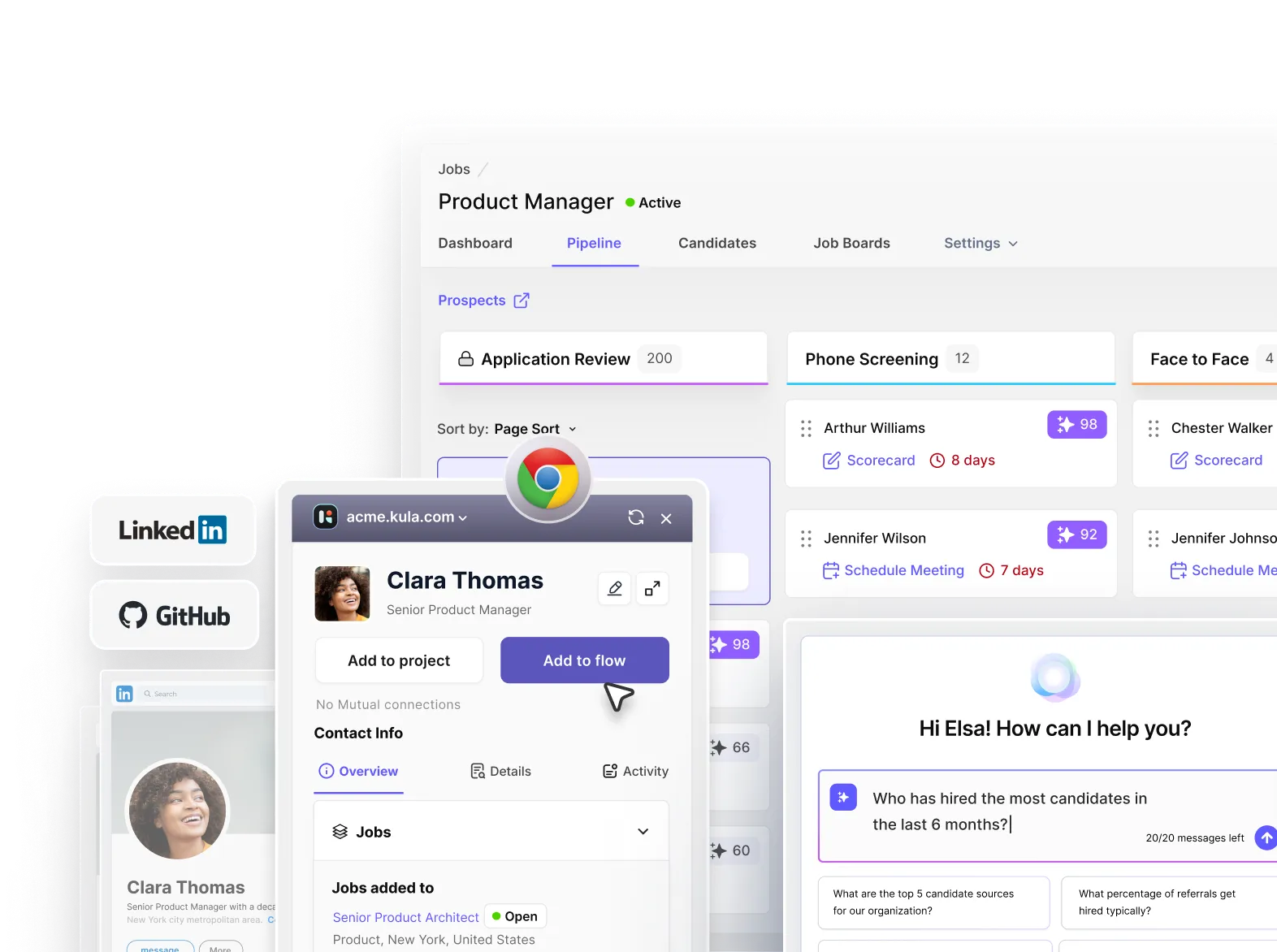
Kula is an all-in-one AI-native ATS that offers native scorecard templates with automated multi-tier escalation at 24 and 48 hours for timely interview feedback submission.
Kula’s interview intelligence toolkit also offers an AI Notetaker that transcribes interviews and auto-fills scorecard fields. The platform also offers automated transcripts, intelligent summaries, and automated scheduling.
The platform is mobile-friendly for hiring manager completion on the go and offers feedback blinding by default.
2. Ashby
Ashby is a modern ATS platform that is best suited for small to midsize companies.
Ashby is a technically advanced platform that offers deep customization capabilities for every hiring stage to its users.
The platform offers deep scorecard customization, native feedback blinding, AI Notetaker with candidate context queries, and analytics on interviewer scoring patterns to detect calibration gaps.
3. Greenhouse
Greenhouse is best-suited to meet high-volume hiring needs and comes with a learning curve.
Greenhouse scorecards include focus attributes, additional attributes, key takeaways, interview-specific feedback, and an overall recommendation of Definitely Not, No, Yes, or Strong Yes.
The platform also offers custom AI evaluation criteria that apply your own questions and team rubric consistently across candidates. Other than this, users also get self-scheduling, interview reporting, and Greenhouse AI notetaker capabilities.
4. Lever
Lever is a collaborative ATS tool and is intuitive with a straightforward learning curve.
Lever offers AI capabilities that can automatically generate candidate scorecards from interviews, score areas such as technical skills, leadership, culture fit, and communication, and provide an overall hiring recommendation.
The platform also offers AI Interview transcripts & summaries, AI-drafted candidate feedback, feedback blinding, and automated fraud signal identification.
5. Workable
Workable is an HR and recruiting platform that offers plug-and-play implementation with no training required.
Workable offers standardized interview kits and customizable scorecards to keep candidate evaluations consistent across hiring teams. The platform also offers automated transcripts and self-service interview booking.
Workable’s feedback blinding feature is specifically praised by many of its users.
6. BrightHire
BrightHire offers 1-click scorecard completion, AI-powered interview notes, ATS scorecard integration, and interview insights and analytics.
The platform also offers AI-generated scoring and probing logic that can automatically generate follow-up, scoring, and probing logic for AI interviews.
7. HireVue
HireVue's AI capabilities are much more focused on assessing/scoring candidates and validating skills.
The platform offers AI-enhanced scorecard workflows within structured video interviews. For example, its AI-Scored Interviews combines structured interviews with skills evaluation and uses AI to score interviews, with input from I-O psychologists to align assessments with hiring needs.
HireVue combines interviews with game-based assessments, Virtual Job Tryouts, technical assessments, and language tests to evaluate different competencies.
The platform also uses AI-driven candidate evaluation to surface candidate insights and validate job-relevant skills rather than relying solely on resumes.
How to choose?
✅ For teams already on a modern ATS: use native scorecards before adding specialized tools.
✅ For teams on Greenhouse or Lever wanting deeper interview intelligence: add BrightHire or HireVue.
✅ For teams evaluating a full ATS switch: scorecard depth should be a top-3 evaluation criterion.
The three questions that reveal whether your scorecards are actually working
Question 1: What percentage of interviews have completed scorecards submitted within 24 hours? If below 80%, the process is broken. Either the scorecard is too long, the ATS does not enforce completion, or the culture does not treat scorecards as required. Fix this before adding more features.
Question 2: Can two interviewers who evaluated the same candidate independently produce similar scorecard ratings? If they routinely produce very different ratings, the rating scale is too vague, or the calibration is drifting. BARS with behavioral anchors fix this issue.
Question 3: When your hiring manager rejects a scorecard-approved candidate, can they cite specific scorecard dimensions the candidate failed? If rejections cite "vibe" or "personality" or "fit" without referencing the scorecard, the scorecard exists but does not drive decisions. Force a debrief structure that requires scorecard citation.
For teams looking to enforce structured interviews inside their ATS, Kula supports native scorecards, feedback blinding, automated reminders, and AI-powered interview notes that auto-fill scorecard fields.
Ready to make scorecards part of your hiring workflow? Book a demo to see how it works in practice.