

Video interview software is one of the most operationally powerful categories in modern recruiting and one of the most controversial.
When it works, teams see documented screening time reductions, increased applications, and time-to-hire compressing from months to weeks.
When it fails, candidates can be rejected because of minor technical issues, applicant PII can be exposed through data breaches, and the candidate experience can suffer.
The category deserves neither uncritical enthusiasm nor blanket dismissal. It deserves an honest assessment of what actually works, where the failures happen, and how to adopt these tools.
This article maps out the category as it exists in 2026— the vendors, the ROI, the failures, and the framework for evaluating whether video interview software is right for your team.
What does video interview software actually cover: three distinct categories?
General video conferencing tools (Zoom, Google Meet, Microsoft Teams) are not video interview software, as they are only meeting infrastructure.
Video interview software includes recording, structured questions, AI scoring, ATS integration, and candidate experience features.
Learn more about the key capabilities of video interview software:
Category 1: Async (one-way) video interviews
It involves no live interview or interviewer, but candidates record video responses to pre-set questions on their own time. Recruiters or hiring managers review these recordings later.
Asynchronous interviews are best fit for high-volume screening where scale matters more than nuance.
The platforms best-suited for async interviews include HireVue, Willo, Hireflix, VidCruiter, and Spark Hire.
Category 2: Live video interviews with AI enhancement
These are traditional live interviews conducted over video but with AI layers such as automated transcription, AI note-taking, automated scheduling, sentiment analysis, and real-time coaching.
It is a different category from traditional live interviews, as here the interview is a real-time conversation, but AI augments the recruiter's work rather than managing everything manually.
Such interviews serve mid-market to enterprise companies best, with high-volume or complex hiring needs.
Single-point solution platforms that support such interviews include Modern Hire, HireVue Live, and iMocha.
Category 3: AI conversational screening
In AI conversational screening, candidates have real-time conversations with an AI agent that asks questions and evaluates responses.
This approach can standardize early-stage screening. Every candidate can be assessed against the same core questions and criteria.
The biggest advantage here is scale: instead of adding recruiter hours every time application volume increases, conversational AI can handle a larger number of initial conversations.
Platforms like BrightHire and Take2 support such interviews.
Where do the categories overlap?
All three categories exist to solve the same problem: recruiters cannot manually phone-screen every candidate at scale. The differences are in how, not why.
These categories can also overlap within the same platform. A vendor may offer multiple interview formats rather than fitting neatly into one category.
For example, HireVue supports async video interviews, live video interviews, and interview coaching, while Willo focuses primarily on async video interviews with AI-powered evaluation capabilities.
So when comparing video interview software, don’t just look at the category. Look at which part of the interview workflow the platform actually automates or enhances.
Measurable outcomes companies achieved with async and AI-enhanced interviews
Async video screening outcomes
1. Cathay Pacific
Cathay Pacific used HireVue OnDemand interviews to replace phone screens for high-volume roles. The airline reduced time-to-hire by 90%, from three months to 2–3 weeks, while also reducing no-shows by 30% and increasing interview attendance by 30%.
2. Penn Medicine
Penn Medicine replaced initial 45-minute phone interviews with on-demand video interviews. The change saved more than 3,300 recruiter hours annually, while recruiters could present hiring managers with 3–5 qualified candidates instead of a larger pool of resumes.
3. Ferguson
Ferguson replaced its traditional campus interview process, which involved phone interviews with roughly 1,800 applicants per semester, with on-demand text and video interviews. Ferguson now handles about triple the candidate volume.
AI conversational screening outcomes
4. UCHealth
UCHealth, a 37,000-employee academic health system, deployed Take2's AI Interviewer to engage candidates immediately after they applied.
The AI screened 81% of impacted applicants, with a median time of 81 minutes from application to completion of screening. Importantly, 60% of screens were completed outside normal business hours, allowing candidates to interview without waiting for recruiter availability
5. Goodfit
Springworks used Goodfit's AI voice interviews and skill assessments to handle high-volume candidate screening.
The customer story reports that Springworks reduced time-to-hire by 80%, moving from 10,000 applicants to a shortlist in days rather than weeks.
Goodfit says its AI interviews can conduct structured conversations and combine them with skill assessments to produce ranked candidate shortlists.
AI-enhanced live video outcomes
6. Plum— AI Notetaker + Interview Intelligence
Plum used Kula’s AI Notetaker to automatically transcribe interviews, capture key takeaways, and generate interview notes and scorecards.
This reduced the burden of manual note-taking. Plum’s interview feedback turnaround fell from 1–2 days to hours. The team also made 10 hires in its first month using Kula.
7. Healthie — AI Notetaker + AI Scoring + AI-Assisted Scheduling
Healthie used Kula’s AI Notetaker, AI Scoring, and built-in scheduling as part of its recruiting workflow. The team reports saving 5–10 recruiter hours per week, alongside faster candidate movement through the funnel and a 78% Candidate NPS.
8. RemotelyHR — AI Notetaker + AI Scoring + Scheduling
RemotelyHR adopted Kula’s AI Notetaker to transcribe interviews and surface information from candidate conversations automatically. The company reports that Kula cut hiring timelines by about 50% overall, with some roles being filled in under a week instead of three weeks.
Other important statistics to consider:
- 73% of recruiters say AI-powered interview tools help them shortlist candidates in under 24 hours.
- AI interviewers can reduce time-to-hire by up to 70% in high-volume hiring.
- 68% of recruiters using AI interview tools can provide candidate feedback within hours.
- 85% of companies using AI interview tools report more accurate candidate evaluations.
Video interview software produces measurable ROI for teams that implement seriously. But every one of these outcomes required organizational commitment. Teams that deployed video interview tools without changing their workflow saw much smaller gains.
The honest failures and controversies with AI-enhanced interviews
1. The HireVue facial analysis reversal
HireVue faced significant public backlash in 2019 and 2020 over its facial analysis feature. Multiple scientific reviews and public advocacy pushed the company to stop using facial analysis in 2020 officially.
This is important context because it defines the category's public perception. Any vendor claiming to evaluate candidates through facial expressions, micro-emotions, or "confidence indicators" should be treated with significant skepticism.
The science is contested, and the legal risk is real.
2. The McDonald's Olivia data breach
McDonald's used Paradox AI's chatbot "Olivia" for candidate screening.
In 2025, security researchers demonstrated a documented data breach exposing personal information of applicants, including full names, resume details, and contact information, along with credentials as weak as the password '123456'.
This is not a hypothetical risk. It is a documented failure. Vendors that ingest candidate data need proven security infrastructure.
You must ask about SOC 2 compliance, data retention policies, and breach history before deployment.
3. The cheating epidemic
Post-COVID data shows a sharp rise in cheating incidence in interviews. Video interview software specifically has to handle this.
Vendors that do not offer strong anti-cheating controls such as biometric verification, session monitoring, and real-time proctoring produce results that cannot be trusted.
4. The bias inheritance problem
AI trained on historical hiring data reproduces historical biases. Amazon discontinued its AI recruiting tool because it favored male candidates.
Other teams have documented AI screening tools that penalized non-native English speakers.
Without third-party bias audits, this failure mode scales silently.
5. The candidate experience revolt
Candidate backlash is less about AI itself and more about how it changes the hiring experience.
Candidates see AI interviews as impersonal, one-sided, and sometimes difficult to trust.
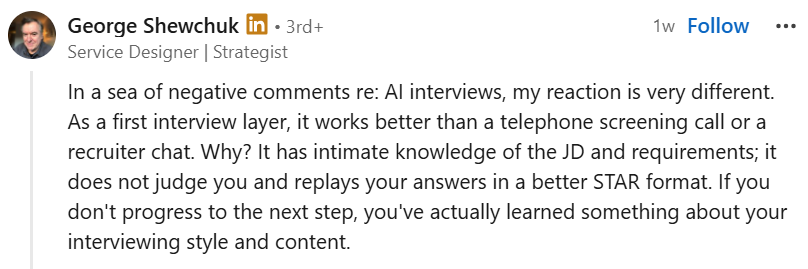
One candidate called AI interviews “a huge NO,” while another said there’s a “huge mismatch” between the effort candidates put in and the effort employers make.
6. The technical rejection problem
One candidate documented being rejected because the video software detected using a phone rather than a laptop. The technical requirement was not clearly communicated. The AI treated the format as disqualifying.
This is a bias multiplier where candidates without access to specific hardware are systematically excluded.
💡The honest position: Video interview software has real value and real risks. Any adoption plan must treat both seriously.
9 Best Video Interview Software Options Worth Evaluating
Async Video Screening
1. HireVue
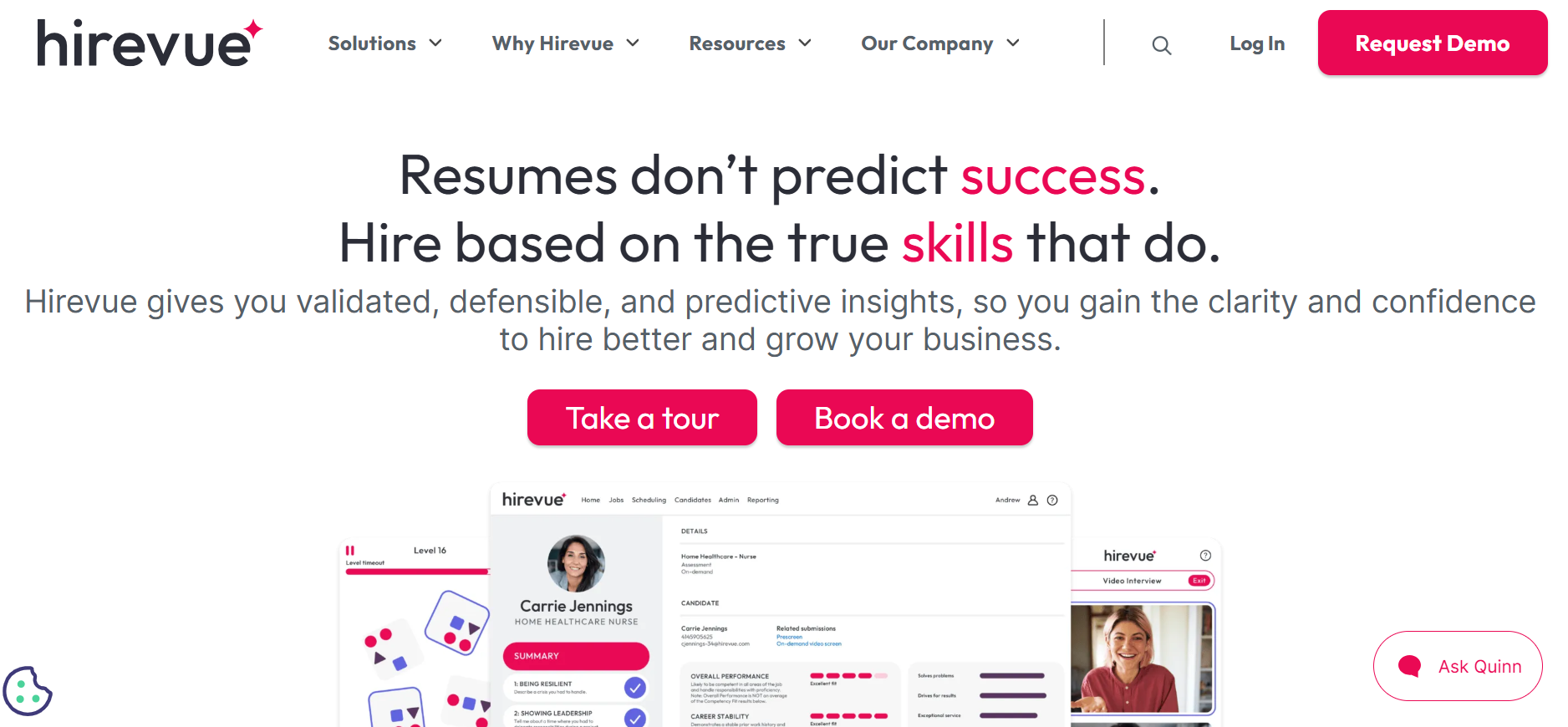
HireVue supports both live and on-demand video interviews. Its video interviewing capabilities can be combined with structured interview guides, assessments, scheduling, and AI-powered tools.
The platform also provides game-based assessments for cognitive ability, multi-language support, and strong ATS integration (Workday, Greenhouse, SAP SuccessFactors, iCIMS).
Real customer outcomes: Emirates NBD’s 80% reduction in time-to-offer, followed by the APAC bank’s 60% reduction in hiring time. And Swire Coca-Cola achieved a 79% interview completion rate.
Best fit: Enterprise and high-volume mid-market hiring. Retail, hospitality, entry-level tech, high-turnover roles.
Honest verdict: Still carries a legacy reputation from the facial analysis era. Expensive. Enterprise-focused pricing and sales cycles.
2. Willo
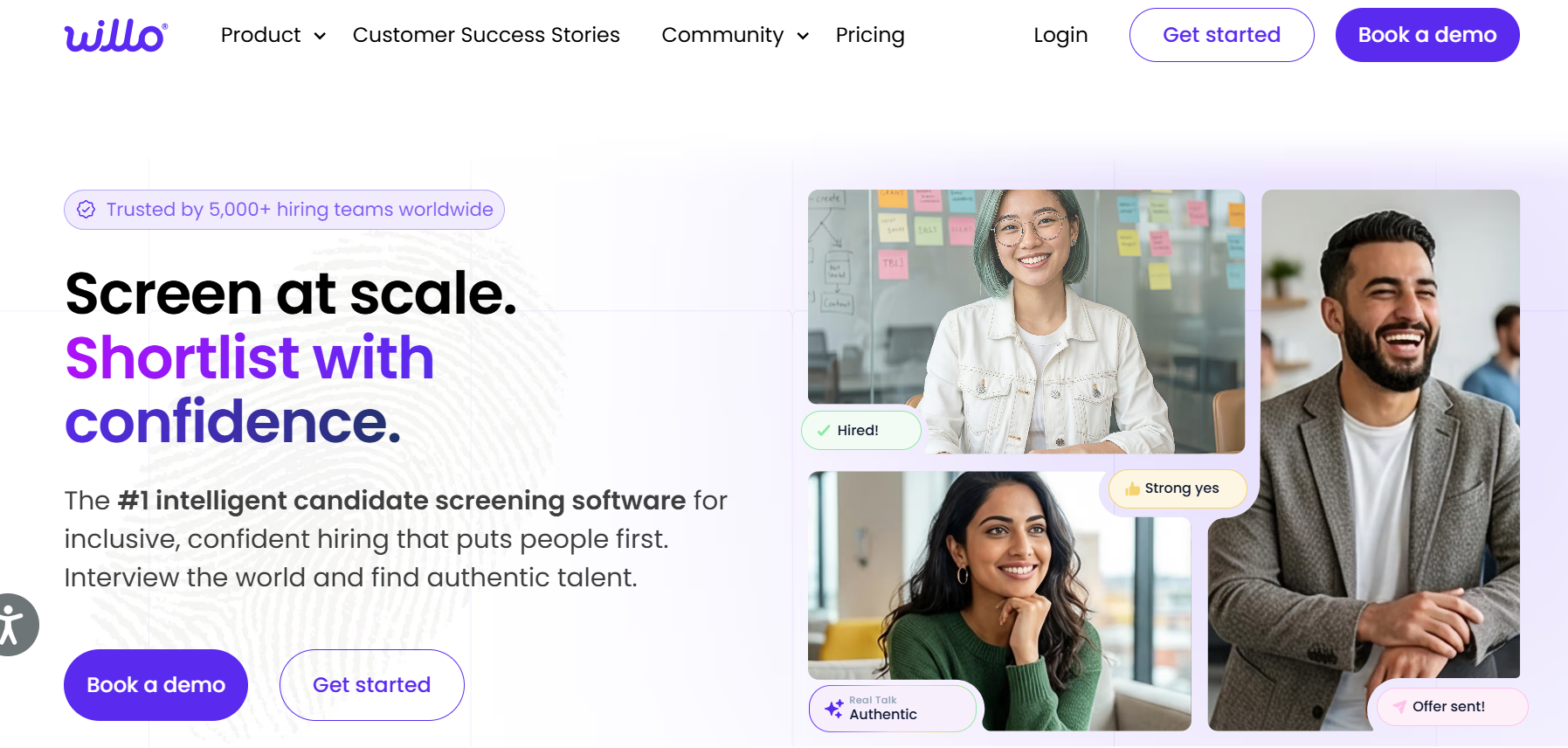
Willo is a user-friendly and affordable asynchronous video interview platform that lets candidates respond to video, audio, or text questions anytime, from any device.
It also supports structured assessments, anti-cheating measures, file uploads, and integrations with 5,000+ apps.
Real Outcomes: Travelxp cut screening time by 66%, LaunchCode reduced interview time by 52%, and EDF and Watermark achieved an 84% interview response rate with Willo.
Best fit: Lower-volume async screening. Teams that want async video without HireVue's enterprise complexity.
Honest verdict: Willo’s 4.6/5 rating across 280 G2 reviews reflects strong user satisfaction, particularly for ease of use and time savings, though reviewers note limitations in advanced assessments, integrations, and the time required to review videos at scale.
3. Hireflix
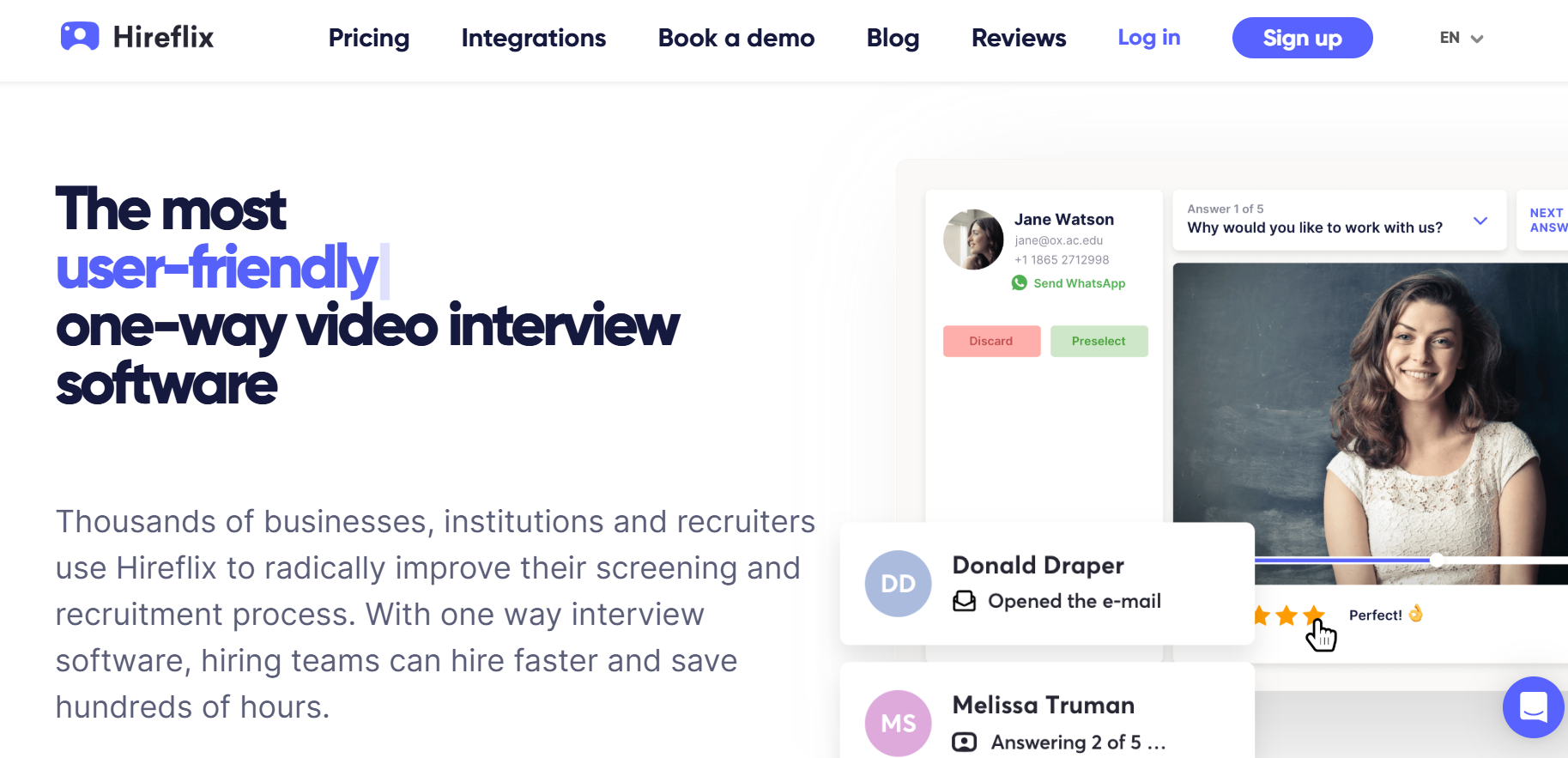
Hireflix is a one-way (asynchronous) video interview platform that lets recruiters create interviews once, screen candidates at scale, review and share recorded responses with hiring teams, and integrate the platform with their existing ATS.
Real Outcomes: SoCal Counseling Center reduced its interviewing process by 90%, and Skyeng scaled to 4,000+ interviews per month.
Best fit: Small to mid-sized teams. Best price-to-value ratio in the category.
Honest Verdict: Hireflix is a highly rated, easy-to-use interview platform (5/5 from 439 G2 reviews), but the format can feel impersonal, and reviewing large volumes of videos can still be time-consuming.
4. VidCruiter
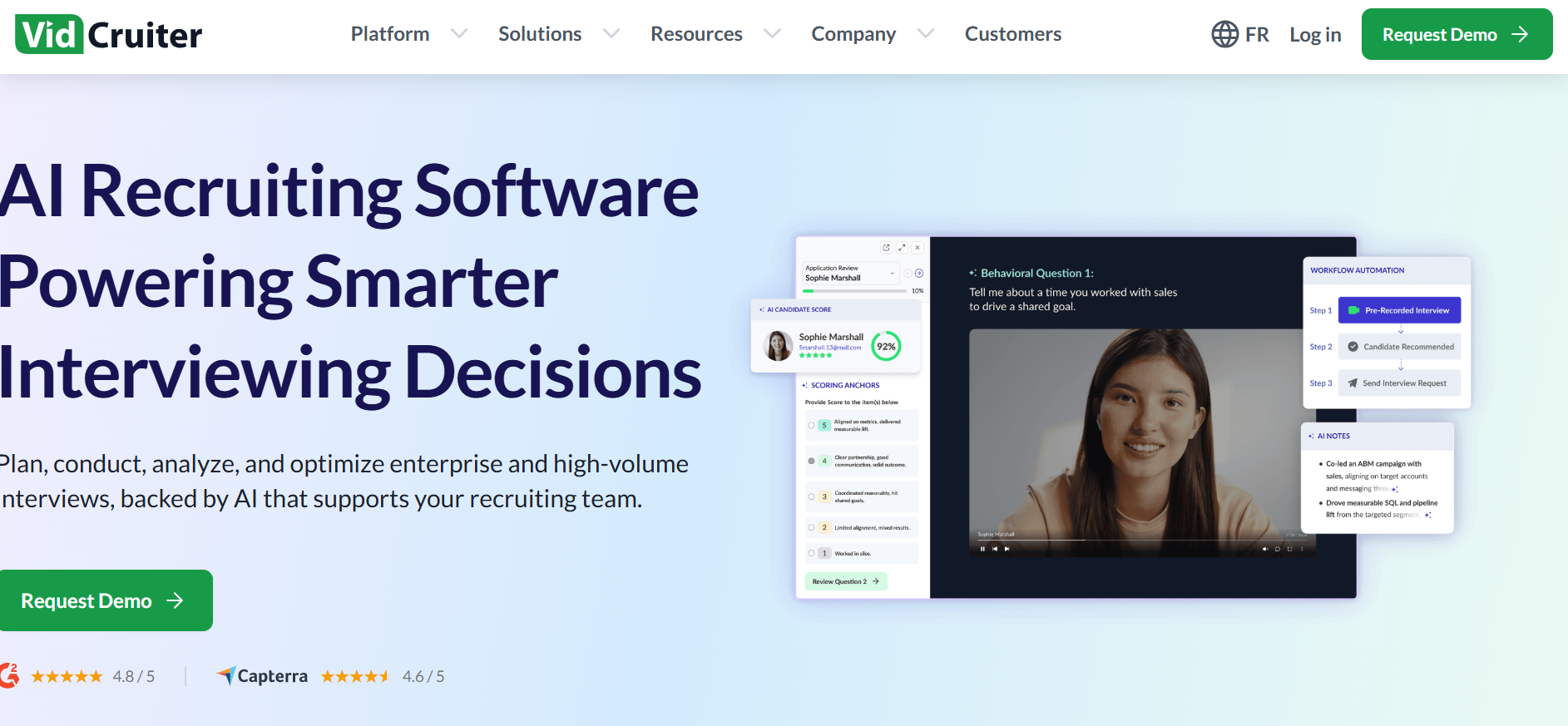
VidCruiter offers a comprehensive video interviewing suite with pre-recorded and live interviews, multi-format interview support, structured interview workflows, interview notes, fraud detection, automated scheduling, and ATS integrations.
Real Outcomes: RaceTrac increased scheduled interviews by 167% and attendance from 70% to 85%, while HealthChannels screened 300,000+ applicants and hired 10,000 candidates in one year.
Best fit: High-volume hiring teams that need to automate and scale video interviewing
Honest Verdict: VidCruiter has a rating of 4.8/5 and is a highly customizable video platform, but its breadth of features can introduce a learning curve, which makes the platform more complex.
5. Spark Hire
Spark Hire’s one-way video interviews let candidates respond asynchronously to standardized questions, while recruiters can review submissions faster and use AI-generated transcripts and summaries in 50+ languages.
Real Outcomes: ECMSI experienced a 50% reduction in time-to-hire, and MeySen Academy completed 59 video interviews with a 78% completion rate.
Best Fit: Lean HR/recruiting teams at 50–500-employee companies doing frequent or high-volume initial screening, where saving recruiter time and avoiding live first-round interviews matters most.
Honest Verdict: 4.7/5 on G2, strong for easy, efficient video screening, but AI scoring, reporting, and workflow flexibility still have some gaps.
AI-Enhanced Live Video
6. iMocha
iMocha offers automated video interview workflows as it combines video interviewing with skills assessments and AI-driven evaluation. The platform is best fit for technical hiring where skills validation is the primary need.
Real Outcomes: Tata Advanced Systems Ltd. (TASL): 40% higher hiring efficiency; Capgemini Engineering: reduced interview time by 40%.
Best Fit: Enterprises with high-volume, skills-based hiring that need customizable assessments.
Honest Verdict: 4.4/5 on G2, iMocha is strong for customizable skills assessment and screening, but its setup, navigation, and reporting still have some usability gaps.
7. Codility
Codility’s video interview capabilities focus on live technical interviews in a real VS Code environment, with whiteboarding, pair programming, and live code execution in one session.
Best fit: Engineering teams hiring developers who need structured, hands-on technical interviews with real coding environments, standardized scoring, and interview recordings;
Honest verdict: With a strong 4.6/5 G2 rating from 905 reviews, Codility is a strong choice for technical interviewing, though G2 users still flag limitations around question quality, debugging, and flexibility.
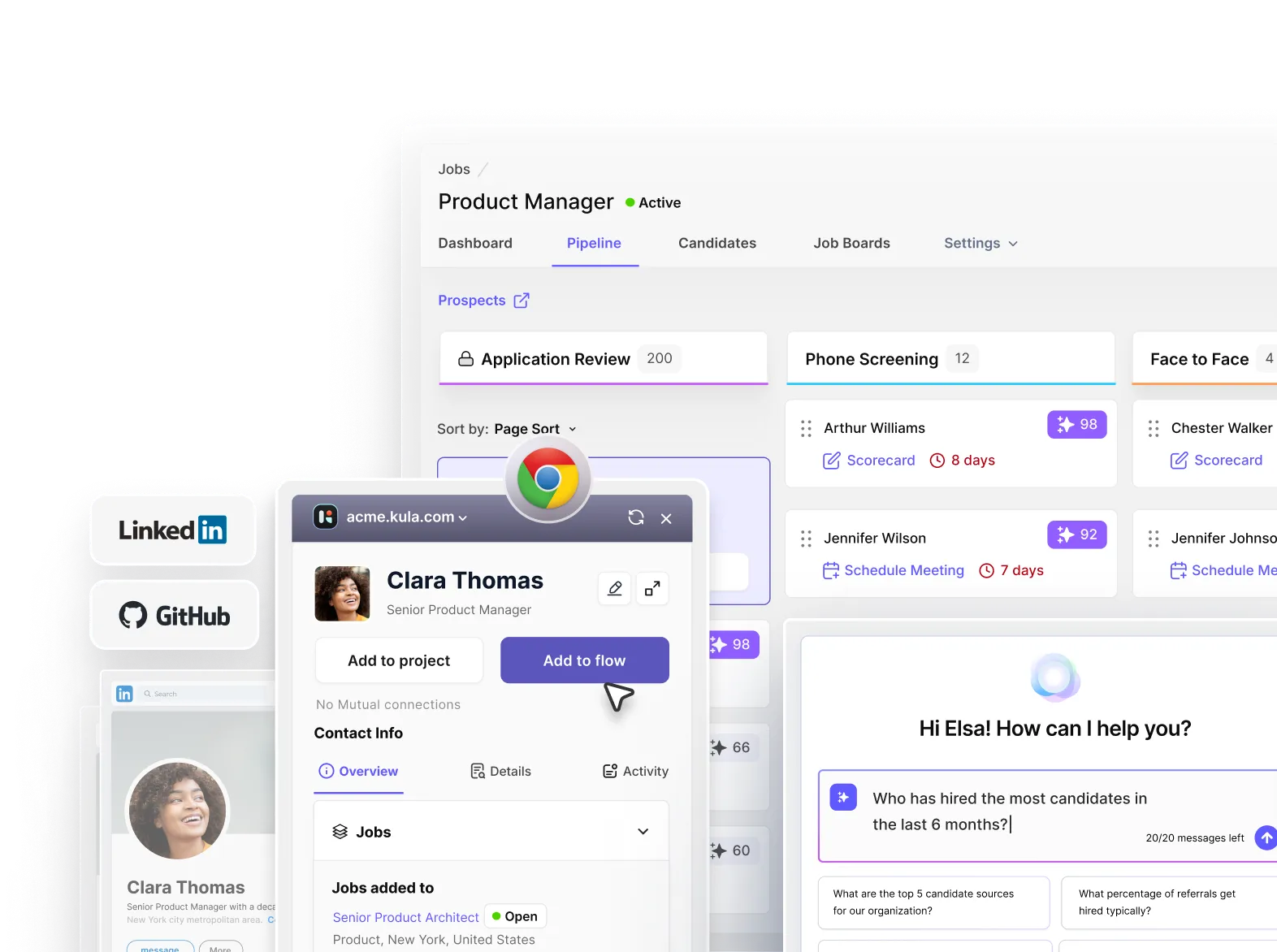
8. Kula AI Interview Assistant
Kula's ATS offers real-time conversational AI screening within the platform, allowing recruiters to conduct live candidate conversations using structured questions. It generates scored, analyzed outputs and includes an AI Notetaker for live interview transcription and automatic scorecard completion.
Real Outcomes: Plum’s feedback from 1–2 days to hours, Healthie saved 5–10 recruiter hours per week, and RemotelyHR cut their hiring timelines by about 50% overall.
Best fit: Teams that want AI conversational screening as part of a consolidated ATS platform, not a standalone tool.
Honest Verdict: 4.5/5 on G2, Kula is strong on intuitive AI-powered recruiting automation and reducing manual work, but its relatively new platform still has gaps in reporting, customization, and some advanced workflows.
AI Conversational Screening
9. BrightHire
BrightHire combines AI-powered first-round interviews, live interview intelligence, AI-generated notes and highlights, structured interview guidance, and candidate-fraud detection.
Real outcomes: Overjet reported a 9% month-over-month increase in SDR hires, and Tinuiti now captures 95% of interviews with BrightHire.
Best fit: Best suited to recruiting teams that want to automate first-round screening and standardize interviews while retaining human oversight, particularly in high-volume hiring.
Honest verdict: With a 4.3/5 G2 rating from just 2 reviews, BrightHire AI Interviewer shows promising gains in structured, fair interviewing, but the very limited review base and feedback around collaboration and limited red-flag insights make its broader effectiveness difficult to validate.
How to choose?
For high-volume async screening: HireVue if you have enterprise budget and integration needs. Hireflix or Willo if you want simpler and cheaper.
For live video enhancement: Modern Hire for structured enterprise assessments. iMocha for technical hiring. Kula's AI Interview Assistant for teams consolidating.
For conversational AI screening: Emerging category. Test with pilots before committing at scale.
For teams already on a modern ATS: use native video interview capabilities before adding standalone tools. The Franken-stack cost is real.
How to adopt video interview software without damaging candidate experience
Rule 1: Be transparent about AI use
Where required by law, companies must tell candidates when and how AI will be used in the hiring process.
For example, the Illinois AI Video Interview Act requires disclosure about how the AI works, and candidate consent for AI analysis of video interviews. NYC Local Law 144 also requires notification when automated employment decision tools are used
Also, candidates who know AI is being used are more accepting than candidates who discover it retroactively and feel deceived.
Rule 2: Never let AI make the final decision
AI should only be used as a tool to support recruiters in making more objective decisions in less time. It should not be used to replace recruiters in making final decisions.
A recruiter or hiring manager must always review AI output before advancing or rejecting a candidate.
Also, the 2025 EU AI Act codifies this: hiring AI is high-risk and requires human oversight.
Rule 3: Communicate technical requirements clearly
The phone-versus-laptop rejection problem is a communication and candidate experience failure.
Tell candidates exactly what device, browser, camera, microphone, and setup they need, and also provide clear troubleshooting resources. The goal is to make the AI interview experience more comfortable.
Rule 4: Actually watch the videos
The "never watched the video" problem is real. If your team is not going to actually watch the async video, do not use async video. Ask candidates to invest 30 minutes only if you will invest the time to review.
Rule 5: Allow re-recording within reason
Rigid single-take async video interviews can add unnecessary pressure, especially when candidates are unfamiliar with the format or dealing with technical issues.
Allowing 2–3 recording attempts gives candidates a reasonable chance to correct mistakes without turning the interview into an unlimited editing exercise.
The goal is to reduce avoidable anxiety and give them a fair opportunity to communicate.
Rule 6: Set clear expectations on timing
Tell candidates when they can expect to hear back and stick to that timeline. If delays happen, send a quick update rather than leaving candidates guessing. Clear timelines reduce uncertainty and signal that the company values candidates’ time.
Rule 7: Track candidate NPS by process
Post-process surveys reveal whether the video interview experience is producing better or worse candidate NPS than your traditional process. Track it. If it declines, investigate why and iterate.
Rule 8: Bias-audit the vendor
Only work with vendors who have completed third-party bias audits and can share results. NYC Local Law 144 requires this. Even outside NYC, it is the standard for responsible AI vendors.
The three questions that determine whether video interview software is right for your team
Question 1: What is your candidate volume in the workflows video interview software would replace?
If your team runs more than 50 initial screens per month, async video produces meaningful ROI. If your volume is lower, the setup and configuration cost may exceed the productivity gain. Below 20 initial screens per month, video interview software is likely overkill.
Question 2: Do you have process discipline to actually use the outputs?
Video interview software produces recordings and scoring outputs. If your team does not commit to reviewing them consistently and integrating them into hiring decisions, the tools will not change outcomes. Process discipline is the prerequisite, not the outcome.
Question 3: Can you handle the compliance and candidate experience workload?
Video interview software triggers disclosure requirements under state and federal law. It also triggers candidate experience risk that damages employer brand at scale. If your team does not have a partnership with legal and cannot invest in candidate experience monitoring, defer adoption or start with lower-risk categories.
The all-in-one alternative: when to consolidate instead of adding another tool
The Franken-stack cost and the consolidation solution
Adding video interview software to an existing stack of ATS + sourcing tool + scheduling tool + notetaker creates operational overhead. Every additional vendor adds cost, integration risk, and workflow complexity.
The consolidation option is a modern all-in-one platform, as it includes video interview capability natively.
For example, Kula's AI Interview Assistant handles live conversational screening within the ATS. Ashby's AI Notetaker handles live interview transcription and scoring. These are not standalone video interview products; they are ATS-integrated capabilities.
When standalone makes sense
If your team is committed to the current ATS but the video interview need is real, standalone tools are the right answer.
Enterprise volume, complex assessments, deep game-based cognitive testing, or industry-specific requirements (McDonald's-scale hiring) generally justify a standalone tool.
When consolidation makes sense
If your team is already evaluating an ATS replacement, adding video interview capability through the ATS is more efficient than adding a standalone tool.
If consolidation is the goal, the strongest option is an ATS that brings video screening and scheduling into the same workflow.
Kula’s AI Interview Assistant supports live conversational screening with native scheduling inside the ATS, so teams can evaluate candidates without adding another standalone video interview tool.
Book a demo to see how Kula fits your recruiting workflow.