


Most legacy ATSs were designed between 1998 and 2010 for a hiring market that no longer exists.
In that market, employers held the leverage. Candidates applied, recruiters filtered applications, and hiring was largely reactive.
The ATS reflected that reality. It acted as a filing cabinet with a workflow layer. It stored applicants, moved them through hiring stages, and generated compliance reports. That was exactly what organizations needed.
In 2026, hiring works differently. The best candidates are rarely applying, so recruiters spend more time on sourcing than screening. AI has become the new baseline for productivity, and businesses are under pressure to consolidate disconnected recruiting tools into a single platform.
The legacy ATS was not built for any of this. This article explains why.
The market shift legacy ATSs missed
The world legacy ATSs were built for
Legacy ATSs were built for the hiring realities of the late 1990s through the early 2010s.
In this era, hiring was largely application-driven. As the internet was rising, companies relied on job boards for attracting candidates rather than proactively sourcing talent.
Recruiters, at that time, were receiving a lot of digital resumes from candidates, for which they needed a system to organize them.
That's what legacy ATSs were built to do. They centralized candidate records, offered basic keyword matching and resume parsing, and supported compliance requirements like EEOC reporting and audit trails.
Legacy ATSs were built to support a linear hiring process and relied on third-party integrations to provide modern capabilities such as scheduling or automation.
Systems like Taleo, iCIMS, Greenhouse, and Lever were architected around this reality.
Why the ATS-as-compliance-tool made sense at the time
Earlier, recruiters spent most of their time filtering inbound applications, as sourcing was a smaller and secondary activity.
Hiring managers had less involvement. Analytics were also basic because leadership was not asking sophisticated questions yet.
The system needed to be reliable, auditable, and comprehensive, and not fast, intelligent, or proactive.
What changed
Every aspect of hiring evolved:
Sourcing
Around 70% of the workforce is now classified as passive. The best candidates have stopped applying. Hence, talent shortages have made outbound sourcing essential to reach senior talent.
Job board
Job board effectiveness collapsed. Job boards still produced volume, but not enough quality. As application numbers grew, the best candidates increasingly had to be sourced rather than waited for.
As recruitment specialist James Moss puts it:
“Well, my argument is job boards are only as good as the person who is using them. If you post a generic advert copy, with very little information, missing salary and benefits, don't be surprised when you receive a low number of relevant applications.”
Even when recruiters optimize their job ads, the hiring landscape has changed. Today, job boards attract a lot of low-quality or AI-generated applications. This fundamentally changed what organizations expected from an ATS.
AI & Automation: AI stopped being optional
As hiring volumes grew, recruiters could no longer spend hours screening resumes, scheduling interviews, or taking interview notes. AI became part of everyday recruiting, fundamentally changing what organizations expected from an ATS.
The goal of using AI is to save time and effort on repetitive tasks and to allot that time to core hiring functions such as candidate experience, employee branding, and making final decisions to stand out from the competition.
All-in-one tool
The Franken-stack got expensive. Companies buying an ATS plus Gem plus GoodTime plus ModernLoop plus a notetaker started asking whether five tools was actually the right answer.
Modern teams now prefer all-in-one platforms that centralize recruiting workflows. They also want tools that are easy to implement, with minimal training and faster team adoption.
Budget and analytics
The senior leadership has started asking questions now. The macroeconomic shifts of late 2022 led to tighter recruiting budgets, putting every recruiting technology investment under greater scrutiny. As a result, platform consolidation shifted from a nice-to-have to a strategic priority.
The expectations from ATS platforms changed as well. It was no longer enough to report hiring metrics. Teams wanted analytics that explained why bottlenecks occurred, surfaced underlying trends, and helped recruiters identify the best next actions.
Why legacy ATSs did not adapt
Many legacy ATSs were acquired, and innovation slowed. With customers locked into multi-year contracts, vendors often prioritized renewals over rapid product development. As hiring evolved, these systems failed to keep pace.
The vendor behaviors that made it worse
Acquisition and stagnation
Oracle acquired Taleo in 2012.
Customer reports since then are consistent: support quality decreased, minimal investment in new features, prices went up.
This pattern is not unique to Taleo. It is what happens when a legacy vendor gets absorbed into a portfolio company optimized for cash extraction rather than product growth.
Multi-year contracts as innovation shields
Many legacy ATS vendors relied on two- or three-year contracts that locked customers into long renewal cycles.
Because revenue was secured well before renewal conversations, there was less immediate pressure to release meaningful product improvements.
As hiring practices evolved rapidly, many of these platforms struggled to keep up, leaving customers with software designed for a very different recruiting environment.
Renewal pricing that punishes loyalty
Martina Branan at Vectorworks documented the pattern. Her previous ATS vendor charged yearly without making meaningful product enhancements and continued to raise their prices every time a contract was due for renewal despite persistent technical failures and lacking support.
This pattern wasn't unique. When vendors depended on long-term contracts and renewal revenue, increasing prices often became easier than competing through faster product innovation.
Customers who stayed loyal frequently paid more without seeing proportionate improvements in the software.
Stagnant products defended by feature gating
Legacy vendors respond to "we need better analytics" with "that's on the next tier."
Basic workflow features such as bulk actions, self-scheduling, DEIB reporting, and custom dashboards are often gated behind higher subscription tiers.
This creates the appearance of ongoing product value while the underlying platform remains unchanged.
Support that decreases as switching costs increase
The longer a customer has been on the platform, the less support they get.
New customers get responsive account management through customer acquisition, while long-term customers are taken for granted and end up in ticket queues.
Multiple recruiters cited unresponsive support and absent account managers as final-straw factors that pushed them to switch.
The monotonous experience
Liz Wagner at Vanta shares her experience with legacy ATS: "I was in the legacy ATS for nine years. It looked very similar nine years later and didn't feel like there were substantial or impactful additions or iterations in the product."
That is the vendor economics working exactly as designed.
The five specific failures modern recruiting teams are hitting
Failure 1: AI is bolted on, not built in
Many legacy platforms treat AI as an add-on module or a third-party integration.
Because these systems were built long before AI workflows became a priority, candidate data often lives across disconnected modules, custom fields, and integrations.
As a result, the AI cannot access full candidate context, past event attendance, historical rejection reasons, or team notes.
When AI is running on incomplete data, recommendations become less reliable. Some users report AI candidate matching that skips strong profiles or produces weak rankings.
The failure is not a training data problem. It is an architectural one.
Failure 2: Sourcing is a separate purchase
Most legacy ATSs are designed to receive candidates and not to proactively source or rediscover talent.
As a result, teams have to buy Gem or a similar CRM to manage outreach and nurture candidate relationships.
The ATS stores years of past applicants, silver medalists, and referrals, but without built-in rediscovery workflows, that data becomes an archive instead of a recruiting advantage.
Modern hiring workflow depends on an ATS with integrated candidate intelligence and rediscovery capabilities. Legacy systems make it impossible.
Failure 3: Reporting requires Excel
This is the most consistent complaint across every legacy vendor.
Legacy ATS platforms typically collect large amounts of recruitment data, but their reporting capabilities are often rigid, outdated, or difficult to customize.
As a result, recruiters and talent leaders spend significant time manually compiling reports rather than acting on insights.
Legacy platforms produce data. Modern platforms produce answers.
The gap between the two is the four hours per week your reporting analyst is losing to VLOOKUPs.
Failure 4: Per-seat pricing that scales exponentially
The seat-based pricing model was reasonable when only recruiters used the ATS. In modern hiring, hiring managers, panel interviewers, and coordinators all need access.
A mid-market team reviewing Lever put it directly: "Given only 20% of the company actually needs access every day, it's very expensive to have to pay for the other 80% who only use the system 1-2 times a year as interviewers.”
Also, this model becomes super expensive as you scale with this model. The pricing model punishes exactly the collaboration modern hiring requires.
Failure 5: Integration hot potato
Legacy systems rely on Franken-stacks. Franken-stacks rely on integrations. Every additional integration introduces another point of failure.
When data has to move between multiple vendors, sync issues, API changes, and field mapping errors become operational risks. And when something breaks, support ownership becomes unclear.
The result is familiar: email history stops syncing, HRIS field mappings break, or automated stage triggers fail silently.
These are not isolated bugs. They are the operational cost of a recruiting stack held together by integrations instead of a unified platform.
Platform-specific breakdowns: Greenhouse, Lever, Workable, iCIMS
1. Greenhouse
Greenhouse is one of the most popular and established legacy ATS platforms.
The platform offers strong compliance features and structured hiring workflows. But for many recruiting teams, the friction shows up in the day-to-day experience rather than the core workflow.
Reporting is slow, non-customizable, and requires manual Excel work for anything beyond basic funnels.
The 2024 UI update also drew criticism, with users reporting that they "have to open multiple tabs just to jump back to a job list."

Basic workflow features are still missing, including scheduled send for interview emails. Search is inconsistent enough that some recruiters say they resort to Google Chrome's page search to find candidates. And DEIB reporting is sold as a paid add-on, which one reviewer described as "primarily a tactic to force those who have to adhere to OFCCP/EEO guidelines to pay extra."
One Greenhouse user also commented on the conservative approach of the platform in AI adoption:

None of these issues is catastrophic on its own. Together, they create the small, repetitive points of friction that slow recruiters down every day.
2. Lever
Since Employ acquired Lever in 2022, product investment has visibly slowed, and support quality has declined.
The complaints are remarkably consistent. Bugs populate the wrong candidate when sending emails. Navigation violates basic UX expectations, for example, application questions are located under Settings > Job Site.
The platform lags under everyday use. Resume preview crashes. Search struggles at scale, with one team describing a database of 13,000 candidates and a search function that had become effectively unusable.
A universal pipeline forces multiple business units into identical hiring stages. Even small changes to offer approvals can require restarting the entire workflow.

Individually, these are usability issues. Collectively, they point to a product that has accumulated friction faster than it has removed it.
3. Workable
Workable is a solid ATS for startups, but many teams start feeling its limits as hiring grows more complex. What works well for a 20-person company often starts breaking down once you're hiring across multiple teams, locations, and recruiters.

Enterprise reporting is one of the biggest complaints. Getting access to more granular hiring metrics typically requires moving to higher-priced plans.
Customization another limitation. Users report that workflows, pipeline stages, and scorecards aren't as flexible as they'd like, making it harder to adapt the ATS to evolving hiring processes.
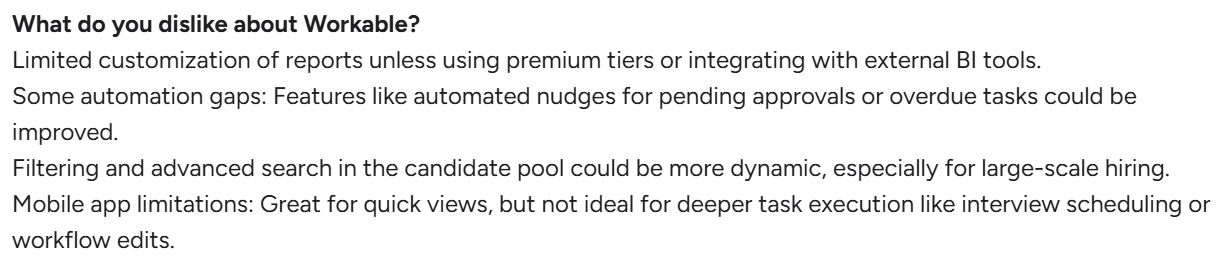
Recruiters also point to inefficiencies in day-to-day workflows. Several reviews mention that bulk actions are more manual than expected, with tasks like rejecting large groups of candidates requiring unnecessary clicks.
Platform reliability is another recurring concern. Some users report experiencing outages and performance issues that disrupted hiring operations.
4. iCIMS
iCIMS is built for enterprise hiring, but its legacy architecture shows in day-to-day use. Many users describe the platform as powerful but less intuitive than newer ATSs, with a steeper learning curve and heavier administrative overhead.

The platform has expanded its AI capabilities in recent years, but the experience can vary across different modules.
Users also report that the interface feels dated compared to newer ATS platforms, and configuring workflows, integrations, or reporting often requires dedicated admin support.

For large enterprises with established recruiting operations, that's manageable. For leaner talent teams, it can add unnecessary complexity.
What modern ATS architecture actually looks like
1. Native AI, not bolted-on modules
Modern platforms treat AI as foundational infrastructure.
Features such as candidate scoring, screening, outreach drafting, and analytics all run on the same underlying model with access to full candidate context.
When AI is architectural rather than additive, the outputs are meaningfully more accurate.
2. Built-in sourcing and CRM
The ATS is your primary sourcing tool instead of just a place to manage applicants.
Because sourcing, outreach, referrals, and candidate rediscovery happen in the same system, teams no longer need to stitch together multiple point solutions. The Franken-stack becomes unnecessary.
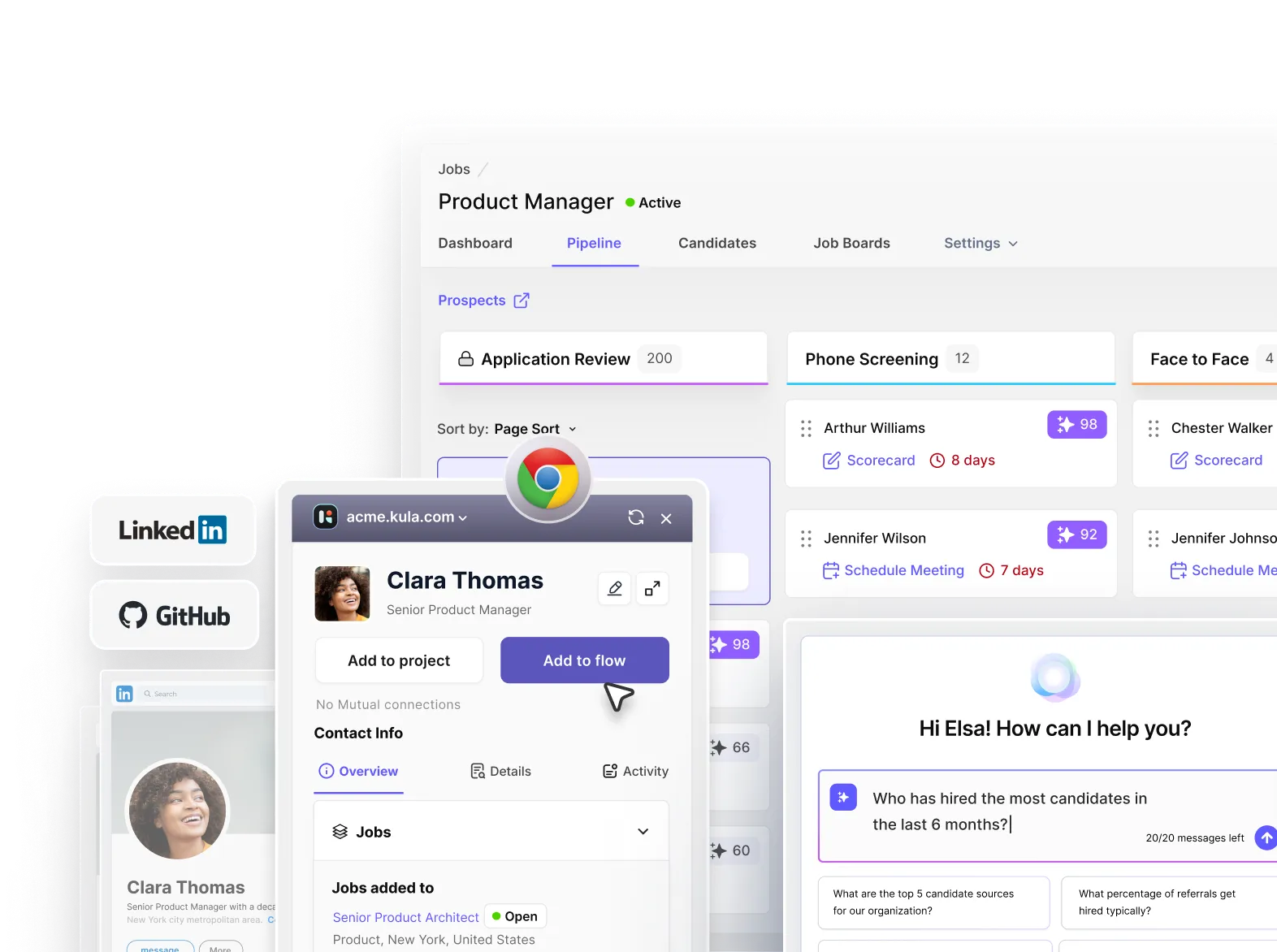
Chrome extensions capture candidates from LinkedIn and GitHub. Email sequencing is native. SOBO is built in. Recruiters can also rediscover past applicants without switching to a separate talent pool.
3. Analytics that produce answers
Executive dashboards render in seconds, not hours. Funnel analytics break down hiring data by department, role, and demographic. Reports export cleanly.
Because these insights are available out of the box, recruiters spend less time building manual reports or combining data in spreadsheets. Excel is no longer the default tool for answering basic pipeline questions.
4. Usage-based or predictable pricing
Traditional ATS pricing often penalizes growth. As more recruiters, hiring managers, coordinators, and interviewers need access, software costs rise with every additional seat.
Modern platforms move away from per-seat models that punish scale. Hiring managers, panel interviewers, and coordinators can access the system without linear cost growth. That makes budgeting simpler and hiring easier to scale.
5. Product velocity as a feature
Modern ATS vendors ship meaningful updates every month instead of saving everything for an annual release.
Faster release cycles mean customers get new features, bug fixes, and workflow improvements sooner instead of waiting months for the next major version. As recruiting changes, the platform changes with it.
Ashby, Kula, JazzHR, and others represent the modern architectural approach. Each has different strengths:
- Ashby leads on analytics depth for technically sophisticated teams
- Kula prioritizes AI-native consolidation for teams tired of the Franken-stack.
- JazzHR emphasizes ease of use and cost-effective recruiting for SMBs
Each of them represents a fundamentally different design philosophy than the legacy platforms they compete with.
The consolidation math
The economic case for switching is usually clearer than the operational one. Companies switching from Legacy ATS to a single modern platform report 26-52% faster hiring speed. That is not a marginal improvement. That is the CFO's business case built in.
The switching pattern: Realization, workaround, breaking point
Phase 1: The realization moment
Teams do not decide to switch because of a feature list. They switch when the system starts slowing the business down.
As Maxime Le Bras at Alan puts it:
"We were wasting lots of time challenging the numbers and going back and forth trying to understand why a certain number didn't make sense."
Once the numbers stop being trustworthy, the tool becomes a liability. That's the moment organizations start looking for a replacement.
Phase 2: The workaround phase
Before switching, teams try to patch the failure: manual Excel syncing, adding a sourcing tool, adding a scheduling tool, or adding a notetaker.
Aurora Solar's team met "one hour each day" simply to manually verify data entry between Workday and their legacy ATS.
Each workaround solves one problem but creates another, which compounds the operational cost.
Phase 3: The Franken-stack ceiling
Every new tool solves a specific problem until the stack itself becomes the problem. Somewhere between 8 and 15 recruiting tools, managing integrations, reconciling data, and paying for overlapping capabilities creates more complexity than value.
At that point, the cost of maintaining the Franken-stack exceeds the cost of replacing it.
Phase 4: The breaking point
By this stage, the business has already outgrown the ATS. The final decision to switch is usually triggered by a specific event rather than years of frustration.
Three factors typically force that decision: CFO-led budget consolidation, disruptive UI changes from legacy vendors that slow everyday work, or renewal negotiations marked by steep price increases despite poor support.
That's why modern ATSs like Kula are built differently, combining native AI, built-in sourcing, and recruiting workflows in one platform with predictable pricing instead of relying on an expanding stack of point solutions.
Book a demo to see how Kula can simplify your hiring stack.