


Most companies claim to prioritize diversity in hiring but produce pipelines that look identical to what they have always produced.
The gap between stated priority and actual outcome is an execution problem.
This article covers what actually changes pipeline composition—the sourcing tactics, the tooling, the metrics, and the leadership structures. It also covers what does not work and why, because most companies are spending significant effort on the second category while getting no results in the first.
Why most diversity sourcing efforts fail
Failure 1: Over-reliance on referrals
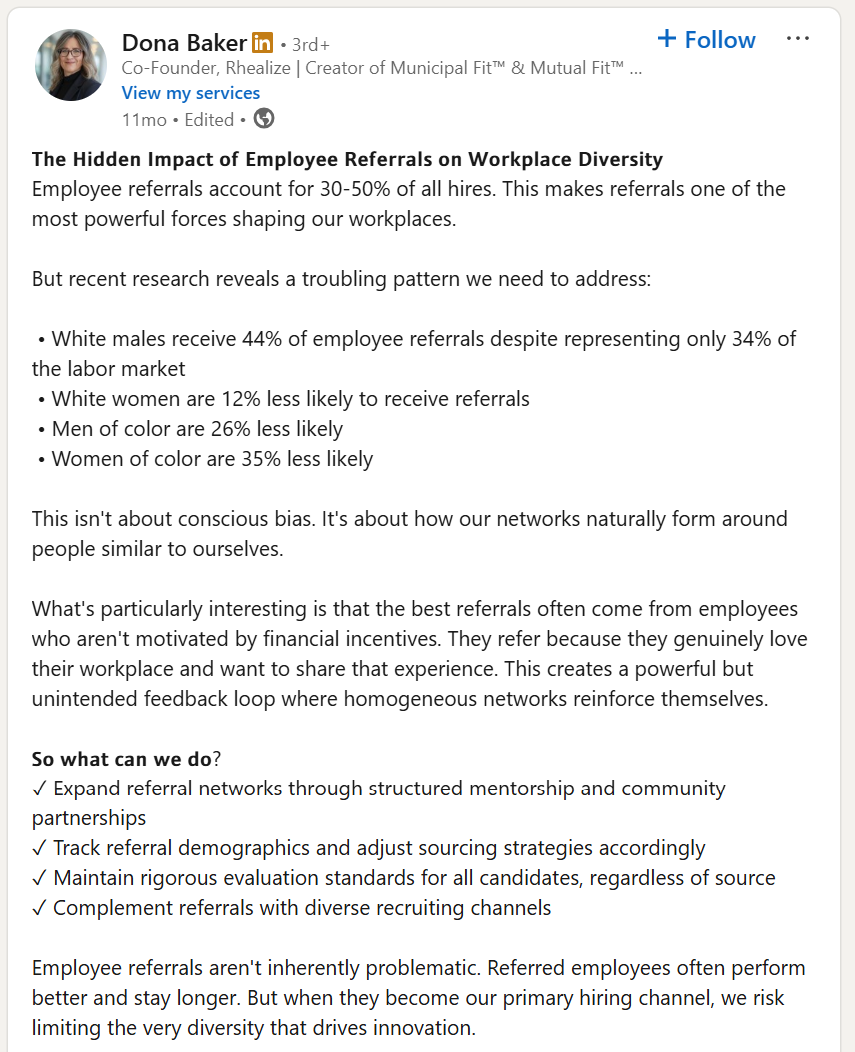
Referrals are the highest-converting hiring channel, but they also tend to reinforce existing workforce patterns.
Employees are most likely to refer people they already know, who often share similar educational backgrounds, industries, professional networks, or demographics.
As referrals become a larger share of hires, the candidate pool becomes less diverse instead of more.
Angela Miller at Pure Storage named the problem directly:
"With our reliance on referrals, we were just bringing in people from the industry — which, as disruptors, was the opposite of what we intended to do. It became evident to me at that point, as a TA leader, that we needed to think differently about how we were approaching our channels philosophy.”
A diversity strategy that relies too heavily on employee referrals often ends up narrowing representation rather than broadening it.
Failure 2: DEI committees as substitutes for structural change
Internal DEI committees are cheap for employers to create and produce visible activity without changing anything about how the company hires or pays people. They become symbolic rather than transformative.
An anonymous tech recruiter documented the cynicism this creates:
"Corporate employers only implement DEI committees for the optics and use it as an excuse for why employees can't have more tangible benefits like pay increases, pensions, or employer-funded insurance. Any candidate who values the existence of a DEI committee over fat pension contributions is a moron."
Another recruiter highlighted a different issue:
“DEI committees are infiltrated by HR or Deans/their representative to control the conversation. They are effectively turned into powerless, purely performative committees with no power to enact policy change. Members of DEI committees would make a bigger impact if they were actually distributed in committees where decisions are ultimately taken.”
The criticism isn't that DEI committees exist. It's that, without decision-making authority or accompanying structural reforms, they risk becoming a substitute for meaningful change rather than a driver of it.
Failure 3: Leadership disconnects from the sourcing motion
Recruiters report a consistent pattern: leaders evaluate recruiting through dashboards and hiring targets, while the actual sourcing work happens in a completely different context
As one recruiter put it: "The people making decisions aren't in the process. It's all numbers to them. Until the market changes, the beatings will continue."
When performance is measured by quotas but operational bottlenecks remain unresolved, recruiters focus on hitting activity metrics rather than improving hiring outcomes. This results in lower-quality sourcing and higher burnout.
Failure 4: Tools that gate compliance features
Recruiters at smaller companies are often limited by their hiring software rather than their intent. Greenhouse specifically forces teams to pay extra for advanced DEIB metrics and OFCCP compliance data.
One Greenhouse user described the challenge:
"GH tells you you have to use a BI connector like Tableau and have your HR Analytics team pull this. That is great for larger companies with those capabilities. However, we are a small to midsize company that does not have an HR Analytics team today."
When basic tracking is a paid upgrade, diversity work becomes a budget decision.
The seven tactics that actually change pipeline composition
Tactic 1: Flip the sourcing funnel toward outbound
Outbound sourcing gives recruiters more control over who enters the pipeline and converts hires at 7x the rate of inbound.
With outbound sourcing, recruiters can also target underrepresented groups specifically and build a pipeline before positions open.
To make outbound sourcing more inclusive:
- Build Boolean searches and talent pools that prioritize skills over pedigree, rather than filtering by a handful of well-known companies or universities.
- Source from communities, professional groups, and events that represent underrepresented talent, not just LinkedIn search results.
- Maintain relationships with promising candidates before roles open instead of restarting the search for every requisition.
Tactic 2: Set top-of-funnel diversity targets tied to local market data
Pure Storage's approach is the template. When Bay Area census data showed 25% of software engineers were women, Angela Miller's team set a requirement that the top of their engineering pipeline had to be at least 25% female. They scaled that target to 30% and achieved it.
The metric here was not "hire more women." It was "ensure the top of the candidate pipeline reflects or exceeds the diversity of the available local talent pool."
If underrepresented candidates are missing from the top of the funnel, they cannot progress through interviews or receive offers.
By making the pipeline itself representative of local talent availability, companies create equal access to later hiring stages without predetermining hiring decisions.
To put this into practice:
- Use labor market data to establish realistic representation benchmarks for each role and location.
- Track diversity at the sourcing and screening stages.
- Review pipeline composition regularly and adjust sourcing strategies if representation falls below market availability.
That approach is measurable, defensible, and produces downstream diversity in hires.
Tactic 3: Remove non-essential job requirements
Every unnecessary degree requirement, such as a "10+ years of experience" clause or niche certifications, narrows the candidate pool.
Research shows underrepresented talent is highly likely to underestimate their skills and self-select out if they do not meet every listed qualification, while majority-group candidates apply anyway.
As a result, overly restrictive job descriptions disproportionately reduce applications from qualified underrepresented talent.
Distinguishing between must-have and nice-to-have qualifications widens the talent pool without lowering the hiring bar. It simply ensures capable candidates aren't screened out before they have a chance to apply.
Checklist:
- Keep only role-critical requirements.
- Prioritize skills over credentials.
- Review and update requirements before every hiring cycle.
Tactic 4: Rewrite job descriptions to remove biased language
Job descriptions shape who sees themselves as a good fit for a role.
Words like rockstar, ninja, guru, and superstar have been shown to discourage applications from some qualified candidates, particularly women, by signaling a more exclusive or stereotypical workplace culture.
Replacing them with neutral, collaborative language is the solution.
The same principle applies to other terminology. Some research and practitioner guidance suggests that words such as stakeholder may carry unintended connotations for some candidates, while alternatives like partners or collaborators can feel more inclusive.
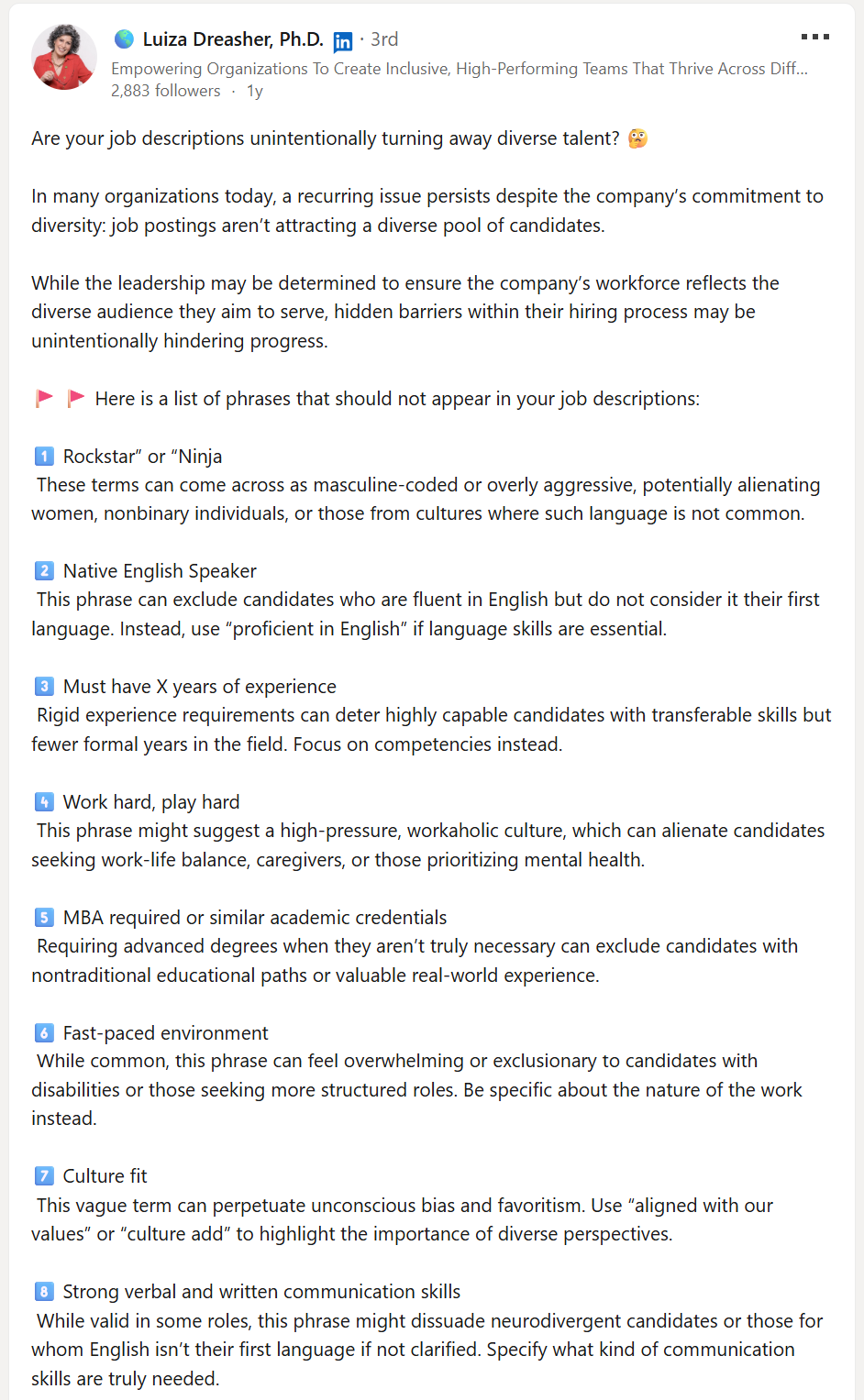
To make job descriptions more inclusive:
- Run every job description through an inclusive language checker before publishing.
- Replace gender-coded, exclusionary, or overly aggressive terms with clear, neutral alternatives.
- Ask someone outside the hiring team to review the description for clarity and unnecessary jargon.
Tactic 5: Source from underrepresented networks directly
Relying solely on LinkedIn and traditional job boards limits recruiters to the same candidate pools as every other employer.
Expand sourcing to other organizations and communities that actively support underrepresented professionals.
Examples of such organizations include Historically Black Colleges and Universities (HBCUs), Hispanic-Serving Institutions (HSIs), the National Society of Black Engineers (NSBE), Code2040, Techtonica, Out in Tech, ALPFA, Women in Technology communities, DiversityJobs, Nexxt, Grace Hopper programs, and CodePath.
To implement this:
- Build relationships with diversity-focused organizations year-round, not just when roles open.
- Include at least one underrepresented talent community in every sourcing campaign.
- Measure the quality and conversion rates of these channels alongside traditional sourcing sources.
Tactic 6: Build diverse interview panels
Homogeneous interview panels signal to candidates that they will be the only person like them at the company.
In contrast, diverse, structured interview panels expose candidates to a broader cross-section of the organization and reduce the influence of any one interviewer's unconscious biases by incorporating multiple viewpoints into the hiring decision.
This improves both candidate confidence in the organization and the consistency and fairness of hiring decisions.
To implement this:
- Include interviewers from different teams, backgrounds, and levels of seniority whenever possible.
- Use structured interviews and standardized scorecards so every candidate is assessed against the same criteria.
- Review interviewer feedback independently before group discussions to reduce conformity and groupthink.
Tactic 7: Make hiring managers accountable for diversity outcomes
Every manager should be the owner of diversity within their team and should be held accountable for it when it comes to bringing on new headcount.
When managers are responsible for diversity outcomes, they consider diversity throughout the hiring process instead of treating it as a separate initiative.
To put this into practice:
- Include diversity and hiring process metrics in manager performance reviews.
- Share pipeline composition and interview-stage data with hiring managers throughout the hiring process.
- Train managers on structured interviewing and bias mitigation before they participate in hiring.
Recruiters cannot own this alone. Manager accountability is the mechanism that closes the gap between stated priority and actual outcome.
Everything about anonymized screening and blind evaluation
What anonymized screening actually is
Removing names, photos, physical addresses, gender, age, graduation dates, and educational institution names from resumes for the initial review. The reviewer only sees skills, experience, outcomes, and not proxies for demographic identity.
Why it works
Unconscious bias operates on shortcuts such as names signal race and gender, school names signal socioeconomic status, and graduation dates signal age.
When these signals are removed, the reviewer evaluates the actual candidate rather than the pattern the candidate fits.
For example, a landmark study of U.S. symphony orchestras found that blind auditions increased a woman's probability of advancing from preliminary rounds by about 50% and increased the likelihood of being hired by about 25%, contributing to a substantial rise in female representation in major orchestras over time.
Where it fits in the hiring process
Anonymized screening applies to the initial review stage. Once the candidate advances to interviews, anonymity is impossible, but by that point the reviewer has already made the decision on skills, not identity.
The tools that support it
- Kula offers native anonymized resume reviews and anonymized grading of assessments.
- Workable includes anonymized screening that hides candidate names, photos, gender, and other background attributes during initial review.
- Pinpoint has built-in blind screening capabilities.
- Manatal automatically reformats resumes to hide personal identifiers.
The limitations
Anonymized screening reduces bias at one stage, but it does not eliminate bias across the process. If interviewers apply subjective criteria at later stages, the initial fairness is undone. Anonymized screening is a good starting point, but structured interviews and hiding interviewers' feedback until group discussions lead to more objective hiring decisions.
The compliance angle
Anonymized screening is compatible with EEOC and OFCCP requirements. The demographic data is collected separately, walled off from interview reviewers, and used only for compliance reporting. Nothing about anonymized screening prevents downstream tracking.
What good AI bias controls look like.
1. PII removal before scoring
The AI should never see names, addresses, or demographic proxies when producing evaluation scores. Instead, PII should be removed before resumes are processed by the AI model.
For example, Gem automatically strips personally identifiable information before resume data is processed by the AI model.
2. Real-time bias warnings on inputs
The system should flag when recruiters use subjective, vague, or potentially biased criteria such as "demonstrates leadership skills" and prompt them to replace these with specific, job-relevant requirements that can be evaluated consistently.
This catches the bias at the input stage, rather than trying to correct it after recommendations have already been made.
3. Independent third-party audits
AI hiring systems should undergo regular independent audits to identify and address potential bias.
For example, Kula partners with Warden AI for regular monthly audits, while Gem undergoes annual third-party audits with BABL.
This is increasingly becoming a compliance expectation rather than a best practice. Regulations such as NYC Local Law 144 require annual bias audits for automated employment decision tools.
4. Explainable AI (glass box, not black box)
Glass-box scoring (also called explainable AI) means the AI's reasoning is visible to the recruiter. Instead of only showing a score, it explains how it arrived at that score.
AI should clearly explain why a candidate received a high or low score by highlighting which skills matched, which are transferable, and where the candidate has gaps.
5. Adversarial debiasing
Adversarial debiasing is an AI technique that trains the model to predict a candidate's fit for a role while preventing it from learning or relying on protected characteristics such as gender, race, or age. The goal is to ensure candidate evaluations are driven by job-relevant qualifications rather than demographic signals.
6. The regulatory landscape
AI used in hiring is increasingly subject to regulation. The EU AI Act classifies hiring AI as a high-risk system, while New York City's Local Law 144 requires annual bias audits for automated employment decision tools. Other jurisdictions, including Colorado and Illinois, have also introduced AI hiring regulations.
Compliance is no longer optional, choose vendors who have already invested in audit infrastructure.
EEOC, OFCCP, and the compliance layer for diversity sourcing
The EEO statement requirement
Job descriptions must include a formal Equal Opportunity Employer (EEO) statement.
This standard clause communicates that hiring decisions are made without regard to protected characteristics such as race, gender, age, disability, religion, or veteran status.
It is a compliance requirement for many employers, particularly federal contractors, and is considered a non-negotiable part of the hiring process.
The voluntary self-identification process
Candidates should be able to voluntarily self-identify race, gender, disability, and veteran status. This data must be encrypted, stored anonymously, and walled off from interviewers and hiring managers during evaluation. Kula, Gem, and Ashby all support this workflow.
The OFCCP "applicant" definition
An individual becomes an applicant only when they meet all four required criteria: they express interest through the internet or another electronic system, are considered for a specific position, meet the job's basic qualifications, and do not withdraw themselves from the hiring process.
General outreach or expressions of interest alone do not create applicant status. This distinction determines which candidates employers must track and include in compliance reporting.
The sourcing former applicants rule
When re-engaging former applicants for evergreen roles, recruiters must use non-discriminatory selection criteria. For example, you can decide not to consider applications older than 180 days as long as that rule is applied uniformly to all candidates.
You cannot decide to re-engage former candidates solely because of their gender or underrepresented minority status. That violates OFCCP guidelines.
This matters because rediscovery is the highest-leverage sourcing activity. The value comes from designing compliant, objective filters, not selective outreach.
The disclaimer: This is a general overview of common considerations, not legal advice. Consult your legal and compliance teams for specific requirements.
The metrics that actually reveal pipeline problems
The stage-by-stage drop-off analysis
Track pass-through rates by demographic group at every stage of the funnel. When you see disproportionate drop-off at a specific stage, that is where the problem lives.
Angela Miller's approach at Pure Storage puts it directly:
"I needed Pipeline Analytics because I needed to know why we weren't hiring more women engineers. Was it a problem in our interview process? Because if so, we would fix that parity issue as a first step."
For example:
- If female candidates disproportionately drop off after the technical coding stage, audit whether the coding evaluation is biased or poorly calibrated.
- If Black candidates disproportionately drop off at the hiring manager review, audit the manager's criteria.
The stage-level data is the diagnostic.
Turn pipeline data into measurable hiring goals
Demographic OKR integration: Modern platforms let you disaggregate pass-through rates by demographic dimensions. This is not just a compliance report. It provides the baseline for setting realistic diversity hiring goals, measuring progress, and identifying where additional investment is needed.
The seven diversity KPIs worth tracking:
- Top-of-funnel diversity relative to local market availability
- Pass-through rate by demographic group at each stage
- Time-in-stage variance by demographic group
- Offer acceptance rate by demographic group
- Retention rate by demographic group (measured at 12 and 24 months)
- Representation by role seniority (not just company-wide percentages)
- Hiring manager scorecard patterns by demographic group
Two of these metrics deserve particular attention:
Representation by seniority: Company-wide diversity numbers can be misleading. A business may appear diverse overall while leadership remains homogeneous. Track representation by role seniority. If women are clustered in entry-level and administrative roles while the C-suite is entirely male, the company-wide percentage looks better than the actual situation.
Retention by demographic group: Diverse hires who leave within their first year signal an inclusion problem, not a hiring problem. Track first-year retention by demographic group. If the retention rate is materially different, the work is not done at the offer stage.
The three questions that determine whether your diversity sourcing is working
Question 1: If you removed all inbound applicants and referrals, what would your pipeline look like? If your diversity metrics would fall, your sourcing strategy isn't doing enough. Proactive sourcing is one of the best ways to bring more diverse candidates into your pipeline.
Question 2: Are hiring managers accountable for diversity outcomes, or is only the recruiter? If only recruiters are held accountable, progress is likely to stall. Hiring managers need to own diversity outcomes because they make the final hiring decisions.
Question 3: Can you show which stage of the funnel is producing the disproportionate drop-off? If not, you have a data problem before you have a diversity problem. Fix the visibility first, then fix the actual bias.
If any of these three answers is unclear, the diversity sourcing motion has structural gaps worth addressing before adding more tactics.
Building a more diverse pipeline requires both better sourcing practices and the right systems to support them.
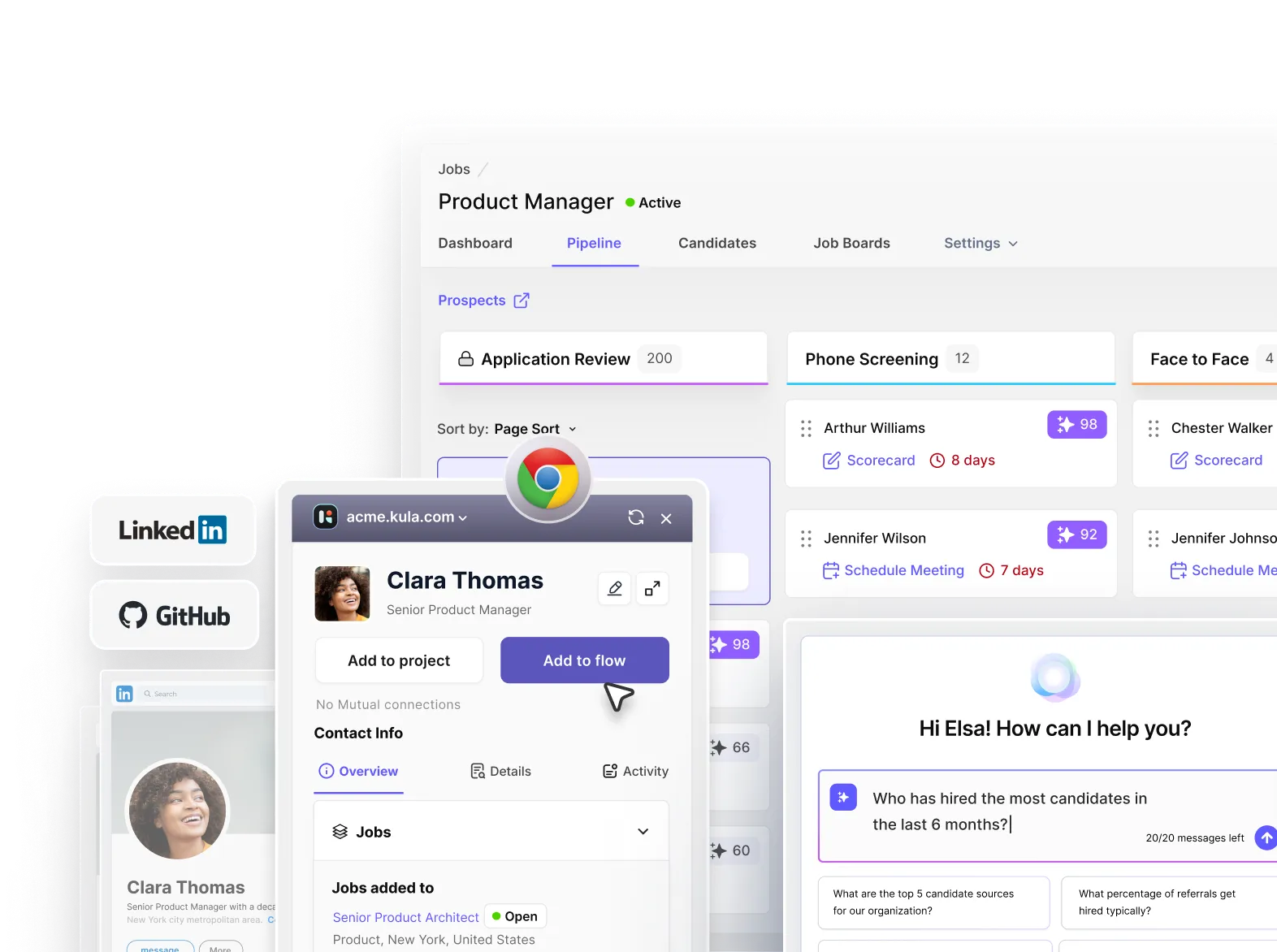
Kula supports this with anonymized screening, built-in EEO and OFCCP reporting, and regular Warden AI bias audits to help teams build a more consistent and compliant hiring process.
Book a demo to see how Kula can help you build a more inclusive candidate pipeline.