




If your sourcing dashboard tells you how many InMails your team sent this month but can't tell you whether those candidates became successful hires, you're measuring the wrong things.
Many recruiting teams still evaluate sourcing through activity metrics:
- Profiles reviewed
- Outreach messages sent,
- Or candidates added to the pipeline
Those numbers have their place, but none of them answer the question leadership actually cares about:
Is sourcing helping us make better hires?
That's where many recruiting teams get stuck. They measure activity because it's easy to track, then struggle to explain why one sourcing campaign outperformed another—or why hundreds of outreach messages resulted in very few interviews.
In this article, we'll look at the candidate sourcing metrics that deserve a place in your reports, how to interpret them, and the benchmarks that help separate healthy recruiting pipelines from ones that only look productive on paper.
Why most sourcing metrics fail: The vanity metric trap
Most sourcing dashboards weren't designed to answer strategic questions. They were designed to report activity.
That's why the same metrics appear across hiring teams regardless of company size or recruiting goals: profiles reviewed, candidates sourced, outreach emails sent, reply rates, and first calls booked.
These numbers are easy to collect, easy to compare between recruiters, and easy to present during weekly hiring reviews.
The problem is that activity alone rarely predicts hiring outcomes.
A recruiter who sends 200 outreach messages may appear more productive than someone who sends 40. But if those 40 messages produce qualified conversations while the other 200 generate almost no engagement, the activity metrics reward the wrong behavior.
Measuring effort without measuring outcomes encourages teams to optimize for volume instead of sourcing quality.
This is where many recruiting organizations run into reporting limitations.
Legacy applicant tracking systems typically make activity reporting straightforward, but answering more meaningful questions—such as which sourcing channel produces the highest-quality hires or which recruiter consistently delivers stronger interview-to-offer ratios—often requires exporting multiple reports and combining them manually.
The strongest sourcing teams solve this by treating activity as only one part of the picture. Instead of relying on a single dashboard filled with volume metrics, they evaluate sourcing KPIs across four dimensions:
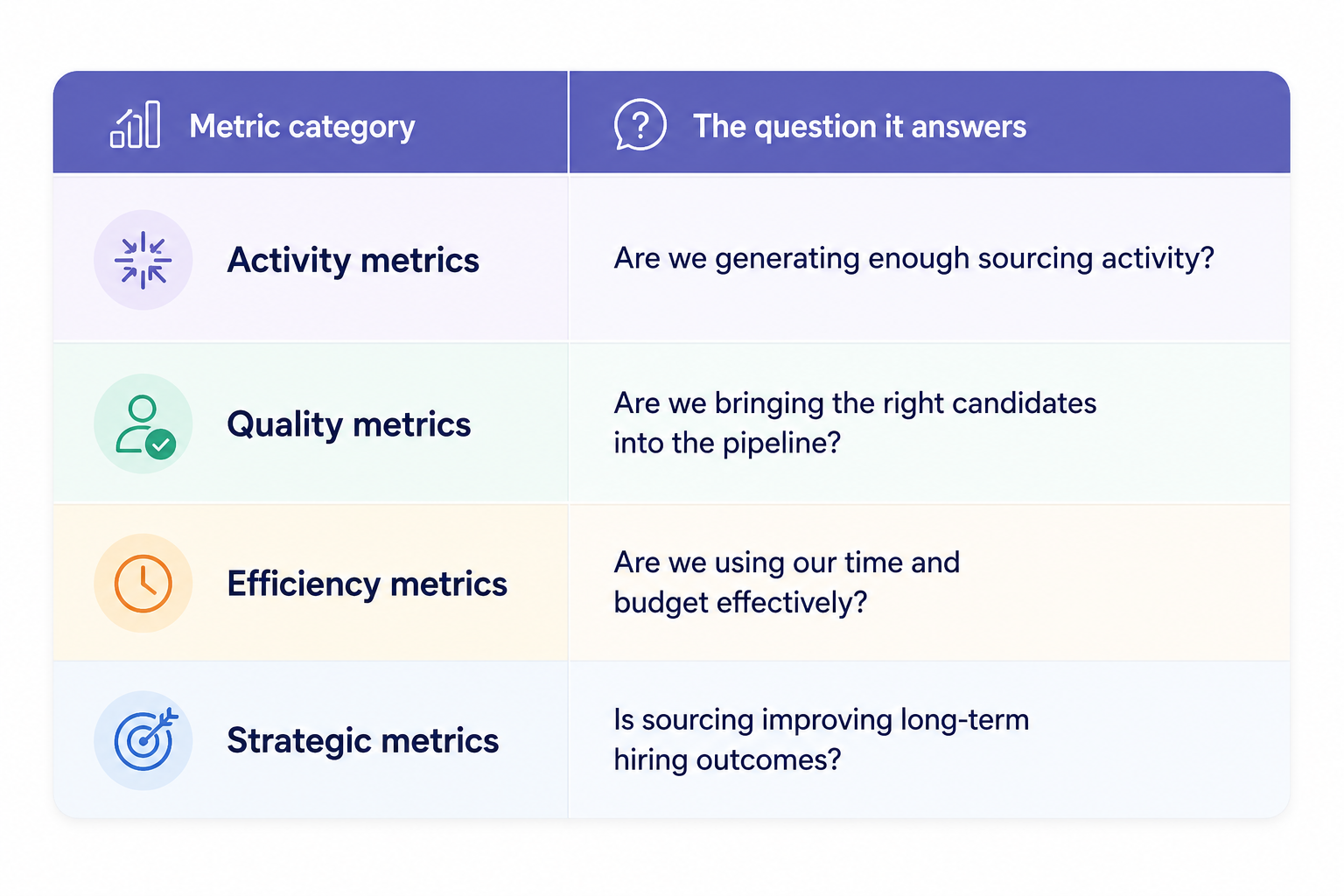
Viewed together, these categories create a much clearer picture of sourcing performance.
Activity metrics become early signals rather than success metrics, while quality, efficiency, and strategic metrics determine whether that activity is actually moving the hiring process forward.
Let’s take a look at these recruiting KPIs in more detail:
Activity metrics: Early sourcing signals
Activity metrics don't tell you whether a hire will happen, but they do provide early signals that your sourcing strategy is moving in the right direction.
The key is to measure activity that reflects intentional sourcing, not just recruiter effort.
Reviewing 500 profiles sounds impressive until you realize only a small fraction matched the role. Likewise, sending hundreds of outreach messages doesn't mean much if they're reaching the wrong candidates.
1. Qualified profiles sourced per role
This is one of the simplest ways to separate productive sourcing from busy work.
Instead of tracking every profile a recruiter reviews, track the number of candidates who meet the role's non-negotiable requirements and are worth moving forward. Those requirements might include specific technical skills, years of experience, industry background, certifications, or location, depending on the role.
This recruiting metric becomes the true starting point of your sourcing funnel. If recruiters consistently struggle to identify enough qualified profiles, the problem may lie with the sourcing strategy, the talent market, or even unrealistic hiring criteria, not recruiter productivity.
2. Outreach performance by channel
Not every sourcing channel performs the same, and averaging them together often hides useful insights.
Track outreach separately for channels such as LinkedIn InMail, email, referrals, phone outreach, and LinkedIn connection requests.
Over time, you'll start to see patterns. Engineering candidates, for example, may engage more readily through email, while referrals could outperform every other channel for leadership hiring.
Looking at channel-level data also makes it easier to shift sourcing efforts toward the channels producing the strongest engagement instead of simply increasing outreach volume everywhere.
3. Response rate and interested rate
Response rate is often the first metric recruiters look at, but it only tells part of the story.
A candidate replying with "Thanks, but I'm not interested" counts as a response. From a sourcing perspective, that isn't the same as a candidate who wants to schedule a conversation.
That's why it's worth tracking two related metrics:
- Response rate: the percentage of outreach messages that receive any reply.
- Interested rate: the percentage of candidates who express genuine interest in continuing the hiring process.
Reviewing these metrics together gives you a much clearer picture of outreach quality.
For example, a campaign with a 35% response rate but only a 5% interest rate may indicate that your messaging is getting attention but attracting the wrong audience.
It also helps to segment response rates by candidate seniority.
Early-career professionals typically respond more frequently because they're actively exploring opportunities, while mid-career candidates often become more selective.
Executive outreach follows a different pattern altogether, with lower response volumes but higher-quality conversations when engagement does happen.
4. Time to first response
How quickly candidates reply can tell you almost as much as whether they reply at all.
Candidates who respond within a day or two are generally more engaged than those who reply after several weeks. While there will always be exceptions, consistently slow response times can indicate that your messaging, targeting, or employer value proposition isn't resonating with the audience you're trying to reach.
Monitoring this metric also helps recruiters identify when promising candidates may need faster follow-up before they lose interest or accept another offer.
5. Multi-touch sequence effectiveness
Very few candidates respond to the first outreach message they receive.
Instead of evaluating only the first touchpoint, measure how candidates move through your entire outreach sequence. Research by Gem found that 4-stage outreach sequences generate roughly twice as many replies as one-off messages, making sequence performance a more meaningful metric than first-message response rates alone.
Look beyond overall reply rates and identify where engagement drops off. If most responses arrive after the second email but almost none after the fourth, your sequence may be longer than it needs to be.
6. Passive versus active sourcing ratio
Finally, look at where your pipeline is coming from.
Track the proportion of passive candidates you proactively source versus active applicants who enter through job postings or other inbound channels. That mix has a direct impact on hiring outcomes. Research shows direct sourcing accounts for a relatively small share of applications but contributes disproportionately to hires, while referrals and internal mobility convert at even higher rates than inbound applicants.
None of these activity recruiting metrics should be viewed in isolation. They're early indicators, not success metrics.
Quality metrics: Is your pipeline worth pursuing?
A full pipeline isn't necessarily a healthy pipeline.
It's possible to source hundreds of candidates, maintain impressive response rates, and still struggle to make hires because the candidates entering the funnel aren't strong enough to clear the interview process.
That's why you need to look at quality metrics to tell you whether your sourcing efforts are producing candidates the hiring team actually wants to hire—not just candidates willing to have a conversation.
7. Qualified candidate rate
Qualified candidate rate measures the percentage of sourced candidates who meet the hiring manager's essential criteria after an initial review. Think of it as the conversion rate between sourcing and genuine hiring potential.
If recruiters consistently source large numbers of candidates but only a small percentage are considered qualified, the issue often isn't recruiter effort. It usually points to overly broad search parameters, poor calibration with hiring managers, or an unrealistic understanding of the talent market.
Tracking this metric also creates a valuable feedback loop between sourcers and hiring managers. Over time, both sides become more aligned on what "qualified" actually looks like.
8. Interview-to-offer ratio
Not every candidate who reaches the interview stage should receive an offer, but the ratio between interviews and offers says a lot about sourcing quality.
High-performing hiring teams often operate close to a 3:1 interview-to-offer ratio, while less efficient processes may require eight, ten, or even more interviews before identifying one suitable candidate. A widening ratio usually indicates that candidates look promising on paper but aren't meeting expectations during interviews.
Because this metric reflects both sourcing quality and interview calibration, it's often more useful to track it alongside hiring manager feedback rather than in isolation.
9. Offer acceptance rate
Finding the right candidate is only half the job.
If sourced candidates regularly decline offers, it's worth looking beyond compensation. Low acceptance rates can indicate that recruiters are targeting the wrong talent pool, setting inaccurate expectations during outreach, or taking too long to move candidates through the hiring process.
As a general benchmark, offer acceptance rates above 90% suggest your sourcing and hiring process are well aligned, while rates below 70% deserve closer investigation.
10. Quality of hire
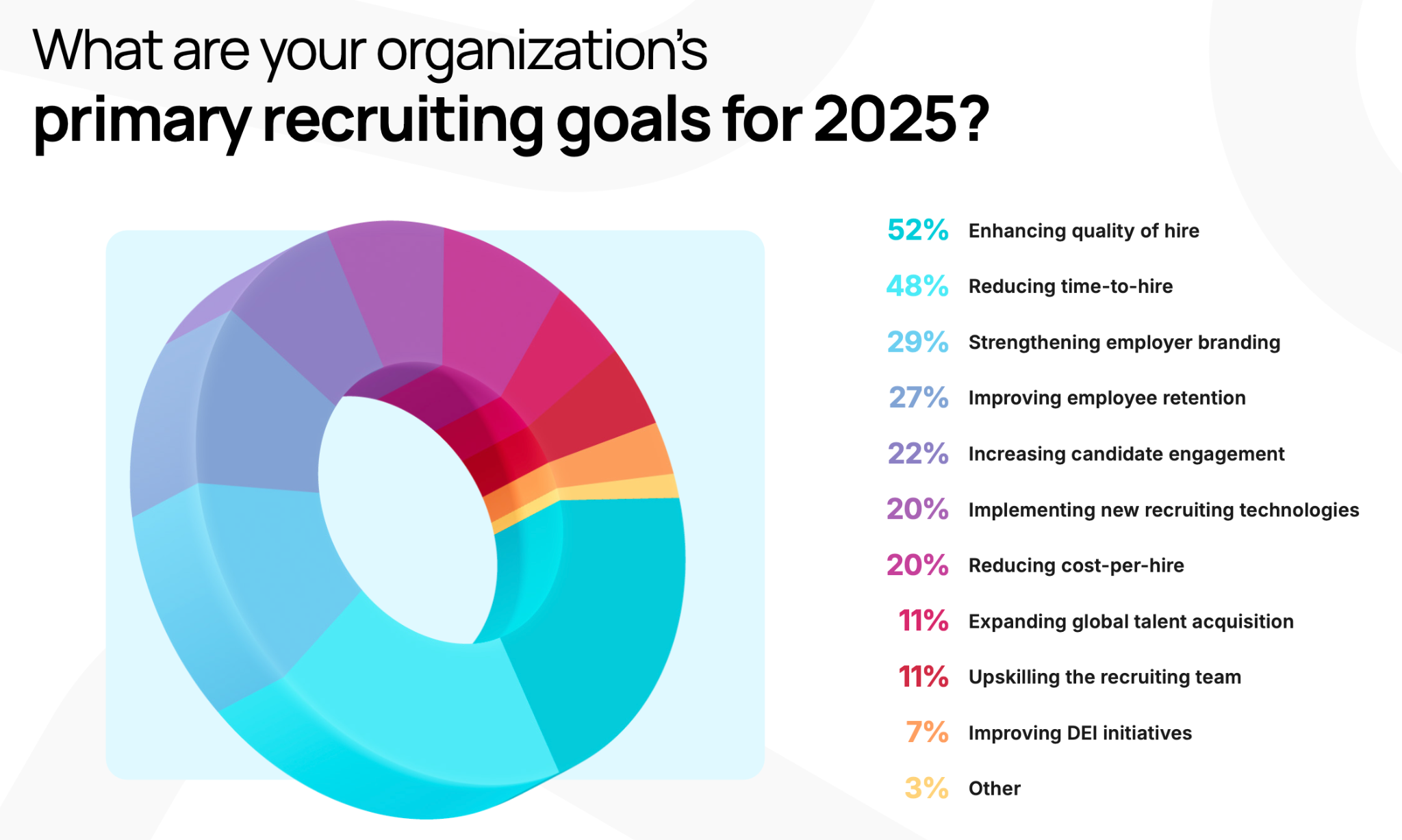
According to Kula’s 2025 State of Recruiting report, 62.5% of TA leaders ranked quality of hire as their top recruiting KPI.
Some organizations calculate it using a weighted combination of performance reviews, engagement, ramp-up time, and cultural alignment. While that approach can provide a richer picture, it also requires data from multiple systems and isn't always practical.
A simpler and more defensible approach is to combine 12-month retention with first-year performance ratings.
If a sourced candidate is still with the company after a year and is consistently meeting or exceeding expectations, the sourcing decision was likely a good one. That makes quality of hire a lagging metric, but arguably the strongest indicator of sourcing success.
11. Retention and time-to-productivity
Looking at retention by sourcing channels can uncover patterns that are easy to miss in day-to-day recruiting.
If candidates from referrals consistently stay longer than candidates sourced through cold outreach, that insight should influence future sourcing investments. Likewise, measuring how quickly hires become fully productive helps identify channels that produce candidates who ramp faster and create business value sooner.
It’s also important to measure first-year-retention. This means, do your sourced candidates stay for more than a year in your organization? This is another big hire quality indicator for teams.
Quality doesn't end when someone signs the offer letter. The strongest sourcing strategies continue to perform months after the hire.
12. Candidate and hiring manager feedback
Candidate NPS and interview feedback provides insight into how sourced candidates experience your hiring process, including those who aren't hired. Declining satisfaction scores often signal friction that will eventually affect employer brand and future sourcing efforts.
Hiring manager ratings are equally valuable. Asking managers to rate the quality of sourced candidates after interview loops—using a simple five-point scale—is often enough to identify recurring calibration issues between recruiters and hiring teams before they become larger pipeline problems.
Ultimately, quality metrics are what give activity metrics meaning. A sourcing team that generates fewer candidates but consistently delivers qualified, interview-ready talent is creating far more value than one that optimizes for pipeline size alone.
Efficiency metrics: Are you hiring faster without wasting resources?
Finding great candidates is only part of the equation. If it takes months to move them through the hiring process (or costs more than it should) you'll still lose top talent.
This is where efficiency metrics help you understand whether your sourcing process is producing strong hiring outcomes without unnecessary delays or spend.
13. Time to fill and time to hire
These two metrics are often used interchangeably, but they answer different questions:
- Time to fill measures the number of days between opening a role and accepting an offer. It's the metric leadership usually watches because it reflects how quickly the business can fill critical positions.
- Time to hire starts later in the process. It tracks how long it takes to move a candidate from first contact to hired. For sourced candidates, this number matters even more because the best talent rarely stays on the market for long.
Don't just look at company-wide averages. Break these metrics down by role, department, and seniority to identify where bottlenecks are actually happening.
14. Sourcing conversion rate
This is one of the clearest ways to measure sourcing efficiency.
It tells you what percentage of sourced candidates eventually become hires. A low conversion rate doesn't always mean recruiters need to source more people, but often means something further down the funnel needs attention.
Track this by sourcing channel, recruiter, and role type. You'll quickly see which sourcing strategies consistently produce hires and which generate lots of pipeline but very little movement.
15. Cost per hire and sourcing ROI
Cost per hire is useful, but it rarely tells the whole story.
Spending $2,000 to hire someone who leaves after six months is far more expensive than spending $8,000 to hire someone who becomes a high performer and stays for years. That's why cost per hire should always be viewed alongside retention and quality of hire.
It's also worth calculating ROI by sourcing channel.
Once you factor in recruiter time, software costs, agency fees, and referral bonuses, you'll often discover that your most expensive channel isn't necessarily your most effective.
16. Pipeline velocity
When hiring slows down, the bottleneck usually isn't the entire process, but one stage that’s lagging.
Measure how long candidates spend between outreach and response, response and phone screen, hiring manager review, and interview scheduling. If one stage consistently takes longer than the others, you've found your next optimization opportunity.
For example, slow response times might point to poor outreach messaging, while lengthy hiring manager reviews often indicate misaligned expectations rather than a sourcing problem.
17. Measure recruiters by outcomes
Finally, resist the temptation to evaluate recruiters by activity alone.
The recruiter who sends the most outreach messages isn't necessarily the highest performer. The one who consistently turns sourcing into hires is creating more value.
Looking at metrics like hires per recruiter or sourcer output alongside conversion rates gives a much more accurate picture of performance than counting emails or LinkedIn messages ever will.
Ultimately, efficiency metrics answer a simple question: are we turning sourcing effort into hires quickly and cost-effectively?
If the answer is no, these metrics will usually tell you where the process starts breaking down.
Strategic metrics: The numbers that shape long-term hiring success
Strategic candidate sourcing metrics look further ahead. They help you understand whether your sourcing efforts are building a stronger hiring function over time, not just filling the next open role.
18. Rediscovery rate
One of the biggest shifts in sourcing over the last few years has been the rise of candidate rediscovery.
Instead of starting every search from scratch, more recruiting teams are finding qualified candidates who already exist in their ATS.
Research shows the share of sourced hires coming from existing talent databases increased from 29.1% in 2021 to 44% in 2024, making rediscovery one of the highest-impact candidate sourcing strategies today.
If you aren't tracking how many hires come from past applicants, you're missing an opportunity to reduce sourcing time and improve hiring efficiency.
Talent pools should convert, not just grow
Instead of measuring how many candidates sit in nurture campaigns, track how many eventually turn into conversations, interviews, or hires. A talent pool with a high conversion rate is far more valuable than one that's simply growing every month.
The same applies to silver medalists—candidates who came close to receiving an offer but weren't selected. Re-engaging these candidates is often faster and more effective than starting a completely new search, making them one of the highest-value talent segments to track.
Build pipelines before you need them
The strongest sourcing teams don't wait until a role opens to start looking for candidates.
For positions you hire repeatedly—or know you'll need in the next six to twelve months—track whether your existing pipeline can meet expected hiring demand. Starting every search with warm candidates instead of cold outreach gives recruiters a significant head start.
Measure the impact beyond hiring
Some of the most valuable sourcing metrics don't directly measure hiring at all.
Candidate feedback can reveal how outreach, recruiter communication, and the interview process influence your employer brand long before someone submits an application.
Likewise, tracking diversity sourcing metrics across every stage helps identify exactly where underrepresented candidates are dropping off, making it much easier to fix process issues instead of guessing where bias exists.
Finally, zoom out and look at the bigger picture.
What's the balance between sourced and inbound hires? Are sourced employees staying longer, ramping faster, or generating more business value?
Metrics like retention-adjusted quality of hire, productivity, and cost of vacancy are ultimately the ones leadership cares about because they connect recruiting performance to business performance.
How to build a sourcing KPIs dashboard that recruiters actually use
You don't need to start by tracking 25 different sourcing metrics.
Pick four or five metrics that expose the biggest gaps in your current hiring process, record your baseline, and improve from there. Teams that try to measure everything usually end up acting on nothing. Here’s how to implement these sourcing analytics into your hiring workflow:
1. Start with a baseline
Before introducing new metrics, document where you are today. Capture your current response rates, time to fill, sourcing conversion rates, or whatever metrics are most relevant to your team.
Don't worry if the numbers aren't perfect. Even rough baselines are enough to measure progress over time. Without them, it's impossible to tell whether your sourcing strategy is actually improving.
2. Keep your dashboards focused
One of the biggest reporting mistakes is trying to track everything.
Instead, build a small scorecard for each category—activity, quality, efficiency, and strategic metrics—with four to six KPIs each. That gives recruiters enough visibility without overwhelming them with dozens of numbers they'll never act on.
3. Benchmark roles separately
Not every role should be measured the same way.
Hiring a senior software engineer naturally takes longer than hiring a customer success representative, so comparing both against a single time-to-fill target isn't particularly useful. Set benchmarks based on role type, seniority, and department so your metrics reflect the realities of each hiring market.
4. Review often, improve deliberately
Metrics should create conversations, not more meetings.
A short weekly check-in is usually enough to spot unusual changes, while a monthly review gives the team time to identify patterns and decide what needs to change. The goal isn't to explain every number—it's to use the data to improve the hiring process.
5. Make your data trustworthy
Reporting is only useful if the underlying data is accurate.
Pay close attention to source attribution so hires are credited to the channel that actually generated them, rather than whichever source happened to be recorded last. It's also worth tracking trends instead of focusing only on absolute numbers.
A steady improvement in sourcing conversion or quality of hire is often a stronger indicator of progress than hitting a single benchmark.
Finally, make sure every important metric has an owner. Numbers don't improve simply because they appear on a dashboard. Someone needs to be responsible for understanding them and acting on them.
The right technology makes this much easier.
Instead of exporting reports into spreadsheets every week, look for recruiting platforms that surface sourcing metrics automatically. For example, Kula's conversational analytics lets recruiters ask questions about sourcing performance in natural language and generates the relevant reports without building custom dashboards manually.

That keeps the focus on improving the numbers, not spending time on collecting and searching for them.
A quick self-check: Are you tracking the right sourcing metrics?
Before you add another KPI to your dashboard, ask yourself these three questions:
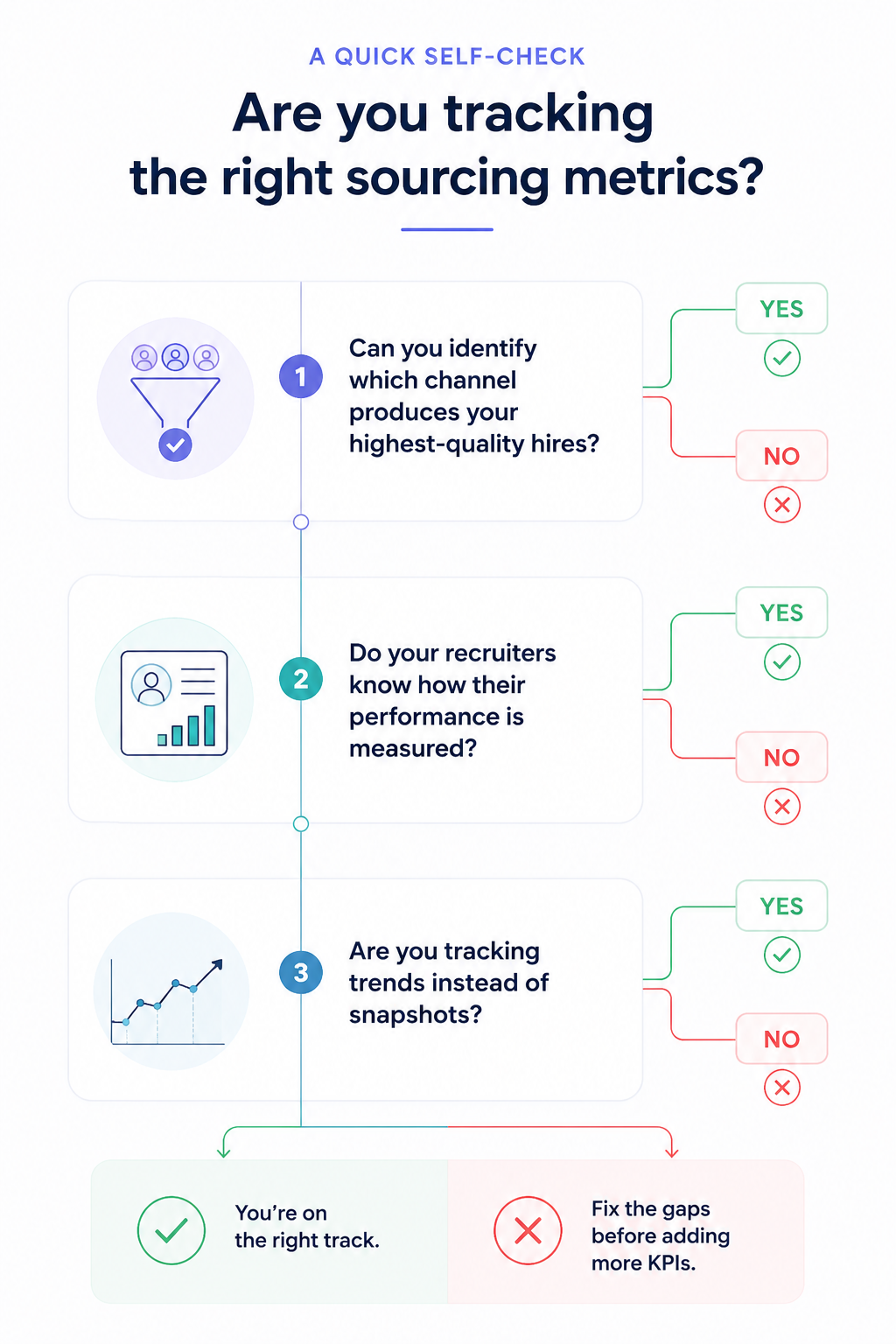
1. Can you confidently identify which sourcing channel produces your highest-quality hires?
If the answer is no, you're probably measuring activity instead of outcomes. Response rates and outreach volume are useful, but they don't tell you which channels consistently produce candidates who get hired and perform well.
2. Do your recruiters know how their sourcing performance is measured?
If success is still defined by the number of profiles reviewed or outreach messages sent, you're rewarding effort instead of impact. Metrics like hires produced, sourcing conversion rate, and offer acceptance paint a much clearer picture of recruiter performance.
3. Are you tracking trends instead of snapshots?
One month's data rarely tells the full story. Metrics like rediscovery rate, offer acceptance, and silver medalist conversions become much more meaningful when you monitor how they change over time.
If you answered "no" to any of these questions, don't add more KPI to your sourcing pipeline metrics. Start by fixing the gaps in your current reporting. A smaller set of meaningful metrics will always be more valuable than a dashboard full of numbers that never influence hiring decisions.
The strongest sourcing teams don't rely on instinct alone, but they use data to improve every search, every quarter.
Track fewer metrics, review them regularly, and use them to guide better hiring decisions.
Want to make that easier? Book a demo to explore how Kula helps recruiting teams track sourcing metrics, rediscover past candidates, and get instant answers with conversational analytics.