


ATS with Built-In Candidate Sourcing: What to Look For
For most of the last decade, the standard recruiting stack was an ATS plus a separate sourcing tool. Greenhouse plus Gem. Lever plus SeekOut. iCIMS plus a homegrown scraper. This model made sense when ATSs were built as compliance repositories and sourcing tools were the innovation layer.
In 2026, the model has flipped. Modern ATSs are being built with sourcing as a foundational capability rather than an add-on, and teams are consolidating away from multi-tool stacks that have become expensive and operationally fragile.
This article covers what "built-in sourcing" actually means in an ATS, why teams are consolidating, what to look for during evaluation, and how the leading consolidated platforms compare.
The goal is to help teams making this decision separate real capability from marketing language.
What "built-in sourcing" actually means
With built-in sourcing, sourcing is part of the same recruiting system. Every sourced candidate, outreach, response, interview, and hiring outcome feeds into a single dataset.
Bolt-on sourcing treats sourcing as a separate function. Candidate data has to be pushed into the ATS after discovery, leading to fragmenting context across tools.
The six components that built-in sourcing ATS offers:
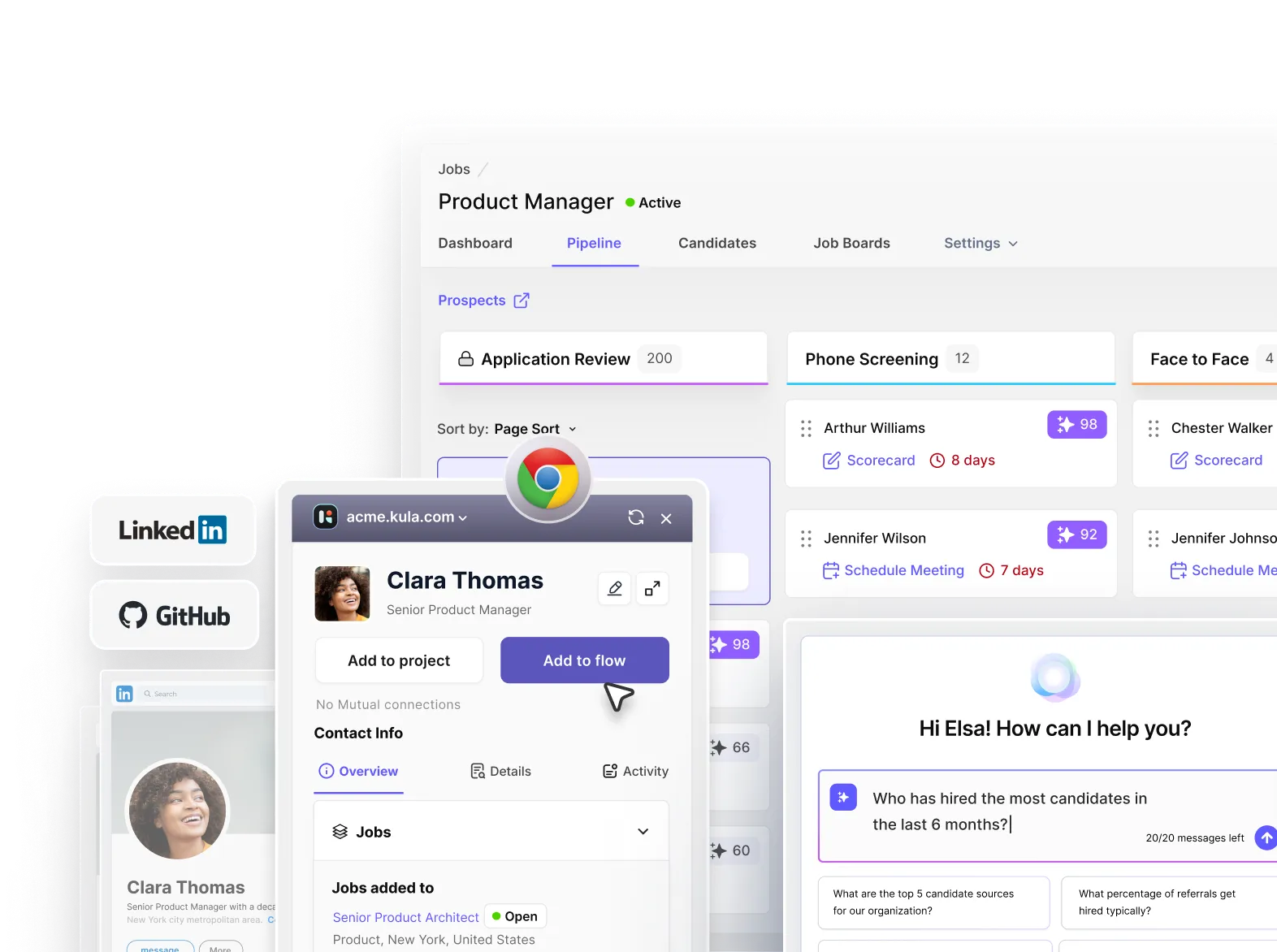
1. Chrome extension for capturing candidates: The recruiter should be able to view any LinkedIn or GitHub profile and add that candidate to the ATS in one click. Kula's Kula Everywhere, Ashby's Chrome extension, and Gem's browser extension all support this. Legacy ATSs generally do not.
2. Email enrichment: When a candidate is captured, the system should find their verified work and personal email addresses automatically. Recruiters should not need a paid add-on extra tool for this function. Also, a credit-based system that charges per lookup becomes expensive in the long run. Look for an ATS that has built-in enrichment as a core function.
3. Multi-channel outreach sequencing: Recruiters can build automated outreach cadences across email, LinkedIn connection requests, and LinkedIn InMails from a single workflow. Multi-touch campaigns produce 2x more replies than one-off messages, making it a table-stakes capability for built-in sourcing.
4. Candidate rediscovery: Sourced hires from existing databases have jumped from 29% to 44% in three years. There should be a native search feature to scan information across the historical ATS database. This gives recruiters the ability to re-engage past applicants for new roles based on skills or scores from previous processes.
5. Referral and network management: Built-in sourcing extends beyond the external talent pool. Recruiters can identify employees connected to target candidates, request warm introductions, and track referral activity from a single platform. This improves referral participation and gives recruiting teams complete visibility into who knows whom across the organization.
6. Reporting on sourcing outcomes: Recruiters should be able to track every stage of the funnel from sourced candidate to outreach, interview, offer, and hire without stitching together data from multiple tools. Since the data is captured natively within the ATS, reporting is real-time and doesn't rely on spreadsheet exports or manual reconciliation.
Why teams are consolidating in 2026
1. The Franken-stack cost is real
The typical mid-market recruiting stack runs between 5-10 tools for AI sourcing, interview capture and intelligence, scheduling automation, assessments and skills tests, outreach and CRM, analytics and reporting, and contact enrichment.
Each tool estimates around $6,000 to $20,000 annually. With this calculation, the combined SaaS spend easily reaches $65,000 for high-volume startups and mid-market organizations. That is before the operational cost of managing integrations.
2. The productivity cost is worse
The hidden cost of bolt-on sourcing isn't another software subscription. It's the constant context switching between sourcing tools, email, LinkedIn, and the ATS.
Every switch forces recruiters to reorient themselves, duplicate work, and manually move candidate information between systems. While each interruption seems small, the cumulative productivity loss is substantial.
FullStory documented this directly. They saved 2,000 hours of recruiter context switching by consolidating on a single platform.
That is a full recruiter-equivalent gain just from eliminating the tool-swapping tax.
3. The reporting problem is compounding
When data lives in five systems, reporting requires manual reconciliation.
As Head of Recruiting Nathalie Grandy at Linktree puts it:
"We tried to build a dashboard to understand our engineering funnel, and it took us four hours to find the information because we couldn't understand it. Our dashboards were always conflicting."
When recruiting data is fragmented, different dashboards tell different stories. Without a reliable source of truth, leadership loses confidence in the metrics and the decisions based on them.
4. The candidate history problem
When sourcing lives outside the ATS, recruiter interactions are split across multiple systems. Previous outreach, replies, and sourcing notes are no longer visible in one place, making it difficult to know whether a candidate has already been contacted.
The result is predictable: duplicate outreach becomes increasingly common as recruiting teams scale.
Every duplicate message is more than an operational mistake. It creates a disjointed candidate experience, and gradually harms employer brand credibility.
5. The CFO pressure has intensified
After the late 2022 hiring slowdown and budget cuts, CFOs began looking beyond the cost of individual tools and instead questioned the cost of the entire recruiting stack.
As one recruiting technology executive explains:
"Companies could no longer justify spending tens of thousands of dollars on fragmented stacks — $50k on Greenhouse plus $20k on Gem plus $10k on ModernLoop. They chose to completely displace legacy systems to save 30-50% on recruiting tech spend through platform consolidation."
Consolidation was no longer an optimization initiative. It became a cost-reduction mandate.
6. The AI factor
When sourcing, screening, and interviewing all live in separate systems, the AI in any one of them is running on incomplete data.
When candidate data lives in one system, AI has the full context it needs to deliver better recommendations and automation. This technical advantage compounds as more recruiting data flows through the platform.
The measurable outcomes teams are seeing
1. Lower recruiting technology costs
Companies replacing fragmented ATS and point-solution stacks are reporting 30–66% reductions in software spend. For example, Tropic reduced annual recruiting technology costs from $65,000 to $22,000 after consolidating its stack, while FullStory cut recruiting software spend by 51% after moving to a unified platform.
2. Higher recruiter productivity
Eliminating manual workflows and context switching gives recruiters more time to spend on hiring. FullStory reclaimed 2,000+ hours annually by removing tool-switching, while Aurora Solar saved 40+ hours every month by replacing manual ATS-HRIS synchronization. Growth by Design Talent increased recruiter capacity by 66%, allowing recruiters to manage five concurrent searches instead of three.
3. Faster hiring cycles
Built-in sourcing reduces manual sourcing, screening, and coordination work, shortening time-to-hire. ChronicleHQ reported 80% faster role closure after adopting Kula, while RemotelyHR reduced overall time-to-hire by 50%. Plum filled 10 roles in its first 30 days after switching from Lever, with application screening reduced from hours to minutes.
4. Better operational efficiency
Teams also report measurable improvements in day-to-day recruiting operations. Tropic reduced application review time by 90%, Coder saved 10+ hours every week after consolidating four recruiting tools into Ashby, and Brightline reduced overall recruiting costs by 64% after replacing multiple point solutions with a single platform.
✅The pattern across all of these is consistent
Consolidation produces measurable outcomes in three categories: reduced tech spend (typically 30-66%), recovered time (typically 10-40+ hours per week or thousands per year), and faster hiring (typically 25-80% improvement in time-to-hire or role closure).
The six evaluation criteria that separate real consolidation from marketing claims
1. Is the sourcing capability actually native or is it a partner integration?
Ask the vendor to demonstrate sourcing without leaving the platform. If the demo involves opening a separate window, tab, or product name, sourcing is not native. Native sourcing means Chrome extension, email enrichment, and sequencing all live inside the same interface as the ATS.
2. Does the AI have access to full candidate context?
Native AI running on native data produces meaningfully better outputs than bolted-on AI running on fragmented data.
Ask what the AI can access—historical rejection reasons, past event attendance, previous scorecard scores, team notes. If the AI is limited to the current application, the architecture is not truly consolidated.
3. What does the pricing model look like at scale?
As more hiring managers, interviewers, and executives start using the platform, licensing costs increase with every additional user. Look for pricing models that support unlimited hiring manager access, unlimited interviewer access, or tiered pricing based on volume rather than seats.
4. What is the migration experience like?
One of the biggest concerns with platform consolidation is implementation time. In practice, most teams report migration timelines of 2–4 weeks.
Ashby customers typically migrate in 2–7 weeks, while Kula customers have completed migrations from Lever in under three weeks.
If a vendor can't commit to a realistic implementation timeline or provide a detailed migration plan with milestones, treat it as a potential implementation risk.
5. Can the platform actually replace all the tools it claims to replace?
Some platforms claim to be all-in-one but require add-ons or integrations for specific functions. Ask the vendor directly which of your current tools the platform will replace and which will still need to run alongside.
6. What is the vendor's product velocity?
Consolidated platforms need to ship faster than legacy vendors to justify the switch. Ask to see the vendor's product roadmap and last six months of released features. If updates are quarterly and mostly UI polish, the platform will feel outdated within 18 months.
The three consolidated platforms worth evaluating
1. Kula
Best for: Mid-market teams tired of the Franken-stack and prioritizing AI-native consolidation.
Kula embeds sourcing directly into the ATS, so recruiters can discover candidates on LinkedIn and GitHub, enrich profiles with contact information, automate multi-channel outreach, nurture talent pools, and manage referrals without leaving the platform.
What it consolidates: ATS, sourcing (Kula Everywhere Chrome extension), CRM, sequencing (Flows), referrals (Circles), scheduling, notetaking (AI Interview Assistant), analytics (conversational chatbot).
Real customer outcomes: ChronicleHQ closed roles 80% faster. RemotelyHR cut time-to-hire 50%. Plum completed 10 hires in first 30 days.
Real customer quote from Anil Puli at Dapper Labs:
"Kula was more nimble than enterprise tools like Ashby and Greenhouse, while still giving us the core functionality with native AI features. Outreach is powered natively within Kula, which significantly reduces the hours I used to spend manually searching either via LinkedIn or other sources like GitHub."
Honest verdict: strongest fit for mid-market teams that want consolidation without enterprise complexity. Less of a fit if you need extremely deep analytics customization or you already have TA ops capacity to configure a more complex platform.
2. Gem
Best for: Teams migrating gradually from a legacy ATS or teams that want the deepest outbound sourcing capability in an all-in-one.
With Gem, recruiters can search across 800M+ profiles, rediscover candidates from their ATS and CRM, source via a Chrome extension, automate personalized multi-channel outreach, and track every interaction in a unified candidate record.
What it consolidates: CRM, ATS, AI Sourcing (AI Sourcing Agent querying 800M+ profiles), AI Rediscovery Agent, AI App Review Agent, scheduling, analytics. Bi-directional integrations with Workday, Greenhouse, iCIMS, and SAP SuccessFactors for teams migrating gradually.
Real customer outcomes: Tropic slashed tech spend 66%. Growth by Design Talent increased recruiter capacity 66%. One Medical saved $15K annually plus a 60% productivity boost.
Real customer quote from James Parker at Tropic:
"I wasn't going into the ATS that much. Everything was being done in Gem already. The ATS was just where the data was held. I just love that all those things that used to be disjointed are now in a single place. I'm actually sitting in the middle of the Venn diagram."
Honest verdict: Strongest fit for teams that want to migrate gradually from a legacy ATS or that prioritize outbound sourcing above other capabilities.
3. Ashby
Best for: Analytically sophisticated teams with dedicated TA ops capacity and appetite for depth over simplicity.
Ashby brings sourcing and CRM directly into its recruiting platform. Recruiters can source candidates through a Chrome extension, organize talent pools, automate personalized email and LinkedIn outreach, rediscover past candidates with advanced search, and nurture relationships over time.
What it consolidates: ATS, CRM, sourcing (Chrome extension with 48% higher positive response rates via AI personalization tokens), scheduling, BI-level analytics.
Real customer outcomes: FullStory saved 2,000+ hours and 51% software spend. Coder saved 10+ hours weekly and 5+ hours per job post. Aurora Solar saved 40+ hours monthly.
Real customer quote from Camilla Lever at Coder:
"I found Ashby to be the missing link between sourcing and staying on top of candidates. From a sourcing perspective, it saves our sourcers and hiring managers 5+ hours on sourcing for each job listing by leveraging the Chrome extension in LinkedIn."
Honest verdict: Strongest fit for teams with the technical sophistication and TA ops capacity to leverage its depth. The most powerful of the three but also the most complex to configure.
The three questions that decide whether consolidation is right for your team
Question 1: How many recruiting tools does your team currently run?
If the answer is more than 5, the operational cost of maintaining the stack is likely higher than the cost of switching to a consolidated platform. Do the math on your total spend across all tools before making assumptions.
Question 2: Can your team produce a single-page pipeline report without opening more than one tool?
If not, reporting fragmentation is already costing you decisions. Consolidation solves this structurally.
Question 3: Are you paying for capabilities in your current tools that you never use because the integration between tools is broken?
This is the most common hidden cost of the Franken-stack. Features you paid for but cannot access because the workflow does not support them. Consolidation eliminates this waste.
If any of these three answers is yes, consolidation is not just a cost decision. It is a productivity decision.
The recruiting market is moving away from fragmented stacks toward unified platforms that combine sourcing, ATS, CRM, and AI in one system.
The right choice depends less on feature count and more on whether the platform can replace the complexity you're managing today.
For mid-market teams evaluating consolidation, Kula combines native sourcing through the Kula Everywhere Chrome extension, Flows for multi-channel outreach, Circles for referrals, and AI Notetaker within a single recruiting platform.
Book a demo to see how the workflow fits your hiring process.